
Dad promised he’d be home by September.
Mitch knew this for certain — because he’d written it down. Not because his memory was bad, but because words on paper felt more real. More official. Like a signature. Like a contract.
“Back by September, buddy. Wait for me.”
September ended five weeks ago.
Mom stopped answering questions about Dad somewhere around the first week of October. Not in a mean way — she was never mean — she’d just drift toward the kitchen and start cleaning something. Dishes, counters, the stovetop. One evening Mitch came in and found her wiping down the refrigerator door at nine o’clock at night. He didn’t say anything.
Dad’s phone just rang.
Not out of service, not the number you dialed is unavailable — just ringing. Long, empty rings that nobody picked up. Mitch called every night before bed. Seven rings, eight, nine. Sometimes he let it go to twenty. Just to hear it. Just to know there was still a phone somewhere on the other end. That Dad was still somewhere on the other end.
Grandma whispered to Aunt Carol one afternoon: “Someone needs to tell that boy the truth.” Aunt Carol said: “Not yet.” Mitch kept his eyes on his book.
He didn’t know what truth they meant. But he could feel the shape of it. Heavy. Like something underwater.
The idea came to him on a Thursday, during art class.
They were supposed to be painting autumn leaves, and Mitch was staring at the orange paint on his brush when he remembered — out of nowhere — the afternoon Dad taught him to make paper boats. Not the simple kind. The real kind, with a turned-up bow and a little flag made from a matchbook label. Dad said if you folded the nose right, those boats could sail anywhere.
“Anywhere?”
“Anywhere at all, buddy.”
Mitch finished his leaves in about four minutes and spent the rest of class working it out in his head. Dad had gone out to sea — that part he understood. The Navy took you out to sea and sometimes the sea kept you longer than planned. Which meant the ocean knew where Dad was. Which meant if he put a note inside a boat and set it on the water, the current would carry it out, and out, and eventually to wherever Dad was anchored. Dad would read the note. He’d know Mitch was waiting. That Mom was cleaning the refrigerator at nine at night. That it was time to come home.
It wasn’t a childish thought. It was the only thought that didn’t hurt.
On Friday, Mom had a late shift.
Mitch wrote the note himself, in careful block letters so there’d be no confusion:
“Dad. We’re waiting. Mom misses you but doesn’t say so. I miss you and I’m saying so. Please sail home. Your son, Mitch. P.S. I grew two inches.”
He folded the boat the way Dad had shown him — slowly, getting each crease right. Turned the bow up twice. Cut a little flag from a sheet of notebook paper since he couldn’t find a matchbook. Tucked the note inside.
Outside, it was raining. That gave him a moment’s pause — but only a moment. Boats were supposed to be in water. Rain wasn’t the problem.
He put on his yellow rain jacket — the one Dad called his “real sailor’s coat” — and went out.
The marina pier was six blocks away. He’d walked it a hundred times.
The wind was worse than it looked from inside. It pushed against his chest, yanked at his hood, made it hard to breathe straight. Mitch walked with both arms wrapped around the boat, shielding it from the rain. The note couldn’t get wet before the ocean had a chance to take it.
The pier was empty.
The wood planks shone with rain, and the waves hammered the pilings in deep, rhythmic thuds. Mitch walked out toward the end — he needed distance from the shore so the boat wouldn’t wash back. He crouched down to set it on the surface gently.
The plank under his left foot was slick.
He didn’t have time to be scared. One second he was crouching, and then he was in the water, and the cold hit him like a wall — every breath gone, lungs locked up, the world gone gray and roaring.
A wave took him before he could get his bearings. He came up, choked, went under, came up again.
“Mom!” he screamed, but the wind grabbed the word and threw it out toward the open water.
His rain jacket had filled with water and was pulling him down. He kicked, he paddled — Dad had taken him to the Y for swim lessons, he knew how, but the pool had lane markers and a shallow end and none of this, none of these black walls of water that came from everywhere at once.
“Mom!”
A wave filled his mouth. Everything went quiet.
He was still moving — arms, legs, something — not because he thought it would work, but because something in him hadn’t gotten the message yet. In the silence beneath the surface there was only one image: a little paper boat with a turned-up nose, sailing anywhere at all.
The water closed over the top of his hood.
And then something grabbed him.
The hand was enormous and it didn’t let go.
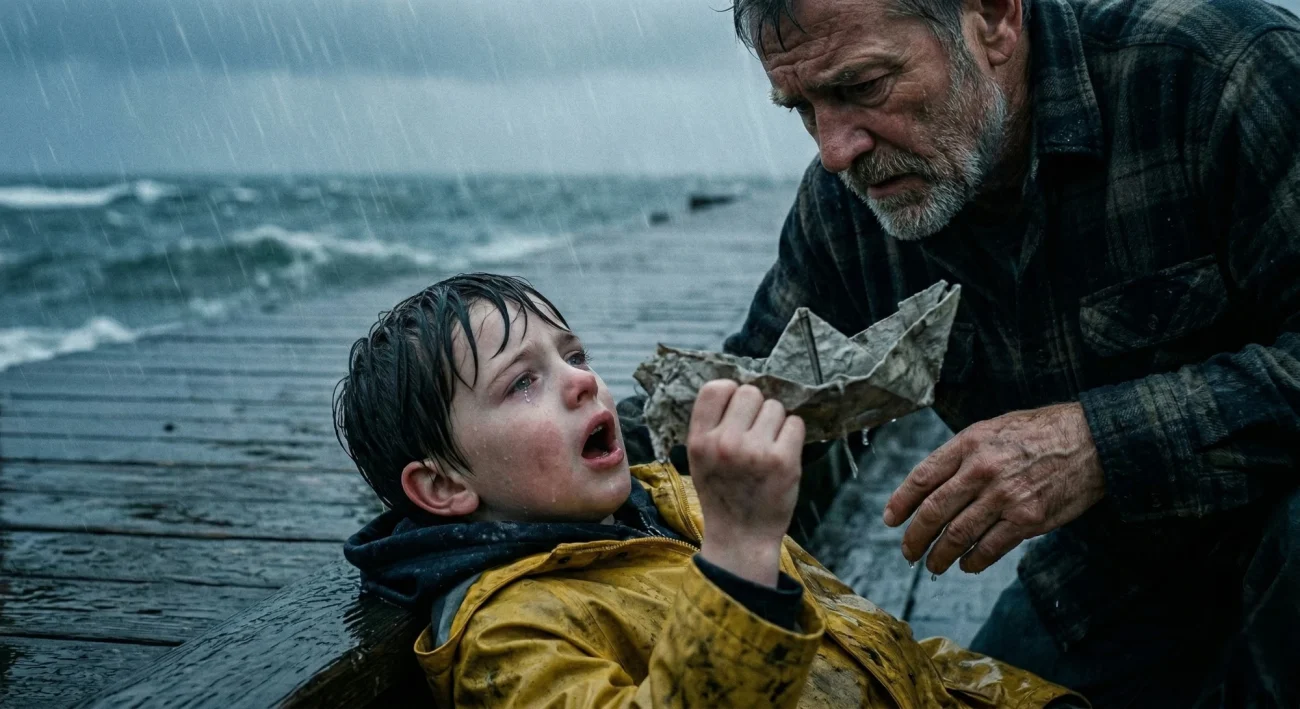
Mitch was pulled straight up out of the water — fast, no warning — and the cold air hit his face like a door swinging open. He coughed, and coughed, and coughed, bent over the strong arm that held him, water pouring out of him while the air fought its way back in.
He was set down on the pier. A weathered face leaned over him — an older man, smelling of fish and diesel. Mitch had seen him here before.
“You okay, son?” the man said.
Mitch nodded. Coughed again.
“What in God’s name were you doing out here?”
Mitch opened his fist.
The boat was still there. Crushed, soaked through, the note inside dissolved to blue-gray blur. Unreadable.
“For my dad,” Mitch said. “I was sending it to my dad.”
The old man looked at the boat for a long time. At the smeared ink. At the boy in the yellow rain jacket lying on the wet planks, not crying, just staring up at the low sky.
“Your dad far away?” he asked quietly.
“I don’t know,” said Mitch. “Mom won’t say.”
The man sat down beside him, right on the wet wood.
“I know how to make boats,” he said finally. “The kind that don’t fall apart. Carved from pine bark. You use a wax pencil on the right paper and the note won’t smear — not even in salt water.”
Mitch turned his head and looked at him.
“Will it make it?” he asked.
The man was quiet for exactly as long as it takes to make words honest without making them cruel.
“Ocean’s a big place,” he said. “Stranger things have happened.”
Behind them, up on Shore Road, his mother was already running — she’d found the note he’d left on the kitchen table, and she was running in her socks with her coat half-on, her voice breaking against the wind as she screamed his name.
Mitch heard her.
He closed his eyes and held the ruined boat in his fist.
They made the pine bark boat the following Saturday.
Mitch wrote the note himself, with a wax pencil on paper the old man had rubbed with a candle stub. The letters came out uneven but clear.
They launched it from the beach — not the pier. Mom wouldn’t allow the pier.
The boat wobbled at the edge of the shore break, then a wave lifted it and carried it out.
They watched until it was a speck. Then until the speck was gone.
Mom stood beside him and held his hand. Very tight. He didn’t mind.
The full truth came later — in pieces, the way real things always come — slowly enough that by the time the whole picture was clear, he was just old enough to hold it.
But that afternoon, a weathered stranger had pulled an eight-year-old boy from the ocean, sat down beside him on cold wet wood, and offered to help him send a message to his father.
Some people spend a lifetime looking for a reason to keep going. Mitch had found his floating in the rain — a soggy paper boat with a turned-up nose.
It was enough.
Original fictional stories. AI-assisted creative content.
