
Caitlin Marsh had learned early that there were two kinds of kids at Westbrook High.
The kind whose parents drove new SUVs to drop-off. And the kind who took the 6:47 bus and arrived with wet sneakers when it rained.
She was the second kind, and she’d made peace with it. Mostly.
Her jeans were clean. Her backpack held together with a carabiner clip she’d found in the lost and found. Her hoodie was two sizes too big and had someone else’s name on it — Tyler Anderson, whoever that was — because it had come in a bag of donated clothes from the church on Fifth.
She had a 3.9 GPA. She had a math quiz today she was going to ace.
It should have been a Tuesday like any other.
Ms. Patricia Holt had been teaching honors English at Westbrook for eleven years. She wore blazers with brooches and kept a French press on her desk and had a talent for saying cruel things in a pleasant voice.
Caitlin was three minutes late — the 6:47 had run behind — and slipped in through the back door while Ms. Holt was mid-sentence.
The teacher stopped talking.
“Well.” Ms. Holt looked her over slowly, the way you’d look at something that had tracked mud onto a clean floor. “Nice of you to join us.”
“Sorry I’m late. The bus—”
“The bus.” Ms. Holt repeated it like it was a punchline. “Of course.” She tilted her head. “Tell me, Caitlin — is that a new outfit?”
A few kids in the front row shifted in their seats.
Caitlin stood very still. “It’s just clothes.”
“It’s just—” Ms. Holt smiled. “Honey, that hoodie has someone else’s name on it. Did you know that? Whoever Tyler Anderson is, I hope he went to a better school than this one.” She paused for the laugh. Two kids gave it to her. “Sit down before you bring the property values down further.”
“That’s not—” Caitlin started.
“Sit. Down.”
The room was quiet in the specific, suffocating way of twenty-two teenagers who are grateful it isn’t happening to them.
Caitlin sat.
Her face was hot. She opened her notebook and stared at a blank page for the rest of class without writing a single word.
It didn’t end there.
The next morning, Ms. Holt was mid-lesson when Caitlin walked in wearing the same hoodie.
She’d worn it on purpose. She’d looked at it in the mirror that morning and thought: she doesn’t get to make me ashamed of this.
Ms. Holt saw her and stopped writing on the whiteboard.
The marker cap went on slowly.
“Again,” Ms. Holt said.
“I’m on time today,” Caitlin said.
“I see the hoodie is still here.” Ms. Holt set the marker down. “You know, I’ve been teaching for eleven years. I’ve seen a lot of students come through that door. The ones who dress like they don’t care — ” she gestured at Caitlin, top to bottom ” — usually don’t end up anywhere worth going.”
“My clothes don’t affect my grades,” Caitlin said evenly.
“No. But they affect how people see you.” Ms. Holt’s voice stayed pleasant, almost gentle. “And in the real world, honey, how people see you is everything.”
“With respect,” Caitlin said, “that’s not something you should be saying to a student.”
The pleasantness left Ms. Holt’s face.
“Excuse me?”
“I said that’s not something you should be saying to a student.”
The room went very still.
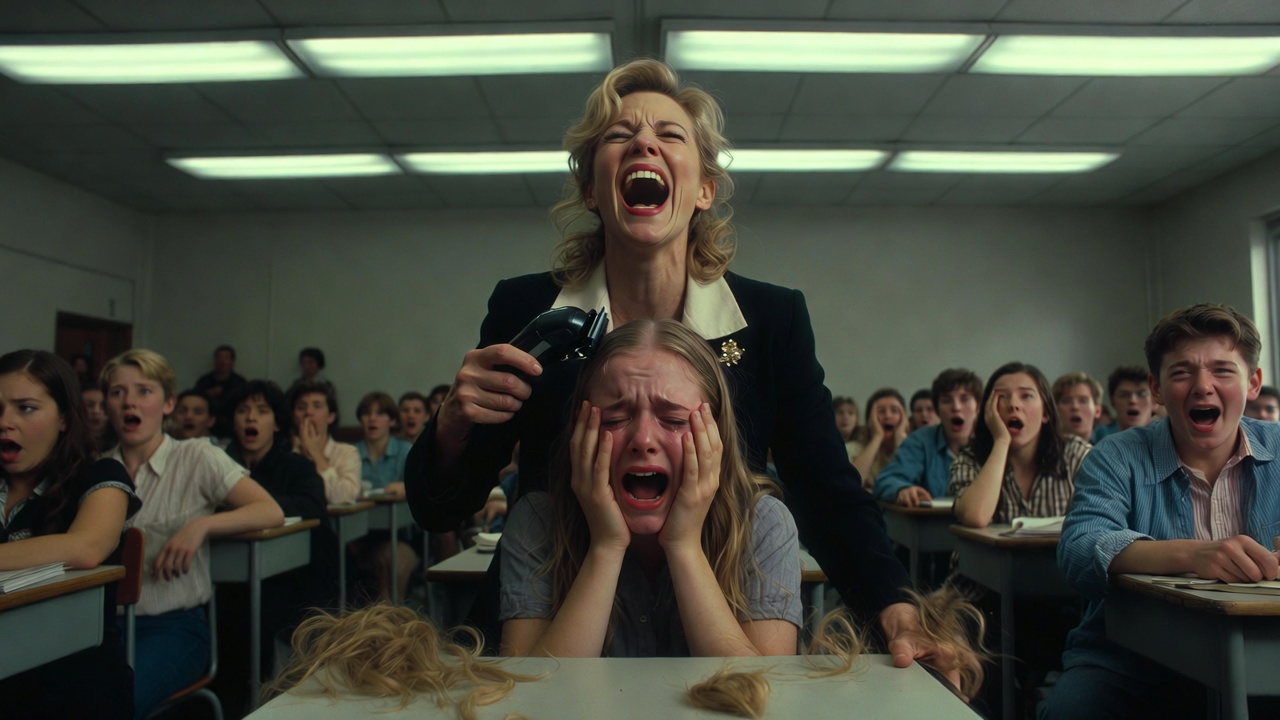
Ms. Holt walked to her desk. When she turned back around, she was holding a pair of scissors — the large kind, orange handles, the kind used for cutting construction paper.
Metal caught the fluorescent light.
“Since words don’t seem to land with you,” Ms. Holt said, voice cold and flat, “maybe a lesson will.”
Caitlin’s breath caught. “What are you doing?”
“Sit down.”
“Ms. Holt—”
“Sit. Down. Now.”
Something in her tone made Caitlin’s legs move before her brain caught up. She sat.
Ms. Holt crossed the floor behind her.
“You want to talk about what’s appropriate?” she said. “Let’s talk about what’s appropriate.”
“Don’t touch me,” Caitlin said. Her voice cracked on the last word. “You don’t have the right—”
A hand gripped her shoulder.
The scissors opened.
Then closed.
The sound was small and sharp and final.
A lock of blonde hair fell to the linoleum floor.
Caitlin made a sound she didn’t recognize as her own voice.
“Please,” she whispered. “Please stop.”
Ms. Holt didn’t stop.
“Look closely,” she told the class, calm as a demonstration. “This is what happens when students think the rules don’t apply to them.”
Another lock fell.
In the second row, a white teenage girl named Becca had her hand pressed over her mouth. A boy in the back — tall, red-haired, the kind of kid who never cried — had tears running down his face and wasn’t moving. Three phones were out. Nobody knew whether to film or look away, and most of them did both.
When it ended, Caitlin sat completely still.
Her reflection stared back at her from the dark screen of the window beside her desk. Uneven. Exposed.
Ms. Holt placed the scissors back in her desk drawer and smoothed her blazer.
“Page thirty-two,” she said. “Let’s continue.”
Nobody turned to page thirty-two.
Caitlin walked home the long way.
She needed the extra twenty minutes. She needed to figure out what her face was doing before she opened the front door.
She hadn’t figured it out by the time she got there.
Naomi Marsh opened the door before Caitlin could turn her key. She looked at her daughter — at the uneven places, the missing pieces, the way Caitlin was holding her jaw too tight — and her expression did something controlled and complicated and devastating all at once.
She pulled Caitlin into her arms without saying a word.
They stood in the doorway.
“Mom,” Caitlin said, muffled against her shoulder.
“I know.”
“She just—”
“I know, baby.”
“In front of everyone.”
“I know.” Naomi’s arms tightened. “I know.”
When Caitlin stepped back, her mother’s eyes were dry. But her hands were gripping her daughter’s arms with the quiet force she used in courtrooms.
“No one,” Naomi said, “has the right to do this to you.”
“I wasn’t doing anything wrong.”
“You weren’t doing anything wrong.” Naomi’s voice was steady. Deliberate. “And this will not end here.”
Becca sent the video at 9:47 PM.
The boy in the back — his name was Connor — sent his at 10:03.
Naomi watched both videos at the kitchen table without speaking. Then she set her phone face-down and made the first call.
She spoke to the district’s legal department at 7 PM. A civil rights attorney at 8:30. She filed the formal complaint at 11:02 PM and did not go to bed.
By morning, two uniformed officers were at the school.
Ms. Holt was mid-lesson when they came through the door.
“Excuse me,” she said sharply. “You’re interrupting instruction.”
“Ms. Patricia Holt,” one officer said, “you are being placed under arrest for assault.”
The class erupted.
“This is absurd,” she said. “I was enforcing discipline.”
“You have the right to remain silent,” the officer continued. “Anything you say may be used against you in a court of law.”
Ms. Holt’s confidence fractured.
She looked at the room — twenty-two students, none of them looking away this time — and said nothing else.
The courtroom was small. Pale wood, fluorescent lights, the smell of old carpet and floor wax.
Ms. Holt sat at the defendant’s table in a gray blazer, her union attorney beside her. She looked composed. She’d been through disciplinary proceedings before. A reprimand. Sensitivity training. Back by January.
“All rise.”
She stood.
The door to chambers opened.
The judge who entered was a white American woman in her late forties. Dark robe. Reading glasses on a chain. Measured steps. She walked to the bench, set down her portfolio, and looked out at the courtroom.
Ms. Holt’s attorney glanced at his paperwork.
Then he looked at his client.
Ms. Holt had gone completely still.
Judge Naomi Marsh took her seat.
She looked at the room the way she always did — even, complete, unhurried. Then she opened the case file and looked up.
“Before I am a judge,” she said, voice steady and clear, “I am a mother.”
Ms. Holt closed her eyes.
“I want to be plain about what happened in that classroom,” Judge Marsh continued. “Cutting a student’s hair without consent is assault. It is a violation of her physical autonomy. When it is done as punishment for the clothes on her back — for the economic circumstances of her family — it is also a form of targeted cruelty that this court will not minimize.” She set her pen down. “The evidence in this case is not complicated. Two videos. Eight witness statements. A pair of scissors in a teacher’s desk drawer.”
She looked at the defendant’s table.
“Ms. Holt, you had authority over a seventeen-year-old girl who rode the bus and wore a secondhand hoodie to school. You chose to use that authority to take something from her — literally — in front of her peers. And then you told those peers she deserved it.”
The gavel came down.
Guilty on assault. Termination upheld. Civil damages awarded. Teaching license suspended pending full review by the state board.
Ms. Holt’s attorney was already packing his briefcase.
Caitlin was on the wooden bench in the hallway when the courtroom doors opened.
Becca was next to her. Connor had shown up too, hands in his pockets, and hadn’t explained why, and nobody had asked.
Naomi came through the doors still in her robe and walked the length of the hallway.
“It’s done,” she said.
Caitlin exhaled. It felt like she’d been holding that breath for three weeks.
“Assault charge?” she said.
“Guilty. Termination. Civil damages. License review.”
Becca grabbed Caitlin’s arm. Connor looked at the ceiling and blinked hard.
Caitlin sat with it for a moment. The fluorescent lights hummed. An elevator dinged somewhere down the hall.
“She really thought it would just go away,” Caitlin said quietly.
“Most of the time, it does,” her mother said. “That’s the problem.”
Caitlin nodded. She understood what that meant — that the ruling mattered, but it mattered because it was on record. Because Becca had hit record. Because Connor had cried and filmed anyway. Because the next kid Ms. Holt might have decided to make an example of wouldn’t exist now.
“Okay,” she said. She stood up, slung her backpack over one shoulder. “Can we get food? I didn’t eat today.”
Naomi looked at her daughter for a long moment. Then she laughed — short and real and completely unguarded.
“Wherever you want,” she said.
“Somewhere that isn’t a school cafeteria.”
“Done.”
They walked out through the glass doors into the gray afternoon. Caitlin didn’t look back.
She was still wearing the hoodie.
Tyler Anderson, whoever he was — she hoped he was doing okay out there. Because his name had been on her back the day everything got set right.
And that felt like enough.
Original fictional stories. AI-assisted creative content.
