
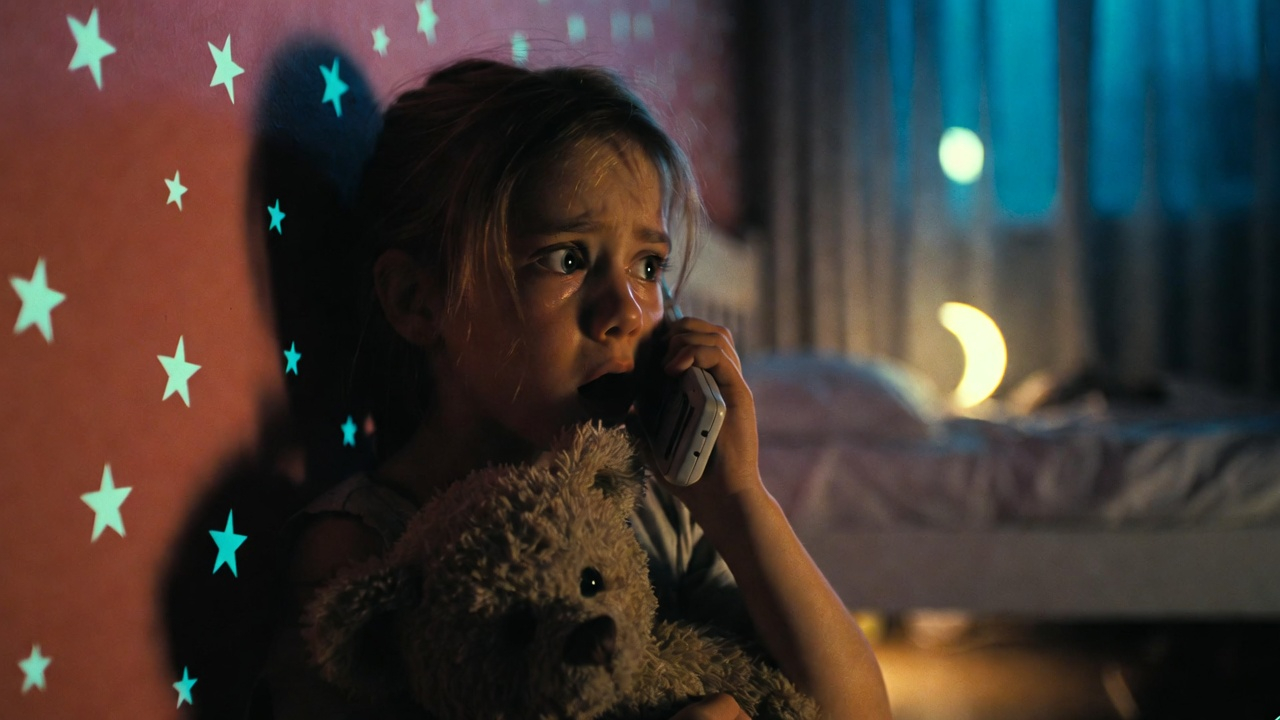
The call came in at 11:47 PM on a Tuesday.
Dispatcher Tom Hadley had been working the graveyard shift at the Lake County 911 center for eleven years. He’d talked jumpers off bridges. He’d guided a teenager through CPR on her own father. He thought nothing could rattle him anymore.
He was wrong.
“911, what’s your emergency?”
The silence stretched for three full seconds. Then a voice came through—tiny, shaking, barely above a breath.
“Hello…?”
Tom leaned forward. “This is 911. What’s your emergency?”
“There’s… someone under my bed.” The girl’s whisper was so faint the recording software almost missed it. “They’re talking. Please come quickly.”
Tom’s hand froze over his keyboard. Kids called sometimes. Nightmares. Prank calls from sleepovers. But something in this voice—the controlled terror, the way she was clearly trying not to cry—sent ice water through his veins.
“What’s your name, sweetheart?”
“Mia. I’m five.”
“Okay, Mia. You’re being really brave. Where are your mommy and daddy?”
“Downstairs. They said I’m making it up.” Her voice cracked. “But I’m not making it up. I can hear it right now. Someone is whispering.”
Tom pulled up the trace. 14 Birchwood Lane. A house in the Meadow Creek subdivision—one of those cookie-cutter developments where every lawn was trimmed and every garage door matched. Crime rate: practically zero.
“Mia, I need you to stay very still and very quiet. Can you do that for me?”
“Yes.”
“Good girl. I’m sending police right now. Don’t hang up. Stay on the line with me.”
He dispatched units and flagged it priority. His supervisor, Janet, walked over with a coffee.
“Kid call?”
“Maybe,” Tom said. “Maybe not.”
Janet glanced at the address on his screen. “Meadow Creek? That’s the neighborhood where people complain about mailbox colors.”
“I know.”
“Probably a nightmare.”
Tom shook his head slowly. “She’s not screaming. She’s not crying. She’s whispering because she’s afraid something will hear her. That’s not a nightmare.”
Janet set her coffee down. She didn’t argue.
On the other end of the line, Mia breathed.
“Mia? You still there?”
“Yes.”
“You’re doing great. Can you tell me what the whispers sound like?”
“Like… two people. Talking really quiet. And sometimes there’s scratching.”
“Scratching?”
“Like something dragging. It stops and starts.”
Tom typed everything into the notes. His fingers were steady but his pulse wasn’t.
“How long have you been hearing this, Mia?”
“A long time. Maybe… since the summer? Mommy says it’s the house settling. Daddy says I watch too many cartoons.”
Tom did the math. It was October. She’d been hearing something for months.
“Have you told anyone else?”
“My teacher. She called my mom. Mom got mad at me.”
“Why did she get mad?”
“She said I was embarrassing the family.”
Tom exhaled. He looked at Janet. “Get Sergeant Cordero on the radio. Tell him I want his unit at this address, not patrol.”
Janet raised an eyebrow but reached for her headset.
Twelve minutes later, two squad cars rolled into the Meadow Creek cul-de-sac with their lights off. Sergeant Ray Cordero stepped out first, followed by Officers Kim Rayden and Deshawn Price. Cordero had twenty-two years on the force and a rule he never broke: trust the caller until proven otherwise.
The porch light flicked on before they knocked. A man in a bathrobe opened the door—mid-forties, thinning hair, reading glasses pushed up on his forehead.
“Can I help you?”
“Sir, we received a 911 call from this residence.”
The man blinked. “From—what? When?”
“Approximately fifteen minutes ago. A child.”
The man’s face shifted from confusion to embarrassment. He turned and called back into the house. “Karen? Karen, the police are here.”
A woman appeared behind him, pulling a cardigan tight around her shoulders. Her expression was already defensive.
“It was Mia, wasn’t it,” Karen said. It wasn’t a question.
“Ma’am—”
“She does this. She has an overactive imagination. I’m so sorry she wasted your time.”
“She’s called before?” Cordero asked.
Karen hesitated. “Not 911. But she tells her teacher, the neighbors, anyone who’ll listen. There’s nothing wrong with this house. We had it inspected before we bought it.”
The father—Greg—stepped forward. “Officers, I apologize. She’s been on this kick since summer. Monsters under the bed. We’ve checked a hundred times. There’s nothing there.”
“We’d still like to take a look,” Cordero said. “Standard procedure.”
Greg looked like he wanted to argue. Karen put a hand on his arm.
“Fine,” she said. “But please try not to scare her more than she already is.”
They went upstairs.
Mia’s room was at the end of the hallway. Pink walls. Glow-in-the-dark stars on the ceiling. A nightlight shaped like a crescent moon casting a pale yellow glow across the carpet. And in the far corner, wedged between the wall and a bookshelf full of picture books, a five-year-old girl sat clutching a threadbare teddy bear.
She didn’t cry when they walked in. She didn’t speak. She just lifted one small hand and pointed at the bed.
Rayden knelt down and smiled. “Hey, Mia. I’m Officer Kim. You called us, right?”
Mia nodded.
“That was really smart of you. We’re gonna check everything out, okay?”
Mia nodded again. Her eyes didn’t leave the bed.
Rayden got on his stomach and lifted the bed skirt. He swept his flashlight beam across the space underneath.
Dust. A plastic doll missing one arm. A sock with unicorns on it. Nothing else.
He pulled himself back up. “It’s clear.”
Karen, standing in the doorway, let out a sigh that sounded more annoyed than relieved. “See? This is what I’ve been dealing with. Every single night.”
Cordero looked at Mia. She hadn’t moved. Her finger was still pointing.
“Mia,” he said gently, crouching to her eye level. “Can you show me exactly where you hear the sounds?”
She lowered her hand and pointed again—not at the bed, but at the floor beneath it. Specifically, the far-left corner.
Cordero looked at Rayden. “Check the floor.”
Rayden got back down. He knocked on the hardwood under the bed. Most of it returned a light, hollow echo—normal for a raised floor with a crawl space underneath.
But the far-left corner gave back a different sound. Dull. Dense. Thud.
“That’s not the same,” Rayden said.
“It’s an old house,” Greg said from the hallway. “The foundation is uneven.”
Cordero ignored him. “Knock again.”
Rayden knocked. Hollow. Hollow. Hollow. Thud.
“Move the bed.”
Greg stepped forward. “Now wait a minute—”
“Sir, please step back.”
They slid the bed to the opposite wall. Mia stayed in her corner, bear pressed to her chest.
Rayden knelt and ran his fingers along the floorboards. One of them shifted. Not much—maybe a quarter inch—but enough.
“Sarge, this board is loose.”
“Lift it.”
Price handed him a pocket knife. Rayden worked the blade under the edge and pried. The board came up with a groan.
Beneath it was dirt. Fresh, dark, recently disturbed.
Karen’s hand went to her mouth. “What is that?”
“Ma’am, I need you and your husband to take Mia downstairs right now.”
“But—”
“Right now.”
Greg grabbed Mia. Karen followed. The bedroom door closed.
Cordero radioed dispatch. “This is Sergeant Cordero at 14 Birchwood. I need forensics and backup. We’ve got a compromised floor structure with fresh excavation underneath a child’s bedroom.”
Tom, still on the line, heard every word. His hands were shaking.
Twenty minutes later, the house was lit up like a crime scene. Three more units. A forensic team. A fire department rescue squad. Neighbors pressed against the yellow tape in their bathrobes.
The forensic team removed four more floorboards. Beneath the dirt—about eight inches down—they hit metal.
A hatch.
Not a standard crawl space access. This was fabricated. Sheet metal welded into a frame, bolted from the inside, concealed with packed earth.
They pried it open.
The smell hit first. Sweat. Rust. Stale air that hadn’t circulated in weeks.
Below the hatch was a drop of about four feet into a crudely dug tunnel. Plywood braces. Battery-operated lanterns. The walls were hand-carved earth, shored up with two-by-fours stolen from a nearby construction site.
Cordero stared into the hole. “You have got to be kidding me.”
The tunnel ran east. Then it branched. One arm went north, under the Hendersons’ house next door. Another went southeast, toward the Patels’ property at the end of the block. A third branch was still being dug—tools left mid-work, a pickaxe leaning against the wall.
They found bedding. Tattered blankets. Canned food—dozens of empty cans of beans, tuna, Vienna sausages. Water jugs. Plastic bags used as waste disposal. Muddy boot prints in three different sizes.
And clothes. Prison-issue clothes.
“Get the state police on the line,” Cordero said. “Now.”
By 3:00 AM, the FBI had been notified.
By 4:00 AM, they had a match.
Three men—Russell Dean Pruitt, forty-one, Marcus Lyle Wayne, thirty-six, and Terrence “Crawl” Jackson, twenty-nine—had escaped from a state correctional facility four months earlier. The escape had made national news for a week, then faded when no trace was found.
Because they’d gone underground. Literally.
They’d somehow located an entry point—an old drainage access behind the Meadow Creek subdivision—and dug their way under the neighborhood over the course of months. They moved at night. They stole supplies from garages and sheds. They expanded the tunnel system slowly, methodically, planning to eventually connect to the city’s storm drainage network and disappear entirely.
They’d chosen Mia’s house because the crawl space was deepest there. The loose floorboard had been their emergency exit point.
And every night, when they worked, they whispered to each other.
Mia heard them.
Every. Single. Night.
And no one believed her.
The manhunt took less than thirty-six hours. Pruitt was found hiding in a drainage pipe two miles south of the subdivision. Wayne was picked up at a gas station in the next county, trying to buy a prepaid phone. Jackson—the one they called Crawl, the one who’d engineered the tunnels—was found still underground, in a branch of the tunnel that ran beneath a church parking lot three blocks away. He’d been asleep when they found him.
When Cordero put the cuffs on Pruitt, the man looked at him with flat, dead eyes and said, “How?”
Cordero said nothing for a long moment. Then: “A five-year-old girl heard you whispering.”
Pruitt blinked. “The kid?”
“The kid.”
Pruitt laughed—a short, ugly bark. “We were so careful. Moved like ghosts. Four months underground without a single alarm. And we got taken down by a kindergartner.”
“Maybe next time dig somewhere without a kid who pays attention.”
“There won’t be a next time,” Pruitt said.
“No,” Cordero agreed. “There won’t.”
Back at the house, the investigation continued for three days. Engineers assessed the structural damage. The tunnel system spanned nearly six hundred feet. Four homes had been undermined. Two had foundation damage serious enough to require evacuation and repair.
The FBI held a press conference. The police chief gave a statement. Reporters swarmed Birchwood Lane. Cameras. Microphones. Satellite trucks.
And through all of it, Mia sat on her living room couch with her teddy bear, watching cartoons.
Karen couldn’t look at her without crying.
“I told her she was lying,” she said to Cordero, her voice breaking. “I told her she was embarrassing us. I yelled at her teacher for calling. I—”
She pressed both hands over her face.
“I failed her.”
Cordero sat across from her. “You’re here now. That counts.”
“Does it? She called 911 because she couldn’t get us to listen. A five-year-old had to call the police because her own parents wouldn’t believe her.”
Greg stood by the window, staring at the yard full of investigators. He hadn’t spoken much since the night of the discovery.
“I checked under that bed fifty times,” he said quietly. “I looked right at those floorboards. I never thought to knock on them.”
“You weren’t trained to,” Cordero said.
“I was trained to listen to my daughter,” Greg said. “And I didn’t.”
Nobody argued with that.
Tom Hadley, the dispatcher, drove to Birchwood Lane on his day off. He’d never visited a caller before—it wasn’t protocol. But he brought a stuffed rabbit he’d bought at the store that morning and knocked on the door.
Karen answered. She recognized his voice before he introduced himself.
“You’re Tom,” she said. “From the phone.”
“Yes, ma’am.”
“You believed her.”
“She didn’t sound like a kid having a nightmare. She sounded like a kid telling the truth.”
Karen let him in. Mia was on the floor, drawing with crayons. When Tom sat down across from her, she looked up.
“Are you the man on the phone?”
“I am.”
“You sent the police.”
“I did.”
She held up her drawing. It showed a house with pink walls and a crescent moon. Under the house, she’d drawn three stick figures in a dark space. And above the house, she’d drawn a police car with a star on the side.
“You believed me,” she said.
Tom’s throat tightened. “Yeah, Mia. I believed you.”
“Nobody else did.”
“I know. And I’m sorry about that. But you did exactly the right thing. You were braver than most adults I know.”
She looked at the stuffed rabbit he set on the floor.
“Is that for me?”
“If you want it.”
She picked it up, examined it seriously, then tucked it under her arm next to the teddy bear. “He can be the teddy’s friend.”
Tom laughed. It was the first time he’d laughed in days.
The story went national. CNN. NBC. Fox. Every outlet ran the headline some version of the same way: “Five-Year-Old’s 911 Call Leads to Capture of Escaped Convicts.”
The governor called the family. A senator mentioned Mia by name in a floor speech. The police department gave her a junior badge and a certificate of bravery.
But the moment that mattered most happened three weeks later, at the Lake County precinct’s annual community dinner.
Cordero stood at the podium. The room was full—officers, families, local officials. Mia sat in the front row between her parents, wearing a new dress and holding both stuffed animals.
“Most of you know why we’re here,” Cordero said. “A few weeks ago, three dangerous fugitives were living underneath a residential neighborhood. They’d been there for months. They evaded every search. Every task force. Every resource the state threw at them.”
He paused.
“They were caught because a five-year-old girl named Mia called 911 and told the truth. A truth that nobody around her believed.”
The room was silent.
“I’ve been a cop for twenty-two years. I’ve seen bravery in a lot of forms. But I’ve never seen anything like what this little girl did. She didn’t stop telling the truth just because people told her she was wrong. She didn’t stop because it was easier to be quiet. When nobody listened, she picked up a phone and found someone who would.”
He looked directly at Mia.
“Mia, you reminded every person in this room of something we should never forget. The truth doesn’t care how old you are. And the people who speak it—especially when it’s hard, especially when nobody believes them—those are the bravest people there are.”
He reached into a box and pulled out a small medal on a red ribbon.
“On behalf of the Lake County Police Department, I’m honored to present you with the Civilian Courage Award.”
The room erupted. Every officer stood. Every person in that room was on their feet.
Mia walked up to the podium. Cordero knelt down and placed the medal around her neck. It was too big for her—it hung almost to her waist.
She looked at it. Then she looked at the room full of people clapping for her.
Then she leaned into the microphone.
“I told you someone was there.”
The laughter and cheers that followed shook the walls.
Karen was sobbing. Greg had his arm around her, his own eyes red. Tom Hadley sat in the third row, wiping his face with the back of his hand.
After the ceremony, a reporter managed to grab Mia for one question.
“Mia, what do you want to be when you grow up?”
She thought about it for exactly two seconds.
“A 911 lady. So I can believe kids when they call.”
Cordero, standing nearby, heard it. He turned away so no one would see him lose it completely.
That night, for the first time in four months, Mia slept in her own room. The floorboards had been replaced. The tunnel had been sealed with concrete. A new carpet covered the spot where the hatch had been.
She put the teddy bear on one side and the stuffed rabbit on the other.
Karen sat on the edge of the bed. “Mia? Do you hear anything tonight?”
Mia listened. Really listened—the way she always did, with her whole body still and her head tilted slightly to the side.
“No,” she said. “It’s quiet.”
Karen kissed her forehead. “If you ever hear anything again—anything at all—you tell me. And I will believe you. I promise.”
Mia looked at her mother. “Pinky promise?”
Karen held out her pinky. Mia wrapped hers around it.
“Pinky promise.”
Karen turned off the light. The crescent moon nightlight glowed. The glow-in-the-dark stars shimmered on the ceiling.
Mia closed her eyes.
And for the first time in a very long time, the only sound in the house was silence.
Real silence.
The kind that means you’re safe.
Original fictional stories. AI-assisted creative content.

That was a awesome story! I loved it. She was a very brave little girl!
That was one of the realist story’s I have ever heard and I liked it