
My name is Laura Bennett, and I want to tell you about the day everything broke open — the day I finally stopped being silent.
I was eight months pregnant. My belly was enormous, my feet so swollen I had to unlace my shoes just to get them on. Our house in a quiet suburb of Nashville had thick walls and even heavier silences, and I had learned to live inside them.
My husband, Ryan Bennett, left before sunrise every morning for his construction site foreman job and came home after dark, too exhausted to notice much. That left me alone in the house with his mother, Diane Bennett — a woman with a cold, measuring gaze and words sharpened like tools.
From the day I moved in, Diane made her position clear.
“You trapped my son,” she said, the first week, setting her coffee mug down without looking at me. “A woman who gets pregnant to lock down a man — that’s not a wife. That’s a strategy.”
I said nothing. I was twenty-six, from a working-class family in rural Tennessee, and I had learned early that silence was sometimes the only armor that didn’t cost anything.
But Diane took silence as invitation.
Every morning she found new tasks. Sweep the garage. Rewash the dishes — “you left streaks.” Iron the curtains. Polish the baseboards. I did all of it without complaint, telling myself: It’s her house. She’s older. It’s temporary.
Except it wasn’t getting better. It was getting worse.
“You sit down too much,” she’d say when I lowered myself onto the couch to rest for ten minutes. “My generation didn’t coddle ourselves over a little pregnancy.”
“I’m sorry,” I’d say. And I’d get back up.
By month seven, I was waking up twice a night with back spasms. By month eight, my ankles looked like someone had tucked balloons under my skin. The doctor had told me to rest when I could. I never told Diane that.
The morning everything changed was a Tuesday in October.
Ryan had left at five. Diane was eating toast at the kitchen table, watching me with that habitual look of quiet contempt. The kitchen smelled like bleach — I’d already wiped the counters twice that morning.
“The floor,” she said, not looking up from her newspaper.
“I mopped it yesterday.”
She turned the page. “It smells like something.”
I filled the bucket. I mopped. My lower back was a sustained, low-grade scream, and I kept my breathing steady and my face neutral, the way I always did.
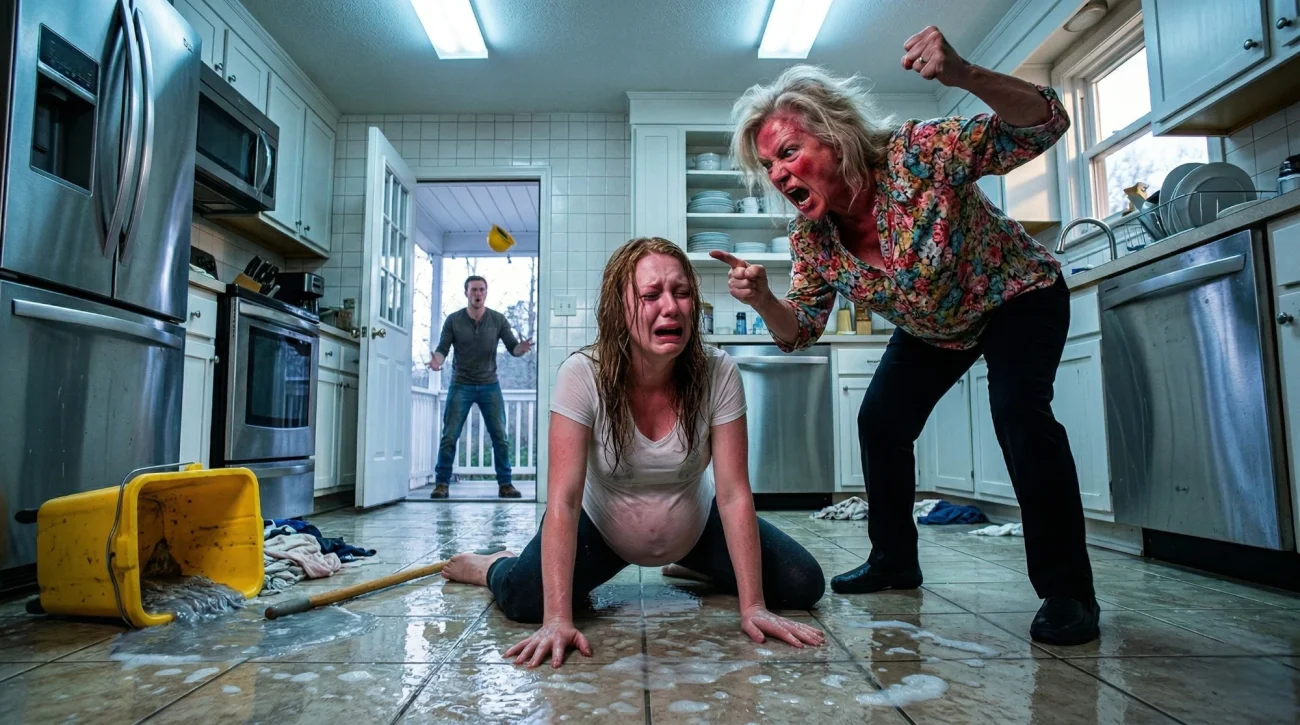
I was working my way backward toward the far corner, the mop handle extended, when the tip of it barely grazed Diane’s ankle as she shifted her chair.
The reaction was instant.
“What is wrong with you?” She was on her feet. Her voice cracked through the kitchen like a gunshot.
“Diane, I’m sorry — it was an accident, I didn’t—”
“You did that on purpose.” Her face had gone rigid, white at the temples. “You are clumsy and stupid and you do not belong in this house.”
“It barely touched you—”
The slap came before I finished the sentence.
It was open-handed, hard enough that my vision went white. I stumbled backward. The wet floor gave under my feet — I had nothing to grab — and I went down sideways, hard, onto my hip and then my abdomen.
The pain was unlike anything I had felt before. Not the dull ache of pregnancy. Something sharp and internal and terrifying.
I lay on the wet tile, one hand pressed to my belly, and I felt warmth spreading between my legs. I knew what it meant. I had read every page of every pregnancy book.
“My water broke,” I said. My voice was small and strange to me. “Diane. My water broke.”
She stood over me. For one second — just one — something crossed her face that might have been alarm. Then it closed back off.
“You slipped,” she said. “You were careless.”
The front door opened.
Ryan walked in still wearing his hard hat, lunch cooler in hand, and stopped completely still in the doorway.
He took in the scene: me on the floor, soaked, one hand on my stomach, the other braced against the tile. Diane standing over me, arms crossed.
“Laura—” He was moving before he finished the word, dropping everything, crossing the kitchen in four steps and kneeling beside me. “What happened? Talk to me—”
“She fell,” Diane said from behind him. “She was careless with the mop.”
Ryan looked at my face. Then he looked at his mother. Something shifted in his expression — not quite understanding yet, but something closing.
“Call 911,” I said. “Ryan. Please.”
He already had his phone out.
The paramedics arrived in eleven minutes. I counted them. Ryan held my hand the entire time, his grip too tight, his face going through things I’d never seen on him before. Diane stood in the hallway doorway, arms still crossed, watching.
“You’re going to be okay,” Ryan kept saying. “You’re both going to be okay.”
“I know,” I said. And then: “I need to tell you some things. When this is over. I need to tell you everything.”
He looked at me. “Okay.”
“Promise me you’ll listen.”
“I promise.”
In the ambulance, the contractions started. I focused on breathing, on my son’s heartbeat on the monitor — steady, steady, steady — and I made myself a promise too. That I would not leave the hospital and go back to silence.
Our son, Cole, was born six hours later. Three weeks early, four pounds eleven ounces, with Ryan’s blue eyes and a cry that filled the delivery room like an alarm. The nurses said he was strong. I believed them.
While Cole was in the NICU and I was in recovery, Ryan sat beside my bed in a recliner that was too small for him, and I talked.
I told him about the names. Opportunist. Parasite. Trash. I told him about the seven-months-pregnant day Diane poured a glass of cold water on the freshly mopped floor and told me to do it again. I told him about the nights I cried quietly in our bathroom so he wouldn’t hear. I told him about the slap, and the bucket, and the floor.
Ryan sat very still through all of it. I watched his jaw tighten and his hands go flat on his knees.
“Why didn’t you tell me?” he said, finally.
“Because she’s your mother.”
“Laura—”
“And because I was afraid you wouldn’t believe me. Or that you would, and it would break something between us.”
He was quiet for a long time.
“I should have seen it,” he said. “I knew she was hard on you. I told myself it was just her personality. Adjustment. I told myself things that let me not look directly at it.” He rubbed his face. “That was a choice. I made that choice and it hurt you.”
“Yes,” I said. “It did.”
He looked at me. “I’m sorry.”
I didn’t say it’s okay, because it wasn’t. But I reached out and took his hand.
Ryan went home that night to get clothes and my toiletry bag. He also went through the kitchen, the hallway, our bedroom. He found the journal I’d been keeping — dates, times, incidents, things Diane had said. I’d started it at five months, when something in me knew I needed a record.
He read all of it.
He also found something I hadn’t known about: a baby monitor we’d set up in the nursery had an audio function that had been running for weeks, automatically saving to a cloud account. Diane had been in that room. Her voice was on it.
Ryan called me from the parking lot of the hospital at two in the morning.
“I’m going to ask her to leave,” he said. His voice was quiet and completely certain. “Tonight.”
“Ryan—”
“She put you on the floor. She put Cole at risk. And she’s been doing this to you for eight months while I let myself not see it. This isn’t a conversation I’m willing to have twice.”
There was shouting, apparently. Diane invoked everything — her rights as his mother, her years of sacrifice, her sense of ownership over the house (his name was on the deed). She cried. She cursed. She told him I had manipulated him and fabricated everything.
Ryan told her she had until morning to pack what she needed.
She left before dawn.
When Ryan came back to the hospital the next morning, he had dark circles under his eyes and my overnight bag and a coffee he’d remembered to get exactly the way I liked it — oat milk, one sugar. He sat down and looked at Cole through the NICU window for a long time without speaking.
“How are you?” I asked.
“Sad,” he said. “And certain. Both at the same time.”
“That’s allowed.”
“I know.” He looked at me. “I want to go to therapy. Both of us, separately, and together. I think I have a lot of—” He stopped. Started again. “I think I let things happen in my family for a long time that I called normal. And I need to look at that.”
I hadn’t expected that. I felt something loosen in my chest that had been tight for so long I’d forgotten it was there.
“Okay,” I said. “Yes.”
Cole came home eleven days later, five pounds four ounces and determined about everything — eating, sleeping, the precise angle at which he wanted to be held. The house was different. Quieter in a different way. A way that felt like space instead of suppression.
Diane called twice. Ryan answered the first time and said three sentences: I love you. What you did is not something I can overlook. I hope you get help. Then he hung up. The second call, he let go to voicemail. They never listened to it.
Some of Ryan’s family took Diane’s side. His aunt sent a long text about how I’d “broken up the family” and how Diane “has always been difficult but means well.” Ryan responded: She put my pregnant wife on the floor. There is no ‘means well’ version of that. Then he blocked the aunt’s number.
Others in the family went quiet — not defending Diane, but not quite ready to say anything either. Ryan didn’t chase them. He said: “People need time to decide who they are. I can’t do that for them.”
I started therapy eight weeks postpartum. My therapist had kind eyes and a direct way of asking questions that I appreciated. In our third session, she asked me what I’d believed, during those months, about what I deserved.
I sat with that for a while.
“I think I believed that surviving was enough,” I said finally. “That if I could just get through it, I’d have done something right.”
“And now?”
“Now I think surviving was the floor. Not the ceiling.”
She wrote something in her notebook. I asked what.
“I’m writing that down,” she said, “because you should remember you said it.”
Cole is eight months old now. He has figured out clapping and is extremely proud of himself about it. He laughs at the dog next door through the window — a full-body laugh that involves his whole torso. He has Ryan’s blue eyes and my stubbornness, and I think that combination is going to serve him well.
Ryan and I are doing the work — the real kind, the kind where you look at patterns that go back decades and you name them out loud and you decide together what you’re building instead. It is not easy and it is not fast and some weeks are better than others. But we are choosing it, deliberately, which is different from just staying.
Diane lives in an apartment across town now. I don’t know much about her days. I think about her sometimes — not with anger anymore, mostly with something that feels like exhaustion. She chose cruelty when she could have chosen something else, and she is living with the consequences of that choice in an apartment alone, her son at a distance she created.
That is not my doing. It is hers.
I used to think that keeping quiet was a form of protection — for my marriage, for Ryan’s family, for some version of peace I was desperate to preserve. I understand now that it was the opposite. Silence doesn’t protect. It just gives cruelty more room to operate.
The day my water broke on that kitchen floor, I thought I was losing everything.
Instead, I found out what I was made of.
Two things were born that night in the hospital: my son, and the version of me who will never again mop a floor she doesn’t need to mop, or stay in a room where someone is calling her trash, or swallow an apology that belongs to someone else.
Cole reached up last week and patted my cheek with his small open hand. Just patted it, looking at me seriously, like he had something to say.
“I know,” I told him. “Me too.”
Original fictional stories. AI-assisted creative content.
