
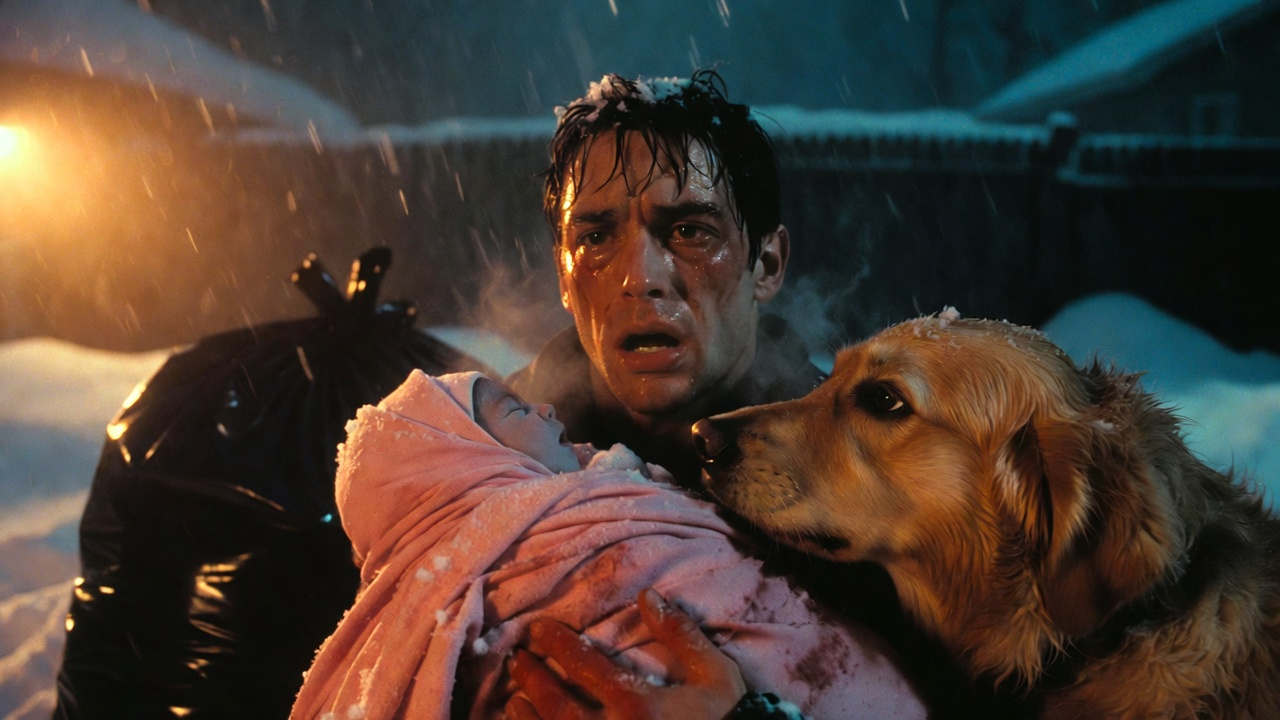
I keep my boots on the top shelf in the garage now. Behind the paint cans. I can’t look at them without feeling sick.
If you own a dog, you know the drill. They bark at everything. Squirrels, mailmen, wind rattling the siding. You learn their language—the treat whine, the stranger growl, the dream twitch.
Buster is a Golden Retriever mix. Six years old. Bad hips. Aggression level: marshmallow. In six years, I’d heard him growl exactly twice.
He’s the best boy.
Which is why I should have listened.
It was February in Minnesota. Twenty below zero. Wind chill pushing it to skin-freezing territory. My wife Sarah was asleep upstairs—she’s an ER nurse, double shifts during flu season. I was half-dead on the couch watching reruns at 3 AM.
That’s when Buster started.
Not a normal bark. A low whine first. Then scratching at the back door. Then a deep, rhythmic chest bark that shook the walls.
“Buster! Quiet!” I hissed.
He didn’t stop. He threw his body against the door. The glass panes rattled.
I stomped into the laundry room, barefoot, furious. When I flipped the light on, his hackles were standing straight up. His tail was stiff and low. He wasn’t excited. He was terrified.
“It’s twenty below,” I grumbled, grabbing his collar. “You’re not going out.”
He spun, looked me dead in the eye, and let out a sound I’d never heard from any dog. A howl mixed with a scream. Primal. Ancient. A warning from somewhere deep in his DNA.
Then he lunged at the door again, clawing the wood frame, shredding the paint.
“Fine,” I snapped. “Go freeze.”
I opened the door. The wind hit me like a slap. Buster exploded into the yard.
He didn’t go to his usual spot. He bolted straight to the far corner, near the alley trash cans, and started tearing at a pile of garbage bags half-buried in snow.
“Buster! Leave it!”
He ignored me. He was biting, digging, shredding plastic like a machine.
I was freezing. I was exhausted. My head was pounding.
I shoved my feet into my heavy boots—the ones on the shelf now—and stomped through knee-deep snow to get him.
When I reached him, I didn’t think.
I kicked him.
Hard. Right in the ribs.
“Get away from there!” I screamed.
He yelped—a sound that cracked something inside me—and tumbled sideways into the snow.
“Get inside! Now!”
Any normal dog would have cowered. Would have slunk away with its tail between its legs.
Buster stood his ground. He scrambled back up, shook the snow off, and growled at me.
My own dog. The marshmallow. Baring his teeth.
Before I could grab his collar, he lunged back into the trash. He clamped his jaws onto something heavy and pulled, bracing his back legs, shaking his head.
Whatever it was, it wasn’t an empty bag.
One final tug and it slid free across the snow.
A dirty pink fleece blanket. Stiff with ice.
“It’s just a rag,” I sighed. “Let’s go.”
I turned toward the house.
He didn’t follow. He was licking the blanket. Whining softly. Nudging it with his nose. The aggression was gone. He was being gentle. Tender.
Something made me turn back around.
The wind blew a layer of powdery snow off the bundle. And I saw it.
A foot.
Tiny. Perfect toes. A little heel that had never walked.
But it wasn’t pink. It was purple. Deep, bruised, violent purple.
The world stopped.
I fell to my knees. My hands shook so badly I could barely grip the frozen fleece. I tore it open.
A baby girl. Maybe days old.
Grey-blue skin. White lips. Frost on her eyelashes. Eyes closed.
She wasn’t breathing.
“No,” I whispered. “No, no, no.”
I scooped her against my bare chest under my t-shirt and ran. I don’t remember screaming, but I must have, because my throat was raw and shredded.
“SARAH!”
I kicked the back door open and collapsed onto the kitchen floor.
Buster was right behind me, barking, barking, barking.
This time I wasn’t angry.
Sarah appeared at the top of the stairs, hair wild, eyes wide. She saw me on the floor, cradling something, weeping.
“Mike? Are you hurt? Is it your heart?”
“It’s not me.” I opened my arms and peeled back the fleece.
She froze. Her hand flew to her mouth. For one second, the veteran ER nurse vanished, and there was just a woman, horrified.
Then her eyes changed. Professional steel.
“Give her to me,” she ordered.
“She’s dead, Sarah. She’s solid.”
“She is not dead until she is warm and dead,” Sarah snapped. “Give. Her. To. Me.”
She laid the baby on the kitchen rug. Two fingers on the neck. Ear to the tiny chest.
Nothing.
“Call 911. Speaker. Now.”
I fumbled for my phone, dropped it, snatched it back. “I found a baby! My dog found a baby in the snow! She’s not breathing!”
“Sir, what’s your address?”
“412 Oak Street! She’s blue! She’s frozen!”
Sarah was already doing compressions. Two fingers. Center of the chest. Push. Push. Push.
“Come on, little one,” she whispered. “Don’t you dare do this on my watch.”
Buster had stopped pacing. He lay down, head on his paws, watching the baby. He let out a low vibrating whimper.
And I stood there, useless. The man who kicked the dog. Ten minutes ago I had tried to drag him inside and lock the door. If he’d listened to me, that baby would have frozen to death under the garbage.
The guilt hit me like a physical blow. I tasted bile.
Sirens cut through the wind. Red and blue lights strobed through the falling snow. Paramedics poured into the kitchen.
“Female infant, approximately days old,” Sarah rattled off. “Found in snow. Exposure time unknown. No pulse, no respiration. I’ve been doing CPR eight minutes.”
They swarmed the tiny body. Cut away the fleece. Placed pediatric pads. Drilled an IO needle into her shin because her veins were collapsed.
“Asystole,” someone said, reading the flat green line. “Flatline.”
“She’s hypothermic. We don’t call it until she’s warm. Keep going.”
A sergeant named Miller took me aside while they worked. Broad-shouldered, mustache, seen-too-much eyes.
“Your dog found her?”
“Yeah. He was barking at the trash. In the backyard.”
“Show me.”
We went outside. The torn bags. The depression in the snow where the baby had lain, impossibly small.
Miller shone his flashlight around. “This wasn’t an accident. Someone hid her. They wanted her taken out with the garbage.”
He looked at me. “Cameras?”
“Doorbell cam. Front only.”
“Alley access?”
“Behind the fence.”
He walked to the gate and illuminated the ground. “Tracks. Someone walked up the alley, tossed the bundle over your fence, and kept walking.”
I stared at the tracks, then turned back to the house. Through the window, Buster’s silhouette sat watching us.
“I kicked him,” I blurted. “When he wouldn’t stop barking. I kicked him hard.”
Miller studied me. “But he didn’t stop.”
“No.”
“And you didn’t lock him inside.”
“No.”
“That baby has a chance because of that dog, and because you came out eventually. Don’t rewrite history to punish yourself.”
His radio crackled. A detective arrived, holding an evidence bag. Inside was a crumpled, wet piece of paper.
“Found this in the blanket folds,” the detective said.
Scrawled in hurried ballpoint:
I can’t keep her. He will kill us both if he finds her. Please save her. Her name is Grace.
Below it: Feb 12, 2026.
She was three days old.
I stared at the handwriting. The looping G. The sharp slant of the T. The curling S.
My stomach dropped through the floor.
“That’s my sister-in-law’s handwriting,” I stammered. “That’s Jessica’s.”
Everything accelerated.
Jessica had told us six months ago she was backpacking through Europe. Brief emails. Landscapes. No face photos. “Having a great time, love you.”
She never went.
I called Sarah at the hospital. “Does the baby look like Jessica?”
Long silence.
“Mike. Why would you ask that?”
“The note in the blanket. It’s Jess’s handwriting. She says he will kill them both.”
A gasp. The phone clattered.
“The emails,” Sarah said when she came back, her voice shaking. “They were always short. Generic. She never sent a single selfie.”
“She never went to Europe.”
“Where is she, Mike?”
“The police are searching.”
“Find her,” Sarah hissed. “Take Buster and find my sister.”
The K9 unit arrived. A Belgian Malinois named Rocco caught the scent from the blanket and pulled hard—not toward the main road, but toward the house directly behind ours.
Old Mr. Johnson’s place. He’d died two years ago. Sold to an investment company. Supposed to be flipped. Had been sitting empty.
Or so we thought.
One narrow path of footprints in the snow, half-filled, led from the vacant house’s back door to our fence and back.
“She walked from that house,” I said. “Dropped the baby over my fence. And walked back.”
“Why walk back?” Miller asked. “Why not run?”
“Because she’s a prisoner. She had a window of time before he noticed.”
The realization settled like lead.
Jessica had been living fifty feet away from me for six months. I had barbecued in the backyard. I had played fetch with Buster. I had complained about the cold. And my wife’s sister was chained in a basement on the other side of that fence.
SWAT breached the house. I heard the battering ram. Then “Clear! Ground floor clear!” Then boots pounding toward the basement.
Miller came back out the kitchen door a moment later. He’d holstered his weapon. His face was grey.
“Mike, don’t go in there.”
I pushed past him. “Where is she?”
“She’s not here. But she was.” He caught my arm. “Prepare yourself. It’s heavy.”
Inside, the house was freezing. No heat. The air smelled of mold, stale food, and something metallic. Copper. Blood.
Miller led me to the basement door. A heavy padlock on the outside. The wood around the frame was scratched deep, gouged raw, as if someone had tried to claw through with their fingernails.
We went down.
Concrete floors. Pink insulation hanging from the ceiling. And in the corner, a mattress on the floor. Around it, a nest. Dirty clothes. Empty water bottles. Ramen wrappers.
But the walls—the walls stopped me cold.
Hundreds of charcoal drawings taped to every surface. Drawn on scraps of paper, napkins, receipt backs.
Drawings of me mowing the lawn. Of Sarah leaving for work in her scrubs. Of Buster chasing a ball in the backyard.
She’d been watching us through the narrow ground-level window. For months.
And scrawled over and over, in frantic charcoal: HELP ME. HELP ME. HELP ME. HE IS COMING BACK. SAVE THE BABY.
“Oh God,” I whispered, backing into the wall. “She was right here. She was right here the whole time.”
“Mike,” Miller said. “Look at this.”
He pointed to the concrete pillar in the center of the room. A heavy chain bolted to it. At the end of the chain, a handcuff—closed, but empty. Blood inside the cuff. The metal bent outward at an unnatural angle.
“She dislocated her own thumb to slip the cuff,” Miller said, his voice thick with something between horror and respect. “She broke her own hand. Then she wrapped the baby, climbed the stairs, walked through the snow to your fence, dropped Grace over, and walked back. All with a shattered hand.”
“Why come back?” I asked. “Why not run?”
“Because if he came home and found the chain empty and the baby gone, he’d hunt them both. She came back to buy time. She rechained herself.” Miller paused. “But he came back too soon.”
On the wall by a shattered basement window, there was a message scrawled in fresh blood—bright red, still wet:
2019 GREY FORD VAN. MN PLATE. XJ-4—
The rest was a long red smear. A drag mark. She’d been writing the plate number while he was pulling her away.
“She left us a trail,” I said. “Even while he was taking her.”
“We’re running the partials now,” Miller said. “Every cop in the state is looking for that van.”
My phone rang. Unknown number.
“Mike?” Weak. Raspy. Terrified. Wind in the background. Tires on pavement.
“Jessica!”
“He thinks I’m unconscious. I found his burner phone under the seat. I can’t hold it long.” She was crying softly. “He’s talking to himself. He says he’s going to the cabin. Dad’s cabin.”
My blood went cold. The old hunting cabin. Three hours north. Boundary Waters. Middle of nowhere.
“We’re coming, Jess. Hide the phone. Stay alive.”
“He’s stopping the van—”
Click.
Miller looked at me. “How far?”
“Three hours. Four in this snow.”
“We fly.”
The helicopter nearly killed us twice. Wind shear over the frozen lake tossed the bird sideways. The pilot, Rick, looked like he’d flown in every war since Desert Storm. He was wrestling the stick with both hands, swearing under his breath.
“Can’t land at the site!” Rick yelled over the headset. “Visibility is zero! Trees are too dense! I’m putting down on the lake ice, half a mile out!”
Miller shoved a heavy tactical vest into my chest. “Put this on.”
“I’m not a cop.”
“No. But you’re the only one who knows the cabin layout. Is there a cellar? A crawl space?”
“Root cellar,” I said, memory flashing—summer vacations hauling soda crates down there for my father-in-law. “Access from outside, under the back deck. Trapdoor comes up in the kitchen pantry.”
“That’s our entry. You lead us to the cellar doors. We handle the rest. If bullets fly, you hit the dirt. You understand?”
“Understood.”
We hit the lake ice hard, skidded sideways, the skids grinding. We piled out into screaming wind. Six of us—Miller, four SWAT operators in white camo, and me. Snow was waist-deep. We slogged toward the tree line, gasping, the cold pressing down on our chests like a physical weight.
Twenty minutes of hell.
Then the cabin materialized through the pines. A rustic A-frame, smoke curling from the chimney, looking deceptively peaceful.
And parked crooked near the porch, engine still ticking as it cooled—a grey Ford van.
“Target vehicle confirmed,” Miller whispered into his radio. “Movement in the front window. Suspect is pacing.”
Through the swirling snow, a shadow passed the glass. Tall. Agitated. Arms waving.
“That’s Damon,” I whispered.
“Where’s Jessica?”
“I don’t see her.”
Miller hand-signaled the teams. “Alpha on the front. Bravo takes the back. Mike, you’re with Bravo. Show them the cellar. Move fast, stay low.”
We circled through the dense pines, the wind masking our footsteps. We reached the back deck. I pointed at the lattice skirting. “Behind there. Flat doors against the ground.”
Two operators cut the lattice with bolt cutters. Silent. Precise. They brushed snow off the old wooden cellar doors. One tested the handle.
Unlocked. Thumbs up.
They slipped inside, disappearing into the dark.
“Hold for my mark,” Miller said in my earpiece.
I crouched behind a woodpile, shivering—not from cold. From adrenaline. From the knowledge that Jessica might already be dead on the other side of that wall.
Then a scream ripped through the storm. A woman’s scream.
“NO! PLEASE!”
“Breach! Breach! Breach!”
Flashbangs detonated. Windows blew out. I kicked in the back door and stumbled through the smoke.
Damon stood by the fireplace. Six-two, all muscle and rage. One arm locked around Jessica’s throat, holding her as a shield. The other hand pressing a serrated hunting knife to her neck.
“Get back!” he screamed. “I’ll do it!”
“Damon, it’s over,” Miller said, rifle trained on him. “The house is surrounded.”
“She tried to leave me!” Damon roared. “She tried to throw our baby away!”
“She saved the baby,” I said, stepping forward, hands raised.
His eyes snapped to me. “Who are you?”
“I’m her brother. I’m the one who found Grace.”
The name made him flinch. “Grace? You have her?”
“She’s alive, Damon. She’s at the hospital. Warm. Safe. Waiting for her parents.”
“She’s alive?” His grip loosened a fraction.
“She’s a fighter. Like her dad, right?”
I was gambling with Jessica’s life. Appealing to his ego.
“Yeah,” he breathed. “Strong. My blood.”
“But she needs you to put the knife down. Hurt Jessica and you’ll never see Grace.”
For one second, his shoulders slumped. I thought it worked.
Then his face twisted into a cruel smile. Rotted teeth. Dead eyes.
“Liar,” he hissed. “You just want to take everything.”
He raised the knife high above Jessica’s chest.
I didn’t think. I grabbed the wrought-iron fire poker leaning against the wall next to me and threw it.
I pitched baseball in college. I wasn’t great, but I had aim.
The poker spun end over end and cracked Damon square in the forehead. He staggered, eyes rolling, his grip on Jessica failing.
“NOW!” Miller shouted.
Three shots. Pop. Pop. Pop.
Damon’s body jerked and collapsed backward through the glass coffee table, taking the Christmas lights down with him. He didn’t move again.
Jessica fell forward screaming. I caught her. I pulled her into me, shielding her from the blood, from the body, from everything.
“I got you,” I sobbed into her matted hair. “It’s over. You’re safe.”
She clung to me, fingernails digging into my back. “Grace. My baby.”
“She’s okay. Sarah is with her. She’s okay.”
They flew Jessica straight to the trauma center. I sat in the copilot seat watching the sun rise over Minneapolis. The storm had broken. The sky turned a brilliant, clear pink, painting the snow-covered world in soft light.
I sat in the waiting room for three hours. Miller brought me bad hospital coffee. We didn’t talk much.
At 6 AM, the double doors opened. Sarah walked out. Wrinkled scrubs. Red-rimmed eyes.
But she was smiling.
“Jessica has a broken hand, three fractured ribs, and severe malnutrition,” she said. “But she’s going to be physically fine.”
“And Grace?”
Tears spilled down Sarah’s face. “She woke up. Her kidneys are responding. She opened her eyes, Mike.”
I collapsed into a plastic chair and wept.
“Can I see them?”
“Come on.”
In the PICU, Jessica sat in a wheelchair wrapped in blankets. Arm in a cast. Face clean for the first time in months. Next to her, an incubator. Inside, looking pink and warm and impossibly small, was Grace.
Jessica was stroking the baby’s cheek through the portal with her good hand. She looked up when I walked in.
“Mike,” she whispered. “You came for me.”
“Always. We’re family.”
She looked at the baby. “You said you found her in the trash. But who actually found her?”
I smiled. “Remember that dopey dog you used to sneak bacon to under the table?”
Her eyes widened. “Buster?”
“He heard her when no human could. He fought me to get to her. I kicked him, Jess. I kicked him hard to make him stop. And he growled at me and went right back.”
Jessica laughed. Weak and raspy, but the most beautiful sound I’d heard all night.
“He’s a good boy,” she said.
“He’s the best boy.”
I got home at noon. Police tape still up. Media trucks parked out front. “Miracle Baby.” “The Dog Who Saved Christmas.”
I walked into the quiet house. The laundry room.
A note from the rookie cop: Fed him at 0600. He’s a good dog.
Buster was lying on his bed. He lifted his head, groaned as he stood, joints stiff from the cold and the kick I’d delivered hours ago.
I didn’t say anything. I lay down on the floor next to him and wrapped my arms around his big golden neck.
He licked my ear. Let out a long sigh. Rested his chin on my arm.
We fell asleep like that. The man and his dog, on the laundry room floor.
Grace is six months old now. She lives with us while Jessica recovers. She’s starting to crawl.
And every time she’s on the floor, Buster is right there. Watching. Guarding. Sleeping next to her crib.
If she cries, he’s the first one there.
The boots are still on the shelf. I look at them every morning. They remind me that hidden horrors live right next door. That evil hides in plain sight.
But they also remind me that sometimes, the only thing standing between life and death is a stubborn, disobedient dog who knows better than you do.
So when Buster barks at the dark, or the wind, or a pile of trash—I don’t get angry anymore.
I put on my boots. I grab a flashlight.
And I follow him.
Because my dog doesn’t lie.
Original fictional stories. AI-assisted creative content.

I love the dog.
Excellent story.