
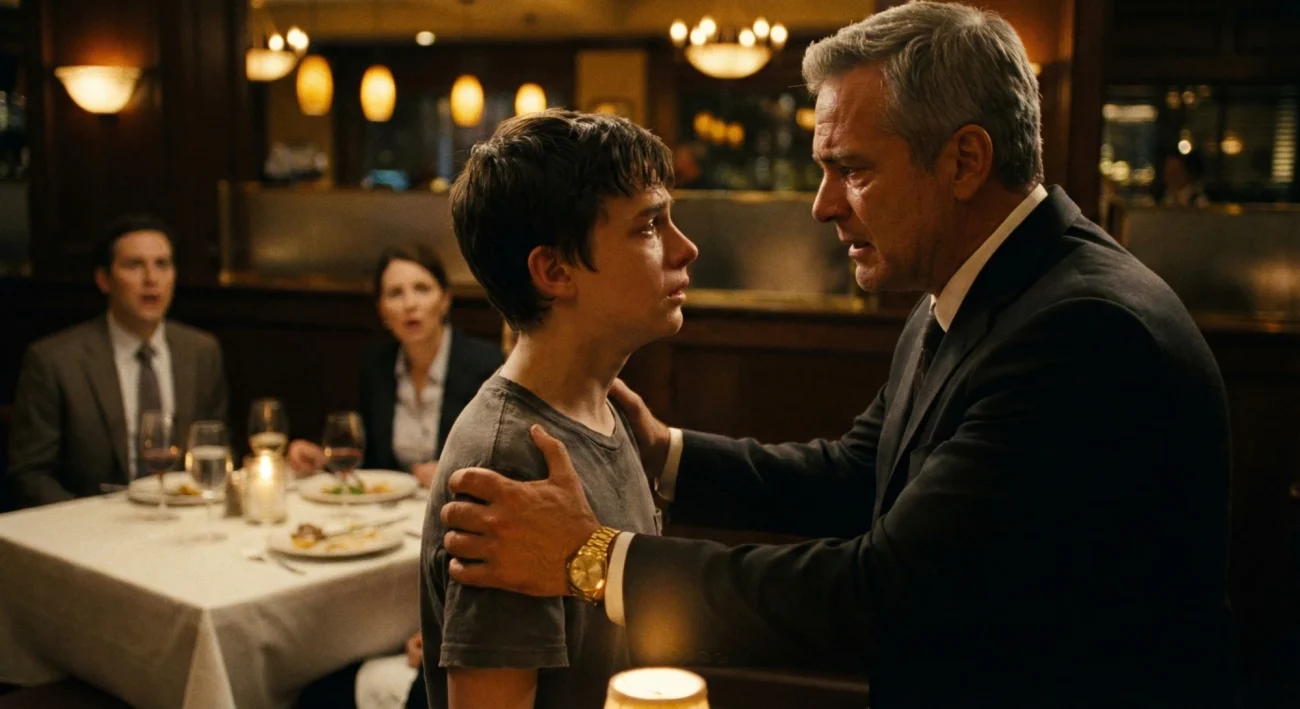
William Harrison was halfway through his second glass of Barolo when the commotion near the entrance broke his concentration.
He didn’t look up right away. He was reviewing the Midtown contract with Charles Bennett and Thomas Whitmore, and distractions in Le Bernardin were rare enough to be ignored. A security issue. A drunk tourist. Nothing that concerned him.
Then a voice—young, breathless, confused—cut through the piano music.
“Sir… you have a watch just like my dad’s.”
William glanced up, annoyed. A security guard had a teenage boy by the arm near the entrance—barefoot, shirt torn at the collar, hair damp with sweat. The kid had pulled free and taken a step toward William’s table. His eyes were locked on William’s left wrist.
William frowned. “Excuse me?”
“Your watch,” the boy said again, bewildered, almost to himself. “It’s the same. The gold. The face. My dad had one exactly like it.”
William looked down at his Rolex, then back at the boy. A strange kid making strange claims. It happened in restaurants like this—grifters, hustlers, people with sad stories and open palms.
Charles leaned over. “William, ignore him. We have the Midtown contract to—”
“Hold on.” William raised a hand. Something nagged at him. Not the words. The way the boy stared at the watch—not with greed, but with recognition. With grief.
“Lots of people have gold watches, kid,” William said, his tone measured but not unkind.
“Not with that engraving,” the boy said.
William’s fork stopped moving.
“What engraving?”
“W.H. On the back. ‘William Harrison for Daniel.'” The boy swallowed hard. “My dad showed it to me a hundred times.”
The restaurant noise collapsed into a single high-pitched hum. William set his fork down carefully, as if it weighed fifty pounds.
“What was your father’s name?” His voice came out wrong—thin, stripped of authority.
“Daniel. Daniel Harrison.”
William stared at the boy. His lips parted, but nothing came out. He looked at his watch. He looked at the boy’s face. Then he looked again—harder.
The crooked nose. The sharp jaw. The faint scar above the left eyebrow.
His son had gotten that scar falling off a bike at age seven.
“Is he—” William stopped. Tried again. “Where is Daniel now?”
The boy’s chin tightened. “He died three months ago.”
The words hit William like a door slamming shut on a room he could never enter again. He leaned back in his chair. He exhaled slowly through his nose. His jaw worked silently, pressing down on something enormous trying to rise.
Charles shifted uncomfortably. “William, you need to verify this. DNA, documentation. People take advantage—”
“I’m not here for money!” The boy yanked his arm free from the guard who had caught up to him. “I just wanted you to know my dad existed. He wasn’t invisible.”
William looked at the boy for a long moment. His expression shifted—the puzzlement was gone. In its place was something raw and open, a wound he hadn’t let anyone see in twenty-two years.
He stood slowly. Stepped around the table. The boy tensed, ready to bolt.
William placed both hands on the boy’s shoulders, gripping firmly, and looked him straight in the eyes. Up close, the resemblance was devastating. Daniel’s eyes. Daniel’s stubborn mouth. Daniel’s way of standing like the whole world was against him and he didn’t care.
“What’s your name?” William asked, his voice quiet but steady.
“Ethan. Ethan Harrison.”
The surname hung in the air between them.
William’s jaw trembled once. He pressed his lips together, composed himself, and pulled the boy into a firm embrace. One hand on the back of Ethan’s head. The other arm wrapped around his thin shoulders.
“I failed your father,” William said, his voice thick but controlled—no tears, just the weight of every wasted year pressing through each word. “But I swear to God, I will never fail you.”
Ethan went rigid. Then his composure shattered. His chin dropped to William’s shoulder and he gripped the back of the man’s suit jacket with both fists, shaking silently.
William held him. Eyes glistening, jaw set, staring past the boy’s head at nothing. He didn’t cry. But the diners who watched him said later they’d never seen a man look more broken while standing upright.
Charles and Thomas sat frozen at the table. The maître d’ quietly waved the security guards away.
When Ethan finally pulled back, his face was red and wet. William’s was dry but hollow—as if something had been carved out of him and replaced with purpose.
“Sit down,” William said hoarsely. “Please.”
Ethan sat stiffly, as though afraid to stain the chair.
“Bring him whatever he wants,” William told the waiter.
“Tell me about the watch,” he managed.
Ethan reached into his pocket and carefully unwrapped a cloth bundle. Inside lay a gold Rolex. Even in the dim restaurant light, the engraving on the caseback was visible: W.H. — William Harrison for Daniel.
William removed his own watch and placed it on the white linen beside Ethan’s. Two identical timepieces. Two halves of a story he’d spent two decades pretending didn’t exist.
“How did he die?” William asked.
“Lung cancer. He worked construction his whole life. Dust. Chemicals. Double shifts because we couldn’t afford the rent otherwise.” Ethan’s voice was flat, controlled. “By the time he saw a doctor, the tumor was the size of a fist.”
William closed his eyes. Construction. His empire was built on construction. Thousands of men in hard hats moved through his sites every year—anonymous, replaceable, invisible.
Had Daniel been one of them?
“Did he—” William stopped. Started again. “Did he work on any of my projects?”
Ethan stared at him. “You don’t even know?”
“Answer me.”
“Yeah. He did. The Lexington Tower. The Brooklyn waterfront condos. The Queens retail complex.” Ethan pulled a folded piece of paper from his back pocket and slid it across the table. “Mom kept his pay stubs. Your company name is on every single one.”
William unfolded the paper. Harrison Development Corp. His own logo. His own signature on the contractor agreements. His son had poured concrete for his buildings, breathed in his dust, and died from his negligence.
And William had never known. Because William had never looked.
“I was wrong to throw him out,” William said quietly.
Ethan’s composure cracked. “Wrong? You destroyed him.”
“Ethan—”
“He wanted to be an architect. Did you know that? He wanted to design the buildings, not crawl inside them. But you laughed at him. You told him architects were dreamers and dreamers were failures. And when he said he’d rather be a failure than a coward, you threw him out.”
William remembered. Every word. The duffel bag. The hallway. The door slamming so hard the frame splintered.
“He was twenty years old,” Ethan continued, his voice rising. “He had nothing. No degree, no money, no connections. He worked every job he could find. He married my mom, Maria Lopez. She cleaned offices at night while he worked sites during the day. They slept in shifts.”
“I didn’t know any of this.”
“Because you didn’t want to know!” Ethan slammed his palm on the table. Silverware rattled. Diners turned. “You had private investigators. You had lawyers. You had every resource in the world. You could’ve found him in a day. You chose not to.”
William said nothing. Because the boy was right.
Silence settled over the table. Just the two of them now—a billionaire and a barefoot teenager separated by two gold watches and twenty-two years of silence.
“He talked about you,” Ethan said, quieter now. “Not a lot. But sometimes, late at night, he’d take out the watch and just hold it. He never wore it. Said he didn’t deserve to.”
“He didn’t deserve to?”
“That’s what he believed. He thought he failed you.”
William’s chest compressed. “He thought he failed me.”
“Yeah. The man who worked sixteen-hour days to keep a roof over our heads thought he was the one who fell short.” Ethan wiped his eyes roughly with the back of his hand. “He died holding that watch. His last word was your name.”
William couldn’t speak. His throat was a fist. His vision blurred.
“My mom lasted six weeks after him,” Ethan said. “Heart attack. The doctors said stress. I say she just couldn’t do it without him.”
“Where have you been living?”
Ethan looked away. “Around.”
“Around where?”
“Shelters. A friend’s floor. A bus station for a while.”
“How long?”
“Two months.”
The meal arrived—steak, soup, bread, water, juice. Ethan stared at it.
“Eat. Then we’ll talk.”
Ethan ate. He tried to eat slowly, with dignity. But his hands betrayed him—fast, desperate, gripping the fork like someone might take the plate away. William watched, and each bite carved another line into the ledger of his failures.
When the plate was clean, Ethan pushed it aside.
“My mom left me two things,” he said. “The watch and this address. She said if I was ever truly lost, I should come here. She said you eat here every Thursday.”
“She knew where I ate?”
“Dad told her. He walked past this restaurant once, years ago. Saw you through the window. He stood outside for twenty minutes. Then he left.”
The image gutted William. His son, standing on the sidewalk, watching his father eat a hundred-dollar meal through glass—too proud to enter, too broken to walk away.
“We’re going to do a DNA test,” William said.
Ethan flinched. “I’m not lying.”
“I know you’re not. But when I claim you publicly—and I will—every lawyer, every journalist, every competitor I’ve ever crossed will try to tear it apart. I need it bulletproof.”
Ethan studied him. “You’d claim me? You don’t even know me.”
“I know your father. I see him when I look at you.” William picked up both watches and held them side by side. “I commissioned three of these. One for me. One for Daniel. One to be given to his first child. The third one is in my penthouse safe. It’s yours.”
Ethan’s breath hitched.
“I failed your father in every way a man can fail his son,” William said. “I chose my pride over his future. I chose control over love. I let him disappear into the exact machine I built, and it killed him.”
“Saying that doesn’t fix anything.”
“No. It doesn’t. But what I do next might.”
William pulled out his phone and called his attorney. “Richard, it’s William. I need you at my office tomorrow morning at seven. Bring estate documents and guardianship paperwork. I’m recognizing a grandchild.”
He hung up and looked at Ethan. “Tonight, you stay at my penthouse. Tomorrow, we start.”
“Start what?”
“Making it right.”
Ethan shook his head slowly. “You can’t make it right. He’s dead.”
“Then I’ll make it right for the people like him. The ones still breathing dust in my buildings. The ones working double shifts with no healthcare. The ones whose kids go barefoot because the pay isn’t enough.”
Ethan said nothing for a long time. Then: “He would’ve wanted that.”
“I know.”
The next morning, William’s attorney, Richard Calloway, arrived at the penthouse at six sharp. Ethan sat on the leather couch in borrowed clothes two sizes too large, looking like a kid playing dress-up in a dead man’s closet.
Richard studied the boy, then the watches, then the pay stubs.
“This is real,” Richard said quietly.
“I told you.”
“William, there’s something else.” Richard opened his briefcase and pulled out a folder. “When you asked me to run a trace last night, I found more than genealogy records.”
“What did you find?”
Richard hesitated. “Daniel filed a workplace injury claim four years ago. Respiratory damage. Against Harrison Development Corp.”
William went still. “And?”
“Your legal department denied it. The claims adjuster flagged it as insufficient documentation and closed the file in seventy-two hours.” Richard placed the folder on the table. “The adjuster’s name was Gerald Pike. Before he became your CFO.”
The room went cold.
Ethan stood up slowly. “Your company denied my father’s health claim?”
William opened the folder. The denial letter was right on top—Harrison Development Corp letterhead, Gerald Pike’s signature, a checkbox marked INSUFFICIENT EVIDENCE. Attached were Daniel’s medical records: chest X-rays showing the early shadow of what would become terminal cancer.
“He tried to get help,” Ethan said, his voice shaking. “He filed the paperwork. He did everything right. And your people threw it in the trash.”
William read every page. His jaw worked silently.
“If that claim had been approved,” Richard said carefully, “Daniel would have received full medical coverage. Early treatment. The oncologist’s notes suggest the cancer was treatable at that stage.”
The implication detonated in the room.
“You’re telling me,” William said, each word measured and lethal, “that Gerald Pike denied a claim that could have saved my son’s life.”
“I’m telling you the timeline is suggestive. I can’t prove causation in court. But the correlation is damning.”
William picked up his phone.
“What are you doing?” Richard asked.
“Calling Gerald.”
“William, if you confront him now, before we’ve secured the legal position—”
“Richard.” William looked at him with eyes that could have melted steel. “My son filed for help. My company said no. And then he died. I am calling Gerald.”
Gerald Pike answered on the second ring. “William, good morning. I’ve been reviewing the quarterly—”
“Did you deny a workplace injury claim from a laborer named Daniel Harrison four years ago?”
Silence.
“Gerald.”
“William, I process hundreds of claims a year. I can’t be expected to remember—”
“His name was Daniel Harrison. Same last name as the CEO. The claim was for respiratory damage on the Lexington Tower project. You denied it in seventy-two hours. Do you remember now?”
A longer silence. Then, carefully: “I may recall the file. The documentation didn’t meet our threshold. That’s standard protocol.”
“Standard protocol. You denied a chest X-ray showing a lung mass.”
“The medical review board—”
“There was no medical review board, Gerald. I checked. You signed off alone. You saved the company eighty thousand dollars in coverage and it cost a man his life.”
“If you’re suggesting I deliberately—”
“I’m informing you that your employment at Harrison Development Corp is terminated effective immediately. Richard Calloway will have security escort you from the building by noon. You’ll receive a subpoena, not a severance package.”
“William, you can’t just—”
William hung up.
Ethan was standing by the window, arms crossed, staring at the Manhattan skyline. Somewhere in that forest of steel and glass were buildings his father had helped raise with bleeding hands and collapsing lungs.
“It doesn’t bring him back,” Ethan said.
“No,” William agreed. “But it makes sure the next Daniel Harrison doesn’t get a letter like that.”
Ethan turned from the window. “You really fired him? Just like that?”
“He killed a man with a checkbox, Ethan. Firing him is the gentle option.” William folded the denial letter and placed it in his breast pocket. “This goes to the district attorney’s office on Monday.”
Richard nodded. “I’ll prepare the referral.”
The DNA results came back nine days later. 99.97% match. William’s grandson. Daniel’s son.
William didn’t wait for the paperwork to dry.
He called an emergency board meeting at Harrison Development Corp. Fourteen executives filed into the glass-walled conference room on the forty-second floor, expecting a contract discussion. What they got was a reckoning.
“Effective immediately,” William said, standing at the head of the table, “every construction worker on a Harrison project receives full health coverage. Every site gets independent air-quality monitoring. Every laborer gets a minimum thirty percent pay increase.”
The CFO, Gerald Pike, nearly choked on his coffee. “William, that’s a sixty-million-dollar annual hit to the bottom line.”
“I’m aware.”
“The shareholders will revolt.”
“I’m the majority shareholder. Let them.”
Gerald pressed harder. “This is emotional decision-making. You met the boy two weeks ago. We can’t restructure the entire company based on—”
“Based on what, Gerald?” William’s voice went dangerously quiet. “Based on the fact that my son died building my towers because I was too cheap to give his coworkers a doctor? Based on the fact that his widow worked herself into a heart attack cleaning the offices we sit in? Tell me, Gerald. What exactly am I basing this on that you find unreasonable?”
Gerald opened his mouth. Closed it. Sat down.
Thomas Whitmore, who had been at that restaurant dinner, spoke up carefully. “William, the liability exposure alone—if you publicly acknowledge your son worked on your sites without proper safety—”
“Good. Let it be exposed. I want every attorney, every reporter, every regulator to see what we did and what we’re changing. If I’m liable, I’ll pay. Personally.”
The room was silent.
“One more thing,” William said. “I’m establishing a foundation. The Daniel Harrison Dignity Initiative. Based in Queens. It will provide scholarships for construction workers’ children, job training for laborers, legal aid for workplace injury claims, and fund affordable housing in neighborhoods we’ve gentrified.”
Gerald made one last attempt. “Who’s funding this?”
“I am. Two hundred million over ten years.”
“Two hundred—”
“If the number bothers you, Gerald, there’s the door.”
Gerald didn’t move.
The initiative launched six weeks later. William chose a vacant lot in Sunnyside, Queens—three blocks from the apartment where Daniel and Maria had lived. The affordable housing project would bear Daniel’s name.
At the groundbreaking ceremony, two hundred construction workers stood in the audience. Many of them had worked on Harrison projects. Some had known Daniel. One older man, Ray Gutierrez, approached Ethan afterward.
“Your dad saved my life once,” Ray said. “Scaffolding collapse on the Lexington job. Everyone ran. Daniel pulled me out.” He gripped Ethan’s hand. “He was the best man on any site I ever worked.”
Ethan nodded, unable to speak.
William stood at the podium and said three sentences.
“My son Daniel Harrison built this city with his hands. I built my fortune on his labor and never acknowledged it. Today, his name goes on the building.”
He stepped aside. No applause line. No corporate phrasing. Just the truth, delivered into a microphone, with two hundred workers as witnesses.
After the ceremony, Ethan found William sitting alone on a bench near the lot.
“I brought you something,” Ethan said.
He handed William a small photograph, creased and water-stained. Daniel, maybe thirty, standing on a construction site, hard hat on, grinning. Behind him, rising steel beams formed the skeleton of what would become the Lexington Tower.
William held the photo with both hands.
“He looks happy,” William said.
“He was. He loved building things. Even if he never got to design them, he loved watching them go up.”
William traced the edge of the photograph with his thumb. “I’m going to frame this and put it in my office. Right next to the window that faces the Lexington Tower.”
“So you can see them both.”
“So I never forget.”
Ethan reached into his pocket and pulled out the gold watch. He turned it over, running his finger along the engraving. Then he put it on his wrist.
It was the first time he’d ever worn it.
William looked at the watch on Ethan’s wrist, then at the one on his own. Two identical timepieces, finally on two living Harrisons.
“You start school next month,” William said.
“Architecture program?”
“If that’s what you want.”
Ethan almost smiled—then let himself actually smile. Full, unguarded, real.
“That’s what Dad wanted. So yeah. That’s what I want.”
William put his arm around his grandson’s shoulders. They sat together on that bench in Queens, looking out at the vacant lot where Daniel Harrison’s name would rise in steel and glass—not as a laborer, but as the reason it was built.
Not every wound heals. Not every wrong is repaid.
But on that lot in Queens, a billionaire who had thrown his son away chose to build something worth more than every tower in his empire.
And a barefoot boy who walked into a restaurant with nothing but a dead man’s watch walked out with a name, a home, and a future his father had been denied.
The third watch—the one William had kept in his safe for twenty-two years, waiting for a grandchild—was engraved that night.
W.H. — William Harrison for Ethan.
It fit perfectly.
Original fictional stories. AI-assisted creative content.

Nice story ❤️