
Viktor had been sweeping streets for thirty-two years. He started when he was forty-one, after the factory where he’d worked his whole adult life shut down overnight. No severance, no warning, just a locked gate and a paper sign. His wife told him to take anything, anything at all, because they had two kids and rent was due in nine days. So he took the broom.
He remembered the first morning. November, still dark at five, the cold biting through a jacket that wasn’t thick enough. He had stood on the corner of Orchard and Main with a broom that was taller than his sense of dignity and thought: this is temporary. This is just until something better comes along. Something better never came. But something else did — slowly, over years, the way dawn comes if you’re patient enough. He began to take pride in it. Not loud pride, not the kind you talk about at parties. The quiet kind. The kind that lives in your hands and your back and the satisfaction of looking behind you and seeing clean pavement where there was mess.
Thirty-two years later, he still had it. Not the same broom, of course, but the same job, the same route, the same 4 a.m. alarm. Orchard Street to Main, Main to Lincoln, Lincoln to the park, and back again. Four miles of sidewalk, six days a week. His knees ached. His back was a conversation between pain and stubbornness. But the streets were clean when he was done, and that meant something to him, even if it meant nothing to anyone else.
His wife, Marta, had died six years ago. Cancer. The kind that takes its time, so you have months to say goodbye but never enough words to fill them. After she was gone, the job became something different. It became the reason to get up. It became the structure that held the rest of his life in place, the way a frame holds a house. Without it, he suspected, he would collapse inward like an old barn.
His daughter called every Sunday. His son sent money once a month, which Viktor accepted because refusing it would hurt the boy, but he never spent it. It sat in an envelope in the kitchen drawer, next to Marta’s reading glasses that he still hadn’t moved.
It was a Tuesday in October, cool enough for a jacket but warm enough to sweat in one. The leaves were turning — maples going red, oaks going gold — and the park was shedding them faster than Viktor could sweep. He didn’t mind. He liked the leaves. They smelled like something ending, but ending gently, the way a song fades out instead of stopping.
Viktor was working the stretch near the park, pushing his wide broom in long, steady strokes, gathering the night’s debris into neat lines — cigarette butts, candy wrappers, a crushed soda can, the usual gifts the city left for him. He moved with the economy of a man who had done the same motion ten thousand times, each stroke identical, each one exactly as wide as the last.
A man sat on the bench nearby. Young, maybe thirty, in expensive joggers and a pristine white designer hoodie, scrolling through his phone with one hand and holding a coffee cup in the other. He hadn’t looked up once. He had the posture of someone who believed the world was a service provided for his convenience — slouched, legs spread wide, taking up the whole bench as if he’d bought it.
Viktor swept around him, the way he always did — quietly, without asking anyone to move. He had learned long ago that invisibility was part of the uniform. The orange vest made you visible to traffic but invisible to people. They looked through you the way they looked through lampposts and fire hydrants — objects in the landscape, necessary but not interesting, certainly not human.
The man finished his coffee. He glanced at Viktor. Made eye contact. Held it for a second.
Then he tossed the cup on the ground. Right in front of Viktor’s broom. Not absently. Not accidentally. Deliberately. With a little flick of the wrist, the way you toss something that doesn’t matter to you — because the person who’ll pick it up doesn’t matter to you either.
Viktor felt it in his chest before he felt it in his head. A heat. A tightness. Not just anger — though there was anger, plenty of it — but something older, something that had been accumulating for thirty-two years of being looked through, stepped around, and treated like part of the pavement he cleaned.
He thought of all the mornings. All the cups, the wrappers, the cigarette butts flicked in his direction. The teenagers who kicked over his pile for a laugh. The businessman who once told him to “hurry it up” because the sweeping was too loud. The woman who stepped over him — literally over him, while he was bent down cleaning a drain — without a word, as if he were a crack in the sidewalk.
He thought of Marta, who had always told him that his work mattered. “You make the world a little more beautiful every day,” she used to say, pressing coffee into his hands at four in the morning. “Not everyone can say that.”
He thought of Marta. And something inside him shifted.
Viktor stopped. He looked at the cup. He looked at the man. The man was already back on his phone, thumbs moving, face lit by the screen, completely unbothered.
Something broke. Or maybe something finally unbroken itself.
Viktor dropped his broom. It clattered on the pavement. The sound made the man glance up — just for a second, just a flicker of attention, already turning back to his screen.
Viktor bent down. He picked up the cup. He could feel that it still had coffee in it — not much, but enough. The cup was warm in his hand. He straightened up, his knees protesting, his back singing its usual chorus of pain.
And he threw it.
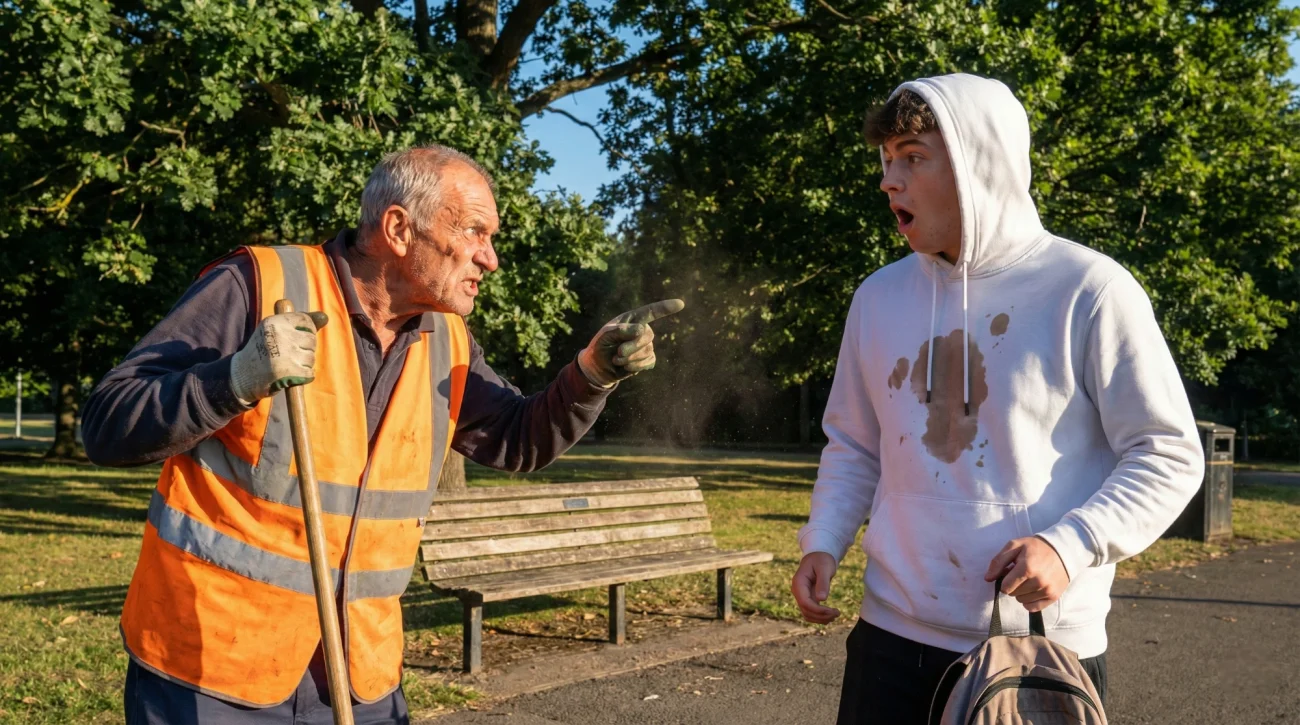
Not gently. Not symbolically. He threw it hard, with thirty-two years of quiet behind it, and the cup hit the man square in the chest. Brown coffee exploded across the white hoodie like a small, satisfying painting. A wisp of steam rose from the stain.
The man jumped up. His phone fell to the bench. His face cycled through emotions like a slot machine — confusion, disbelief, the beginning of fury. He looked down at the stain spreading across his chest, then up at Viktor.
“What the — ?” he started.
Viktor stepped forward. Not much. One step. But it was the kind of step that changes the geometry of a conversation, the kind that says: I am here, and you will listen.
He raised his finger. Not shaking. Steady. The finger of a man who had held a broom for thirty-two years and still had strength left over.
“Respect other people’s work,” Viktor said. His voice was loud. Louder than he expected. Louder than he’d spoken in years. It came from somewhere deep, somewhere below the politeness and the patience and the decades of keeping his face very still. “You understand?”
The words hung in the morning air. A jogger passing on the far side of the path slowed down to look. A woman walking her dog stopped. For a moment, the park was very quiet.
The man on the bench said nothing. His mouth was open. The coffee was soaking into his hoodie. He looked like a man who had reached for a light switch in a dark room and touched something alive.
Viktor held his gaze for three seconds. Then he did something that surprised even himself.
He smirked.
It was small — just a twitch at the corner of his mouth, a crack in the stone of his face — but it was real, and it was satisfied, and it was the most alive he had felt since Marta made him coffee in the dark.
He turned around. He bent down — knees aching, back singing — and picked up his broom. He gripped it the way he always gripped it, with both hands, the wood smooth and warm from thirty-two years of the same palms.
And he walked away. Sweeping. Steady strokes. Orchard to Main. Main to Lincoln. Lincoln to the park. Four miles of sidewalk. Clean by morning.
Behind him, the man stood by the bench, frozen, stained, silent. The jogger shook her head and kept running. The woman with the dog muttered something approving and moved on. The park resumed its morning. The leaves kept falling.
Viktor didn’t look back. He didn’t need to. He could feel the weight of something lifting off his shoulders — something he’d been carrying so long he’d forgotten it was there.
It was a Tuesday in October. The leaves smelled like endings. His back ached. His knees were loud. The city would make a mess again tomorrow, and the day after that, and every day after that until the day he finally put the broom down for good.
But today, Viktor walked a little taller.
Today, Viktor smiled all the way to Lincoln Street.
Original fictional stories. AI-assisted creative content.
