
Claire Whitfield had been running the house for eleven years.
That was how she thought of it. Running it. Organizing it. Maintaining it. She kept the calendar, the cleaners, the grocery orders, the guest towels monogrammed and folded just so. She had made that house something worth living in, and she had never once been thanked for it.
Not really. Not the way she deserved.
She stood in the walk-in closet off the master bedroom and pulled blouses from their hangers in fistfuls. Her hands were shaking. She didn’t care.
“I am done,” she said to no one. “I am completely done.”
The weekend had been the last straw. It always was — some small, infuriating thing that broke the surface after months of pressure building underneath. This time it was the kitchen. Margaret had reorganized the pantry again. Moved the spices Claire had ordered alphabetically into some system that made no sense to anyone but Margaret herself. Left a pot soaking in the sink overnight. Used Claire’s good linen dish towels to wipe down the stovetop.
Small things.
Except they weren’t small. They were a message, delivered quietly, every single day. This is my son’s house. I was here before you. I will be here after you.
Claire had said something. Of course she had said something. She hadn’t screamed. She hadn’t been cruel. She had been direct, the way she always was, because she believed in being direct. She had told Margaret, firmly and clearly, that the pantry was not to be reorganized without asking, that the dish towels were not for stovetop use, and that if Margaret wanted to soak a pot, she could do it in the utility sink downstairs.
Margaret had said nothing. She had looked at Claire with those flat gray eyes and said nothing at all, which was somehow worse than anything she could have said out loud.
Claire had poured herself a glass of wine and gone to bed.
Now it was Monday. Daniel had been in Seattle since Thursday. He was supposed to be home by six. It was four-thirty, and Claire was packing a bag because she had decided, with total clarity, that she was not spending another night in the same house as that woman.
She yanked a sweater from the shelf. It caught on something and a row of folded shirts tumbled to the floor. She left them there.
“Claire.”
She spun around.
Daniel was standing in the doorway of the closet, still in his travel clothes — gray shirt, jacket over his arm, the particular exhaustion of a man who had just come off a four-hour flight. He was looking at the bag on the floor. At the clothes spilling off the shelves.
At her face.
She hadn’t heard him come in. She hadn’t even heard the front door.
“You’re home early,” she said. Her voice came out harder than she intended.
“Flight was moved up.” He set his jacket on the hook behind the door and looked at her steadily. “What’s happening?”
“I’m leaving.” She turned back to the bag. “Not permanently — I just need a few days away from her. I can’t do this anymore, Daniel. I have told you this. I have told you this for two years.”
“Claire—”
“She moved my pantry again.” She knew how it sounded. She didn’t care. “She used my good dish towels on the stovetop. She doesn’t respect any boundary I set in this house, and when I try to address it with her, she looks at me like I’m speaking a foreign language and then goes right back to doing whatever she wants.”
“Okay,” he said. “I hear you.”
“Do you?” She finally turned to face him. “Because I have said these exact words to you before, and every time, you say you hear me, and then nothing changes. She’s still here. The pantry still gets rearranged. And I am still the one who feels like a guest in my own home.”
Something moved across his face. Not the guilty softening she expected — the slight flinch she had learned to read as Daniel preparing to apologize and change nothing. This was different. More still.
“What did you say to her?” he asked. “This weekend, when it happened. What exactly did you say?”
“I told her the pantry system is not to be changed without asking. I told her the dish towels—”
“That’s not what I mean.” His voice was quiet. Too quiet. “I mean did you say anything else. Anything about where she could and couldn’t go in the house. Anything about — the utility room.”
Claire went still.
She had said that. She had said it in anger, on Saturday night, when she had found the soaking pot for the second time and Margaret had been standing there with that expression — that careful, impenetrable expression — and something in Claire had snapped. She had told her. She had told her clearly.
She hadn’t thought Daniel knew.
“Who told you that?” she said.
“No one told me.” He hadn’t moved from the doorway. “I heard it.”
The bag sat between them on the floor.
“When?” The word came out smaller than she meant it to.
“About forty seconds after I walked in the front door.”
Claire’s throat tightened. She set down the sweater in her hands. She thought about what she had said — not the content of it, she knew the content, she remembered every word — but the sound of it. How it had sounded coming out of her mouth in that moment. How it must have sounded to someone hearing it from the hallway.
“Daniel, she had been pushing me all weekend—”
“I know.” He stepped into the closet. Not toward her — toward the bag on the floor. He picked it up, set it on the shelf, and zipped it closed without unpacking it. “I know she’s not easy. I know you two have real problems that need to be addressed. I know this situation isn’t what either of you expected it to be.” He turned. “And none of that is what I want to talk to you about right now.”
“Then what do you want to talk about?”
“Come with me.”
She didn’t move. “Daniel—”
“Claire.” His voice had an edge now that she didn’t hear often — not raised, not angry exactly, but final. Certain. “Come with me. Please.”
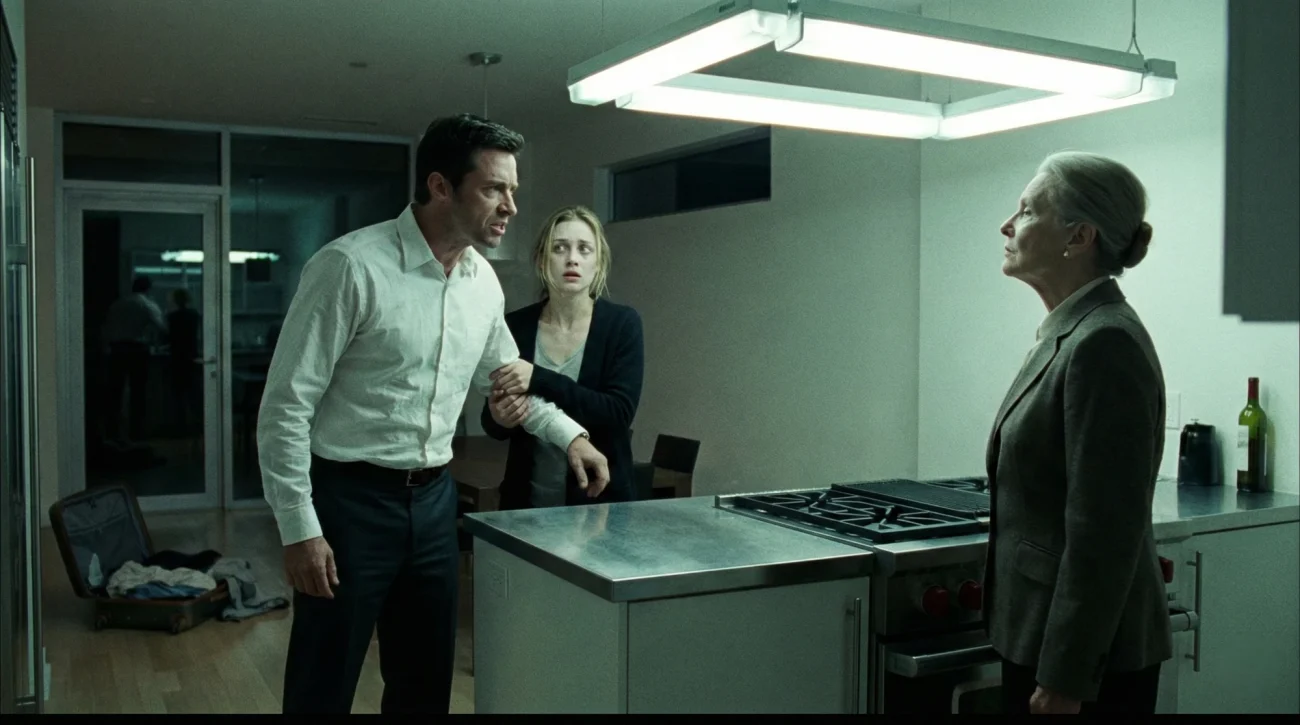
She followed him down the hall. Down the stairs. Through the living room and into the kitchen, where Margaret was standing at the counter with her back to them, her hands folded in front of her, very still. She had heard them coming. She had probably heard everything.
Daniel stopped a few feet from his mother. He reached back without looking and took Claire’s arm — not rough, but firm — and brought her forward until they were both standing in front of the older woman.
He let go of Claire’s arm.
He looked at his mother.
He didn’t speak.
It was the silence that got to Claire. She had expected him to say something immediately — to launch into the speech she had been waiting for, the one where he finally addressed his mother directly and made clear whose side he was on. Instead he just looked at her. Long and level and without any of the apologetic deference Claire had watched him deploy for years — the slight softening around the eyes, the way he always seemed to be preemptively forgiving his mother for whatever came next.
There was none of that now.
Margaret held his gaze. Her chin was up, the way it always was — that particular posture that Claire had spent years interpreting as dismissal. She was a small woman, Margaret, but she occupied space with the authority of someone who had never once doubted her right to be wherever she was. Even now, in the silence of her son’s stare, she didn’t yield an inch.
Three seconds. Four.
Finally Daniel spoke.
“Did you do it again?” His voice was low. Completely controlled.
Margaret said nothing. Her expression didn’t change. The silence was its own kind of answer.
Claire felt something shift in the room. She wasn’t sure what it was — some change in pressure, like before a storm.
Daniel’s jaw tightened. When he spoke again his voice was harder, the control still there but thinner now, stretched over something that had real weight behind it.
“You are going to apologize to her.”
Margaret’s chin lifted the smallest fraction. A reflex. The quiet arrogance of someone who had already decided, before the sentence was finished, that she had done nothing requiring an apology.
The half-second of silence that followed was the worst kind — the kind where everyone in the room knows what’s coming and no one wants to be the one who breaks it.
Then, quieter. And somehow much worse.
“Right now.”
Claire had been standing slightly behind Daniel’s shoulder. She was watching his mother’s face — watching for the softening she expected, the reluctant compliance, the small performance of contrition that Margaret had always been willing to offer when pushed far enough.
It didn’t come.
Margaret looked at her son with those gray eyes and said, very quietly: “I have nothing to apologize for.”
The room went completely still.
Daniel didn’t raise his voice. He didn’t step closer. He looked at his mother for a long moment, and when he spoke, something in his face had settled into a resolution that Claire had never seen there before — the expression of a man who had just made a decision he wasn’t going to unmake.
“Then we’re going to have a different conversation,” he said. “One I should have had a long time ago.”
He turned to Claire. “Go upstairs. I’ll come find you in twenty minutes.”
Claire looked at him. “Daniel—”
“Please.”
She went.
She sat on the edge of the bed and listened to the silence below. No raised voices. No crashes. Just the low, continuous sound of Daniel talking — steady, methodical, the voice of someone working through a list that had been building for years.
Twenty-two minutes later, she heard footsteps on the stairs.
Daniel came in and closed the door. He looked tired — not the travel-tired she’d seen when he walked in, but something older. The particular exhaustion of finally saying a thing you’ve been carrying too long.
He sat down beside her on the bed.
“She’s going to apologize to you,” he said. “Tomorrow morning. Not tonight — tonight everyone needs to step back. But tomorrow, before breakfast, in the kitchen. A real one. I’ll be there.”
Claire looked at him. “What did you say to her?”
“I said a lot of things.” He rubbed his face with one hand. “I said some of them in a way I’m not entirely proud of. But I said them.”
“And she agreed?”
“She didn’t agree that she’d done anything wrong.” A short pause. “She agreed that this can’t continue. That’s different, but it’s real.” He looked at her. “I also told her that if something like this happens again — if she speaks to you or treats you in a way that I would not accept anyone treating you — she’ll need to make other arrangements. Permanently.”
Claire sat with that for a moment. “Do you mean it?”
“I’ve never meant anything more.” He said it simply, without drama. Like a fact.
She looked at her hands. Outside the window, the light had gone blue-gray — the long American dusk, hanging over the neighbor’s oak tree and the quiet street below.
“I was really leaving,” she said quietly.
“I know.”
“I had half the closet in that bag.”
“I know.”
She almost laughed. It came out as something between a laugh and a long exhale.
He put his hand over hers on the bed. She didn’t pull away.
The next morning, at eight-fifteen, Margaret came into the kitchen while Daniel was making coffee. Claire was at the island with a cup of tea. No one had planned the timing — it had just happened, the way mornings do, with their particular inevitability.
Margaret stood at the edge of the kitchen. She was dressed, hair done, carrying herself the way she always did — upright, composed, nothing given away in the posture.
She looked at Claire.
“I owe you an apology,” she said. Her voice was steady. Uninflected. “What I said on Saturday was out of line. The pantry, the dish towels — I understand those things are yours to decide in this house, not mine. And I should not have said what I said about the utility room.” A pause, short and precise. “I’m sorry.”
It wasn’t warm. It wasn’t accompanied by softened eyes or a lowered chin or any of the physical vocabulary of genuine remorse. It was the apology of a woman who had been brought to a conclusion she had not reached on her own — clear-edged, controlled, offered with the dignity of someone who would not perform contrition she didn’t feel.
And yet.
Claire looked at her for a moment. Then she nodded once.
“Thank you,” she said. “I accept it.”
Margaret moved to the stove to make her tea. Daniel poured his coffee. Outside, a car started in the driveway next door, and somewhere down the street a dog was barking at something ordinary.
The kitchen was quiet in the way kitchens are in the early morning — full of small sounds and ordinary light and the low-grade effort of people learning to share the same space.
It wasn’t perfect. Claire knew that. There would be other mornings, other moments of friction, other negotiations she hadn’t anticipated yet.
But the bag was unpacked. The door was still closed. And for the first time in longer than she could clearly remember, her husband had walked into a room and stood on the right side of it.
She picked up her tea. The mug was warm in both hands.
That was enough.
Original fictional stories. AI-assisted creative content.
