
Claire Donovan Larkin knew the Sterling Society Gala would be exhausting. What she didn’t know was that her husband had already rehearsed what happened next.
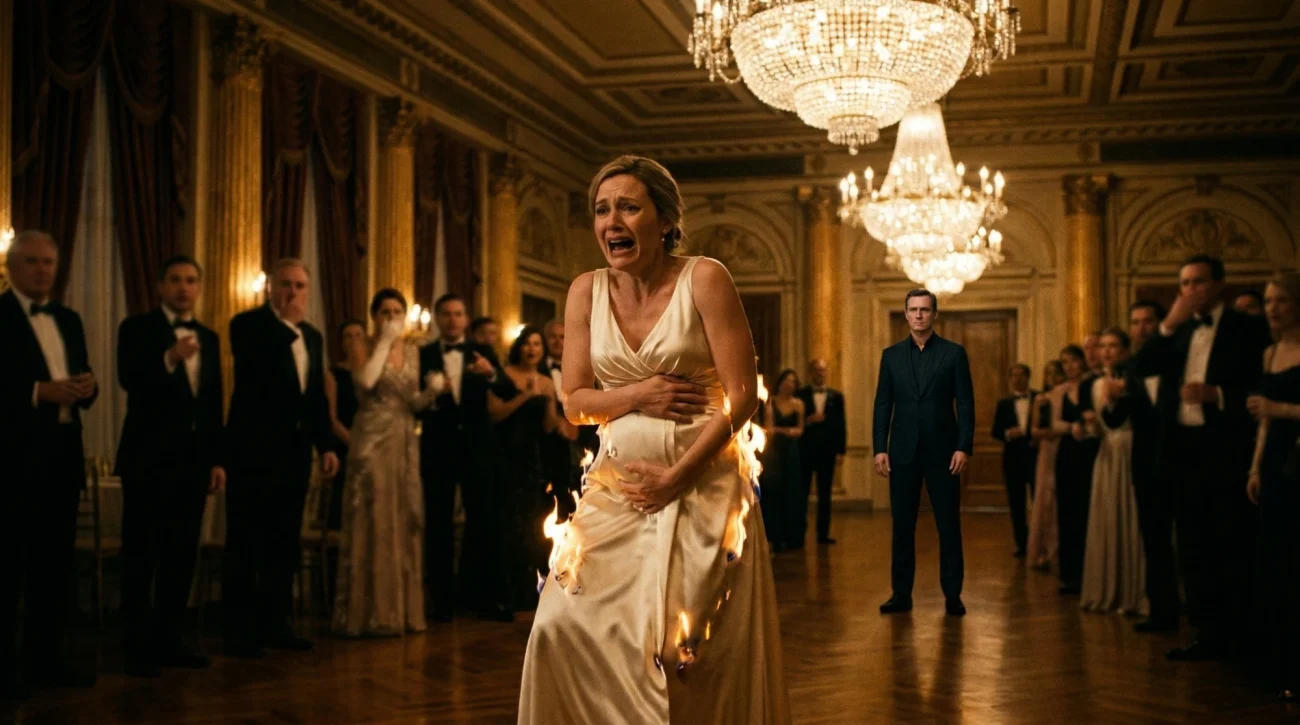
She stood beside Maxwell in an ivory maternity gown, her belly full and visible, her smile practiced. Around them, Manhattan’s elite moved in smooth, self-congratulating circles. Champagne flutes caught the light. Nobody looked directly at anyone for too long.
“You look beautiful,” Maxwell said, squeezing her waist.
Claire smiled. “You’ve been saying that more lately.”
He didn’t answer.
Then the woman in red appeared.
She moved through the crowd like she belonged there, dark dress fitted, heels deliberate, eyes fixed on Maxwell with the calm of someone who had already been paid. Claire’s stomach tightened before her brain caught up.
“Who is that?” Claire asked quietly.
“No one,” Maxwell said—too fast.
The woman stopped directly in front of them. She looked at Claire the way you look at an obstacle you’ve already planned around.
“Claire,” she said. “You look radiant.”
“Do I know you?”
The woman’s smile widened. “Not the way I know your husband.”
The air changed. Claire felt her baby kick—hard, urgent—as if registering the threat before she could name it. She turned to Maxwell, waiting for outrage, denial, anything human. His face stayed perfectly smooth.
“Max.” Claire’s voice dropped. “What is she talking about?”
“Ignore her,” he said. But he didn’t move.
The woman reached toward a passing waiter’s tray and lifted a glass of vodka—not sipping it, just holding it, with deliberate calm. “Don’t worry,” she murmured. “This won’t take long.”
Before Claire could step back, the glass tipped. Cold liquid spread across the front of her gown, soaking through the satin, reaching her stomach. Claire gasped and cupped her belly with both hands, the reflex faster than thought.
“What—” she started.
The woman reached into her clutch.
A lighter clicked.
The flame appeared for one fraction of a second before it touched the vodka-soaked fabric, and then the fire climbed the front of Claire’s gown in a terrible, orange bloom. She heard herself scream. She heard the crowd scream. She heard chairs scraping and glass shattering and someone yelling call 911—
She didn’t hear Maxwell move.
Because he didn’t.
Claire staggered backward, both arms wrapped across her belly, her mind screaming protect the baby, protect the baby, while the heat climbed toward her ribs. A waiter tackled her with a tablecloth. Another appeared with a fire extinguisher, and the white blast of foam smothered the flames with a sound like a punch.
Claire collapsed to her knees. The smell of burnt satin and alcohol choked her. Her skin burned in sharp, immediate patches across her abdomen and upper thighs. But beneath her hands she felt it—movement. A kick. Strong and defiant.
She burst into tears.
Paramedics arrived within minutes. As they strapped her to the stretcher, she turned her head and found Maxwell through the crowd. He stood near the bar. Hands at his sides. Face composed. Watching her be loaded onto a stretcher with the same expression he wore at board meetings when something went according to plan.
Then someone handed Claire her clutch, and as they adjusted it, Maxwell’s phone lit with a notification preview.
Payment after the fire. Confirm she’s not getting up.
Claire’s body went colder than the foam.
The ambulance ride was sirens and bright questions and a paramedic repeating, “Stay with me.” When doctors confirmed the baby’s heartbeat—strong, steady—Claire sobbed until she couldn’t breathe.
At the hospital, she was diagnosed with second-degree burns across her abdomen and upper thighs, milder burns along her side. The nurses moved with controlled urgency, and Claire could feel their restrained anger—the quiet kind professionals carry when they’ve witnessed cruelty dressed up as accident.
Detective Aaron Kline arrived before dawn. He didn’t start with Maxwell. He started with Claire.
“Tell me exactly what happened,” he said, notebook open.
She told him everything: the woman in red, the vodka, the lighter, the way her gown caught fire. She told him about the crowd’s delayed reaction. And then she told him about the notification preview.
Aaron’s expression shifted—barely. “Do you still have the phone?”
“My purse. They brought it in.”
Aaron secured her device and obtained a warrant for Maxwell’s. Officers fanned out to interview gala witnesses. By lunchtime, the story online had been packaged into something ugly and familiar: gala tragedy, freak accident, jealous woman attacks billionaire’s pregnant wife. Maxwell’s publicist released a statement praising the “quick response of staff.”
Aaron wasn’t interested in statements.
Within forty-eight hours, investigators identified the woman in red as Leah Caldwell—a private event consultant with no legitimate reason to be near Claire. Her financials showed sudden large deposits, cash withdrawals, and a luxury apartment lease she couldn’t afford on her usual income.
The money trail pointed to Maxwell.
A subpoena revealed he had increased Claire’s life insurance policy three months prior—five million dollars—and updated the beneficiary information. He had also withdrawn fifty thousand dollars in cash one week before the gala. The timeline snapped into place like a trap closing.
Aaron delivered the findings to Claire in her hospital bed, bandaged and exhausted, while monitors tracked the baby’s steady heartbeat.
“It looks coordinated,” he said. “Not impulsive. Planned.”
“My baby was right there,” Claire said quietly.
Aaron nodded once. “That’s why we’re treating it seriously.”
When Maxwell finally appeared at the hospital, he came with flowers and a camera-ready expression. He took Claire’s hand gently, as if he hadn’t watched her burn.
“I’m devastated,” he said. “I’ll make sure Leah pays for this.”
Claire stared at him. Something inside her went still and cold. “Why weren’t you helping me?” she asked. “When I was on fire. Where were you?”
Maxwell’s smile faltered for half a second. “I was in shock.”
“You weren’t in shock.” Claire pulled her hand back. “You were waiting to see if it worked.”
His eyes sharpened. He leaned closer. “Careful,” he murmured. “You’re in pain. People will say you’re confused.”
That sentence made her skin crawl worse than the burns. She looked at the nurse in the room and held her gaze until the nurse stepped closer. Maxwell straightened and left without another word.
Aaron returned with more. Texts between Maxwell and Leah had been recovered, along with a recorded call Leah had made to a friend the night before the gala—complaining about “doing something crazy for a payout.” There were logistics messages about alcohol choice, ignition speed, how to make the attack look like a drunken accident.
And one message from Maxwell that read like a confession typed in a boardroom:
If she’s gone, I’m free. Don’t hesitate.
Claire lay in the hospital bed and thought about every time Maxwell had adjusted her schedule, controlled her contacts, redirected her questions. She realized the gala wasn’t the beginning. It was simply the moment the plan became visible.
Three months later, the trial began.
Prosecutors charged Maxwell with conspiracy to commit murder, attempted murder, insurance fraud, and solicitation. Leah, facing overwhelming evidence, accepted a deal and agreed to testify.
Claire walked into the courthouse with the bandages gone but the scars visible. Her baby was in a carrier beside her attorney—alive, healthy, present. Maxwell sat at the defense table in a tailored suit, trying to look like a man who still owned outcomes.
He avoided Claire’s eyes until she took the stand.
Under oath, she told it cleanly: the vodka, the flame, the way she protected her belly, the way Maxwell watched. She read the messages aloud without her voice breaking. She explained the insurance increase she hadn’t questioned. She described the threat in the hospital room: People will say you’re confused.
The courtroom held a silence the gala never had.
As Leah prepared to follow her to the stand, the prosecutor leaned toward Claire and said something quietly that made her heart slam.
Leah wasn’t the only person Maxwell had paid.
They found two others. A bartender who had been instructed to keep Claire near the center of the room. A security contractor who had delayed the emergency response by forty seconds. Both accepted plea deals. Both testified.
The verdict arrived without drama. It arrived with weight.
The foreperson stood. Claire held her baby’s hand inside the carrier, grounding herself in the reality Maxwell had tried to erase.
“Guilty”—conspiracy to commit murder.
“Guilty”—attempted murder.
“Guilty”—insurance fraud.
“Guilty”—solicitation.
Claire didn’t cry right away. Her body responded in stages: numbness first, then a deep shaking that felt like her nervous system releasing a storm it had held for months. Detective Aaron Kline nodded once from across the room, the kind of nod that means: You made it to the part where the truth holds.
At sentencing, the judge looked at Maxwell without softening his words.
“You treated your wife’s life as a financial instrument,” he said. “You tried to turn pregnancy into vulnerability, and vulnerability into profit.”
Twenty-five years. Eligible for parole after fifteen.
As deputies led him away, Maxwell finally looked at Claire—not with remorse, but with the stunned anger of a man learning that money cannot purchase reality forever. Claire held his gaze without flinching. Then she looked down at her child.
Justice didn’t erase the nightmares. Claire knew that going in.
She woke for months smelling smoke that wasn’t there. A lighter at a neighbor’s cookout sent her pulse spiking. She learned that surviving is not a single event—it is a practice you repeat daily, some days better than others.
Therapy helped. So did routine: morning walks with the stroller, meals with friends Maxwell had once isolated her from, doctor appointments where his name wasn’t on any paperwork.
Within a year, Claire founded the Donovan Safe Harbor Foundation—focused on survivors of domestic violence and coercive control, especially those whose abusers hid behind wealth and reputation. The foundation funded emergency relocation, legal advocacy, and trauma therapy. She insisted on a rapid-response fund for pregnant women and new mothers, because she knew how fast danger could escalate when a baby was involved.
Donors came for the headlines. Claire made them stay for the work.
She partnered with hospitals to train staff on warning signs of coercion. She spoke publicly about how abusers weaponize reputation, how “perfect marriages” can be prisons, and how a room full of witnesses can still fail a victim when they’re more afraid of discomfort than injustice.
Five years after the gala, Claire stood on a small stage—not under crystal chandeliers, but under simple track lights in a community center. Behind her was a wall of photographs: survivors who had found housing, won restraining orders, rebuilt careers, protected their children.
She touched the scar on her side. She didn’t hide it.
“This scar is proof,” she told the room. “Not of what he did to me. Of what I lived through.”
After the event, a young woman approached with trembling hands. “I thought no one would believe me,” she whispered.
Claire took her hands. “I believe you,” she said. “And we’ll help you prove it.”
That night, she went home, kissed her child’s forehead, and sat in the quiet of her living room with one lamp on. She let herself feel both grief and gratitude without choosing between them.
Maxwell had tried to turn her into a payout.
She became a warning—and a way forward.
Original fictional stories. AI-assisted creative content.
