
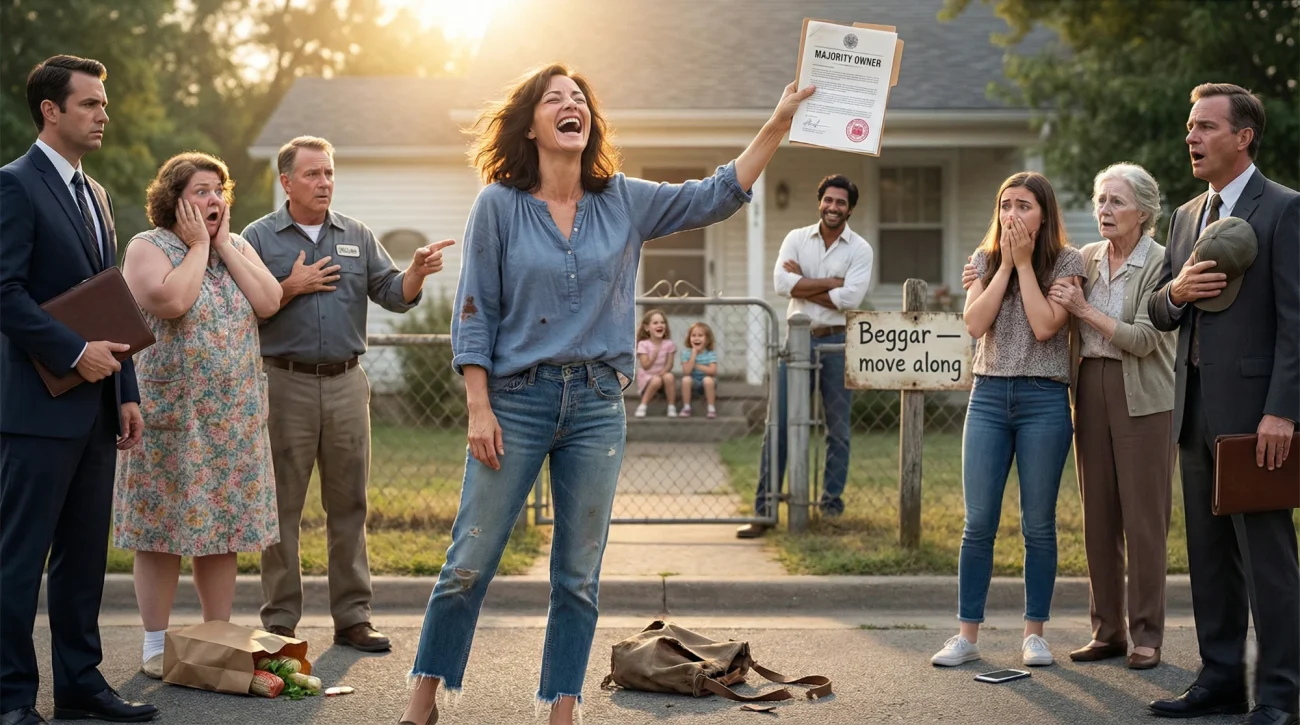
The day I turned 36, my neighbor Mr. Tám leaned over the fence and said, flat as a board: “Khải, face it — you’re going to die alone.”
I handed him a cigarette and said nothing. Some truths you let people believe until you prove them wrong.
I found her on a Tuesday, mid-February, when the market smelled like wet straw and diesel. She was sitting near the vegetable stalls with her knees pulled to her chest and one hand held out — not aggressively, not pitifully, just… there. Like she’d made her peace with the world ignoring her.
But her eyes stopped me cold.
They weren’t broken eyes. They were watching. Taking everything in with a kind of quiet intelligence that had no business being on a woman sitting in the dirt.
I bought two rice cakes from the stall behind me, walked over, and crouched down.
“Hungry?” I asked.
She looked up. For a second I thought she might refuse out of pride.
“Yes,” she said softly. “Thank you.”
I went home that night and couldn’t sleep.
Three days later I saw her again, same corner of the market, same thin jacket that had no shot against the February wind. I sat down beside her on the curb like we were old friends.
“What’s your name?”
A pause. “Hạnh.”
“Where are you from, Hạnh?”
She looked down the road like the answer was somewhere far away. “Nowhere anymore.”
I found out slowly, over two more conversations. No parents. No siblings she could find. She’d been on the streets for three years, moving between towns when people’s tolerance ran out.
The fourth time I sat with her, I said something that bypassed my brain entirely and came straight out of my chest:
“If you’re willing — I’d like to marry you.” I held up a hand before she could react. “I’m not rich. I have a small house, a garden, chickens. But you’d have a roof and food and someone who won’t treat you like a problem to be moved along.”
The market went quiet around us. I heard someone behind me actually snort.
Hạnh stared at me for a long moment. “You don’t know me.”
“I know enough.”
“You’ll regret it. People will talk.”
“People already talk. I’ve stopped caring.”
She looked away. A vendor nearby whispered something to his wife and they both shook their heads.
“Give me a few days,” Hạnh said.
On the fifth day she was waiting at my gate with nothing but a small cloth bag.
“I’ll try,” she said. That was all.
The wedding was six tables, some rice wine, and a lot of stares. My cousin Phong pulled me aside before the toast.
“Brother, I respect you. But this woman — you know nothing about her background. What if she’s running from something?”
“Then she ran far enough,” I said, and walked back to my bride.
The village had opinions. The village always has opinions.
“Khải lost his mind.” “She trapped him with those eyes.” “Give it six months.”
I gave it zero seconds of worry.
The first months were genuinely hard. Hạnh had never cooked on a wood-burning stove. The first meal she made — rice porridge — came out with the consistency of wallpaper paste. She looked at the pot, then at me, mortified.
“It’s fine,” I said, taking a bowl.
“It’s terrible,” she said.
“Yes,” I agreed. “But you made it, so I’m eating it.”
She almost smiled. A week later the porridge was perfect.
I noticed things about her as months passed. She was meticulous about details — she reorganized my tool shed so efficiently I saved two hours a week just not looking for things. She kept a small notebook in her pocket and wrote in it sometimes when she thought I wasn’t watching. When I asked what was in it, she said, “Nothing. Old habits.”
I didn’t push.
She was cautious with money to the point of anxiety. If I spent more than I should on anything, she’d go quiet for a day. I learned to tell her the actual cost of things and talk through it. She’d nod, recalculate, relax.
But she never talked about before. Not once. And I kept my promise to myself — I wouldn’t ask until she was ready.
Our son was born fourteen months after the wedding. We named him Minh.
The village came around faster than I expected. Babies have that effect. Suddenly Hạnh was “that hardworking young wife of Khải’s” instead of “the beggar woman he dragged home.”
She was a natural mother — patient, steady, never rattled. When Minh cried at 3 a.m. she was up before I’d even processed the sound.
“Go back to sleep,” she’d whisper. “I have him.”
Two years later, our daughter Bình arrived. The house that used to echo with just my footsteps now had a soundtrack — small feet, laughter, the sound of Hạnh singing off-key while she cooked.
I used to think peace was silence. I learned it’s actually this specific kind of noise.
Bình had just turned two when it happened.
It was a Saturday, mid-morning. I was fixing the fence along the front of the property when I heard the sound — not a motorbike, not a truck, but something low and expensive, the kind of engine hum that doesn’t belong in our village.
I looked up.
Three black SUVs came down our road in a slow, deliberate convoy. People stopped what they were doing. Mr. Tám put down his hoe. The woman who ran the rice stall stepped out to look.
The cars stopped in front of my gate.
The driver of the first vehicle got out — a man in his fifties, navy suit, posture like a person who has never once been uncertain in his life. Behind him, two more men in similar suits emerged from the second car. From the third came a woman in her sixties, elegant, silver-haired, wearing clothes that cost more than most people in this village made in a year.
They all looked at my house. Then the older woman looked at me.
“Is this the home of Nguyễn Thị Hạnh?” she asked. Her voice was controlled, but I heard something underneath it. Something that had been held in for a long time.
My throat tightened. “Who’s asking?”
From behind me, I heard the screen door open.
I turned.
Hạnh stood on the porch. She had Bình on her hip. She looked at the convoy, at the woman in the expensive clothes — and the color left her face completely.
The older woman’s composure cracked. Just for a second, but I saw it.
“Hạnh,” she said. One word. The weight of years in it.
Hạnh handed Bình to me without a word.
She walked down the porch steps slowly. She stopped at the gate, five feet from the silver-haired woman. Neither of them moved.
“How did you find me?” Hạnh asked. Her voice was completely flat.
“We never stopped looking.” The older woman — I would learn later her name was Bà Loan — took one step forward. “Three years, Hạnh. Three years.”
“I didn’t want to be found.”
“Your father—”
“Is dead,” Hạnh said. “I know. I found out. That’s not why I left and you know it.”
Bà Loan flinched like she’d been struck.
The man in the navy suit stepped forward. He was, I’d find out, the family’s chief legal counsel. “Ms. Hạnh, your father’s estate — the board requires a decision. The restructuring cannot be completed without—”
“I don’t care about the board,” Hạnh said.
“There’s a controlling stake—”
“I said I don’t care.”
I was standing there holding my two-year-old daughter, completely at sea. My neighbor Phong had materialized at the corner of the road. Three more neighbors behind him. The audience was growing.
Bà Loan stepped closer to the gate, voice lower now, stripped of performance.
“Your father changed the will before he died. Everything — the majority stake, the properties, the trust — it goes to you. Not to your uncle. Not to the board. To you.” She paused. “He knew what your uncle did. He found out two years after you disappeared. He spent the last year of his life trying to fix it.”
Silence.
Hạnh’s jaw worked. “He believed them over me. For two years he believed them.”
“Yes.”
“He chose them over me. He threw me out.”
“Yes.” Bà Loan’s voice broke, just slightly. “And he knew it. That’s why he changed everything. It doesn’t undo it. But it’s what he could still do.”
Hạnh stood very still for a long moment.
Then she turned and looked at me.
That night, after the lawyers left — they left a card, a document case, and a promise to return — after the neighbors dispersed and the children were asleep, Hạnh and I sat at our kitchen table with tea going cold between us.
“Your family has money,” I said finally. Not a question.
“My father built a construction group. Forty years. Multiple subsidiaries.” She stared at her cup. “When I was twenty-eight, I had a position in the company. My uncle — my father’s brother — wanted full control. He fabricated evidence. Made my father believe I was embezzling from him. Stealing from my own father.” Her mouth tightened. “Dad believed it. He cut me off completely. Publicly. My uncle made sure everyone knew why.”
“That’s why you were on the streets.”
“I had money saved, personal accounts. My uncle’s lawyers froze what they could and I fought for a year until I had nothing left to fight with. I just… walked away. I didn’t want to exist in that world anymore.”
“You had a notebook,” I said. “When we first—”
“Old financial habit. I kept tracking numbers even when I had nothing. Muscle memory.” A pause. “I was waiting for my mind to stop. It never did.”
I thought about the tool shed. The reorganization. The way she tracked every expense with the precision of someone who had once managed millions.
“The children,” she said suddenly. “Whatever I do — whatever decision I make — it doesn’t change what this is.” She gestured at the table, the house, the sleeping sounds from the kids’ room. “I need you to understand that.”
“I know,” I said.
“You married a woman with nothing.”
“I married you,” I said. “The amount was never relevant.”
She looked at me for a long moment. Then, for the first time in the entire conversation, her eyes filled.
She didn’t cry. She blinked it back.
“I need to think,” she said.
“Take all the time you want,” I said. “We’re not going anywhere.”
Hạnh spent two weeks going through the documents the lawyers left. She worked at the kitchen table after the children were in bed, the notebook out, pages filling up with her tight, precise handwriting.
She made calls. Several of them. I’d hear her voice from the other room — clipped, exact, not unkind but utterly without softness.
One evening she came and sat across from me while I was watching Minh try to build a tower out of clay pots.
“I’m going to accept the inheritance,” she said. “But on conditions.”
“What conditions?”
“My uncle is removed from every board and every property. The lawyers who fabricated the evidence are sued. The company is restructured — the workers my uncle underpaid for years get back wages. And—” She paused. “I’m not moving. We can open an account, invest, build better conditions for the family. But this is home.”
I looked at her.
“You don’t want to go back,” I said.
“I want that world to answer for what it did,” she said. “That’s different from wanting to live in it.”
I nodded slowly.
“One more thing,” she said.
“What?”
“Bà Loan asked if she could visit. My father’s mother — my grandmother. She’s eighty-one. She never knew any of it. She just thought I ran away.”
“Tell her she’s welcome anytime,” I said.
Hạnh exhaled. Something shifted in her posture — a weight she’d been carrying so long she’d stopped noticing it.
“Okay,” she said quietly. “Okay.”
Four months later, Hạnh’s uncle stood in front of a civil court and watched the ruling come down: full removal from the corporate board, financial liability for the fabricated case, mandatory back-pay to 340 employees for three years of wage theft he’d pocketed during the restructuring. His own lawyers had turned on him once the paper trail from Hạnh’s father’s private files was produced.
He’d built his position on one lie told to one grieving, trusting man.
And that man, before he died, had methodically dismantled it from the inside and handed the key to his daughter.
Hạnh wasn’t in court. She watched the live stream at our kitchen table with Minh on her lap and Bình asleep on the couch behind her. When the ruling was read, she closed the laptop and sat quietly for a moment.
Minh looked up at her. “Mama? What happened?”
“Something got fixed,” she said.
“Is that good?”
“Yes.” She kissed the top of his head. “It’s very good.”
The village, to no one’s surprise, had a great deal to say about all of this. The SUVs. The lawyers. The inheritance. The fact that Khải the bachelor farmer had apparently married a woman who turned out to be an heiress in exile.
Mr. Tám appeared at the fence the following week looking like a man who had consumed a very large piece of humble pie.
“I may have spoken too quickly,” he said, “some years ago.”
“About which part?” I asked pleasantly.
He cleared his throat. “The… dying alone thing.”
“Ah,” I said. “Yes. That.”
“I apologize, Khải.”
I handed him a cigarette. “Forget it.”
He smoked in relieved silence for a moment. “She’s a remarkable woman.”
“She was remarkable when she had nothing,” I said. “The rest is just detail.”
He nodded slowly. “Yes,” he said. “I suppose it is.”
That evening I sat on the porch while the kids ran through the garden and Hạnh cooked — something that now smelled extraordinary, a long way from that first pot of paste-porridge.
She came to the doorway, dish towel over her shoulder.
“Dinner in ten minutes.”
“Kids!” I called. “Ten minutes!”
A chorus of protest from the garden.
I looked up at her. She was backlit by the kitchen light, expression easy, shoulders down — the constant low-level tension she’d carried in her body for years, finally, completely gone.
She met my eyes and held them for a moment.
“Thank you,” she said quietly.
I knew she didn’t just mean dinner.
“You’d have found your way back regardless,” I said. “I just gave you somewhere to land.”
She shook her head slightly, like I’d gotten it wrong, but she smiled — and it was the full version, the one that reached everything — and then she went back inside.
Minh crashed into my legs demanding to be carried.
I picked him up and listened to the sounds of the house: Bình laughing, oil hitting a hot pan, the good clatter of a meal being made, the long road behind us that led here.
Every neighbor. Every whisper. Every “he’ll die alone.”
I thought: you were almost right. Almost.
But not quite.
Original fictional stories. AI-assisted creative content.
