
I wasn’t looking for trouble that Tuesday afternoon. I was just riding through Oak Creek on my Harley, headed
for the highway, minding my own business.
But fourteen years of living rough teaches you something most people never learn — how to hear silence.
And the silence outside Oak Creek High School was wrong.
I pulled to the curb across the street. Killed the engine. Pulled off my helmet.
Thirty, maybe forty students stood frozen near the main staircase. Every single one of them had a phone raised.
Not one of them was moving.
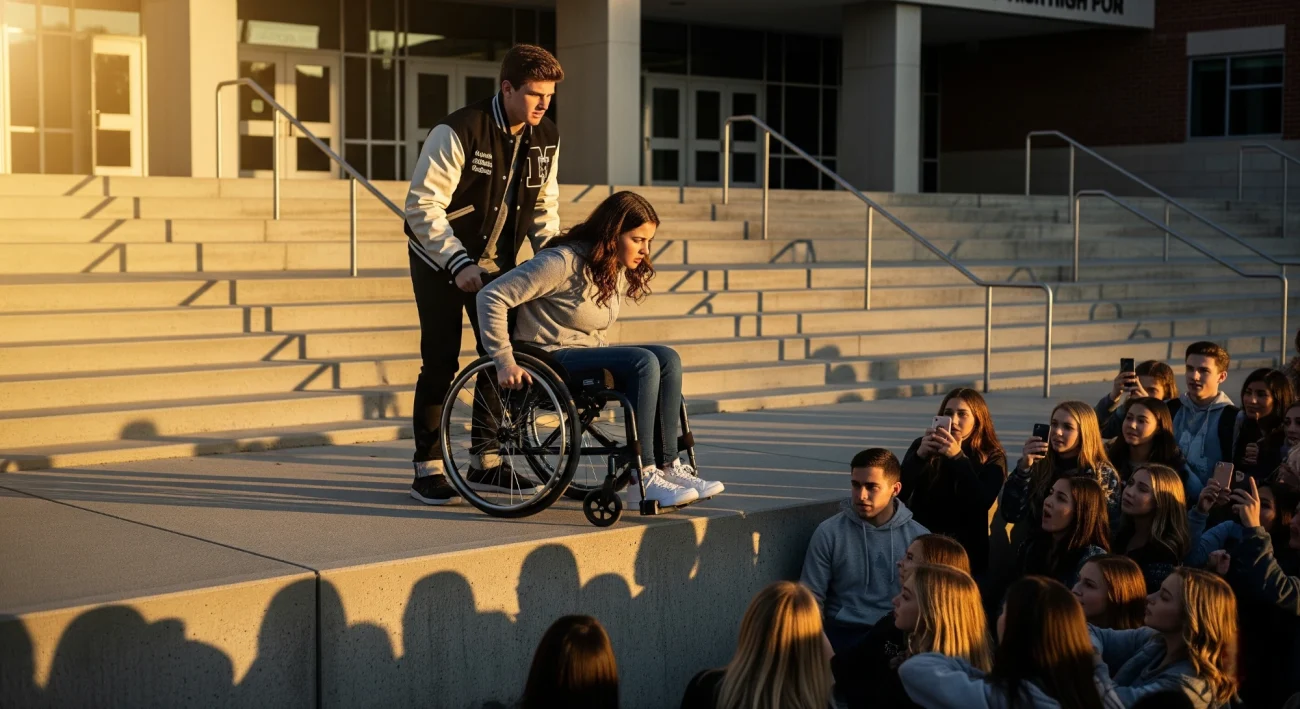
At the top of the concrete steps, I saw him. Jaxson Miller. Varsity quarterback. Six-two. Two-twenty. The kind
of kid who wore his letterman jacket like it was body armor.
And in front of him, backed against the railing, was Sophia Reyes.
I knew Sophia. She worked weekends at Maggie’s Diner off Route 9. Quiet girl. Always polite. Always had a
smile even when she was clearing plates by herself because the other waitress called in sick. She’d been in a
wheelchair since a drunk driver hit her family’s car when she was eleven.
She was sitting in that chair now, at the very edge of the top step, and her knuckles were white on the wheels.
“Jaxson, please,” she said. “My bus is leaving. I just need the ramp.”
He didn’t move. He stood right in the center of the path, arms crossed, grinning like this was the funniest thing
he’d seen all week.
“The ramp?” He looked over his shoulder at his buddies. “You hear that? She needs the ramp.”
Laughter. Not from everyone. But enough.
“Come on, Jax,” one girl in the crowd muttered. “Just let her go.”
He ignored her.
“You know what, Sophia? I think you can take the stairs.” He tilted his head. “Oh wait.”
More laughter. Sophia’s jaw tightened. She tried to wheel around him. He sidestepped and blocked her again.
“Jaxson, stop.”
“Or what?” He leaned down until his face was inches from hers. “Your mom gonna call somebody? She can
barely pay rent.”
Sophia’s eyes went glassy. She didn’t cry. She just sat there, hands shaking, and said, “Please move.”
“Say it louder.”
“Please move.”
“Louder.”
“Please!”
He straightened up, looked around at the crowd like he was taking a bow, and then — fast, careless, like
swatting a fly — he shoved the back of her wheelchair.
Hard.
The chair lurched forward. The front wheels hit the edge of the top step and tipped.
Sophia screamed.
The wheelchair tumbled down ten concrete stairs. Metal scraped and cracked. Sophia hit the pavement at the
bottom and didn’t get up.
For one full second, nobody moved.
Then everything happened at once.
I was already running. I hit the crosswalk at a dead sprint. Students rushed down the stairs. A teacher burst
through the front doors.
Sophia was on the ground, face down, one arm bent at an angle that made my stomach turn. Her wheelchair was
upside down three feet away, one wheel still spinning.
“Don’t move her!” I shouted. I dropped to my knees beside her. “Sophia. Can you hear me?”
She was conscious. Barely. Her lips were moving but no sound came out.
“You’re okay,” I said. “Stay still. Help is coming.”
I looked up the staircase. Jaxson was standing at the top, phone in hand, and the look on his face wasn’t fear. It
wasn’t guilt.
It was annoyance. Like this had become inconvenient.
A teacher, Mrs. Calloway, reached us. She was shaking. “I called 911. Oh my God. Oh my God.”
“Keep everybody back,” I told her. “And make sure nobody leaves. Especially him.” I pointed up.
Jaxson saw me pointing. For the first time, something flickered across his face.
He pocketed his phone and walked back inside the school.
The ambulance arrived in nine minutes. They stabilized Sophia’s arm — fractured in two places — and checked
for spinal injuries. She was loaded onto a stretcher while half the school watched. She still hadn’t cried. She just
stared at the sky with this look that told me she’d been through worse and that was the part that made me
furious.
The police arrived right behind the paramedics. Two cruisers. Officer Daniels, a guy I’d seen around town,
started taking statements.
And then a black Escalade pulled up.
Mayor Richard Miller stepped out. Navy suit. American flag pin on his lapel. He walked past every student, past
the ambulance, past the bloodstain on the concrete, and went straight to Officer Daniels.
I couldn’t hear the conversation. But I watched Officer Daniels’ posture change. His shoulders dropped. He
nodded. He closed his notebook.
Ten minutes later, the official line was: “Equipment malfunction. The wheelchair’s brakes failed on the stairs.”
I stood there and listened to a police officer say that to a reporter who had shown up with a camera. Equipment
malfunction. A wheelchair just rolled itself down a staircase while the quarterback happened to be standing right
behind it.
“That’s not what happened,” I said.
Officer Daniels looked at me. “Sir, were you on school property at the time of the incident?”
“I was across the street. I saw the whole thing.”
“So you were not on school property.”
“I saw him push her.”
“At this time, witness accounts are being reviewed. We ask that you not spread unverified information.”
The Mayor was watching from twenty feet away. He didn’t say a word to me. He didn’t have to. The message
was clear: This is handled. Walk away.
I walked to my bike. But I didn’t ride off.
I sat there and watched every single student who’d been recording get approached by school administrators. I
watched them being told to delete their videos. I watched two kids get their phones physically taken away by
Vice Principal Drennan, who told them the recordings were “potential evidence” that needed to be “secured.”
One girl — couldn’t have been older than fifteen — said, “You can’t take my phone. My parents—”
“Your parents will be contacted,” Drennan said. “Hand it over.”
She handed it over. Her hands were trembling.
Secured. Right.
But here’s the thing about teenagers in 2025. They don’t just record to their camera roll. They stream. They
upload. They AirDrop. By the time the administration started confiscating phones, thirteen different videos were
already on the internet.
I found the first one that night. Posted by a kid named Marcus Webb. Twenty-two seconds. You could see
Jaxson standing behind Sophia. You could see the shove. You could see the wheelchair disappear over the edge.
You could hear the scream.
Fifty thousand views by midnight. Two hundred thousand by morning.
I shared it to every local group I was part of. Riders. Veterans. Parents. Neighbors.
By 7 a.m., Oak Creek was on fire.
The school released a statement at 8:15: “We are aware of video circulating online. The incident is under
investigation. We ask for patience and remind the community that student privacy is paramount.”
Student privacy. Sophia was in a hospital bed with a fractured arm and three cracked ribs, and they were
worried about Jaxson’s privacy.
At 9 a.m., I rode to the school. I wasn’t alone.
Forty-seven motorcycles lined up along the curb. No revving. No shouting. No signs. We just parked, took off
our helmets, and stood there.
Big Dave from the shop was on my left. He didn’t say a word. He just crossed his arms and stared at the front
doors. Tommy Reece, who’d ridden with me for six years, stood on my right. His daughter had graduated from
Oak Creek two years earlier. He told me later he’d heard stories about Jaxson even then.
Parents showed up next. Then more students — kids from other schools who’d seen the videos. Then neighbors.
Teachers who weren’t on duty. People I’d never met. A woman in nursing scrubs who must have come straight
from a shift. An old man with a cane who stood in the sun for three hours without sitting down.
By noon, there were over three hundred people standing silently outside Oak Creek High.
Nobody chanted. Nobody blocked the entrance. They just stood there and made it impossible for anyone inside
that building to pretend this wasn’t happening.
Principal Whitmore came out at 12:30. He looked at the crowd and went back inside without saying a word.
Mayor Miller held a press conference at 1 p.m. at City Hall. He stood behind a podium and said, “My family is
cooperating fully with the investigation. I have confidence in our school and our police department to handle
this matter appropriately. I will not comment further.”
A reporter asked, “Mayor Miller, have you seen the videos?”
“I’ve seen edited clips that lack context.”
“Thirteen different angles lack context?”
He didn’t answer. He walked off.
That afternoon, attorney Gloria Vasquez — a civil rights lawyer out of Austin who’d won cases against three
school districts — called Sophia’s mother, Elena.
“I saw the videos,” Gloria said. “I’d like to represent Sophia. Pro bono.”
Elena broke down on the phone. She’d been sitting in the hospital for eighteen hours, terrified, with no
insurance and no idea how she’d pay for any of it. She said yes.
Gloria filed an emergency protective order by 5 p.m. and a civil suit against the school district by end of
business the next day. She also contacted the county DA directly, bypassing local police entirely.
“Officer Daniels reports to Chief Harding,” Gloria told me when I met her at Maggie’s Diner that evening.
“Chief Harding golfs with the Mayor every Saturday. This case was never going to move through the local
department.”
“So what happens now?”
“The county handles it. DA Patricia Sheldon doesn’t golf with anyone.”
That night, more videos surfaced. Not just of the staircase incident.
A sophomore named Lily Chen posted a compilation she’d been building for months. Jaxson tripping a kid on
crutches in the cafeteria. Jaxson throwing a boy’s hearing aids into a trash can. Jaxson cornering a freshman girl
in a hallway and blocking her path until she cried. Six separate incidents. All on video. All ignored by the
school.
Lily captioned it: “They knew. They always knew.”
The compilation hit a million views in twelve hours.
The school board called an emergency meeting.
I was in the room. It was standing room only. Parents were furious. One father stood up and said, “My son
reported Jaxson Miller to Vice Principal Drennan in October. He was told to ‘work it out between yourselves.’
His son was the kid with the hearing aids.
Another mother said, “My daughter stopped eating lunch at school because she was afraid of the football team’s
table. She’s fourteen.”
Board member Carol Hutchins looked like she’d swallowed glass. She said, “We take all reports seriously—”
“You didn’t take a single one seriously!” the father shouted. “I have the emails. I have the responses. ‘Thank you
for bringing this to our attention. We’ll look into it.’ That’s it. Every single time.”
He held up his phone. He’d printed the email chain. Twelve messages over eight months. Not one follow-up
action.
A teacher — a woman I later learned was Mrs. Alvarez, who taught sophomore English — stood up from the
back row. Her voice was shaking.
“I reported Jaxson Miller to Principal Whitmore in September,” she said. “I saw him corner a student in my
hallway. I wrote a formal incident report. Do you know what Whitmore told me?”
The room was dead quiet.
“He said, ‘Linda, the boy’s under a lot of pressure with the season. Let’s not make this bigger than it needs to be.’
And then he asked me if I’d considered that the other student might be exaggerating.”
She sat down. Nobody on the board said a word for fifteen seconds.
Then another parent stood. And another. Five different families. Five different reports. All filed. All ignored. A
pattern so obvious it could’ve been drawn with a ruler.
Gloria Vasquez was taking notes in the second row. She didn’t need to say anything. The room was doing her
work for her.
The board voted unanimously to place Principal Whitmore and Vice Principal Drennan on administrative leave
pending an independent investigation.
Mayor Miller released a written statement the next morning: “I love my son. I believe in due process. I am
stepping back from public duties to focus on my family.”
Stepping back wasn’t enough.
The city council met that Friday. Council member Janet Reyes — no relation to Sophia — presented a motion
calling for the Mayor’s resignation. She cited three things: his visit to the scene on the day of the incident,
Officer Daniels’ altered report, and a text message chain obtained through a public records request.
The texts were between Mayor Miller and Chief Harding. Sent the afternoon of the incident.
Mayor Miller: “Handle this. Keep it internal.”
Chief Harding: “Done. Telling Daniels equipment failure.”
Mayor Miller: “Good. Make sure the videos disappear.”
Chief Harding: “Working on it.”
Janet read them aloud in the council chamber. The room was silent.
The vote was 6-1. Mayor Miller was formally asked to resign.
He resigned that evening. No press conference. A one-paragraph written statement.
Chief Harding resigned the next morning.
Officer Daniels was placed on unpaid suspension and referred to internal affairs.
County DA Patricia Sheldon filed charges against Jaxson Miller three days later. Aggravated assault causing
bodily injury. Jaxson was taken into custody at his home. Because he was seventeen, the case went to juvenile
court, but Sheldon filed a motion to certify him as an adult given the severity and the evidence of a pattern of
violence.
The judge granted the motion.
Jaxson Miller was tried as an adult.
His defense attorney argued it was horseplay that went wrong. “My client is a seventeen-year-old boy,” the
attorney said. “A boy who made a terrible mistake in a moment of poor judgment. This was not malice. This
was immaturity.”
The prosecutor played the videos. All thirteen angles. One after another. The courtroom watched Sophia beg.
Watched Jaxson mock her. Watched the shove. Watched the fall.
Then they played Lily Chen’s compilation. Six incidents over eight months. The cafeteria. The hallway. The
hearing aids in the trash.
“This,” the prosecutor said, “is not a moment. This is a pattern.”
Seven witnesses testified. Marcus Webb. Lily Chen. The girl Jaxson had cornered in the hallway, who was so
nervous on the stand she could barely speak above a whisper but who said, “He blocked the door and told me
nobody would believe me. He was right. Nobody did. Until now.”
Then Sophia rolled into the courtroom in her wheelchair. The room went silent. She looked directly at Jaxson
and said:
“I asked you to move. That’s all I did. I asked you to let me pass. And you decided that was funny.”
She paused.
“I want you to know something, Jaxson. I’m not afraid of stairs. I’m not afraid of you. I’m not afraid of your
father or your lawyers or anyone who tried to make this go away. I’m here. And I’m not going anywhere.”
The jury deliberated for three hours.
Guilty.
Jaxson Miller was sentenced to two years in a juvenile detention facility with the possibility of transfer to adult
prison if he violated any terms. He was expelled from Oak Creek High and barred from participating in any
school athletic program in the state.
His college football scholarship offers — all four of them — were rescinded within a week.
Principal Whitmore was terminated. Vice Principal Drennan was terminated. The school district settled Sophia’s
civil lawsuit for $1.4 million and agreed to implement mandatory bystander intervention training, an
anonymous reporting system, and a full-time student advocate.
Gloria Vasquez held a press conference outside the courthouse.
“This case was never about one boy pushing one girl,” she said. “It was about a system that decided some
children matter more than others. That system failed. Today, it was held accountable.”
A reporter asked, “What’s next for Sophia?”
Gloria smiled. “School. That’s all she ever wanted. To go to school and be left alone.”
I was standing in the back of the crowd. Elena found me. She pushed through a dozen reporters and walked
straight to me.
Elena walked up to me, grabbed both my hands, and said nothing for ten seconds. Then: “You stopped. Nobody
else stopped. You just… stopped.”
“Anybody would’ve.”
“No,” she said. “They wouldn’t. I watched the videos. Forty students stood there. You were across the street and
you were the one who ran.”
I didn’t know what to say to that. So I just squeezed her hands and said, “She’s gonna be okay.”
“She already is,” Elena said.
A month later, Sophia was back at school. New wheelchair — paid for by the settlement. A ramp had been
installed at the main staircase. Not a temporary one. A permanent, concrete ramp with railings, built into the
architecture of the building.
On her first day back, she wheeled up that ramp and through the front doors. Students lined the hallway. Not
with phones this time.
They were clapping.
Marcus Webb was standing near the lockers. He gave her a nod. Lily Chen was waiting by the water fountain
with a handmade sign that read “Welcome back, Soph.” Mrs. Alvarez was in her classroom doorway, dabbing
her eyes with a tissue.
Sophia didn’t stop. She didn’t wave. She just rolled forward, chin up, and went to class.
After school, she texted Gloria Vasquez two words: “I’m back.”
Gloria texted back: “I know. The whole country knows.”
That afternoon, I was back on my Harley, riding past the school on my way to the highway. Sophia was outside,
sitting in the sun with two friends, laughing about something.
She saw me and raised her hand. Not a wave, exactly. More like a salute.
I raised mine back and kept riding.
Some fights you don’t start. You just refuse to look away. And sometimes — not always, but sometimes — that’s
enough to make sure the right people lose and the right people win.
Jaxson Miller lost everything. His father lost everything. The people who covered for them lost everything.
And Sophia Reyes rolled right through the front door.
Original fictional stories. AI-assisted creative content.

This is why My career took me to so many young kids their parents grandparents. Special needs kids. And kids who were endanger.Some body to care is all thats needed