
Marcus had been driving Sonia to school every morning for three years. He knew every crack in the road, every traffic light pattern, every shortcut. But that Tuesday, he almost missed the exit because his daughter’s words hit him like a physical blow.
“Dad, who is that man who always touches Mom’s body with a red cloth every time you sleep?”
He gripped the steering wheel until his knuckles went pale.
“Sonia.” His voice came out carefully measured. “What are you talking about?”
“The man who comes at night,” she said, with the flat certainty of a child reciting the alphabet. “He has a red cloth. He rubs it on Mom. She just keeps her eyes closed.”
“Sonia, stop. That is not something you should be saying.” He heard how sharp his own voice was and softened it. “Did you see something on TV? A movie?”
“No, Dad.” She looked at him through the rearview mirror. Eight years old. Clear eyes. No confusion, no drama. Just fact. “It happens in your room. When you’re sleeping next to her.”
He pulled up to the school entrance.
“Go. We’ll talk later.”
She kissed his cheek and got out. He watched her disappear through the double doors and sat there for a full minute, engine running, staring at nothing.
Marcus and Diana had been married eleven years. He was a logistics coordinator at a mid-sized freight company. She was a pediatric nurse with a schedule that rotated — days, nights, swing shifts. They had built a quiet, careful life together in their three-bedroom house in Decatur, Georgia.
He had never doubted her. Not once.
That was what made the drive home unbearable — not suspicion, but the collapse of certainty. The thing he had always assumed was steel turned out to be only an assumption.
She would have told me. She tells me everything.
But Sonia’s face had not been the face of a child inventing stories.
When he walked in through the back door, Diana was at the stove, hair pulled back, coffee mug beside the range.
“Honey, you’re back already?” She turned and smiled.
He looked at her. Really looked. The woman he had watched sleep beside him for over a decade. The woman who still reached for his hand during thunderstorms.
“Yeah,” he said. “Traffic was light.”
He kissed her on the cheek. She didn’t notice that his lips barely made contact.
He spent the day moving through routines like a man underwater. He answered work emails. He ate lunch. He did the dishes. All the while, one thought rotated in his mind on a slow, grinding loop.
Tonight, I’ll know.
He considered asking Diana directly. He turned the conversation over in his head a dozen ways. But every version of it ended the same: if something was happening, she would deny it. And if nothing was happening, he would have broken something that couldn’t be unbroken.
See it yourself first. Then decide.
He had read somewhere that the brain fills in gaps with fear. That most of what we dread is our own imagination given permission. He held onto that like a rope.
Dinner was normal. Sonia talked about a science project. Diana asked about a coworker of his named Pete. Marcus nodded, answered, asked follow-up questions on autopilot. He was already somewhere else entirely.
After Sonia went to bed — “Goodnight, Daddy,” her small arms around his neck — Marcus and Diana went through their usual routine. Locked the doors. Brushed teeth. Turned off the hall light.
In bed, he lay on his side of the mattress. Diana was reading on her phone, the blue glow soft on her face.
“Long day?” she asked.
“Little bit. You?”
“Twelve-hour shift tomorrow. I should sleep.”
She set her phone down. He watched the ceiling.
Five minutes. Six.
Her breathing slowed.
He snored.
Not his natural sound — he didn’t snore — but a slow, rhythmic performance he had constructed in his head all afternoon. Deep. Even. Convincing.
He lay there in the dark for what felt like an hour but was probably fifteen minutes.
And then he felt it.
A shift in the room. Not a sound exactly — more like a pressure change, the way air moves differently when a door opens. A presence, close to the bed. Near Diana’s side.
Every nerve in his body went electric.
He heard her breathing change. Not panicked — something else. A low, almost involuntary sound. Like pain. Or like effort.
He couldn’t hold it any longer.
He opened his eyes.
What he saw stopped his heart for a full second.
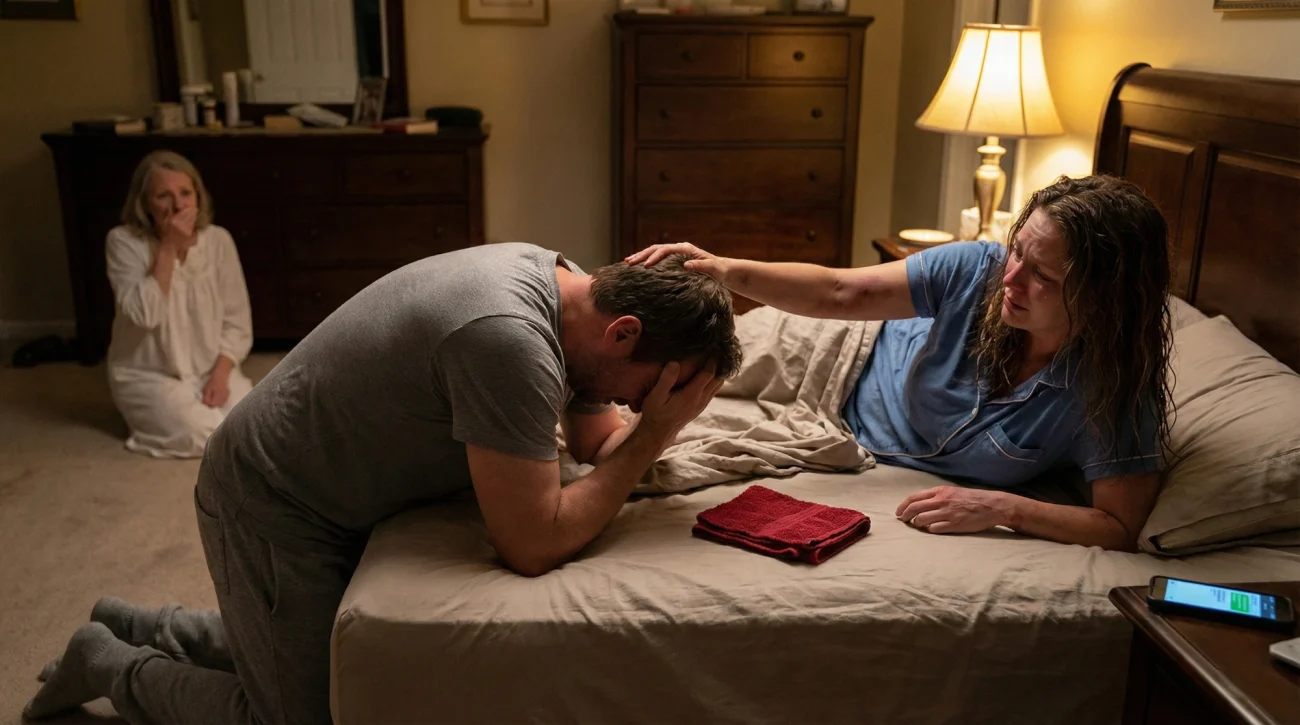
Diana was on her back, eyes closed, face tight with concentration. Beside her, kneeling on the floor next to the bed, was her mother — Evelyn. Sixty-three years old. Cotton nightgown. Silver hair loose around her shoulders.
In her hand: a worn red cloth.
She was pressing it gently, in slow strokes, along Diana’s left arm. From elbow to wrist. Then back up. Murmuring something under her breath — low, rhythmic words Marcus couldn’t quite make out.
Diana’s face wasn’t peaceful. Her jaw was clenched. Her left hand was balled into a fist against the mattress.
Marcus sat up.
“Evelyn — what are you doing?“
Both women startled. Diana’s eyes flew open.
“Marcus—” Diana’s voice was strained.
“What is happening? What is this?” He was on his feet now, around the bed, staring at the red cloth in Evelyn’s hand. “What is that?”
Evelyn looked up at him. Her eyes were wet.
“Sit down, Marcus,” she said quietly. “Please.”
“I am not sitting down until someone tells me—”
“Marcus.” Diana’s voice cut through. Not angry. Exhausted. Broken in a way he hadn’t heard before. “Sit down. I need to tell you something.”
He sat.
Diana pushed herself upright against the headboard. She didn’t look at him right away. She looked at her own arm — the left one. And she pulled up the sleeve of her sleep shirt.
The bruising ran from her inner elbow almost to her wrist. Deep purple, yellowing at the edges. Old and new marks layered together.
Marcus’s chest hollowed out.
“Diana. What—”
“I was diagnosed four months ago,” she said. “Peripheral artery disease. Early stage, but progressing.” Her voice was a nurse’s voice now — clinical, controlled, the armor she put on when emotions were too large. “The circulation in my left arm has been compromised. Mom has been doing manual lymphatic drainage every night. It’s… it’s a technique that helps when the medication isn’t enough.”
She finally looked at him.
“I didn’t tell you because I knew what you’d do.” The clinical voice cracked at the edges. “You’d quit work. You’d hover. You’d be so afraid. And I wasn’t ready to watch you be afraid.”
The silence lasted a long time.
Evelyn set the red cloth on the nightstand. It was just a cloth — soft, worn at the center, the kind used for gentle therapy work. No mystery. No darkness. Just a mother caring for her daughter in the only quiet way she knew how.
“Four months,” Marcus said. The words came out hollow.
“I know.”
“You’ve been carrying this for four months.”
“I was trying to protect you.”
“Diana.” His voice finally broke. “My job is to be here. That’s all I — that’s the only thing I actually need to do. Be here.“
He moved to her side of the bed and took her hand. Her left hand. Carefully, the way he might hold something fragile.
“I’m not going anywhere,” he said. “You hear me? I don’t care how afraid I am. I want to be afraid with you. That’s what this is.”
Diana pressed her forehead against his shoulder and finally, finally let herself cry.
Evelyn stood quietly, cloth in hand, and slipped out of the room, pulling the door almost all the way closed behind her.
The next morning, Marcus called his supervisor before six a.m. and rearranged his schedule to accommodate Diana’s upcoming specialist appointments. He drove Sonia to school himself.
“Dad,” Sonia said, buckling her seatbelt. “Did you find out about the man with the red cloth?”
He looked at her in the mirror.
“It wasn’t a man, sweetheart. It was Grandma Evelyn.” He paused. “Mom is a little sick. But Grandma was taking care of her. And now I’m going to help too.”
Sonia thought about this for a moment.
“Is Mom going to be okay?”
“Yes,” he said. And for the first time in twenty-four hours, he meant it completely. “She’s going to be okay.”
He drove the rest of the way with one hand on the wheel and Sonia’s small hand in his other.
Three weeks later, Marcus sat beside Diana in the vascular specialist’s office as the doctor walked them through the updated scan results. The drainage therapy combined with adjusted medication had slowed the progression significantly. Not reversed — but slowed.
“Better than we expected at this stage,” the doctor said.
Diana squeezed Marcus’s hand.
He squeezed back.
He had spent twenty-four hours believing his marriage was a lie. It turned out his marriage was a woman who loved him so completely that she tried to carry pain alone to spare him from it. And a mother-in-law who knelt on a hardwood floor every night because her daughter needed her.
He thought about what Sonia had seen and felt a deep, quiet gratitude that his daughter had unknowingly forced the door open.
Some secrets, he realized, are not betrayals.
Some secrets are just love that ran out of room.
He drove them home in the late afternoon light, Diana’s head against the window, already half-asleep in the passenger seat. He turned the heat up slightly and didn’t say anything.
He didn’t need to.
Original fictional stories. AI-assisted creative content.
