
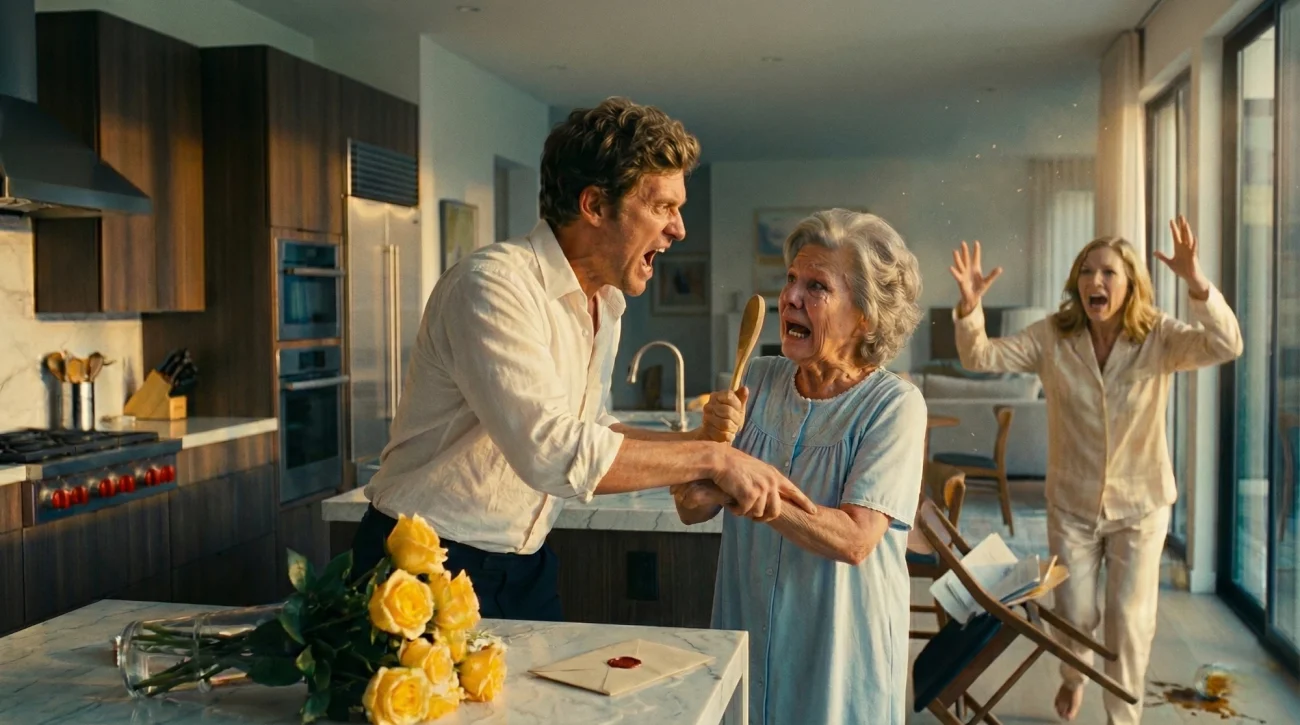
Marcus Chen had been in the air for fourteen hours when he decided to bring roses home.
Not for his wife. For his mother.
He stopped at a florist near LAX, bought a dozen yellow ones — her favorite — and tucked them under his arm beside his briefcase. Tokyo had been worth it. The merger was done. He could relax now.
He punched the code for the side entrance and slipped inside.
The kitchen smelled like ginger and star anise. His mother was cooking soup. His whole childhood lived in that smell.
He smiled — and then stopped walking.
“I told you not to cook that disgusting food when I have guests.”
Victoria’s voice. Sharp. Aimed.
“The whole house stinks like a cheap Chinatown diner.”
Marcus went still behind the marble column separating the foyer from the kitchen. The roses hung loose in his fingers.
“I’m sorry, Victoria. Just a little soup for myself.”
His mother’s voice was barely above a whisper. Her English tightened the way it always did when she was afraid.
“Don’t give me that look. You know exactly what you’re doing. My book club is coming tomorrow. I will not have them think we live in an immigrant boarding house.”
Marcus pressed his shoulder blades against the cold marble. His pulse was loud in his ears.
This isn’t real. This is jet lag. I misheard something.
“Please,” his mother said. “I’ll open the window. I’ll use the fan. Everything will be clean.”
“From now on, you’ll eat in the utility room. I don’t want to see your face during dinner, and I certainly don’t want to smell whatever you’re cooking.”
The briefcase hit the Persian rug. Marcus hadn’t felt it slip.
He stood in the shadow of the column and listened to his mother’s footsteps — the slow shuffle of a woman who had stopped arguing. Who had decided the cost of arguing was too high.
He had heard that sound before. In the garment factory on her double-shift nights. In the Chinatown apartment where she sat at the kitchen table after midnight, sewing buttons onto sample coats by lamplight so he could sleep.
He had heard her decide, over and over, that her dignity was negotiable.
He had told himself that was over. That he’d changed her life.
He had been wrong about what he’d actually built.
“And another thing,” Victoria continued. “Stop leaving your reading glasses everywhere. This isn’t a retirement home where you can scatter your old-lady junk around my house.”
“I only keep things in my room.”
“Your room?” A short, cold laugh. “This is my house. Marcus bought it for me. Not for some old immigrant who barely speaks English after thirty years.”
Thirty years.
His mother had worked in America for thirty years. She had given him thirty years. She had taken double shifts, skipped vacations, reused tea bags, and worn the same winter coat for eleven years so that he could go to Stanford.
And now she was being told to eat alone in a utility room.
Marcus stepped out from behind the column.
Victoria was standing at the island, a glass of white wine in one hand, her phone in the other. She was wearing the cream silk blouse she saved for social occasions. She looked up when she heard his footsteps.
For one second, her face opened with something that looked like surprise mixed with relief — the automatic warmth of a wife greeting her husband.
Then she saw his expression.
The warmth closed like a door.
“Marcus. You’re home early—”
“I heard everything.”
His mother stood at the stove with a wooden spoon in both hands, gripping it like something that might keep her upright. Her eyes moved between them. She was already calculating whether she should leave the room.
“Mom,” Marcus said. “Don’t move. Please.”
He set the roses down on the kitchen island — between himself and Victoria — and looked at his wife.
“How long?”
“You’re overreacting. She and I just had a small—”
“How long, Victoria?”
She set her wineglass down carefully. “She doesn’t understand boundaries, Marcus. She wanders the house at six in the morning. She cooks strong food that gets into the curtains. She rearranges things in the pantry—”
“She lives here.”
“I live here. You bought this house for us. Not for a houseguest who—”
“She’s my mother.”
The word landed like a flat stone.
Victoria shifted her weight. “I have tried, Marcus. I have been patient. But there are limits—”
“What are the limits?” His voice was very quiet. “Tell me exactly where the limit is between ‘your mother-in-law’ and ‘old immigrant who eats alone in the utility room.'”
Victoria’s jaw tightened. “Don’t twist my words.”
“I heard them. I heard every word.”
His mother had set the wooden spoon on the counter. She was watching him with an expression he recognized: equal parts love and dread. She had spent thirty years watching the people she loved stand in the way of something painful to protect her. She never knew whether to be grateful or guilty.
“Marcus,” she said quietly. “It’s all right. I can eat somewhere else. It’s no trouble.”
“No,” he said. “It is not all right. And you will not eat somewhere else.”
He looked at his wife. He had loved her for six years. He had built a life with her. But he was standing in his own kitchen, in his own house, and his mother was gripping a wooden spoon and offering to disappear to make things easier.
“I need you to apologize to her,” Marcus said. “Now. In this room.”
Victoria’s expression shifted into something harder. “You’ve been traveling for three days. You walked in ten minutes ago. You don’t know what it’s been like—”
“Apologize.”
“Marcus—”
“Or start deciding what you’re taking with you.”
The silence that followed was the kind that changes things permanently.
Victoria looked at him for a long moment. She was measuring him — trying to find the edge of how serious he was, the way she had learned to do in arguments. She was looking for the place where he softened.
She didn’t find it.
“Fine.” She turned toward his mother. Her voice was flat, controlled, the voice of a woman performing a word rather than meaning it. “I apologize if you were offended.”
“No,” Marcus said. “Try again. Without ‘if.'”
Victoria’s eyes flicked to him. Something moved across her face — fury, then something more fragile beneath it.
She looked at his mother again.
“I’m sorry,” she said. “What I said was cruel.”
His mother nodded once. She didn’t smile. She didn’t say it’s fine the way she usually did to make everyone comfortable. She just nodded, the way a woman nods when she has waited a long time for something and finally received it and isn’t sure yet what to do with it.
Marcus picked up the yellow roses from the counter and crossed the kitchen. He placed them in his mother’s hands.
“These are for you,” he said in Mandarin. “I brought them from the florist near the airport. I was thinking of you on the plane.”
His mother looked at the roses. Her eyes filled. She pressed her lips together and didn’t let herself cry — the same discipline she’d had her whole life, the same iron control that had carried her through factory floors and double shifts and thirty winters in a city that had never felt entirely like home.
“Thank you,” she said softly. In Mandarin. As if they were alone in the room.
Marcus kissed her forehead.
Then he straightened and looked at Victoria.
“I’m going to talk to my lawyer tomorrow,” he said. “We need to formalize some arrangements about this property. My mother’s right to live here needs to be protected in writing — not as a guest, but as a permanent resident with legal standing. I should have done that from the beginning.”
Victoria stared at him. “You’re serious.”
“I have never been less sure about anything in my life than I was two hours ago,” he said. “And I have never been more sure about anything than I am right now.”
He picked up his briefcase from the floor.
“I’m going to take a shower. The three of us are going to have dinner together tonight. At the table. In the dining room.” He paused. “Mom, the soup smells incredible.”
His mother — for the first time since he’d walked in — almost smiled.
She turned back to the stove, straightened her back, and picked up her wooden spoon.
She did not go to the utility room.
She never did again.
Three weeks later, the family lawyer drew up a formal residency agreement giving Lil Chen permanent, irrevocable right to live in the main residence. Marcus had it notarized and framed a copy for her room — not out of spite, but because he understood, finally, that love without documentation is just a promise, and promises are only as strong as the people making them.
Victoria signed it. She had a choice, and she made it.
For the first time in months, when Marcus walked through the side door from the driveway, he could smell ginger and star anise and feel something that had been missing from the house for longer than he’d realized.
It smelled like home.
Original fictional stories. AI-assisted creative content.
