
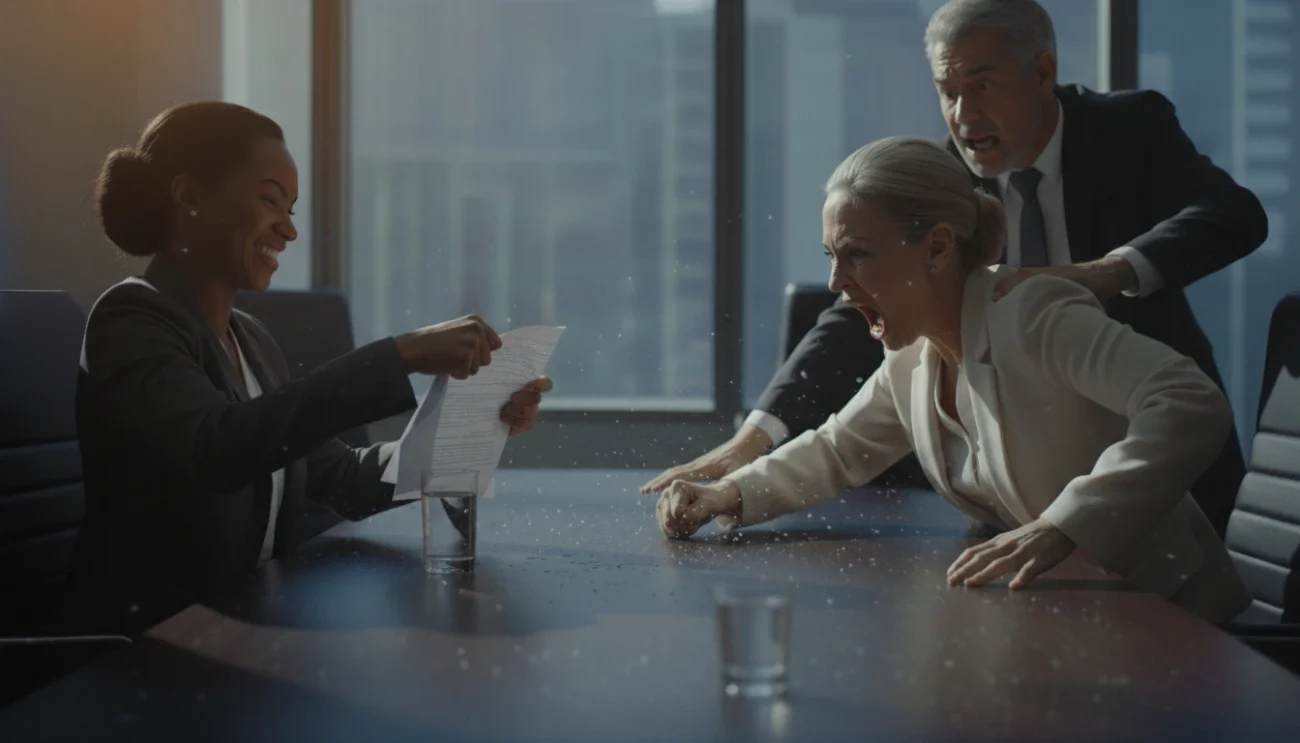
The black dress landed in the wet grass like it had somewhere better to be and missed.
I watched it from the driveway — my driveway, technically — as Beverly Washington stood on the marble porch with her arms crossed and her chin raised, radiating the specific satisfaction of a woman who had waited a long time for this moment.
“You got what you wanted,” she called out, loud enough for the whole street to hear. “Now get out of our house!”
I bent down and picked up the dress. The hem was wet. I folded it slowly, deliberately, the way Terrence used to fold laundry when he was trying not to say something he’d regret. He always said patience was its own kind of power.
I was starting to understand what he meant.
My father-in-law Howard stood in the doorway, arms folded, eyes fixed at a point somewhere above my head. Looking at me directly was beneath him. It always had been. The day Terrence brought me home the first time, Howard had shaken my hand like I was a contractor he hadn’t hired yet.
Crystal was already filming. Of course she was. She stood on the porch steps with her phone angled perfectly, wearing a small smile like she was watching the satisfying end of a movie she’d seen coming for years.
And Andre — sweet, useless Andre — stood half a step behind everyone else, hands in his pockets, eyes down. Choosing silence like it absolved him of choosing a side.
“Beverly.” I kept my voice flat. “Where are the rest of my things?”
“Boxed up in the garage. You can take them now or we’re donating them Monday.”
I nodded. “Okay.”
She blinked. Whatever reaction she’d prepared for, it wasn’t that.
“That’s it? That’s all you have to say?”
“I have a lot to say,” I told her. “Just not today.”
I loaded my boxes into my car in four trips. No one offered to help. Crystal narrated quietly into her phone the entire time — something about dignity and karma and a waitress who’d gotten too comfortable. I didn’t look at her. I looked at the garden, at the rose bush Terrence and I had planted our second spring here, which had somehow survived the drought that killed everything else on the block.
Beverly had probably planned to dig it up by Tuesday.
I drove to my attorney’s office.
Marcus Webb had been Terrence’s lawyer for eleven years, and mine for the last four. He was one of those men who wore expensive suits with the ease of someone who’d never needed them to impress anyone. When I walked in that afternoon with a wet dress folded over my arm and red eyes, he stood up immediately.
“Simone.” He came around the desk. “Sit down. Please.”
“I’m fine.”
“You are not fine. Sit.”
I sat.
He poured me water I didn’t ask for, set it in front of me, then sat across and folded his hands. “They threw you out.”
“Beverly threw my clothes out. I left voluntarily.”
“That is not a meaningful legal distinction to me right now.” He opened a folder. “I need you to read this. Terrence had me update it three weeks ago — he didn’t tell you the full scope.”
I looked down at the document. Then I looked up at Marcus.
“How much?”
He turned the page to a number with nine digits before the decimal.
I had known Terrence was wealthy. I had not known the exact architecture of it. He’d kept much of it unspoken — not hidden from me, but quiet — because he knew I’d never married him for money and he never wanted me to start thinking about him that way. We’d lived well but not ostentatiously. I drove a four-year-old Lexus. We’d argued once about whether to remodel the kitchen.
The number on the page was five hundred and twelve million dollars.
“He converted nearly everything after his diagnosis,” Marcus said carefully. “Real estate holdings, the tech portfolio, the patents. All of it consolidated, all transferred to a trust in your name six weeks ago. The family gets the Washington house — their house, not yours — and a sum that was generous by any standard.” He paused. “But the rest is yours, Simone. Free and clear. They cannot contest it. He made sure of that.”
I stared at the paper for a long time.
“They think I have nothing,” I said.
“Yes.”
“They put me out on the lawn twenty-four hours after I buried my husband because they think I’m walking away with a wet dress and some shoes.”
“Yes.”
Something quiet settled behind my sternum. Not anger — I’d had that. Not grief — I was drowning in that. Something colder and more precise.
“I’m going to need a good CPA,” I said. “And a publicist. And I want to move my primary residence within the month.”
Marcus allowed himself a small smile. “I anticipated that. I have names.”
I didn’t tell anyone.
Not for six weeks.
I moved into a furnished apartment in the city — modest, deliberate, the kind of place the Washington family would assume I’d ended up in. I went back to work three days after the funeral, taking double shifts at the hospital where I’d finished my nursing degree the year before. I drove my same Lexus. I bought groceries on a normal schedule. I called Beverly exactly once to let her know I was fine. She hung up after forty seconds.
Crystal posted the video of me loading boxes. It got eleven thousand views. The caption said: Even the fake ones have to face reality eventually. Rest easy, Terrence.
Sixty-eight comments agreed with her.
I screenshotted every single one.
My phone rang on a Tuesday, seven weeks after the funeral. It was Howard Washington.
“Simone.” His voice had changed. The detachment was gone, replaced by something that sounded almost — not quite — like uncertainty. “I hope you’re well.”
“I am.”
“Good. Good.” A pause. “I’ve been speaking with Marcus Webb about some administrative matters related to the estate. There seem to be some complications.”
“There are no complications,” I said. “Marcus handles everything efficiently.”
“Of course. Of course.” Another pause, longer this time. “I wonder if we might — if you’d be willing to sit down. As a family. To discuss some of these matters together.”
“I’d be happy to meet with you, Howard. Have Marcus schedule it.”
He wasn’t expecting that either.
The meeting was held at Marcus’s office, at a long conference table with Marcus on my left and a second attorney — mine — on my right.
Beverly came in first, in a cream blazer, her composure so carefully constructed it was practically architecture. Howard followed. Crystal arrived five minutes late without an apology.
Andre was not there. I noticed that.
Beverly looked at me the way people look at someone they’re trying to reassess in real time — like a math problem that keeps coming out wrong. She’d expected someone smaller. Someone already diminished.
“Thank you all for coming,” Marcus said. He opened a folder. “I’ll be direct. As you’re now aware, Terrence Washington’s estate was substantially restructured in the final weeks before his passing. The primary trust, valued at—”
“We know the number,” Beverly said sharply.
“—is held entirely in Simone’s name. The family trust, as outlined in the original documents, distributes $8.2 million across the four Washington family members named—”
“That’s not what Terrence intended,” Beverly said. Her voice was tight. “He would never have—”
“He did.” Marcus slid a document across the table. “His signature. His attorney’s witness. Notarized. The restructuring was entirely voluntary, conducted while he was legally competent. There is no legal avenue to contest this.”
Beverly looked at the signature for a long time. Her jaw worked.
Howard set his hands flat on the table. “Simone. You have to understand — Terrence was under significant stress at the end. He wasn’t always—”
“He was clear-minded every day of his illness until the final week,” I said. “He knew exactly what he was doing.” I looked at Howard steadily. “He told me he was protecting me. I didn’t understand the full scope until after. But he did it because he knew how his family would respond when he was gone.” I paused. “He was right.”
Crystal looked up. For the first time, she looked like herself without the phone — without the filming, without the smile. She just looked like a person who had made choices she couldn’t undo.
“I never wanted this to be contentious,” I said. “I loved your son. I loved my husband. I would have stayed in that house grieving quietly for the rest of my life if you’d allowed it.” I looked at Beverly. “You threw my wedding album in the mud.”
Beverly’s mouth opened.
“There’s nothing to negotiate here,” I continued. “The estate is legally settled. What I’m telling you — as a courtesy — is that I’m not going to spend the rest of my life defined by what happened in that driveway. I’m going to build something with what Terrence left me. That’s what he wanted.”
I stood up.
“Crystal.” She startled. “You can delete the video. Or don’t. It doesn’t matter to me anymore.”
I gathered my folder. Marcus was already on his feet.
“One more thing,” I said, at the door. I looked at Howard. “The rose bush on the south side of the yard. The one Terrence and I planted. I’d like it transferred to me before the property transition finalizes. I’ll have someone come collect it.”
He nodded. He didn’t have a choice.
The rose bush sat in a terracotta pot on my balcony for two weeks before I found the right house.
It wasn’t large. Three bedrooms. A wide backyard. Good morning light, the kind that came through windows at the perfect angle and made everything look intentional.
I planted the rose bush on the south side of the yard. Same position. Different ground.
Andre called on a Sunday, four months after the funeral. I almost didn’t answer.
“I know I don’t deserve this call,” he said immediately. “I know I stood there. I’m not calling to make excuses. I just—” His voice broke slightly. “He was my brother. And I let him down by letting you down. I’m sorry.”
I looked out at the rose bush. It had started to bud again.
“Thank you,” I said. That was all I said. But I meant it.
Beverly called once, from an unknown number I traced later. She said something about family, and legacy, and Terrence wanting everyone to stay close.
I deleted it without saving it.
The Washington name would eventually appear in one place — the philanthropy section of the foundation I established in Terrence’s honor. A scholarship fund for nursing students from working-class backgrounds, the kind who once had to choose between decent shoes and a textbook, and kept choosing the textbook.
I named it after him. The Terrence A. Washington Memorial Fund.
The first year, we awarded nineteen scholarships.
Beverly saw the press release. She called Marcus’s office to ask if there was a board seat available.
Marcus forwarded me the message with a single line of his own:
Awaiting your instructions.
I typed back: No vacancy.
Then I closed my laptop, walked outside into the afternoon light, and stood beside the rose bush for a while — not thinking about anything, just feeling the sun on my face the way Terrence always said I never did enough.
He’d been right about that, too.
He’d been right about most things.
Original fictional stories. AI-assisted creative content.
