
The Harley screamed at seventy on a back road outside Tulsa. I didn’t want to think. Thinking meant the empty house, the silence where my wife used to be.
My name’s Jack. Fifty-four. Mechanic. Nobody special.
Then I saw it—something on the chain-link fence, kicking.
I locked the brakes. Gravel sprayed. The bike died.
It was a dog. Shepherd mix, maybe two years old. A yellow nylon rope was knotted around his neck, looped over the top rail. He was standing on his tiptoes. If he relaxed, he’d hang.
Someone had measured the cruelty perfectly.
I ripped off my helmet. “Hey! Hold on!”
The dog turned his head. No bark. No growl. Just two dark eyes full of nothing left.
I slid down the embankment, pulled my grandfather’s folding knife from my belt, and reached for the rope.
Up close, it was worse. The rope had cut into the skin. He was trembling so violently the fence rattled.
“I’m not him,” I whispered. “I’m not the one who did this.”
One clean cut.
The tension released. His legs gave out. He didn’t bolt. He fell straight into me—seventy pounds of dirty, terrified muscle slamming into my chest.
He buried his face in my neck and screamed. Not a bark. A high-pitched, broken sob.
I fell to my knees in the gravel, my hand burying itself in the matted fur on his back. “I got you, buddy. You’re down. You’re down.”
Cars blew past on the highway ten feet behind us. People on their way to dinners and families, completely unaware that a life had just been saved right next to them.
The dog wouldn’t let go. He was shaking so hard his teeth were chattering. I felt water running down my face and realized I was crying. I hadn’t cried since the funeral.
I looked at the knot still swinging on the fence. It wasn’t hasty. It wasn’t a slip knot. It was a complex series of loops—someone had taken the time to do this right. Someone had stood here, looked this animal in the eye, tied him to suffer slowly, and then gotten back in their car and driven away.
The rage that hit me was cold and black. But the weight in my arms was warm.
“You’re not going back there,” I whispered into his ear. “I don’t know who you are, but you’re not going back.”
I sat there holding him for what felt like an hour. The adrenaline was fading, replaced by a dull ache in my knees and the realization that I was on a motorcycle with a seventy-pound dog who couldn’t walk.
A shadow fell over us.
An old Ford F-150 had pulled onto the shoulder twenty yards back. The driver—older guy, baseball cap, plaid shirt—was standing a few feet away with a bottle of water. He looked at the cut rope on the fence, then at the dog in my arms. He didn’t need to ask.
“You need a lift, brother?”
“Yeah. He can’t walk.”
“I got a blanket in the back.”
Moving the dog was a process. The moment I tried to shift, he panicked—claws digging into my leather vest, trying to climb up me, away from the ground. He associated the ground with the pain.
“Easy,” I soothed. “I’m not leaving you.”
We wrapped him in the wool blanket like a burrito, trapping his legs. We laid him across the backseat of the cab—not the truck bed. I wasn’t putting him in the open air again.
“There’s an emergency vet on Route 9,” I told the driver. “Creekview Animal Hospital.”
“I know it.” He paused, looking at the dog through the window. “Who does that? Who ties a living thing up like a decoration?”
I spat on the ground. “Someone who better pray I never find them.”
I followed the truck on the bike, watching the silhouette of the dog’s head pacing back and forth through the rear window. By the time we pulled into Creekview, the sun had dipped below the horizon, turning the sky a bruised purple.
Dr. Sarah Miller took one look at the rope burn and her jaw went tight.
“Lift him up.”
We hoisted him onto the steel table. He was shaking so hard it vibrated.
“Stay,” I said, locking eyes with him. “Look at me.”
He froze. He held my gaze like I was the only solid thing in the world.
Dr. Miller peeled back the fur near his shoulder blades and stopped.
“See this white line? This scar tissue?”
“What is it?”
“Embedded collar scar. This dog spent his puppyhood tied to something. The collar grew into his skin.” She reached for a syringe. “This wasn’t a one-time thing. He’s been a prisoner his entire life. Today was just the execution.”
She sedated him to clean the wound. As his head dropped onto the table, I finally exhaled.
“Scan him.”
She ran the microchip reader over his shoulders.
BEEP.
“He’s chipped?” I said.
She typed the code into the database.
Owner: Marcus & Tara Dean. 402 Oakwood Lane, Owasso.
“Gotcha,” I whispered.
She dialed the number on speaker. Dead line.
“Jack,” Dr. Miller warned. “Don’t do anything stupid.”
“I’m just going to see if they’re home.”
“Dogs with collar scars aren’t stolen. They’re escaped inmates.” She paused. “If nobody claims him in seventy-two hours, he goes to the shelter. A dog this fearful won’t pass the behavioral assessment. They’ll put him down.”
“No shelter,” I said.
“You? You live alone. You travel three weeks a month. You’re not dog-dad material.”
“I’m not leaving him in a cage.”
She sighed. “Okay. I’ll list you as foster. But fixing the neck is easy. Fixing the head takes a long time.”
“I’ve got time,” I said.
That night, I rode to 402 Oakwood Lane. Rental property in a subdivision that had seen better days. Knee-high grass. FOR RENT sign crooked in the yard.
I killed the engine and walked up the driveway. The house was dark. I peered through the front window with my phone flashlight.
Empty. Not just empty—abandoned. Trash bags piled in the corner. A broken chair. And on the back door, deep gouges in the wood where a dog had tried to claw his way back inside.
I walked around to the backyard.
It was a mess of mud and weeds. In the corner, a heavy chain attached to a ground stake. The dirt worn down to a perfect, barren circle. That was his world. His whole life, measured in the length of a chain.
And when they moved, they didn’t even have the decency to let him go. They walked him to a fence, tied him to die, and drove to their new life.
I stood in that circle of dirt, fists clenched.
“Buster,” I whispered—the name on the chip. “That’s not your name anymore. That’s a victim’s name.”
I needed something stronger. Something that fit.
I walked back to the bike. The headlight swept across the trees. A black bird startled from a branch and took flight against the moon.
Rook. Yeah. That fit.
I went home. Didn’t sleep. Threw out the rugs, bought kibble, a soft bed, and a harness. No collars. Never again.
Next morning, I picked him up from the clinic. He was huddled in the kennel corner, growling.
“He won’t let us touch him,” the tech said.
I knelt down. “Hey. It’s the guy from the fence. We’re going home. No more cages.”
He sniffed my fingers. Then he crept forward and licked my hand.
Getting him home was a process. He stood in the driveway, rain pelting his shaved neck, looking around wildly—waiting for the chain. His eyes scanned the yard, searching for the stake in the ground, the circle of dirt, the only world he’d ever known.
“No chain,” I said, guiding him toward the front door. “Inside. You come inside.”
He hesitated at the threshold. He sniffed the doormat. Looked up at me, confused. He’d never been allowed inside a house before.
“Come on,” I said.
He took a step. Then another. His paws hit the hardwood floor and he slipped, nails clicking on the surface. I closed the door behind us, shutting out the rain and the world.
Rook stood in the center of the living room, dripping wet, staring at the television, the couch, the rug. He looked like an alien on a different planet.
I set down food and water. He wouldn’t eat until I left the room. Then he crept to the bowls, took a mouthful, checked over his shoulder, took another.
He wedged himself behind a recliner and slept.
That night, a thunderstorm broke. He ran in circles, panting, trying to squeeze under the sofa.
I sat on the floor. “Come here.”
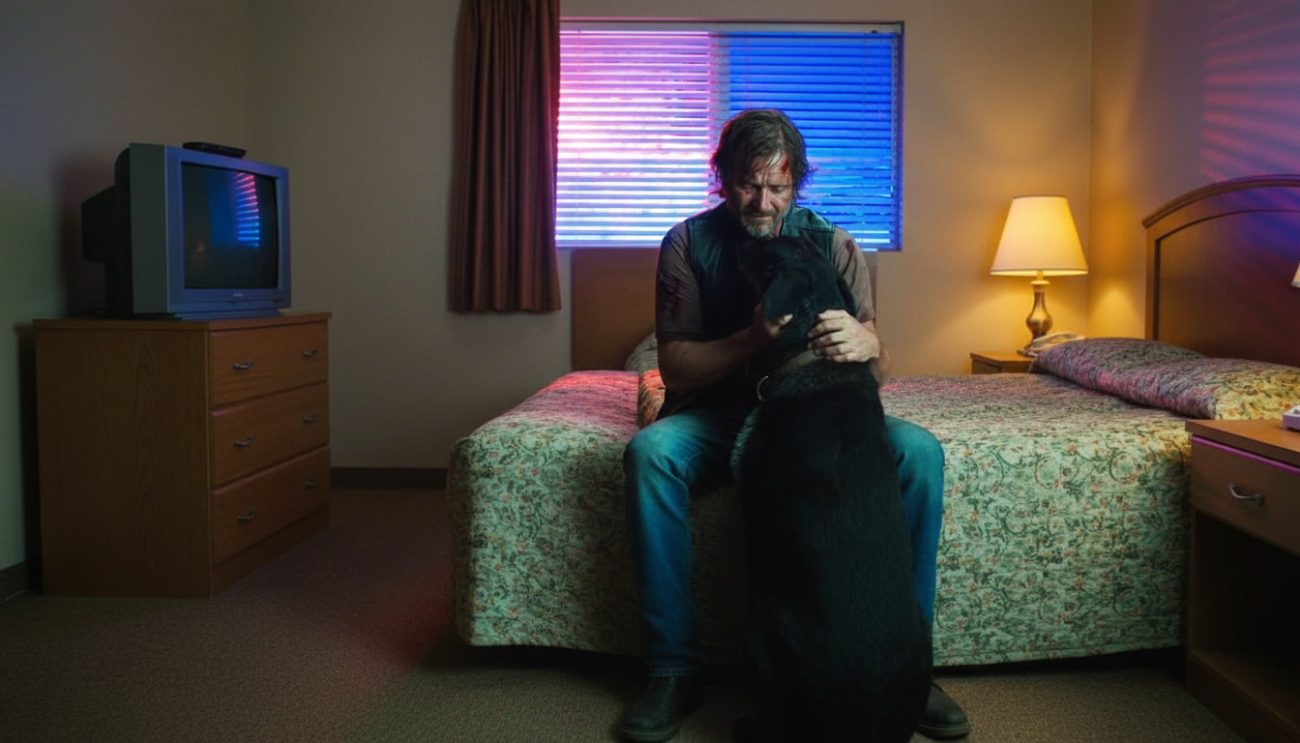
He crawled into my lap. All seventy pounds. Pressed his head into my neck.
“The sky isn’t falling,” I whispered.
We sat there two hours. My legs went numb. I didn’t move.
When the thunder stopped, he licked my chin—one rough swipe—and sighed.
Something loosened in my chest. A knot I hadn’t known was there.
“Okay, Rook,” I whispered. “We figure this out. Together.”
Three days of quiet followed. Rook shadowed me everywhere. He learned my hands were for scratching ears, not hitting. He chewed a rubber toy for the first time. He looked like a dog instead of a victim.
Saturday afternoon. I was in the driveway, carburetor apart, hands black with grease. Rook was lying in a patch of sun.
Gravel crunched at the end of the drive.
Rook’s head snapped up. He went rigid. The toy fell from his mouth.
A beat-up blue sedan rolled up slow. Dark tint. Mismatched bumper.
The driver’s door opened. A guy in his late twenties, stained hoodie, twitchy energy.
He looked past me. Straight at Rook.
“There he is,” he said. Not relieved. Angry.
Rook whimpered and scrambled under the workbench.
I stepped into the center of the driveway.
“Can I help you?”
“Yeah. Give me my dog back.”
“I don’t have your dog.”
“Don’t play dumb, old man. My neighbor saw a guy on a bike take him off the fence. Got your plate.” He stepped forward. “That’s Buster. He’s my property.”
“You mean the dog you left hanging by his neck to die?”
“I was coming back for him. Had business. He was tied up so he wouldn’t run off.”
“He was strangling. The vet said he’s been abused for years.”
His face darkened. “I paid three hundred bucks for that dog. He’s a guard dog. I want him back. Now.”
He moved to walk around me. I put a hand on his chest.
“You’re not touching him.”
“Or what?”
“I call the cops. Show them the vet’s photos. Animal cruelty is a felony here. You want them looking into you?”
His eyes darted. The threat of police rattled him. He had warrants.
Then the passenger door opened.
A bigger man stepped out. Older. Solid. Dead, cold eyes.
“Problem, Marcus?”
“This guy won’t give up the dog.”
The big man walked toward me. “We don’t need police. We just need what’s ours. The dog has… sentimental value.”
“He’s not going with you.” My hand found the wrench on the tool cart.
“You willing to bleed for a stray mutt?”
“Yeah. I am.”
He weighed his options. Wrench. My size. The house.
“Marcus. Get in the car.”
“But—”
“Get in the car.”
Marcus obeyed. The big man stepped closer, voice dropping.
“You keep the dog for now. But here’s the thing—it’s not just a dog. You don’t know what you walked into.” He pointed at my chest. “We’ll be back. Next time, we won’t be asking.”
The sedan peeled out, spraying gravel.
I ran to the garage. Rook was pressed into the wall, shaking, a puddle of urine beneath him.
“They’re gone,” I whispered, kneeling. “They’re gone.”
It’s not just a dog. What the hell did that mean?
I locked every door. Pulled the shades. Sat at the kitchen table, thinking.
Why would criminals come back for a mutt they left to die? Unless it wasn’t about the dog.
Unless it was about what was on the dog.
The collar. The vet had cut it off. Said it was thick, matted into the skin. She threw it in the bio-hazard bin.
I grabbed my keys and drove Rook two towns over. Paid cash at a motel. Searched the Oakwood Lane address on my phone.
A news article from three days ago: “POLICE RAID OWASSO HOME IN DRUG TRAFFICKING INVESTIGATION. SUSPECTS FLEE.”
Drug runners. They’d fled in a hurry. Tied the dog to the fence. But they came back—not for the dog. For whatever was inside that collar.
I wasn’t a Good Samaritan anymore. I was a loose end.
Headlights swept across the motel window. A dark sedan, cruising the parking lot.
They’d followed me.
“Rook. We have to run.”
I opened the motel door. The shadow was already standing there.
I didn’t wait to see a face. I slammed my shoulder into the door, but a heavy boot kicked it back open, sending me stumbling over the carpet.
The Big Man stepped in. Neon light from the parking lot sign buzzed behind him, casting a long red shadow across the floor. Marcus was right behind, jittery, holding a crowbar.
“You’re a hard man to find, Jack.” He wasn’t smiling. He closed the door and locked it.
Rook backed into the bathroom corner, growling—deep, guttural, nothing like the terrified whimper from the garage. Something had shifted in him.
“Get out,” I warned, backing up until my legs hit the bed frame. “Cops are on the way.”
“You’re lying. You’re running. Innocent people don’t run.” He took a step forward. “Now. Where is it?”
“Where is what?” I shouted.
“The collar,” Marcus snapped. “The leather collar he was wearing. It had a lining. Where is it?”
It hit me like a physical blow. The vet. She had cut the collar off. Mentioned it was thick, matted into the skin. Threw it in the bio-hazard bin.
“It’s gone,” I said, and a dry laugh escaped my throat. “The vet cut it off. It’s in a dumpster in Creekview.”
The color drained from Marcus’s face. He looked at the Big Man. “Boss… if the cops find that collar…”
The Big Man’s eyes went dead cold. “Then we have a problem.” He looked at me. “And we have a witness.”
He didn’t hesitate. He lunged.
He hit me like a freight train. We went down hard, crashing through the nightstand. The lamp shattered. Darkness. Red neon flashing outside.
I swung, connected with his jaw. He didn’t flinch. His hands closed around my throat.
“You should’ve kept driving,” he hissed.
Black spots. I clawed at his face. Strength fading.
I thought about my wife. I thought about the silence.
So this is how it ends. In a motel room, over a piece of leather.
A blur of motion from the corner.
Rook.
The dog who was afraid of rain. The dog who flinched at falling leaves.
He launched himself into the Big Man’s side, jaws locking on his forearm with a bone-crushing crunch.
The Big Man screamed—a sound of pure shock and agony. He released my throat to punch at the dog.
“Get off! Get off me!”
Rook didn’t let go. He thrashed his head, growling with a ferocity that made the walls vibrate. Seventy pounds of vengeance. This dog who had been beaten, starved, chained, strangled—this dog who flinched at thunder—was not fighting for himself.
He was fighting for me.
Marcus swung the crowbar, missed Rook by an inch, smashed the TV screen into a shower of sparks.
“Rook, run!” I rasped, gasping for air.
He held on. Took a blow to the ribs from the Big Man’s free fist and just bit down harder. He wasn’t letting go. Not this time. Not ever again.
I grabbed the broken lamp base—heavy brass—and swung it with everything I had.
It connected with the Big Man’s skull.
He crumbled. Went limp.
Rook released instantly, spun around, placed himself between me and Marcus. Teeth bared. Hackles raised. A wall of fur and fury.
Marcus stared at his unconscious boss. At the blood. At the dog.
He dropped the crowbar.
“I didn’t want this,” he stammered. “I just wanted the money.”
Sirens wailed in the distance. Real ones. Louder.
“You better run,” I coughed.
Marcus fled into the night.
I sat up against the bed, chest heaving. “Rook.”
The growl died instantly. The wolf vanished. The puppy returned.
He limped over—favoring the side where the man hit him—and shoved his nose into my neck. Licked the sweat off my face. Checked me for damage.
I wrapped my arms around him and buried my face in his fur. We sat in the dark, broken glass everywhere, the unconscious criminal on the floor, while the room flashed red, then blue, then red, then blue.
The police came first. Two cruisers, lights blazing. Then paramedics. Then more cops. They cuffed the Big Man while he was still out cold on the carpet. They took my statement three times.
A detective named Reeves pulled me aside while the EMT checked my throat.
“You know what they were after?” he asked.
“Something in the dog’s collar,” I said, my voice raw. “The vet in Creekview cut it off days ago. It’s in her bio-hazard disposal.”
Reeves made one call. Twenty minutes later, they had the collar. Forty minutes later, they had the memory card.
It contained names, routes, drop locations, bank accounts—the full architecture of a multi-state trafficking ring, stitched into the lining of a dog collar that nobody was ever supposed to find.
Marcus was picked up three miles from the motel, hiding in a drainage ditch. The Big Man got twenty years. Marcus flipped on three others and still got twelve.
“Biker and Dog Bust Crime Ring.” Big story for a week.
I declined every interview. I just wanted to go home.
SIX MONTHS LATER
The sun is setting over the backyard. I built a new fence—solid wood, six feet high. No gaps. No ropes.
I’m on the porch steps with a cold beer.
Rook is chasing a tennis ball. He’s filled out. Coat shiny and black. You can’t see the scar unless you look for it.
He trots back, drops the ball at my feet, and sits. He leans his weight against my leg—heavy, solid, warm.
He still hates thunderstorms. When the sky goes gray, he climbs into the bathtub, and I sit on the tile floor reading a book until the thunder stops. Every time, without fail.
And I still have bad days. Days when the house feels too quiet. Days when the grief tries to pull me under, when I look at the chair where she used to sit and the air turns to concrete.
But on those days, Rook knows. He comes over, rests his heavy head on my knee, and lets out that long, shuddering sigh. Not asking for anything. Just reminding me: we’re still here. Both of us. Still breathing. Still standing.
The detective called last month. Said the Big Man’s trial was over. Guilty on all counts. Sentencing: twenty-two years federal, no parole. Marcus took a plea. Twelve years. The ring was done. Every last thread pulled apart by a memory card hidden inside a dog collar that was never supposed to be found.
Justice doesn’t always come on time. But it came.
I reach down and scratch Rook behind the ears.
“You’re a good boy, Rook,” I say softly.
He thumps his tail once. Hard.
I used to think I was the hero of this story. That I cut the rope to save him.
But that rope was choking both of us.
I cut him down. And he pulled me up.
That’s not a debt. That’s a life.
Original fictional stories. AI-assisted creative content.
