
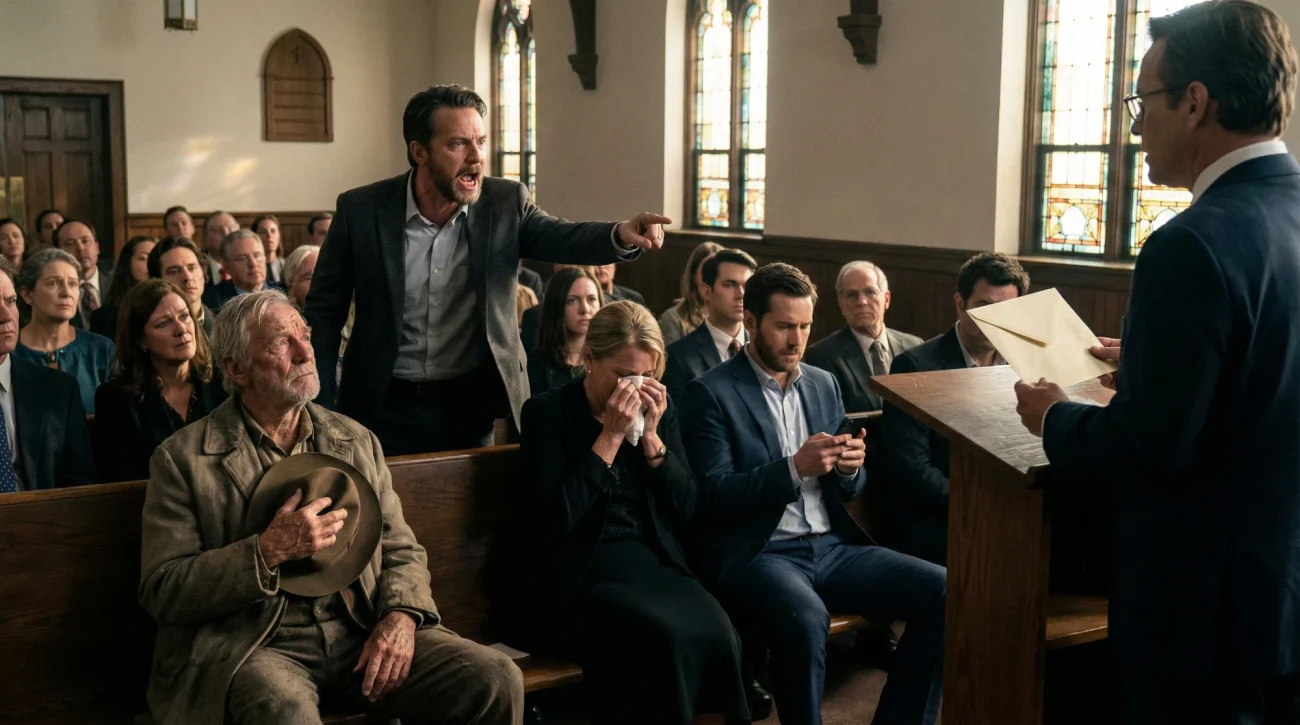
Black suits filled the chapel like a uniform nobody earned.
Fabric brushed fabric. Whispers floated in careful, practiced tones — the kind people use when they want to
sound sad but are really calculating square footage.
Samuel Reed sat in the last row. His coat had seen better decades. His shoes had given up on shine somewhere
around 2006. His hands — scarred, thick-knuckled, honest — held a worn hat against his knees.
Nobody sat near him. There were two empty seats on either side of him, like a quarantine buffer for people who
couldn’t afford to belong.
Nobody looked at him longer than it took to decide he didn’t matter.
A teenage girl in the third row nudged her mother. “Why is that man sitting alone?”
Her mother didn’t look back. “Some people come to funerals they’re not really invited to, sweetheart. It’s
nothing.”
It was everything. But nobody knew that yet.
Near the front, a woman in a charcoal Chanel jacket leaned toward her sister. “Do you know who that is?” she
whispered.
Her sister glanced back. “No idea. Maintenance, maybe?”
“Or someone from the old neighborhood,” a man behind them murmured. “Harold had that charity phase.”
They all nodded like that explained it.
It didn’t.
The family occupied the front two rows like a fortress. Harold Whitmore’s children — Gregory, the eldest,
sharp-jawed and impatient; Diane, the middle child, clutching a handkerchief she hadn’t actually used; and
Kevin, the youngest, who kept checking his phone under his program.
They accepted condolences the way customs agents accept passports. Quick scan. Practiced nod. Next.
Not once did any of them look back.
Samuel watched the casket. Mahogany. Polished. Expensive. Harold would’ve hated it. He always said he
wanted pine. “Bury me cheap, Sam. Spend the rest on bourbon for the wake.”
Samuel’s jaw tightened.
There was no bourbon. There was sparkling water with cucumber slices.
The service was efficient. The eulogies were clean. Gregory spoke for four minutes about “legacy” and “vision”
without once mentioning that his father liked crossword puzzles, old westerns, and black coffee with too much
sugar.
Diane read a poem she’d found on the internet that morning.
Kevin didn’t speak at all.
When it ended, people stood in clusters. Laughter crept in between the tears — business laughter. Cards
changed hands. Someone mentioned a property on the west side. Someone else said “probate” like it was a
dessert they were eager to taste.
Samuel didn’t move.
A woman brushed past him without apology, her elbow catching his shoulder. A man stepped over his foot like
it was part of the furniture.
He said nothing. He’d gotten good at that.
The lawyer — a trim man named Paul Sheldon, mid-fifties, steel-rimmed glasses — stepped to the front and
cleared his throat.
“I’ll need the immediate family to remain,” he announced. “And those named in the will.”
The room shifted like a current had run through it. Postures straightened. Eyes sharpened. Suddenly everyone
was doing math.
Gregory smoothed his tie. Diane set down her water. Kevin finally pocketed his phone.
Samuel stood slowly. His knees cracked. His back protested. But he stood.
A few people noticed. Confusion first. Then irritation.
A woman in pearls stepped into his path. “Sir,” she whispered, the word sharp as a letter opener. “This is for
family.”
He looked at her. Not angry. Not embarrassed. Just tired in a way that went deeper than sleep.
“I know,” he said.
She didn’t move.
“Ma’am,” the lawyer called from the front. “Please let him through.”
Her lips parted. She stepped aside like she’d touched something hot.
Samuel walked forward. Each step sounded louder than it should have. The carpet couldn’t absorb the weight of
what was coming.
Gregory uncrossed his arms just long enough to cross them again. “Who is this?”
“Sit down, Gregory,” Paul said.
“Excuse me?”
“Sit. Down.”
Gregory’s jaw flexed. He sat. But the anger didn’t.
Paul adjusted his glasses and lifted a thick envelope from his briefcase. Cream-colored. Sealed with wax —
actual wax, the old-fashioned kind Harold insisted on.
The sound of the seal breaking was louder than it should have been.
Or maybe the room was just that quiet.
“Before I begin,” Paul said, “I want to make something clear. This will was updated eighteen months ago. It was
witnessed, notarized, and reviewed by two independent attorneys. It is ironclad.”
Gregory leaned forward. “Why are you telling us that?”
Paul didn’t answer him. He looked at Samuel instead.
“Mr. Reed,” he said. “Please stand beside me.”
Whispers detonated across the room.
“What?” Diane said.
“That’s ridiculous,” Kevin muttered, suddenly awake.
Samuel hesitated. Then he walked forward and stood next to the lawyer. Up close, everyone could see it — the
wear on his coat, the cracked leather of his shoes, the scars on his hands from decades of labor. He looked like a
man who had worked every day of his life and never once complained about it.
Paul began reading.
“I, Harold James Whitmore, being of sound mind and body, declare this to be my last will and testament,
revoking all prior wills.”
Standard. Expected. Gregory exhaled. He glanced at Diane with a look that said, “Here comes our payday.”
Diane returned a small nod. They’d talked about this — late-night phone calls, spreadsheets, even a meeting
with their own estate planner. They had plans. Renovation plans. Investment plans. Vacation plans. All of it built
on the assumption that their father’s money was already theirs.
Kevin, meanwhile, was doing the math in his head. Thirty-one percent of Whitmore Industrial alone could clear
his debts and then some. He’d been underwater for two years. Three credit cards maxed out. A condo he couldn’t
afford. An ex-girlfriend threatening to sue over a loan he swore was a gift.
“To my son Gregory,” Paul read, “I leave the framed photograph from my desk. The one of us at the lake, 1989.
It is the last time I remember you looking at me without calculating what I was worth.”
Gregory’s face drained.
“That’s — that’s it?” he stammered.
Paul didn’t pause.
“To my daughter Diane, I leave the set of letters I wrote to her mother during our courtship. Perhaps they will
remind you what love looks like when it isn’t performed for an audience.”
Diane’s hand flew to her chest. “This is cruel.”
“To my son Kevin, I leave nothing. He will understand why, or he won’t. Either way, the result is the same.”
Kevin shot to his feet. “You can’t do this. I’ll contest—”
“Sit down, Kevin,” Paul said, and something in his voice made Kevin obey.
The room buzzed. Relatives shifted. Nieces and nephews exchanged glances. The air tasted like metal.
Paul turned the page.
“Now,” he said. “The remainder of the estate.”
Every ear in the room sharpened to a point.
“The house at 114 Wycliffe Drive, valued at approximately two point four million dollars.”
Silence.
“The investment accounts totaling approximately three point eight million.”
A woman gripped her husband’s arm.
“The shares in Whitmore Industrial, representing a thirty-one percent stake in the company.”
Gregory stood up so fast his chair hit the person behind him. “Those shares are mine. Dad promised—”
“Your father promised you nothing,” Paul said evenly. “I was his attorney for twenty-two years. I have every
conversation documented. You assumed. That is not the same thing.”
Gregory’s mouth opened. Nothing came out.
Paul looked at the room.
“The entirety of the remaining estate,” he read, “is left to Mr. Samuel Reed.”
The explosion was immediate.
“WHO?” Diane shouted.
“This is fraud!” Kevin yelled.
“He manipulated our father!” Gregory roared, pointing at Samuel. “Look at him — he’s a con artist. He preyed
on an old man!”
Samuel said nothing. He held his hat against his chest like a shield.
Paul raised a hand. “I’m going to need everyone to be quiet, or I will have the room cleared.”
“You can’t—”
“I can. And I will. Sit. Down.”
They sat. Shaking. Furious. Terrified.
Paul continued.
“The deceased requested that I read the following statement in full. And I will honor that request.”
He lifted a second page. This one was handwritten. Harold’s handwriting — shaky but deliberate, every letter
pressed hard into the paper.
“If you are hearing this,” Paul read, “then I am gone, and you have gathered. Most of you are here out of
obligation or expectation. Very few of you are here because you loved me.”
Diane pressed her handkerchief — finally — to her eyes.
“Let me tell you about Samuel Reed.”
The room turned to him. He didn’t look up.
“I met Sam forty years ago. He was fixing a fence on the property next to mine. I offered him water. He said he
had his own. I offered again. He said, ‘If you’re going to insist, at least sit down so I don’t have to look up at
you.'”
A few people almost smiled. Almost.
“That was the beginning of the most honest friendship I have ever known.”
Paul paused. Swallowed. Continued.
“Sam never asked me for a dime. Not once. Not when his wife was sick. Not when he lost his house. Not when
he worked double shifts at sixty-seven years old to keep the lights on.”
Samuel’s hand trembled around the brim of his hat.
“But he came every Tuesday. Every single Tuesday for thirty-seven years. Rain, snow, heat. He sat in my
kitchen and drank bad coffee and told me I was a stubborn fool, and I told him he was worse.”
Paul’s voice wavered. He steadied it.
“When Margaret died — Sam’s wife — I was the first person he called. When my own wife left me, Sam drove
forty minutes in a snowstorm to sit on my porch and say nothing for three hours. That was enough.”
Gregory shifted in his seat. His anger was crumbling, replaced by something more uncomfortable.
“My children,” Paul read, and the word landed like a verdict, “visited when it was convenient. Called when they
needed something. Sent flowers on holidays with cards they didn’t write.”
“That’s not fair,” Diane whispered.
“Sam changed my sheets when I couldn’t get out of bed after the hip surgery. Sam drove me to chemo. Sam held
my hand in a waiting room and told me a terrible joke about a duck, and I laughed so hard the nurse thought I
was having a seizure.”
Someone in the back of the room let out a sound between a laugh and a sob.
“Gregory — you called me four times last year. Three were about the company. One was about Thanksgiving,
which you canceled.”
Gregory stared at the floor.
“Diane — you visited twice. Both times you brought a real estate agent to ‘just take a look’ at the house. I was
still living in it.”
Diane’s face crumbled.
“Kevin — I don’t remember the last time you called. I checked my phone records. It was fourteen months ago.
You asked for forty thousand dollars. I sent it. You didn’t say thank you.”
Kevin’s jaw was clenched so tight a vein pulsed in his temple.
“I do not leave my estate to Sam because I am angry. I leave it to him because he earned it. Not with labor. Not
with money. With presence. With loyalty. With the kind of love that doesn’t announce itself.”
Paul set the letter down.
“Sam will not spend it on himself. I know this because I know him. He will probably fix the fence. Donate most
of it. Maybe buy a decent coat for once.”
Samuel let out a small sound. Not quite a laugh. Not quite a cry.
“To my children — I loved you. I loved you in ways you will never understand because you never stayed long
enough to see. But love without presence is just a word. And words were never enough for me.”
Paul folded the letter carefully.
“That concludes the personal statement.”
The silence that followed was unlike any silence the room had ever held. It wasn’t empty. It was full — overfull
— with things that should have been said and done and felt years ago.
Gregory spoke first. His voice was hoarse.
“Can we contest this?”
Paul looked at him. “You can try. Two independent attorneys, a notary, and a detailed capacity assessment will
make it difficult. Your father anticipated this.”
“He was manipulated,” Gregory said, but the conviction was gone. He sounded like a man trying to start a car
with a dead battery.
“Your father was sharper at eighty-four than most people are at forty,” Paul said. “And he made this decision
with complete clarity.”
“I want copies of everything,” Diane said. Her voice was controlled, but her hands shook.
“You’ll receive them within the week.”
Kevin stood. He walked toward Samuel. The room tensed.
Kevin stopped two feet away. His eyes were red. His fists were balled.
“Did you make him do this?” he asked.
Samuel finally looked up. His eyes were wet but steady.
“Your father asked me to come fishing with him last March,” Samuel said quietly. “I asked him if you three
were coming. He laughed and said, ‘Sam, they don’t even know I fish.'”
Kevin opened his mouth. Closed it. Turned and walked out of the room.
Diane followed a moment later. She stopped at the door and looked back at Samuel. Something passed across
her face — not forgiveness, not understanding, but the raw, uncomfortable beginning of recognition.
Then she was gone.
Gregory was last. He stood slowly. He walked to Samuel and stopped.
“He really talked about me?” Gregory asked.
“Every Tuesday,” Samuel said. “Every single one.”
Gregory’s chin trembled. “What did he say?”
“He said you were brilliant. And that it broke his heart you never used it on anything that mattered.”
Gregory closed his eyes. He nodded once — not in agreement, but in the way people nod when they’ve been hit
with something too true to argue with.
Then he left.
But he didn’t go far. He stood in the hallway outside the chapel doors, staring at a painting on the wall he
couldn’t actually see because his vision was blurred.
His phone buzzed. A text from his wife: “How much?”
He stared at it for a long time. Then he typed: “Nothing.”
Three dots appeared. Then: “WHAT?”
Gregory turned his phone off and put it in his pocket.
Down the hall, Diane sat on a bench with her head in her hands. Kevin stood near the exit, staring through the
glass doors at the parking lot like it held answers.
A woman from the congregation — a cousin, maybe — approached Diane carefully. “Are you okay?”
“He left me letters,” Diane said, almost to herself. “Love letters he wrote to my mother. That’s what I got.”
The cousin hesitated. “That’s… actually kind of beautiful.”
Diane looked up, mascara streaked. “It’s a punishment. He’s telling me I don’t know what love is.” She paused.
“And he might be right.”
Outside, Kevin leaned against the glass and called someone. It rang four times.
“Yeah?” a voice answered.
“The money’s gone,” Kevin said flatly. “All of it. Some old guy got everything.”
A long pause on the other end. “What old guy?”
“His name is Samuel Reed. I’ve never heard of him in my life.”
“Can you fight it?”
Kevin rubbed his face. “The lawyer said it’s ironclad. Two witnesses, a notary, a psych eval. Dad planned this
like a military operation.”
“So what are you going to do?”
Kevin didn’t answer. He hung up and pressed his forehead against the cool glass. For the first time in years, he
had no play, no angle, no shortcut. Just the empty, ringing truth that he had treated his father like an ATM, and
the ATM had finally shut off.
The room emptied. The business cards, the whispers, the performative grief — all of it drained away like
bathwater.
Samuel stood alone with Paul.
“You okay?” Paul asked.
Samuel looked at the casket. “He told me about this two years ago. I told him to leave it to the kids. Give them a
chance.”
“He said you’d say that.”
“What did he say back?”
Paul almost smiled. “He said, ‘Sam, I gave them forty years of chances. They used every single one to
disappoint me.'”
Samuel put his hat on. It fit the way old things fit — perfectly, through persistence.
“What are you going to do?” Paul asked.
Samuel reached into his coat pocket and pulled out a small photograph. Creased. Faded. Two men on a porch,
beers in hand, grinning at the camera like the world was something to laugh at.
“He gave me this twenty years ago,” Samuel said. “Told me to keep it in case he ever forgot who he was. I never
had to show it to him. But I kept it anyway.”
Paul looked at the photograph. Harold looked healthy in it. Happy. Young in a way that had nothing to do with
age.
“He talked about you every time I saw him,” Paul said. “You know that?”
“He talked about them too,” Samuel said, nodding toward the hallway where the children had gone. “That was
the hard part. He never stopped loving them. He just stopped pretending they loved him back.”
Paul was quiet for a moment. “For what it’s worth, I think the letter will stay with them. It’s the kind of thing
you read once and never forget.”
“Maybe,” Samuel said. “Or maybe they’ll hire a lawyer and try to take it all. People do strange things when
money’s involved.”
“Let them try. Harold was thorough.”
Samuel nodded. He put the photograph back in his pocket, right over his heart. Old habit.
Samuel walked toward the casket. He placed his hand flat on the polished wood — the expensive, wrong wood
Harold never wanted.
“I’m going to fix the fence,” he said. “Then I’m going to set up a trust for the grandkids. The ones who might
still turn out different.”
“And the house?”
“I’ll live in it. Someone should. Harold hated an empty house.”
Paul extended his hand. Samuel shook it. Firm. Honest. The way handshakes used to be.
“He was lucky to have you, Sam.”
“No,” Samuel said. “I was lucky to have him. Most people go their whole life without a friend who tells them
the truth.”
He walked past the casket, down the aisle, and through the chapel doors into the gray afternoon light.
The sun broke through the clouds for exactly long enough to warm his face.
He tilted his hat back, looked up, and said, “You always did have lousy timing, Harold.”
A bird landed on the railing near the chapel steps. It sat there for a moment, head cocked, watching him. Samuel
shook his head and smiled — a real smile, the first one that day.
“Yeah, yeah,” he muttered. “I’m going.”
Then Samuel Reed walked to his truck, turned the key, and drove home — to a house that was now his, to keep
a promise that would never expire, carrying a friendship that death itself could not dissolve.
Original fictional stories. AI-assisted creative content.
