
The eviction notice was taped to the door like a death sentence.
Denise Warren saw it the moment she turned the corner onto Birch Lane — a white rectangle on the green paint of the front door, flapping in the November wind. She was carrying two grocery bags and her daughter Zoe’s backpack because Zoe was seven and believed that backpacks were for mothers to carry, not children.
“Mama, what’s that paper?” Zoe asked.
Denise set the bags down on the porch. She pulled the notice off the door and read it three times. The words didn’t change no matter how many times her eyes went over them.
NOTICE OF EVICTION. VACATE WITHIN 72 HOURS. BY ORDER OF CARVER COUNTY COURT. PROPERTY TRANSFERRED TO RIDGEMONT DEVELOPMENT GROUP.
“Mama?”
“Go inside, baby. Find your coloring book. I need to make a phone call.”
Denise Warren was thirty-four years old. She had grown up in Greyfield, North Carolina — a town of eight thousand people tucked between tobacco fields and pine forest, the kind of place where families stayed for generations because leaving required money nobody had.
She’d been born in this house. Her grandmother had bought it in 1971 for eleven thousand dollars, paid off the mortgage in fifteen years, and left it to Denise’s mother, who left it to Denise. Three generations of Warren women under one roof. The foundation had cracks. The kitchen faucet dripped. The porch railing needed replacing every few years. But it was theirs. Free and clear. No mortgage. No debt.
Or so Denise thought.
She’d been working double shifts at the hospital — weekday nursing at Greyfield General, weekend home care for elderly patients — ever since Zoe’s father Marcus left four years ago. Marcus had been charming and useless in equal measure, the kind of man who could talk his way into any room and out of any responsibility. He was in Charlotte now, or maybe Raleigh, or maybe nowhere. Denise had stopped tracking.
The point was: she worked. She paid her taxes. She kept the house. She kept her daughter fed and clothed and in a school where the teachers knew her name. She did everything right.
And now there was an eviction notice on her door.
She called the county clerk’s office the next morning at eight sharp.
“Carver County Clerk, how can I help you?”
“My name is Denise Warren. I’m at 412 Birch Lane. There’s an eviction notice on my door and I need to know why, because I own this house outright.”
Keyboard clicking. A long pause.
“Ma’am, according to our records, the property at 412 Birch Lane was transferred via tax lien sale to Ridgemont Development Group on September fourteenth.”
“Tax lien? What tax lien?”
“It shows unpaid property taxes for three consecutive years. The county filed a lien, and when it wasn’t resolved, the property was sold at auction.”
Denise gripped the phone so hard the plastic creaked.
“I have paid my property taxes every single year. I have the receipts. Every January, I walk into your office and I pay in person because my grandmother told me to never trust the mail with money.”
Another pause.
“Ma’am, I can only tell you what’s in the system. The system shows three years of unpaid taxes.”
“Then your system is wrong.”
“You’re welcome to file a dispute. The process takes six to eight months.”
“I have seventy-two hours.”
“I understand, ma’am. But—”
Denise hung up.
She stood in her kitchen and stared at the eviction notice on the table. Zoe was at school. The house was quiet. The faucet dripped.
Three years of unpaid taxes. She had paid every year. She had the receipts in a shoebox in the closet — handwritten receipts from the clerk’s office, stamped and dated. She went to the closet, pulled down the box, and spread the receipts on the kitchen table.
- Paid. Stamped.
- Paid. Stamped.
- Paid. Stamped.
All three. All real. All in her name.
Someone had erased her payments from the system.
The law office of Gerald Pratt occupied a converted house on Main Street, between a barbershop and a bail bonds office. It was the only legal aid clinic within forty miles.
Gerald Pratt was seventy years old, half-retired, and spent most of his time fishing. But he still took cases when something smelled wrong, and Denise Warren’s case smelled like a landfill.
“Sit down, Denise.”
She sat. She put the shoebox of receipts on his desk.
Gerald put on his reading glasses and examined each receipt carefully. He held them up to the window light. He checked the stamps.
“These are real,” he said.
“I know they’re real. I was there when they stamped them.”
“Who took your payment at the clerk’s office?”
“Same woman every year. Linda Hodges.”
Gerald set the receipts down. He leaned back in his chair and rubbed his eyes.
“Denise, do you know what Ridgemont Development Group is?”
“Some company that bought my house out from under me.”
“Ridgemont Development Group is a shell company. I’ve seen their name three times this year. Three different families in Greyfield, all in the same neighborhood, all got eviction notices. All claimed they’d paid their taxes. All lost their homes.”
Denise felt the blood drain from her face.
“Three families?”
“The Harrisons on Oak Street. The Petersons on Elm. And now you.” Gerald took off his glasses. “All three properties are in the Birch-Oak corridor. You know what’s happening on the east side of town?”
“The new development. The shopping center.”
“A hundred-and-forty-million-dollar mixed-use development. And guess which three properties are sitting right in the path of the access road they need?”
Denise’s hands went flat on the desk.
“Someone is stealing our houses.”
“Someone is deleting your tax payments from the county system, triggering a lien, and buying the properties at auction for pennies.” Gerald stood up and walked to the window. “The county clerk is a man named Dale Richter. He was appointed last year by the county commission. Before that, he was a real estate consultant.”
“For who?”
Gerald turned around.
“For Ridgemont Development Group.”
Denise didn’t sleep that night.
She sat at the kitchen table with her laptop — the old one Zoe used for homework — and searched everything she could find. Ridgemont Development Group. Dale Richter. The Birch-Oak corridor project. She printed articles at the library the next morning. She made a timeline on notebook paper. She called the Harrisons and the Petersons.
Patricia Harrison cried on the phone. “We’ve been living in my sister’s basement for two months. They took our house while we were at church.”
Earl Peterson was angrier. “I went to the clerk’s office with my receipts. They said the receipts were fraudulent. Called me a liar to my face.”
Denise stared at her receipts on the table. The same ones the same office had stamped and handed back to her with a smile.
“They’re going to say the same thing to me,” she said.
“Probably,” Earl said. “They’ve got the system. We’ve got paper.”
“Paper is enough,” Denise said. “If you show it to the right person.”
Gerald Pratt filed an emergency motion to halt the eviction. The judge — a man named Howard Kemper — denied it within four hours.
“Four hours?” Denise said, standing in Gerald’s office. “He didn’t even look at it.”
“He looked at it. He just didn’t care.” Gerald sat down heavily. “Judge Kemper and Dale Richter go to the same church. Their wives are in the same book club. This is Greyfield, Denise. These people have dinner together.”
“So what do we do?”
“We go over his head. State attorney general’s office. But that takes time.”
“I have forty-eight hours left.”
“I know.”
Denise picked up her folder — the one she’d assembled with every receipt, every printout, every piece of the timeline — and held it against her chest.
“Gerald, if I lose this house, I lose everything. My grandmother’s house. My mother’s house. My daughter’s home. Everything three generations of Warren women built.”
Gerald looked at her over his glasses. His eyes were tired but sharp.
“Then don’t lose it.”
Gerald got the call from a journalist that same afternoon.
A reporter from the Raleigh News & Observer named Kim Sato had been investigating Ridgemont Development Group for three months. She’d found the shell company, traced it back to Dale Richter, and hit a wall because none of the affected families had kept their original receipts.
“I have a client who kept every receipt,” Gerald said. “Stamped, dated, in a shoebox.”
Kim Sato was in Greyfield by the next morning.
Denise sat across from Kim in Gerald’s office and laid out the folder. Every receipt. The timeline. The printouts. The names of the three families. The connection between Richter and Ridgemont. The judge who denied the motion in four hours.
Kim recorded everything. She photographed every receipt.
“Denise, this is the missing piece. The receipts prove the payments were made and then deleted. That’s not a clerical error. That’s fraud.”
“I know what it is.”
“If I publish this, it’s going to blow up. Are you ready for that?”
Denise looked at her. “I’ve been ready since the moment they put that paper on my door.”
The article ran on a Sunday.
Front page, above the fold. “STOLEN HOMES: How a County Clerk and a Shell Company Are Evicting Families to Build a Shopping Center.” Kim Sato’s byline. Denise Warren’s receipts photographed in full color.
By Monday morning, the state attorney general’s office had opened an investigation. By Tuesday, Dale Richter was suspended. By Wednesday, Judge Kemper recused himself from all property cases in Carver County. By Thursday, Ridgemont Development Group’s bank accounts were frozen.
Other families came forward — not three, but eleven. Eleven families in the Birch-Oak corridor who had been told their taxes were unpaid. Seven had already lost their homes. Four had fought back, and all four had been denied by Kemper’s court.
Gerald Pratt’s fishing retirement was officially over.
The hearing was scheduled for January, at the Carver County Courthouse.
Denise didn’t want to go back into that building. Kemper’s building. Richter’s building. The building where her emergency motion had been killed in four hours. But Gerald said she had to.
“The state judge is coming here. Courtroom Three. You testify, you show the receipts, we win.”
“And if they try to stop me?”
“Nobody’s going to stop you, Denise.”
He was wrong.
She arrived at the courthouse at eight-thirty in the morning.
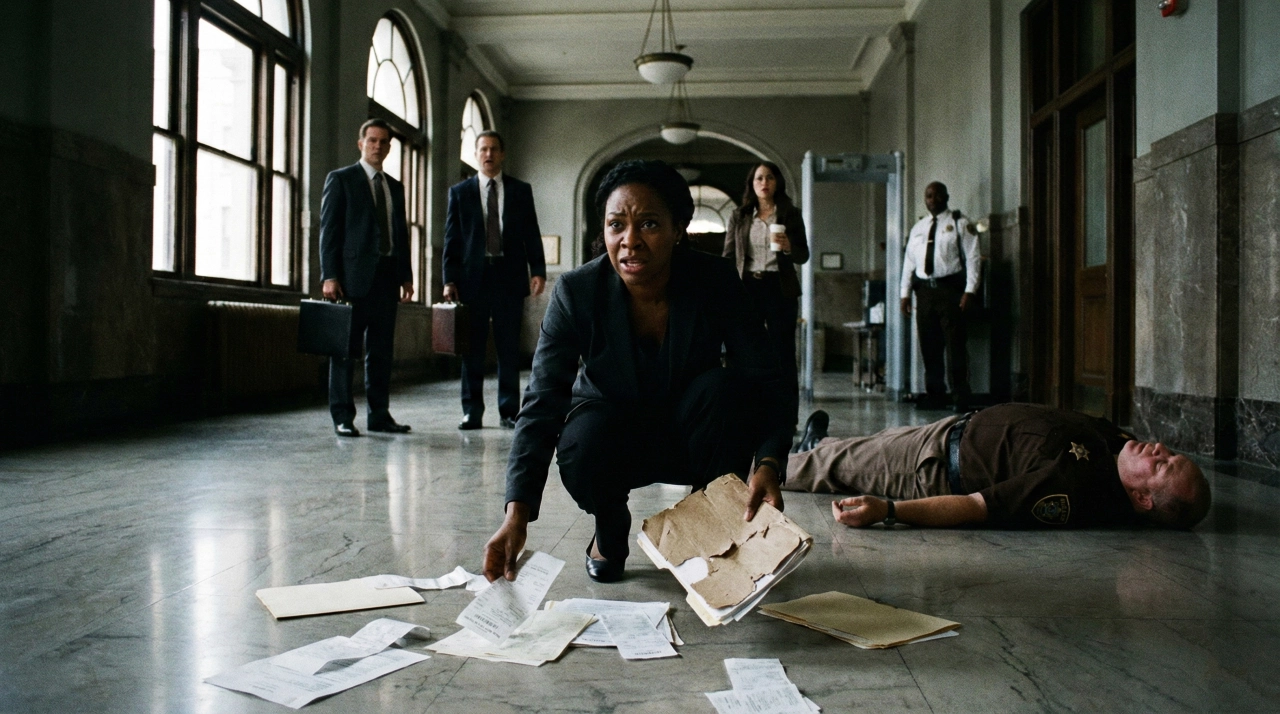
Dark blazer. The same one she wore to her mother’s funeral. The folder pressed against her chest — receipts, timeline, printouts, everything. Her heels clicked on the marble floor of the main hallway. The sound echoed off the high ceilings and bounced between the stone walls. The place smelled like floor wax and old authority.
Courtroom Three was at the end of the corridor. Denise walked fast. Her heart was pounding but her legs were steady. She’d rehearsed her testimony with Gerald a dozen times. She knew every date, every receipt number, every dollar amount. She was ready.
She didn’t see Holt until she heard his boots.
Deputy Marshal R. Holt. The same man who had come to her porch with the locksmith kit. The same man who had tried to change her locks while Zoe ate breakfast upstairs. He was behind her, half-jogging down the marble corridor, slightly winded, his utility belt jangling with each step.
Denise kept walking. Faster.
“Ms. Warren,” Holt called out. His voice bounced off the marble. “Ms. Warren, stop.”
She didn’t stop. Courtroom Three was fifty feet away. Forty. Thirty.
Holt picked up his pace. He was close now — close enough that she could hear his breathing, heavy and short, and the contempt in his voice when he spoke again.
“Get out of here…” he said, sneering, each word dripping with disdain. “You don’t belong here anymore.”
And as the last word left his mouth, his hand grabbed her shoulder from behind.
Everything went still.
Three generations. Grandmother. Mother. Daughter. Eleven thousand dollars in 1971. A lifetime of taxes paid by hand. A shoebox of receipts. A seven-year-old girl who asked “Are we home for real?” And now this man — this uniform, this badge, this hand on her shoulder — was trying to stop her from walking into a courtroom where the truth was waiting.
Denise dropped the folder.
She pivoted on one foot. Her whole body spun — hips, shoulders, leg — and she drove a full spinning back kick straight into Holt’s chest.
The impact was solid. Holt’s eyes went wide. His hands flew up. He stumbled backward and fell flat on his back, hitting the marble floor hard. The sound cracked through the corridor like a judge’s gavel.
Pages scattered everywhere. Receipts. Printouts. The timeline. Three years of proof, fanned across the marble like a deck of cards.
Denise stood in her follow-through stance, one foot forward, breathing hard, eyes locked on the man on the floor. Zero hesitation. Zero regret.
Holt lay on his back, mouth open, gasping, staring up at her. He didn’t move. He didn’t speak.
People had stopped in the hallway. A clerk with a coffee cup. Two lawyers with briefcases. A security guard by the metal detector. All frozen. All watching.
Denise crouched down. She picked up the scattered pages one by one. She stacked them. She tapped the edges neat against the marble floor. She slid them back into the folder.
Then she stood, straightened her blazer, and walked the remaining twenty feet to Courtroom Three.
She didn’t look back.
Inside the courtroom, the state judge — Diane Okonkwo — was already seated. The room was packed. Patricia Harrison was in the second row, twisting a tissue. Earl Peterson sat with his arms crossed, jaw tight. Kim Sato had a notebook open. Gerald Pratt was at the plaintiff’s table, glasses on, papers spread.
Dale Richter sat at the defense table with two expensive lawyers. He looked smaller than Denise had imagined. Thin, pale, sweating.
Denise walked to the front, placed the folder on the evidence table, and sat down.
Gerald leaned over. “You all right? I heard something in the hallway.”
“I’m fine.”
“Denise—”
“I’m fine, Gerald. Let’s go.”
The state’s attorney laid out the case. Deleted tax records. Fabricated liens. A shell company buying properties at auction for fractions of their value. A county clerk who received two hundred and sixty thousand dollars in “consulting fees” from Ridgemont over eighteen months.
When it was Denise’s turn to testify, she placed her receipts on the evidence table one by one.
“This is 2022. This is 2023. This is 2024. All paid. All stamped by Linda Hodges at the Carver County clerk’s office. All deleted from the system by Dale Richter.”
The state’s attorney asked: “Ms. Warren, why did you keep paper receipts?”
Denise looked at the judge.
“Because my grandmother told me to. She said, ‘Baby girl, the system wasn’t built for us. Always keep your paper. Paper doesn’t forget.'”
A murmur ran through the courtroom.
Judge Okonkwo looked at the receipts. She looked at Dale Richter.
“The court finds sufficient evidence to proceed with criminal charges against Dale Richter for fraud, conspiracy, and abuse of public trust. All evictions executed under the fraudulent lien scheme are hereby reversed. Properties are to be returned to their rightful owners immediately. Mr. Richter is remanded into custody.”
Richter’s lawyers started talking. Richter himself turned white.
Denise didn’t move. She sat perfectly still, folder on her lap, and let the words wash over her.
Reversed. Returned. Immediately.
Behind her, Patricia Harrison sobbed. Earl Peterson stood up and said “Thank God” loud enough for the whole courtroom to hear.
Gerald Pratt, sitting next to Denise, put his hand on her arm.
“You did it.”
Denise looked down at the folder. The same pages that had been scattered across the courthouse marble ten minutes ago. Her grandmother’s receipts. Her mother’s house. Her daughter’s home.
“We did it,” she said. “All of us.”
On the way out of the courtroom, Deputy Marshal Holt was standing by the hallway wall. He had an ice pack pressed to his chest. His face was blank. Two other officers stood nearby.
Denise walked past him. She slowed but didn’t stop.
“For the record,” she said, not looking at him, “I do belong here. I belong everywhere I choose to stand.”
Holt said nothing. Denise kept walking. Her heels clicked on the marble. The sound echoed down the corridor like a heartbeat.
The drive back to Greyfield took three hours.
Denise picked up Zoe from Dorothy’s house and drove home in silence. Zoe fell asleep in the car seat, her head tilted against the window, a crayon still in her hand.
When Denise pulled into the driveway at 412 Birch Lane, the porch light was on. The green paint. The cracked steps. The railing that needed replacing.
Home.
She sat in the car for five minutes, hands on the steering wheel, engine off. She didn’t cry. She was past crying. She was in that place beyond tears where everything is quiet and clear and you can feel the weight of what you almost lost pressing down on your chest like a stone.
Then Zoe stirred.
“Mama? Are we home?”
“Yeah, baby. We’re home.”
“For real?”
Denise looked at the house. The porch light glowed warm against the dark.
“For real. Forever.”
She carried Zoe inside. She put her to bed. She kissed her forehead and pulled the blanket up to her chin and stood in the doorway of her daughter’s room, listening to her breathe.
Then she went downstairs and sat at the kitchen table. The faucet dripped. The house creaked in the wind. Everything was exactly the same as it had been before the eviction notice, and everything was completely different.
She opened the shoebox one more time and looked at the receipts. Three pieces of paper. That’s all that stood between her family and the street. Three pieces of paper that a dead woman had taught her to keep.
“Thank you, Grandma,” she whispered.
The faucet dripped. The wind blew. And Denise Warren, in the house where she was born, finally closed her eyes.
Six months later, Dale Richter was sentenced to nine years in federal prison.
Ridgemont Development Group was dissolved. Its assets were seized and distributed among the eleven families. The Birch-Oak corridor development project was canceled. In its place, the county broke ground on a community center — named, at the town’s insistence, the Rose Warren Community Center, after Denise’s grandmother.
Gerald Pratt went back to fishing. But he kept a framed copy of the Raleigh News & Observer front page on the wall of his office.
Patricia Harrison moved back into her house on Oak Street. She planted roses in the front yard.
Earl Peterson moved back into his house on Elm. He replaced the mailbox the developers had ripped out.
And Denise Warren fixed the kitchen faucet.
She did it on a Saturday morning while Zoe colored at the table. It took a five-dollar washer and twenty minutes. Forty years of dripping, fixed in twenty minutes.
“Mama, the water stopped,” Zoe said.
“I know, baby.”
“It was always dripping.”
“Not anymore.”
Zoe went back to her coloring. Denise stood at the sink and ran her hand along the counter — the same counter where Grandma Rose had rolled biscuit dough, where her mother had stacked bills on paydays, where Denise had spread out eviction notices and tax receipts and evidence of a conspiracy designed to steal her life.
The counter was clean now. The faucet was silent. The house was hers.
On the mantel in the living room, next to the photo of Grandma Rose and the photo of Denise’s mother, there was a new frame. Inside it was a single tax receipt — 2022, paid, stamped — with a handwritten note beneath it in Denise’s careful script:
“Paper doesn’t forget. Neither do we.”
Original fictional stories. AI-assisted creative content.
