
Viktor Hale hadn’t looked at another human being — really looked — in eleven years.
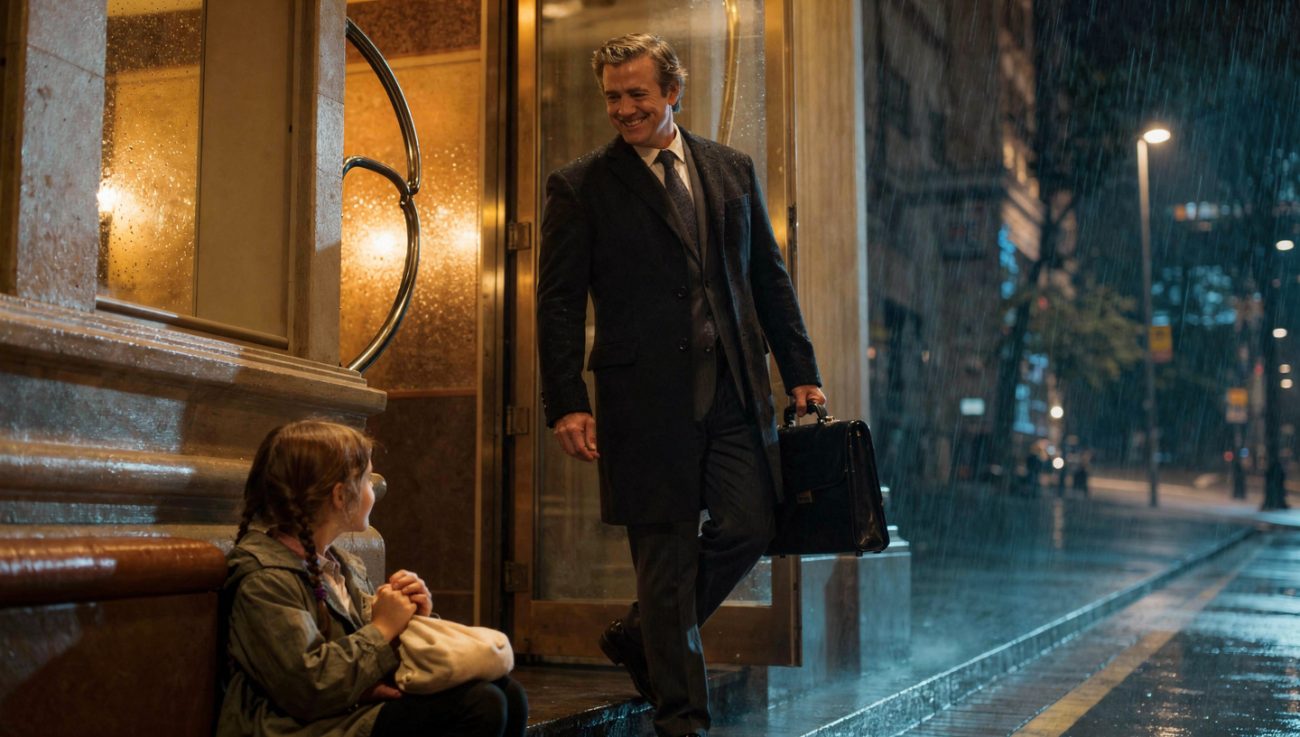
He stepped out of the Meridian Grand Hotel at 9:47 PM, already two minutes behind schedule. Rain slicked the sidewalk. His driver waited at the curb. Between them sat a girl.
She was maybe nine. Maybe ten. Thin coat, cloth bag on her lap, shoes held together with duct tape. She sat on the marble step like she belonged there more than anyone inside.
Viktor’s instinct was to walk past. He’d perfected that skill. Thirty years of building an empire meant learning which distractions to ignore.
But something made him stop.
She was humming.
Not aimlessly. Not the tuneless drone of a restless child. She was humming a Chopin nocturne — Op. 9, No. 2 — with the phrasing of someone who understood loss.
“Where did you learn that?” he asked before he could stop himself.
The girl lifted her gaze. Her eyes were calm. Far too calm for a child who had learned early how to survive without comfort.
“I’m listening,” she replied softly.
Viktor frowned. “Listening to what?”
She tilted her head slightly toward the lobby doors. “The piano. It sounds like it’s sad… but trying not to be.”
He turned. Inside, a pianist played for a half-empty lobby, the notes echoing gently against marble walls. Viktor hadn’t noticed it. He rarely noticed anything that didn’t involve numbers, contracts, or screens.
“And why does that matter to you?” he asked.
The girl hesitated. She reached into her cloth bag and pulled out a folded photograph. She didn’t hand it to him. She just held it close, like armor.
“My mother used to play,” she said. “Before she got sick. When she played, it felt like the world stopped hurting for a little while.”
Something shifted behind Viktor’s ribs. A door he’d sealed shut years ago cracked open an inch.
“What’s your name?” he asked.
“Liliana.”
“Liliana.” He repeated it like it weighed something. “You shouldn’t be sitting out here. Where are your parents?”
She looked down. “My father left when I was little. My mother passed last winter.”
“Who takes care of you now?”
“I stayed with neighbors for a while. The Delgados. Then Mrs. Delgado got transferred and there was no more room.” She said it plainly, without self-pity, which made it worse. “I’ve been okay.”
Rainwater dripped from the hotel’s awning. The city resumed its hum. Viktor glanced at his watch. He had a meeting upstairs. Important people were waiting. A $40 million deal was sitting in a conference room on the fourteenth floor.
Yet his feet didn’t move.
“You’re hungry,” he said. Not a question.
Liliana nodded once. “But it’s okay. I’m used to waiting.”
That sentence struck him harder than any accusation, any lawsuit, any boardroom betrayal ever had.
Viktor exhaled slowly. “Come inside. Just to get warm.”
She hesitated, eyes flicking to the polished doors. “I won’t cause trouble.”
“I know,” he replied quietly.
Inside, the warmth wrapped around her instantly. The pianist noticed them enter and softened the melody, as if making room for something fragile.
Viktor led her to a corner booth. The maître d’ raised an eyebrow. Viktor silenced it with a look.
“Bring soup,” Viktor said. “Bread. Hot chocolate. Whatever she wants.”
Liliana sat very still. Her hands were folded in her lap. She watched the pianist with an expression Viktor couldn’t name — hunger, yes, but not for food. Hunger for something she’d lost.
The soup arrived. She ate slowly, carefully, as if afraid the moment might vanish if she rushed it.
“Thank you,” she whispered after the first spoonful.
Viktor’s phone buzzed. A text from his CFO: Where are you? Chen is getting impatient.
He typed back: Start without me.
Three dots appeared. Then: Viktor, this is the Chen deal.
He set the phone face-down on the table.
“What do you want to be when you grow up?” he asked.
Liliana smiled for the first time. It transformed her face entirely — from weathered survivor to the child she still was.
“I want to play music,” she said. “Not to be famous. Just… to help people breathe when life feels heavy.”
Viktor looked away. His jaw tightened.
Twenty-six years ago, he’d said almost the same thing to his own mother. He’d been fourteen, sitting at an upright piano in a one-bedroom apartment in Cleveland, and he’d told her, “I want to make people feel something, Mom.”
She’d smiled and said, “Then do that, Viktor. Whatever else happens, do that.”
He hadn’t. He’d chosen finance. Then real estate. Then acquisitions. The piano collected dust. Then it was sold. Then he forgot it existed.
Until now.
“Can I hear you play?” Viktor asked.
Liliana’s eyes widened. “I haven’t played in a long time. Not since Mom.”
“That’s okay.”
He stood and walked to the pianist — a man named Gerald, according to the small placard. Viktor leaned in and spoke quietly. Gerald nodded, smiled, and stood from the bench.
Liliana approached the piano like someone approaching an old friend they weren’t sure would remember them. She sat down. Her feet barely reached the pedals.
She placed her fingers on the keys. They trembled.
Then they steadied.
She played.
The melody was simple. Gentle. Sad, but trying not to be. It filled the lobby the way light fills a room when curtains are drawn back for the first time in months.
The few guests scattered around the lobby stopped their conversations. A bartender set down a glass mid-pour. A woman near the fireplace pressed her hand to her mouth.
Viktor stood completely still.
When the last note faded, silence held the room. Then, softly, applause.
Liliana looked up at Viktor. “Was that okay?”
His voice came out rough. “That was more than okay.”
His phone buzzed again. Then again. Then a call. He silenced it.
“Liliana, I need to make some calls. Not about business. About you.”
She stiffened. “Are you calling the police?”
“No.”
“Social services?”
“I’m calling people who can help. Real help. Not the kind that shuffles you around and loses your file.”
She studied him with those old, careful eyes. “Why?”
“Because someone should have done this months ago,” he said. “And because I almost walked past you tonight.”
Viktor made calls he had avoided for years. Not to his usual contacts — not investors or board members. He called Margaret Calloway, a family law attorney he’d once helped with a property dispute. He called David Reese, who ran a children’s advocacy nonprofit. He called Dr. Priya Nolan, a child psychologist he’d met at a fundraiser and promptly forgotten.
“I need your help,” he told each of them. “Not for a deal. For a kid.”
Margaret called back within the hour. “Viktor, this isn’t simple. There’s a process. Background checks, foster certification, court petitions—”
“I don’t care how long it takes. Start tonight.”
“It’s eleven PM.”
“Margaret.”
A pause. “I’ll make some calls.”
David Reese was more cautious. “Viktor, I’ve seen billionaires adopt kids for the press cycle. If that’s what this is—”
“It’s not.”
“How do I know that?”
Viktor was quiet for a moment. “Because I haven’t called my publicist. I’ve called you.”
David paused. “Okay. I’m listening.”
That night, Liliana slept in a hotel room for the first time in her life. Viktor arranged for a female staff member to stay with her. He sat in the hallway until midnight, answering emails he’d ignored for hours, but his mind wasn’t on any of them.
His CFO called at 12:30 AM. “Chen walked. The deal is dead.”
Viktor stared at the ceiling. Forty million dollars. Gone.
“Okay,” he said.
“Okay? Viktor, that’s eighteen months of—”
“I heard you. Schedule a call with Chen’s people for Monday. If it’s dead, it’s dead.”
Silence on the line. Then: “What happened to you tonight?”
Viktor didn’t answer.
The weeks that followed were the hardest of Viktor’s life — and not for any reason his board would understand.
Liliana was enrolled in temporary foster care while the legal process moved forward. Viktor visited every other day. He brought books. Sheet music. A small keyboard that fit in her room.
She was quiet at first. Guarded. Trust came slowly — not in leaps, but in millimeters.
“You keep coming back,” she said one afternoon, almost suspiciously.
“Yes.”
“People don’t usually do that.”
“I know.”
She looked at the keyboard. “Will you listen if I play something?”
“Always.”
She played a piece she’d composed herself. It was raw, unpolished, full of mistakes — and it was the most honest thing Viktor had heard in decades.
“That’s yours?” he asked.
She nodded. “I wrote it for my mom. I call it ‘Still Here.'”
Viktor’s throat tightened. “She’d be proud of you.”
Liliana’s eyes glistened. “You think so?”
“I know so.”
Margaret called on a Tuesday morning. “The petition’s been filed. But Viktor, the judge is going to scrutinize this. A single man, no prior parenting experience, workaholic reputation — they’re going to ask hard questions.”
“I’ll answer them.”
“They’ll ask about your schedule. Your travel. Your lifestyle.”
“I’ll change it.”
Margaret paused. “You mean that?”
“Margaret, I built a company from nothing. I can restructure my life.”
“Building a company and raising a child are fundamentally different.”
“I know. That’s the point.”
Two months in, Viktor got a call from someone he hadn’t expected to hear from: Richard Hale. His father.
“I hear you’re trying to adopt some kid,” Richard said. No greeting. No warmth. That was Richard.
“Her name is Liliana.”
“Viktor, I’m going to be direct. This is a liability. You’re a public figure. If this goes sideways—”
“It won’t.”
“You don’t know that. Kids are unpredictable. What if she has behavioral issues? What if the press gets hold of this? What if someone accuses you of—”
“Stop.” Viktor’s voice was ice. “You called to tell me not to help a child because it might look bad?”
“I called to protect the family name.”
“The family name.” Viktor laughed — a short, bitter sound. “Dad, you walked out on Mom when I was twelve. You missed every recital, every graduation, every call I made. You don’t get to lecture me about family.”
Silence.
“This conversation is over,” Viktor said, and hung up.
The court date arrived on a cold Thursday in November.
Viktor wore a suit. Liliana wore a blue dress she’d picked out herself. She held the folded photograph of her mother in her pocket.
The judge was a woman named Honorable Karen Whitfield. She was thorough. She was fair. And she was skeptical.
“Mr. Hale, your professional schedule shows 70-hour work weeks. International travel. Late-night calls. How do you intend to be present for a child?”
Viktor leaned forward. “Your Honor, six weeks ago I stepped down as CEO of Hale Capital. I’ve appointed a successor. I’ve reduced my travel to domestic only. I’ve hired a qualified live-in nanny and a part-time tutor. I’ve also enrolled in a parenting course through the Family Bridge program.”
The judge raised an eyebrow. “You stepped down as CEO?”
“Yes, ma’am.”
“That’s a significant sacrifice.”
“It’s not a sacrifice, Your Honor. It’s a correction.”
Murmurs in the courtroom. Margaret fought a smile.
Judge Whitfield turned to Liliana. “Sweetheart, I need to ask you a few questions. Is that okay?”
Liliana nodded.
“Do you feel safe with Mr. Hale?”
“Yes.”
“Has he ever made you feel uncomfortable or scared?”
“No. He listens. Even when I don’t talk.”
The judge softened slightly. “What do you like most about being with him?”
Liliana thought for a moment. “He came back. Every time he said he would, he came back.”
Judge Whitfield was quiet for several seconds.
“Mr. Hale, I’ve seen a lot of petitions in this courtroom. Most come with impressive paperwork and mediocre commitment. Yours is the first where the petitioner resigned a CEO position before the hearing.”
She straightened her papers.
“Petition granted. Temporary guardianship is awarded to Viktor Hale, with a six-month review period. We’ll revisit in May.”
Liliana’s hand found Viktor’s under the table. She squeezed it.
He squeezed back.
The months that followed weren’t a fairy tale. They were hard. Real. Messy.
Liliana had nightmares. She woke up screaming some nights, calling for a mother who wouldn’t answer. Viktor sat on the floor outside her room, reading aloud from whatever book was nearest until her breathing slowed.
She had bad days at school. A boy named Derek told her she was “a charity case.” She came home and refused to eat dinner.
Viktor found her sitting by the piano, not playing. Just sitting.
“Want to talk about it?” he asked.
“No.”
“Okay.” He sat down next to her. “Want to play something?”
She placed her hands on the keys. Paused.
“He said nobody actually wants me. That you’re doing this for attention.”
Viktor felt a flame of anger so intense it surprised him. He kept his voice steady.
“Liliana, look at me.”
She did.
“I walked away from a $40 million deal the night I met you. I gave up a company I spent thirty years building. I sat in a courtroom and told a judge I’d change my entire life.” He paused. “Does that sound like attention?”
Her lip trembled. “No.”
“I’m here because I want to be. Not because I have to be. Not because anyone’s watching. Because you matter.”
She lunged forward and wrapped her arms around him. It was the first time she’d hugged him.
Viktor held her and closed his eyes.
Spring came.
Liliana’s piano teacher, a woman named Helen Marsh, called Viktor one afternoon.
“She’s extraordinary,” Helen said. “I don’t use that word lightly. She has something I haven’t seen in thirty years of teaching.”
“What do you mean?”
“She doesn’t just play notes. She plays emotions. There’s a regional youth competition next month — the Ellsworth Piano Invitational. I’d like to enter her.”
Viktor hesitated. “She’s only been taking lessons for five months.”
“I know. And she’s already outpacing students who’ve trained for five years. She needs this, Viktor. Not for the trophy. For herself.”
Viktor brought it up at dinner.
“A competition?” Liliana set down her fork. “Like, in front of people?”
“In front of people.”
“What if I mess up?”
“Then you mess up. And you keep going.”
She chewed her lip. “Will you be there?”
“Front row.”
She nodded slowly. “Okay.”
The Ellsworth Piano Invitational was held at the Redfield Arts Center — a small but respected venue in the city. Thirty-two young pianists from across the region.
Liliana was the youngest. The least experienced on paper. And the most nervous Viktor had ever seen her.
Backstage, her hands shook.
“I can’t do this,” she whispered.
Viktor knelt in front of her. “Yes, you can.”
“What if I forget the notes?”
“Then you play what you feel.”
“What if they laugh?”
“Then they don’t deserve the music.”
She took a shaky breath. “I’m playing Mom’s song. ‘Still Here.'”
“I know.”
“If I cry—”
“Then you cry. And you keep playing.”
She wiped her eyes with the back of her hand and walked out onto the stage.
The auditorium was packed. More than Viktor expected. Helen sat beside him, hands clasped.
Liliana sat at the grand piano. She adjusted the bench. Her feet still barely reached the pedals.
She looked out at the audience. For a moment, Viktor thought she might freeze.
Then her eyes found his.
He nodded.
She placed her fingers on the keys.
And she played.
The piece began softly. A simple melody, almost fragile. It was the same tune she’d hummed on the hotel steps all those months ago — the sad melody that was trying not to be sad.
But now it had grown. It had layers. It had depth. It started in grief and moved through uncertainty, through fear, through loneliness — and then, slowly, into warmth. Into trust. Into something that sounded like home.
The audience was silent. Not polite silence — the kind of silence that happens when people are afraid to breathe because they don’t want to miss a single note.
A woman in the third row wiped her eyes. A man near the back leaned forward with both hands on his knees. Helen pressed her fingers to her lips.
Liliana’s hands moved with a certainty that had nothing to do with technique and everything to do with truth.
The final passage swelled — not loud, but full. Full of everything she’d carried. Everything she’d lost. Everything she’d found.
The last note rang out and held the room.
Then silence.
Then the audience stood.
Every single person. On their feet. Some crying. Some just staring, shaken, changed.
Helen grabbed Viktor’s arm. “She won,” she whispered. “They haven’t announced it yet, but she won.”
Original fictional stories. AI-assisted creative content.

This is a very sweet and kind story because of there pasts he saved her and she unknowingly saved him I love it it is great 😊🤗🤗🤗🤗🙏🙏🙏🙏🙏❤️❤️❤️❤️❤️🫶🏻🫶🏻🫶🏻🫶🏻🫶🏻
Beautiful story. Read with any interruption with advertisement in between. Thank you very much
Very nice story…i will love to read if there is more!!!
I don’t cry easily but today I did. I know it is just story, but it still hit that spot in my heart that makes tears come. Thank you..
Beautiful…
I want to read more…
This was absolutely beautiful!