
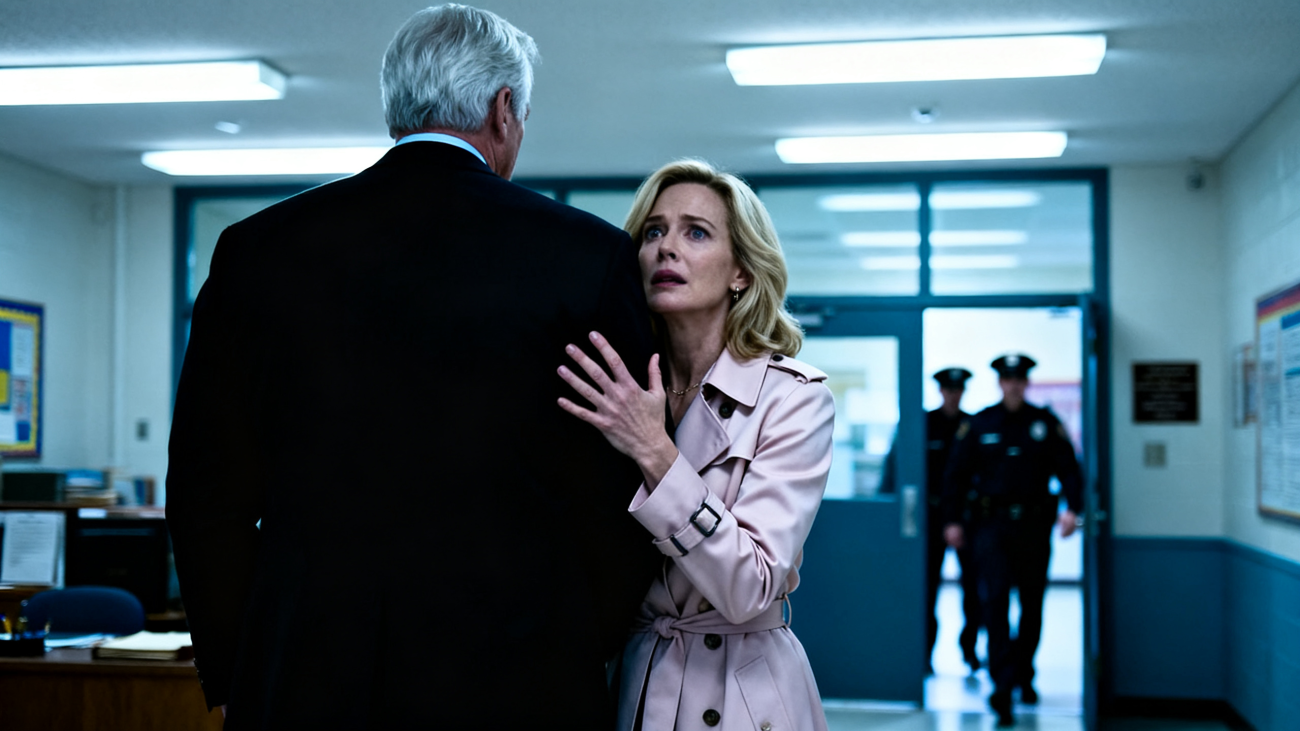
The bruise wasn’t the problem.
Arthur Vance had seen bruises. He had spent twenty years in the Marines cataloging the geography of human damage — the shape of a fist, the bloom of a boot heel, the clean-edged mark of a cable. He could read violence the way other men read weather.
No. The bruise wasn’t the problem. The problem was the girl’s face.
Maya Linwood sat in the hard plastic chair beside her mother and stared at the linoleum floor with the absolute, hollow stillness of a child who had learned that every expression had a price attached to it.
Eleanor Linwood laughed.
It was a light, musical sound — the kind that belonged at a suburban wine tasting, not in a school office thick with the smell of administrative panic. Her blonde bob caught the fluorescent light. Her diamond ring flashed. Her pastel pink trench coat was immaculate.
“Oh, Arthur, you really mustn’t look so grim,” Eleanor said, waving her manicured hand. “Maya is just terribly clumsy. She falls constantly. We joke about it at home all the time. Don’t we, sweetheart?”
Eleanor’s hand moved to Maya’s shoulder.
To anyone else, it looked like a mother’s comfort. What it was: Eleanor’s thumb pressing directly into a fresh contusion on the girl’s collarbone, hidden beneath a thick navy sweater that Maya had begged to wear despite the unseasonable warmth of the May morning.
Maya didn’t flinch. She had learned, at considerable cost, not to flinch in public.
Instead, her right hand — resting beside her on the plastic chair, slightly hidden by her sleeve — began to move.
Two fingers. Against the left wrist. Press. Hold. Release.
Vance’s eyes dropped to the motion. His brow furrowed.
Press. Hold. Release.
He had attended a state seminar in Harrisburg three years ago. A forensic child psychologist specializing in high-status abuse cases had stood in front of forty school administrators and explained the mechanics of the Silent Pulse — a distress signal designed to look like a nervous habit to an abusive parent but to read, to a trained observer, with the unmistakable clarity of a flare fired over a dark ocean.
I am in immediate danger. Do not let me leave this room with them.
Vance looked from Maya’s fingers to her face.
For one fractional second, she looked up.
Her eyes were the eyes of a prisoner. Dark, hollow, and absolutely, bone-chillingly awake. She wasn’t asking for sympathy. She was transmitting coordinates.
“Arthur?” Eleanor’s voice sharpened. “If we’re quite finished here, I’d like to take my daughter home. She needs rest. I have a dinner engagement.”
Eleanor’s hand tightened on Maya’s shoulder, beginning to pull her upright.
“Sit down, Mrs. Linwood,” Vance said.
The room changed.
Eleanor froze mid-rise, her expression cycling from charm to confusion to outrage in under two seconds. “I beg your pardon?”
“Sit down.”
“Arthur Vance, do you have any idea who you are speaking to?” Her mask cracked cleanly down the center, revealing the cold, predatory architecture beneath. “My husband sits on the board of trustees for this district. I funded the new library wing. You are a sixty-dollar-an-hour public employee threatening the wrong family.”
Vance didn’t answer. He reached forward, pressed the intercom button, and spoke without looking away from Eleanor.
“Marcus. Code Blue. My office. Now.”
Eleanor went pale. She reached down, her fingers wrapping around Maya’s wrist — the exact wrist the girl had been using to signal for her life — and pulled.
Maya made a single, small sound. Not quite a cry. The involuntary compression of pain.
Vance was around the desk in two strides.
He stepped between them — all two hundred and thirty pounds of former Marine Corps Sergeant Major — and stood like a concrete barrier between Eleanor Linwood and her daughter.
“Do not touch her.”
The words weren’t loud. They didn’t need to be. They filled the room the way pressure fills a sealed container — expanding against every wall simultaneously, leaving no space for anything else.
Eleanor stumbled back a step. Her perfect composure, so carefully assembled over decades of suburban social engineering, shattered completely. For one naked, unguarded second, Arthur Vance saw her face as it truly was: not a mother’s face, not a victim’s face, not the face of a woman who had been misunderstood. It was the face of something that calculated. Something that controlled.
The door burst open. Officer Marcus Brody stepped in, followed by two patrol officers who had been running a traffic ticket in the parking lot. Brody’s hand rested near his belt, reading the room in a single professional glance.
Vance spoke without turning around. “Call CPS emergency response. I need an intake assessment, priority one. And nobody goes through that door with that child.”
Eleanor straightened, smoothing her trench coat with both hands, reassembling her composure with a speed that was almost impressive. “This is absolutely outrageous. You are detaining a private citizen without cause, without a warrant, and without legal representation present. My husband is going to dismantle this school.” She pulled out her phone. “Richard. Get down here. Now.”
Richard Linwood arrived fourteen minutes later.
He moved through the front entrance of Silver Ridge Elementary the way a demolition crew moves through a condemned building: purposeful, unhurried, and certain of the outcome. Two partners from his firm flanked him in identical charcoal suits. His silver-cut hair was precise. His watch cost more than Vance’s annual salary.
He stopped in front of Officer Brody with the easy authority of a man who had spent thirty years being the most powerful person in any given room.
“Let me make this entirely clear,” Richard said, his voice filling the hallway like an argument filling a courtroom. “You are currently holding my wife in a restricted space without an active warrant, without formal charges, and without counsel present. That is a Fourth and Fourteenth Amendment violation. If that door isn’t opened in the next sixty seconds, I will personally see to it that your badge is pulled, your pension is liquidated, and this district is buried under a civil rights suit that runs until every one of you is eating from a food bank.”
“Your wife was detained,” Brody said steadily, “because she was actively interfering with a mandatory reporting investigation and attempting to physically remove a child following documentation of visible trauma.”
Richard smiled. It was a cool, dismissive curl. “Based on a third-grade art teacher’s hysteria.”
“He’s not opening the door, Richard.”
Vance stepped into the corridor. He walked directly to Richard Linwood and stopped twelve inches from him, using his height with a quiet, deliberate authority.
Richard looked up. He didn’t back down. “Vance. I was wondering when the architect of this performance would surface. Stand down before this becomes something you genuinely cannot survive.”
“I’ve survived a lot worse than a billing rate in a suit.”
Richard leaned forward, his voice dropping beneath the threshold that Brody could hear. “You think you’re a hero, Arthur. The big Marine, saving the day. But I know exactly who you are. I research people before I operate in their towns.” A pause. The smile thinned into something surgical. “I know about your sister. Sarah. I know what happened to her forty years ago. You sat there and watched, didn’t you? Watched her get broken, and did nothing. You’re not saving my daughter. You’re trying to fix the little boy who failed his sister in a hallway in 1986.”
The words landed like a detonation.
Forty years dissolved in an instant. The fluorescent lights became Pennsylvania summer heat. The linoleum became cracked kitchen floor. He was fourteen years old, frozen outside a locked bathroom door, listening to his sister sob while their stepfather laughed his awful, wet laugh on the other side.
Vance’s right hand pulled back. His fingers curled.
“Principal Vance!” Brody’s voice cracked across the room. “Don’t!”
Richard didn’t move. He leaned marginally closer, his eyes steady, practically inviting the blow. One punch. That was all he needed. One physical assault to invalidate every legal position the school had built in the last three hours and hand him the lawsuit of the decade.
Vance’s fist hung in the air.
Then he looked past Richard’s shoulder.
Through the small glass panel of the inner office door, a small shape stood in the shadows of the back hallway. Maya. She had come out of the clinic. She was watching the scene through the glass with her hand pressed against her lips, her eyes wide and terribly still.
She was watching to see if the wall would hold.
The fog of 1986 cleared instantly. The fourteen-year-old boy receded. In his place stood the fifty-eight-year-old Sergeant Major who had held his discipline in firefights, in IED craters, in hospital tents, in every moment when rage was the easy option and discipline was the only thing keeping men alive.
Vance’s hand uncurled. He lowered his arm. He exhaled once, slow and controlled.
Then he smiled at Richard Linwood — the cold, clean smile of a man who had already won and was simply watching the other side realize it.
“You’re right,” Vance said quietly. “I couldn’t save Sarah. I was a child. I have carried that weight for forty years.”
He stepped closer, his shadow covering the attorney completely.
“But I am not a child anymore. And I am not alone.”
Vance raised one finger and pointed toward the entrance doors.
Through the thick glass panels of Silver Ridge Elementary’s front entrance, the courtyard lit up. Red. Blue. Red. Blue. Three county emergency vehicles and two unmarked black SUVs pulled into the parking lot in tight, coordinated formation. The warble of multiple sirens rose and then cut off simultaneously — the sound of a planned operation reaching its final phase.
Richard’s smile vanished.
“That is the state attorney general’s special task force for child exploitation,” Vance said, his voice carrying no triumph — only a flat, final certainty. “I didn’t call the county. I called the state. I bypassed the family court entirely. I sent the forensic photographs and the mandatory report directly to the AG’s office twenty minutes ago. Your country club friends in the local judiciary? They don’t have jurisdiction over a state-level intervention.”
Richard stared at the vehicles. His jaw moved without producing sound.
“And if you’re wondering why I escalated so fast,” Vance continued, “it’s because I’ve spent twenty years learning the difference between a chain-of-command problem and a live-threat extraction. Your daughter was sending me a signal that taught to trauma survivors by forensic psychologists for one specific reason. I didn’t hesitate. I won’t apologize.”
The two lawyers flanking Richard exchanged a rapid, panicked glance. One of them quietly stepped back, creating immediate, professional distance from his client.
The front doors of the school opened.
Detective Karen Reyes walked in first — a compact woman in her late forties with sharp eyes and a blue legal folder under her arm, the kind of composure that only develops in someone who has seen the worst and chose to come back anyway. Four state troopers followed, along with two agents from the state child exploitation unit carrying forensic case kits.
“Richard Linwood?” Reyes said, stopping in front of him without offering her hand.
“Detective,” Richard said, and the word came out slightly wrong — too flat, the instinctive courtroom authority absent for the first time in the conversation.
“We’re going to need to speak with your wife immediately. And I’m going to need your keys to the residence at Silver Ridge.”
“You’re going to need a warrant for that,” Richard said, recovering some of his footing. “Which you don’t have.”
Reyes opened the blue folder and held out a single document. “Signed forty-five minutes ago by the state duty magistrate. The address, the vehicle, and the private basement storage area specifically.”
Richard looked at the warrant. He looked at it for a long time.
“The basement,” he said. The word was barely audible.
“We’ll be executing it tonight,” Reyes said. “In the meantime, your wife will be accompanying us for a formal interview at the county field office. You are welcome to contact your counsel.” She glanced at the two lawyers beside him, both of whom were now examining the far wall with great professional concentration. “Or find new ones.”
The door to the inner office opened. Officer Brody escorted Eleanor out, her pearl necklace slightly askew, her composure entirely reconstructed — the mask rebuilt in the six seconds between the latch clicking and entering the corridor.
She saw the state troopers and the forensic kits.
The mask dissolved for the second and final time that afternoon.
“Richard,” she said. Just the name. Nothing else.
Richard didn’t answer. He was still looking at the warrant.
The state forensic team arrived at the Linwood residence in Silver Ridge at 9:47 that evening.
They moved the wine racks in the basement at 11:22 PM.
At 11:31 PM, Detective Reyes called Arthur Vance’s personal cell phone.
He picked up on the second ring.
“They found it,” Reyes said. Her voice was steady, but the steadiness cost her something. “Behind the wine rack. Five-by-eight room. Concrete floor. No windows. Single steel eye-bolt anchored into the center of the floor.” A pause. “Twenty-four industrial zip-ties in the corner. Six severed. They ran an expedited forensic wash on three of them at three this morning.”
Vance sat in his kitchen in the dark. His coffee had gone cold an hour ago.
“And?” he said.
“Blood, skin cells, and hair fiber matching Maya’s profile. All three ties.”
The silence stretched.
“She described the room during her intake interview,” Reyes continued, “before we found it. She said the walls were cold and the floor was rough and there was a hook in the middle that the cord attached to. She called it the quiet room.” Another pause, longer. “She was nine years old, Arthur. She thought it was normal. She thought all children had a quiet room.”
Vance looked at the window above his kitchen sink. The street outside was empty, the houses dark, the manicured lawns and expensive cars sitting in their driveways under the same suburban sky that had always hidden what happened behind these doors.
“How is she?” he asked.
“Pediatric trauma unit. The doctors say she’s physically stable. She asked about the crane.”
“The crane?”
“She told the intake nurse that a man at her school had a paper crane in his pocket and she wanted to know if it was still there. I didn’t know what she meant.”
Vance reached into the breast pocket of the shirt he’d been wearing since 7 AM. The yellow paper crane — folded by his sister Sarah in 1983, carried by Vance for forty years as both penance and promise — sat small and worn in his palm.
“It’s still here,” he said.
The emergency custody hearing was held in Courtroom 3B of the Linden County Courthouse on the following Monday morning.
Jonathan Sterling, senior partner, three decades of family law, a man who had never lost a custody case in his career, arrived with a briefcase of motions and the practiced confidence of someone who knew how to make evidence disappear into procedural paper.
He sat across from Detective Reyes and the state AG’s assistant counsel at the long plaintiff’s table and arranged his documents with the unhurried precision of a man playing the game on home turf.
He had filed seven pre-trial motions. He had assembled a private medical expert to dispute the forensic pathology. He had retained a child psychologist to argue that Maya’s intake statements were the product of leading questions and institutional bias. He had prepared the argument that the zip-ties were a coincidence of storage, that the room was a wine overflow space, that the eye-bolt was a structural remnant from a previous renovation.
He was very good at his job.
Judge Harrison Holcombe the Third took the bench at 9:04 AM.
He was seventy-one years old. He had served on the Linden County bench for forty years. He had the bearing of someone who had heard every version of every argument ever constructed in a family court and retained the ability to be precisely, quietly, devastatingly furious about all of them.
Sterling rose. “Your Honor, the defense moves immediately to suppress all physical evidence gathered pursuant to the state warrant, on the grounds that the warrant application contained materially misleading characterizations of—”
“Denied.”
Sterling blinked. “Your Honor, if I may present the—”
“Mr. Sterling, I have read your motion. I have read the warrant application. I have read the affidavit submitted by Detective Reyes and the forensic documentation submitted by the state laboratory. Your suppression argument rests on the assertion that the forensic photographs submitted by the school nurse were insufficient to establish probable cause. I disagree. Motion denied. Move on.”
Sterling smoothed his tie. He moved on.
The state’s first witness was Dr. Marcus Thorne, a forensic pediatric pathologist who had spent twenty-two years testifying in child abuse cases across the eastern seaboard.
Thorne was precise. He was unhurried. He described, with the careful specificity of a man who had explained these findings hundreds of times, the nature of the injuries documented on Maya Linwood’s arm.
He hit a button on the court display. A high-resolution scan filled the screen — a four-millimeter-wide, perfectly circumferential welt running around the full circumference of a small child’s upper arm.
“This is a compression mark consistent with prolonged application of a non-elastic binding material,” Thorne said. “It is uniform in width. It shows pinpoint hemorrhaging along the margins consistent with venous restriction over an extended period. This is not a fall injury. It is not a playground scrape. It is the mark of something wound tightly around this limb and left in place long enough to cause localized tissue damage.” He paused. “We also recovered epithelial cellular material from the locking mechanism of one of the recovered zip-ties that matches the minor’s DNA profile.”
Sterling rose. “Your Honor, Dr. Thorne is presenting speculation dressed as science. The child’s injuries are consistent with any number of activities — a garden hose, a rope swing, a—”
“A garden hose,” Thorne said, his voice carrying the faintest edge of professional contempt, “does not apply a uniform four-millimeter circumferential force sufficient to deposit DNA on a locking mechanism.”
“Mr. Sterling,” Judge Holcombe said quietly, “sit down.”
Sterling sat.
Detective Reyes rose next.
She walked the court through the search. The wine racks. The concealed door. The room with no windows and no light source. The eye-bolt. The pile of severed zip-ties in the corner. She placed the three forensic reports on the evidence table — each one confirming the same biological profile on the ties that matched the child sitting seventeen feet away from the defense table in a yellow sweatshirt, holding the hand of a court-appointed advocate.
“Your Honor,” Reyes said, her voice carrying the particular, contained fury of someone who had held it together through a long night and several more after it, “the child described this room in her intake interview before we found it. She described the rough floor, the cold walls, the hook in the center, and the cords. She described being placed there when she made mistakes. Dropping a pencil. Speaking out of turn. Not sitting still at the table. She called it the quiet room.” Reyes stopped. “She was nine years old. She believed all children had one.”
The courtroom was absolutely silent.
Eleanor Linwood sat at the defense table with her hands folded in her lap and her face arranged into an expression of studied dignity. She had been crying for most of the morning — graceful, contained tears that played well for the room.
The tears stopped.
Richard sat beside her, his jaw tight, his eyes fixed on the middle distance, his hands very still on the surface of the table.
Jonathan Sterling stared at the forensic reports. Then at his clients. Then at the forensic reports again.
He had prepared for a complicated case. He had not prepared for a concrete room with an eye-bolt in the floor and biological evidence on twenty-four industrial zip-ties.
He had absolutely nothing to say.
Judge Holcombe took off his reading glasses and set them flat on his ledger.
He looked at the photographs of the room. He looked at the medical scans. He looked at Richard and Eleanor Linwood with the gaze of a man who had spent forty years swearing an oath to the most vulnerable members of his community, and whose capacity for carefully measured judicial patience had reached its precise and absolute limit.
“In forty years on the bench,” Holcombe said, his voice dropping into a register so quiet that the entire room leaned fractionally forward, “I have heard many arguments about the complexity of domestic circumstance and the inadequacy of forensic interpretation. I will not be hearing those arguments today.” He set his hands flat on the bench. “What has been presented in this courtroom this morning is not ambiguous. It is not complex. It is a concrete room with no light and no windows and a steel bolt in the floor and twenty-four industrial zip-ties carrying the biological material of a nine-year-old girl who believed this was a normal feature of childhood.”
He turned to Eleanor.
“Mrs. Linwood, you came into this court today wearing the costume of a grieving mother. You have traded on your social standing, your charity work, and your carefully maintained public image to shield you from the weight of your actions. You bound your daughter with plastic cords in a lightless room as a behavioral correction. You crushed the veins of her arm because she was not still enough at the dinner table.”
He looked at Richard.
“And you, Mr. Linwood. Senior partner. Officer of this court. A man who spent thirty years arguing for the rule of law, who used his professional connections to threaten a school principal, a social worker, and two law enforcement officers in an attempt to drag that child back inside those walls.”
Holcombe reached for his gavel.
“The emergency petition for injunction is denied. The habeas writ is denied with prejudice. Temporary legal and physical custody of Maya Linwood is granted exclusively to the Commonwealth of Pennsylvania, effective immediately. The signature bonds for both defendants are revoked.” He struck the block. The sound filled the room like a closing door. “Officer Brody. Detective Reyes. Execute the warrants. Charge both defendants with felony child endangerment, aggravated assault on a minor, unlawful restraint, and conspiracy to obstruct. They are to be held without bail pending formal arraignment Monday next.”
He paused.
“Get them out of my sight.”
The sound of the handcuffs was the loudest thing Arthur Vance had ever heard in a room that quiet.
Eleanor didn’t scream. She let out a single dry, rattling gasp as the state trooper pulled her arms behind her back, her perfect blonde bob falling over her face, her pearl necklace catching on her collar. Richard was turned against the defense table, his tailored jacket wrinkling, his head bowed, the architecture of thirty years of arrogance collapsing in real time under the weight of steel around his wrists.
They were walked out through the prisoner transport door. Their leather shoes dragged across the floor. They left behind only the ghost of their cologne and the permanent, irreversible ruin of the Linwood name.
Jonathan Sterling closed his alligator briefcase. Clicked the gold clasps. Walked out through the rear doors without looking back, his associates trailing behind him in total silence.
The walnut doors of Courtroom 3B shut.
The room was still.
Vance sat in the front row of the spectator benches and breathed. Just breathed. He felt a sensation in his chest that he hadn’t felt in forty years — the specific, physical relief of a weight he had carried so long he had forgotten it had a shape, loosening at the base of his spine and dissolving in the morning light coming through the high courthouse windows.
He had thought about Sarah every day for forty years. He had carried the memory of her face at that kitchen table like an open wound — a debt he had accumulated in a hallway at age fourteen and never found a currency sufficient to repay.
He could see her face now. Clearly. And for the first time in four decades, it didn’t bring the metallic taste of guilt to the back of his throat. It brought something quieter. Something he hadn’t had a name for in a very long time.
He looked down.
Maya was standing in front of him.
She had walked around the wooden partition in her yellow sweatshirt, moving through the solemn walnut emptiness of the courtroom with the careful, deliberate steps of a child navigating a space that was finally, genuinely safe. She didn’t look at the place where her parents had been sitting. She didn’t look at the projection screen or the evidence table or the empty defense chairs.
She looked straight at Vance’s face.
He lowered himself into his familiar military crouch, bringing his eyes level with hers, and held out his open palm.
Maya didn’t take his hand. She reached instead for his breast pocket, found the worn paper crane, and lifted it out carefully. She smoothed one of its wings with her thumb, running the pad of her finger along the fold with a precision that suggested she had been thinking about this crane since she first saw it in the front office.
She placed it in his palm.
She wrapped his large, calloused fingers around it, one by one, until his fist was closed.
Then she looked toward the tall courthouse windows, where the morning sun had broken through the grey cloud cover and was flooding the room with a wide, indiscriminate, democratic light that fell equally on the empty defense table and the spectator benches and the face of a nine-year-old girl who had survived a quiet room and found her way to the other side of it.
“It can fly now,” Maya said. Her voice was clear and steady and full of something that had no business existing in a child who had been through what she had been through — a fragile, specific, undefeated hope. “Because the wall stayed still.”
Vance closed his hand around the crane. He held it there against his chest, above his heart, and for the first time in forty years, the debt was settled. Not erased. Not forgotten. Settled — paid in full by a nine-year-old girl with her grandmother’s signal in her fingers and the unshakeable belief that someone in the room was worth sending it to.
He had been.
Original fictional stories. AI-assisted creative content.
