
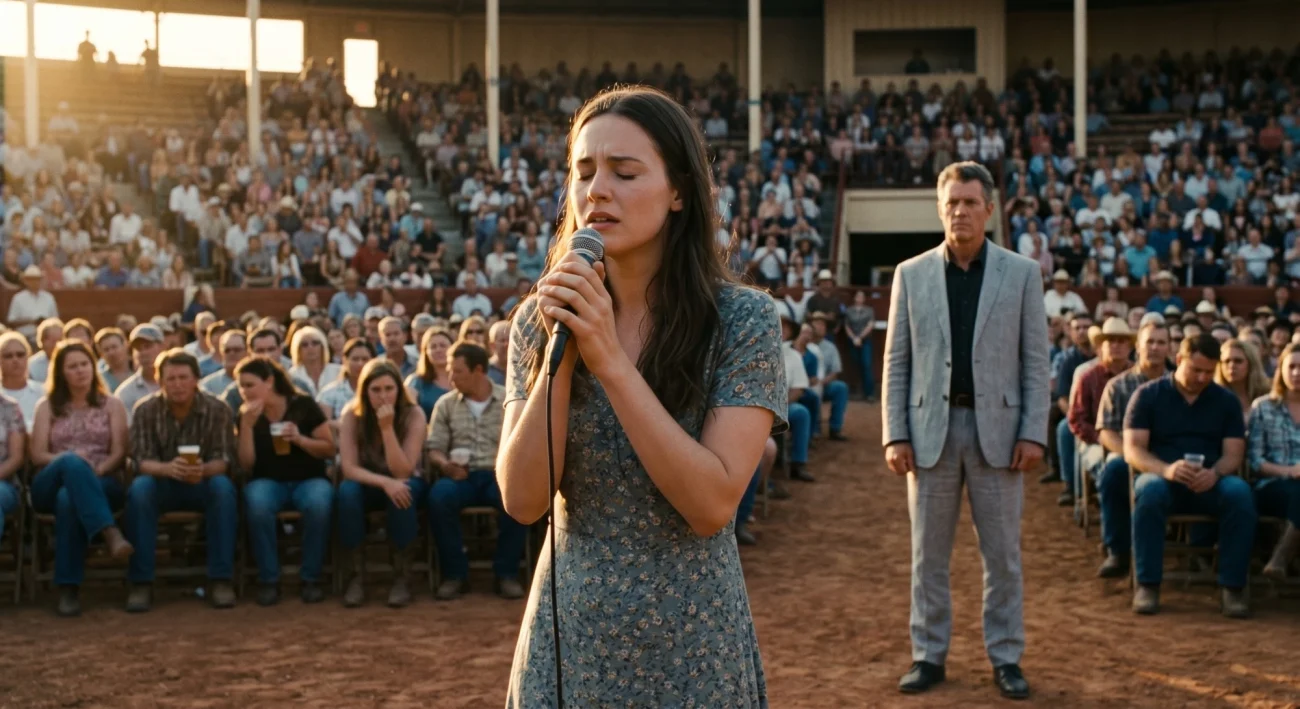
Sarah had exactly three dollars in her coat pocket when she arrived at the festival.
She hadn’t planned to come. Her mother had insisted — “We never go anywhere, Sarah. Just one afternoon.” So they bought the cheapest seats, near the back, where the dust from the arena floor rose in slow clouds and the announcer’s voice sounded far away.
She should have stayed home.
The festival belonged to Marcus Cole.
Everyone in the region knew his name. He ran the largest agricultural operation in three counties, owned two local judges, and had never once been told no by anyone who intended to keep their livelihood. He sat in the honorary box in a white linen suit, flanked by men who laughed at everything he said and said nothing he didn’t approve of first.
Sarah had met him once, six weeks earlier, at the market. He’d looked at her the way men like him looked at things they wanted — appraising, already certain of the outcome.
“You’re William Ashford’s daughter?” he’d asked.
“Yes, sir.”
“Your father owed me money when he died.”
“I know.”
He’d smiled then. Not warmly. “I’m willing to forget that debt. Under certain conditions.”
Sarah had understood immediately. She’d also understood that saying no to Marcus Cole required a very specific kind of courage — the kind that didn’t care about the consequences.
“I’m not interested,” she said. And she walked away.
She hadn’t expected him to let it go. Men like Marcus Cole never let things go.
She was watching the horse race when the announcer’s voice crackled through the speakers.
“Ladies and gentlemen, our generous host would like to invite a very special guest into the arena.”
Her mother squeezed her arm. “How exciting.”
“Sarah Ashford. Would Sarah Ashford please make her way to the floor.”
The name hung in the air. Around her, people turned. Thousands of eyes found her at once — a girl in a secondhand dress, sitting in the cheap seats.
Her mother whispered, “Sarah? Do you know him?”
She didn’t answer.
Two men in Cole’s colors appeared at the end of her row. They didn’t grab her. They didn’t have to.
The walk to the arena floor felt like drowning in slow motion.
The sand was orange-red under the afternoon sun. The crowd made a sound like a living thing — low, curious, already entertained. Sarah counted her steps. Twelve. Fifteen. Twenty. She stopped in the center.
Marcus Cole descended from the honorary box with a handheld microphone and the unhurried stride of a man who had done this kind of thing before.
“Sarah,” he said, and his amplified voice rolled across the stadium. “We’re so glad you could join us.”
Applause from the crowd. Polite, uncertain.
“I’ve been told,” he continued, “that you’re a very talented young woman.”
She said nothing. Her hands were steady at her sides. She was making herself keep them still.
“Sing something for us.” He held the microphone toward her. “Just one song. That’s all.”
The crowd stirred. A few people laughed nervously. Others leaned forward.
Sarah looked at him. Really looked — past the white suit, past the practiced smile, into the thing underneath. She’d seen it before, in other men, in smaller arenas. The absolute certainty that the person in front of them would crumble.
He was certain she’d crumble.
“And if you do it,” he said, louder now, performing for the crowd, “I’ll announce our engagement right here. Today. In front of everyone.” He let the pause stretch. “But if you can’t — if you just can’t manage a single song — then you’ll be escorted out of this arena the way your father was escorted out of my office. Empty-handed.”
Murmurs rippled through the stands. Someone near the front called out: “What kind of contest is that?”
Cole didn’t look away from Sarah. “The fair kind,” he said, and smiled.
He knew. That was the worst part — he knew about the stutter. He’d found out somehow, the way powerful men always found out the things they needed. He’d orchestrated every detail of this moment specifically to break her in front of ten thousand witnesses.
The microphone hovered between them.
For a long moment, Sarah didn’t move.
The stadium grew quiet in the way that stadiums go quiet when something real is about to happen — not silence exactly, but a held breath, collective and involuntary.
Then she stepped forward and took the microphone.
Cole’s eyes lit up. He stepped back, gesturing to the crowd as if to say: watch this.
Sarah looked out at the stands. Ten thousand faces. Her mother somewhere in the back rows, probably terrified. The sun pressing down. The smell of horses and dust and fried food from the vendors at the gates.
She could feel the stutter waiting in her throat like a stone.
She’d lived with it her whole life. She knew exactly where it lived — in the hard consonants, in the words that started with p and s and t, in any sentence she tried to push out too fast when her heart was pounding. She knew the face people made when they heard it: the brief wince, the barely-hidden impatience, the pity that was somehow worse than mockery.
She also knew something Marcus Cole did not.
She took one breath.
And then she spoke.
“I stutter,” she said. Her voice was steady. Clear. It carried.
The crowd went absolutely still.
Cole’s smile flickered.
“I have stuttered my entire life.” She wasn’t rushing. She was measuring every word. “When I was seven, a teacher told my mother I’d never be able to speak in public. When I was twelve, a boy at school used to count my stutters out loud so the whole class could keep score. When I was seventeen, a man at a job interview told me he couldn’t hire someone who ‘couldn’t communicate.'”
The stadium was silent now. Not the held-breath silence of before — something different. Something attentive.
“People have been waiting my whole life for me to fail because of it.” She glanced at Cole. Just once. “Some people are still waiting.”
He wasn’t smiling anymore.
“But here is what those people never knew.”
She closed her eyes.
When she opened them, she wasn’t looking at Cole anymore. She was looking out at the crowd — at the people in the cheap seats, at the children sitting on their fathers’ shoulders, at the old women with paper fans, at the young men who’d leaned forward without realizing it.
She lifted the microphone.
And she sang.
The song was an old one — a folk ballad her mother had taught her before her father died, about a river that ran through a valley and never stopped moving regardless of the season. Simple melody. Honest lyrics. The kind of song that didn’t ask for anything except to be heard.
But the voice that delivered it.
The voice was something else entirely.
It was the thing nobody knew — not even most people who’d known Sarah her whole life. When she sang, the stutter disappeared. Completely, cleanly, as if it had never existed. Her voice came out clear and full and absolutely certain of itself, with a natural tremolo in the high notes that seemed physically impossible from a girl standing alone in an open arena without amplification backing her up.
The musicians stationed behind the stage stopped their idle tuning and stood still.
The vendor near the east gate stopped counting change.
A child near the front row grabbed her mother’s sleeve without looking away.
Sarah sang two verses. Then the chorus. Then the bridge, which climbed high and held there, the note suspended over the entire stadium like something physical — like light, like weather.
She finished.
For three full seconds, there was no sound at all.
Then the east stands erupted. Then the west. Then the cheap seats in the back, where her mother was on her feet with both hands pressed over her mouth. The sound built like a wave — tens of thousands of voices, then the drumming of feet on the wooden bleachers, then full-throated noise that rolled back on itself and multiplied.
People were standing.
A woman two rows from the floor was crying and didn’t seem to know it.
Even three of the men in Cole’s own section had risen without quite deciding to.
Cole stood motionless.
He was still holding his own microphone. His hand had dropped to his side at some point during the song and he hadn’t raised it again. The expression on his face was something Sarah had never seen on him before — he looked caught. Not angry. Not calculating. Just caught, like a man who had opened a door expecting a broom closet and found himself standing at the edge of a very long drop.
He didn’t speak.
He didn’t have to.
Because at that moment, a man stood up from the front row.
He was in his late sixties, compact, wearing a plain gray jacket that somehow looked more expensive than everything else in the honorary box combined. He had a lanyard around his neck with a festival credential badge, and he walked with the particular unhurried certainty of someone who was used to being in rooms where his opinion mattered.
His name was Daniel Reeves.
If you worked in music — seriously, professionally, anywhere in the country — you knew Daniel Reeves. He’d spent four decades developing artists out of nothing, and three of his early-career discoveries were now selling out arenas. He was not the kind of man who appeared at regional agricultural festivals. But his daughter had married a local rancher, and family obligations brought him to places his career never would have.
He walked to the center of the arena.
He stopped in front of Sarah.
He looked at her for a moment — not performing the look, not making it theatrical, just actually looking — and then he said, quietly enough that the microphone barely caught it:
“I’d like to talk to you about a contract.”
The crowd heard it anyway.
The sound that came out of the stadium next was different from the applause — it was something rawer, almost disbelieving, the sound of ten thousand people watching something that wasn’t supposed to happen actually happening.
Someone in the upper deck — nobody ever identified exactly who — leaned over the railing and shouted down:
“Hey Cole! Maybe you should marry your bull instead!”
For a beat, the stadium held.
Then it broke open.
Even the men in the honorary box were laughing. Not at a joke — at him. At Marcus Cole, who was still standing in the center of the arena holding a dead microphone, flanked by men who had stopped pretending not to smile.
Cole’s jaw tightened. He turned and walked back toward the box without a word.
Nobody stopped him. Nobody followed him. A few people didn’t even notice he’d left.
Sarah signed a development contract with Reeves’s firm eleven days later.
The signing happened in a lawyer’s office in the city — a real one, with proper paperwork and a second attorney present to represent her interests. Her mother sat next to her in a chair that probably cost more than their monthly rent and held Sarah’s hand while she signed her name.
“Your voice is extraordinary,” Reeves told her afterward. “But that’s not the only reason I walked down there.”
“What was the other reason?” Sarah asked.
He looked at her evenly. “Because you told the truth first. Before you sang a note, you stood in front of ten thousand people and told them exactly who you were and what you’d been through. That takes a different kind of courage.” He paused. “The industry is full of great voices. It isn’t full of people with that kind of nerve.”
Sarah nodded slowly.
“One more question,” he said. “That first moment — before you sang. You looked at him. Cole. What were you thinking?”
She considered the question honestly.
“I was thinking that he’d spent thirty years making sure that everyone around him was too afraid to tell him the truth.” She looked at her hands. “And I thought — that must be a very lonely way to live.”
Reeves was quiet for a moment.
“It is,” he said finally. He didn’t explain how he knew.
The debt her father had owed Marcus Cole — the one Cole had used as leverage six weeks earlier — was dismissed in civil court four months later. Cole’s attorney filed to pursue it, but the judge reviewing the case was a woman Cole had not yet managed to buy, and she found the original loan agreement to be predatory and improperly documented.
Cole didn’t appeal.
He’d lost something more important than a debt in that arena, and everyone in the region knew it. When a man’s power rests entirely on other people’s fear, the moment enough people stop being afraid, the whole structure collapses. It doesn’t happen loudly. It just happens.
His circle got smaller. His invitations stopped being accepted. His name stopped meaning what it used to mean.
He was still rich. He still owned his land. But the room went quiet when he entered now for a different reason than it used to — not because people feared him, but because they’d seen, in front of ten thousand witnesses, exactly what he was.
Sarah’s first recording came out eight months after the festival.
It wasn’t a polished, over-produced commercial single. Reeves had listened to her for a week before deciding what he wanted: a live record, minimal instrumentation, her voice in a room with good acoustics and almost nothing else. He wanted people to hear what he’d heard in that arena.
The title track was the old folk ballad — the one about the river.
In the liner notes, where most artists put thank-yous, Sarah wrote three sentences:
I have stuttered my whole life. I used to think that made me less. Now I know it made me exactly who I needed to be.
The record sold forty thousand copies in its first month, entirely by word of mouth.
Her mother framed the liner notes and hung them in the kitchen of the new apartment — the one with the heating that worked properly and windows that looked out over something other than an alley.
It wasn’t everything. But it was more than enough.
And the river, as the song goes, kept moving.
Original fictional stories. AI-assisted creative content.
