
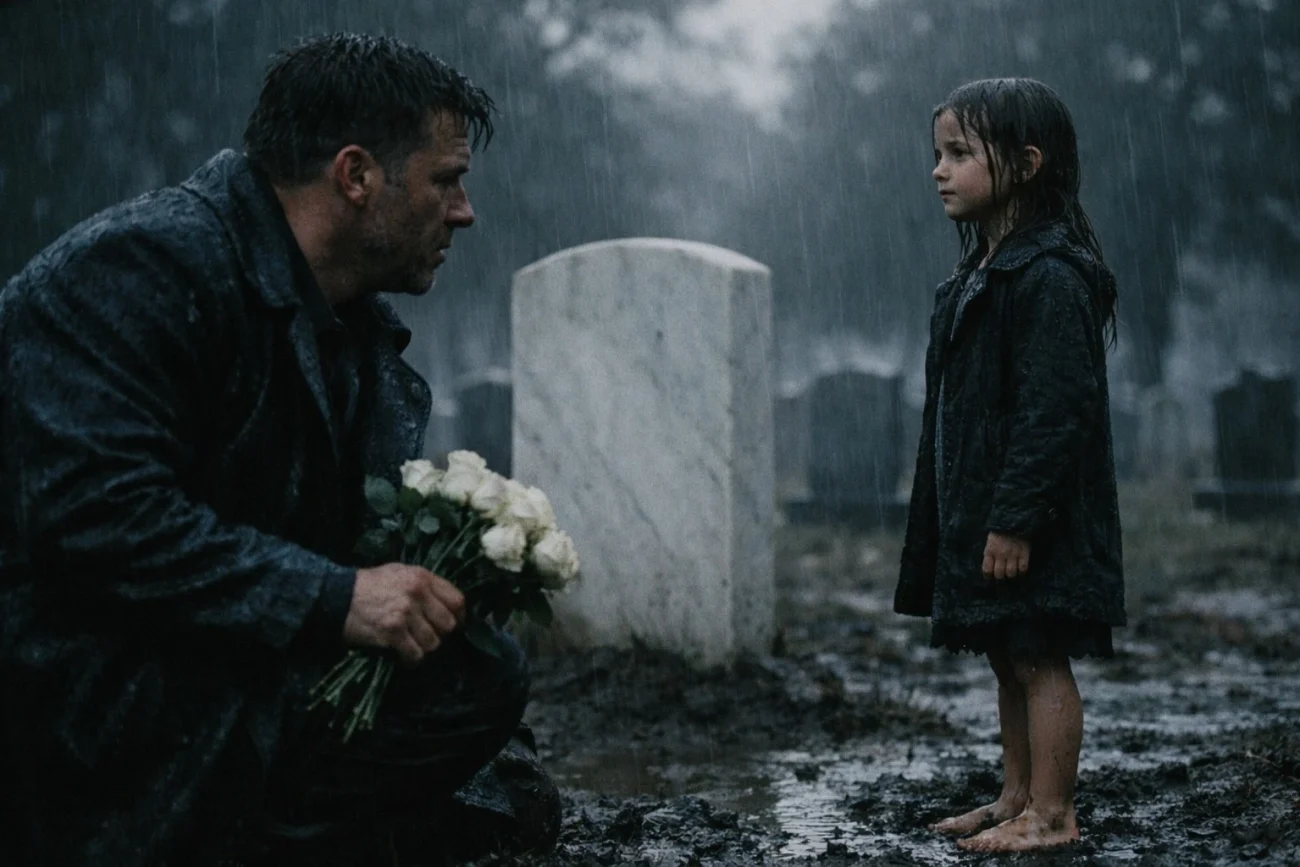
Jude Nelson had a ritual.
Every Sunday. Ten a.m. White roses. The same headstone.
Rebecca Roland Nelson. Beloved wife. Beloved light. Gone too soon.
He had chosen those words himself, and he hated how true they felt. Two years of Sundays. Two years of kneeling in the mud, pressing his palm against cold marble, saying things out loud that he could never say to anyone else.
Rain hit him sideways today. The kind that soaked through an overcoat in sixty seconds and turned the cemetery paths to rivers.
He didn’t care.
“I still miss you,” he said.
Not for the driver waiting near the gate. Not for the groundskeepers who recognized him now and left him alone. Just for her. Just for the habit of speaking into silence and pretending it went somewhere.
Then a voice cut through the rain.
“Sir.”
He didn’t turn. Grief made you hear things.
“Sir, please. I need to tell you something.”
He turned.
A girl stood a few feet away. Barefoot. Her feet dark with rain-soaked mud. She couldn’t have been more than nineteen — clothes clean but threadbare, face drawn tight with cold. Her eyes, though, were completely steady.
Not a beggar. Not random.
She had come here with a purpose.
“Whatever you need,” Jude said carefully, “speak to my driver.”
“I’m not here for money.” She didn’t flinch. “I came to find you specifically.”
He studied her. “You have thirty seconds.”
She reached into her pocket with trembling fingers.
“Your wife isn’t dead, sir.”
He stared.
The world didn’t tilt. It just stopped.
“What did you say?”
“She faked her death.” The girl’s voice shook, but it held. “And I know where she is.”
He rose from the mud slowly, the full weight of him straightening. She held her ground.
“Who sent you?”
“Nobody.”
“Who are you working for?”
“I sell bread at a market. She told me to find you if anything happened to her.” She reached into her pocket again, pulling out something small. “She said you’d need proof.”
She opened her palm.
A silver bracelet. Oval pendant. A flower engraved on one side, the initials J and R on the other.
The scratch near the clasp where Rebecca had bumped it against a car door the night he proposed.
The repaired hinge he’d had fixed at a jeweler in 2019.
The exact weight he still knew by memory.
He had placed this bracelet in the casket himself.
His voice came out as a whisper. “Where did you get that?”
“She gave it to me three weeks ago. She said — if I disappear, find him. Show him the scratch. He’ll know it’s real.”
He took the bracelet from her hand. Held it. Cold metal. Real weight. Real scratch.
Which meant the grave beneath his feet was a stage set.
His phone rang.
His head of security. He answered without looking up.
“Sir, you need to come back immediately. Someone broke into Mrs. Nelson’s private archive room. Everything she had stored there — documents, research, correspondence — it’s gone.”
Jude lowered the phone slowly.
The bracelet. The archive. The same night.
No coincidence.
He looked at the girl. “How far away is she?”
“Four hours by road. Maybe five in this weather.”
“Get in the car.”
Her name was Sophia. She told her story in the back seat while the city dissolved into dark highway and the wipers fought the rain.
Rebecca had appeared at her market eight months ago. Sunglasses. Cash only. Never lingering. She bought bread, rice, basic things, and left without speaking.
Then a little boy fell in front of the market stall and scraped his knee badly. Everyone walked around him. Rebecca stopped, knelt in the road, cleaned the wound with the edge of her scarf, and talked the child calm until he stopped crying.
That was when Sophia noticed her.
“She was lonely,” Sophia said. “Not sad — she functioned fine. But lonely in a way that goes all the way down.”
Jude kept his eyes on the road ahead. That description was exactly right.
“Three weeks ago she came in more frightened than usual,” Sophia continued. “Her hands were shaking. She bought only bread. Then she pressed the bracelet into my hand and told me what to do.” She paused. “Ten days ago she stopped coming. No warning. Just gone.”
“Did she ever tell you why she was hiding?”
“Not clearly. But once someone at the market mentioned your name. I watched her face.”
“What about it?”
“She wasn’t afraid of you,” Sophia said. “She was afraid for you.”
That sentence sat between them for the rest of the drive.
The town appeared near midnight. Small, quiet, the kind of place that asked no questions and kept its lights off by ten. Sophia directed the driver down a dirt road past a wooden gate.
At the end of a short path stood a one-story house with one window lit.
Jude stared at it for a long moment.
Then he walked to the door and knocked.
Silence. Then movement inside.
He knocked again. “I’m not here to hurt you. I just need to see your face.”
The door opened a crack.
A line of warm light cut across the path.
One eye looked out.
And Jude’s entire architecture of grief collapsed in a single second.
It was Rebecca.
Thinner. Hair cut short. Fear written bone-deep into her face. But it was her — alive, breathing, twenty feet from the grave he’d spent two years crying over.
She saw him — and slammed the door.
He pressed his palm flat against the wood. “Rebecca.”
Nothing.
“You sent Sophia. You sent the bracelet. I drove through four hours of rain. I am not leaving this porch.”
A long silence. Then the bolt slid back.
She stood in the open doorway, arms wrapped around herself, shaking.
“You shouldn’t be here,” she whispered. “You have to go right now.”
“Tell me everything first.”
Her eyes filled. “I did it to save you.”
Inside, she finally told him the truth.
Months before the yacht explosion, Rebecca had stumbled onto financial irregularities inside Jude’s company — transactions that looked like accounting errors until she followed the thread. Shell companies. Ghost accounts. Millions moving through Jude’s corporate structure into criminal networks. It had been operating for years.
“Under your name,” she said. “Using your authority. But not you.”
“I didn’t know.”
“I knew you didn’t. That’s exactly why I didn’t come to you first.”
The deeper she dug, the faster the threats escalated. Anonymous messages. Photos of her taken without her knowledge. Then a message that didn’t name her at all — it named Jude.
We can reach him through you.
“I had two choices,” Rebecca said. “Tell you and watch you confront it directly — which would have gotten us both killed. Or disappear so completely that they’d stop looking.”
Jude turned away from her. He stood facing the wall, jaw locked, two years of grief crashing against the relief of finding her alive and producing something that felt like fury.
“You let me bury you,” he said.
“Yes.”
“You let me stand over an empty coffin. You let me come every single week —”
“I know.” Her voice broke. “I know. I heard you were still coming. Every week. Same time. And every week I wanted to come back.”
“I talked to marble. In the rain. For two years.“
She couldn’t answer that.
He stood there for a long time, breathing.
Then they both heard it.
A car engine outside. Moving slow. No headlights.
Rebecca went pale. “No.”
Jude was already on his phone. “How many exits?”
“Back door through the kitchen. But if they found me here —” She stopped. “They probably covered it.”
Sophia was still outside in the car.
Rebecca moved first. “Bring her in. Now.”
Jude sprinted out. Up the lane, a black car had stopped. Four men stepped out, moving with the smooth, unhurried precision of people who had done this before.
He got Sophia inside, killed the light, locked the door.
Darkness.
Through the window they watched the men come through the gate.
Rebecca stood close enough to Jude that he could feel her trembling.
“I know who sent them,” she whispered.
“Who?”
“Tell me if we survive the next ten minutes.”
The knock on the door was hard and professional.
“Open the door.”
Nobody moved.
The knock came again, heavier.
Rebecca touched Jude’s arm. “Bedroom. Third floorboard from the bed. Brown envelope. Everything I rebuilt — two years of documentation.” She looked at him. “Whatever happens, it can’t stay here.”
He went and found it. Thick. Heavy with evidence. He tucked it inside his coat.
The front door exploded inward.
Three men entered. One stayed outside. They spread through the room with practiced efficiency, flashlight beams cutting the dark.
The beam stopped on Jude’s face.
Then moved to Rebecca.
Then the man in the center reached up and removed his sunglasses, and Jude felt reality crack open down the middle.
Thomas Dan.
His business partner of eleven years. Best man at his wedding. The man who had arranged Rebecca’s funeral, who had coordinated every detail with the church and the cemetery and the florist and who had stood at Jude’s side at the graveside and said, Grief doesn’t have a schedule.
Thomas looked past Jude at Rebecca. His voice was almost gentle.
“You,” he said, “should have died.”
Nobody moved. Eleven years of trust compressed into a single second of silence.
Thomas held out his hand. “The envelope, Jude.”
Jude didn’t move.
“You stood beside me at her grave,” Jude said.
Thomas’s face was completely still. “I was fond of Rebecca. But she became a problem.”
“You arranged her funeral.”
“She was going to destroy something that took a long time to build.”
Rebecca’s voice came from behind Jude, steady as a verdict. “It was already rotten. You just didn’t want it exposed.”
Thomas turned to her with something like irritation. “Give me the envelope and walk out of here. Both of you. That’s still a possible outcome.”
“Is it,” Jude said.
“There are interests involved here far bigger than you understand.” The pleasant mask slipped for the first time, something cold surfacing underneath. “Don’t make this difficult.”
Jude said nothing.
Then the night outside went white.
Headlights blazed through every window simultaneously. Sirens. Then a voice through an amplified speaker, flat and absolute:
ARMED POLICE. DO NOT MOVE.
Thomas froze.
For the first time that night, his confidence was completely gone.
His men looked toward the windows. Made the calculation in under a second.
Doors opened outside. Boots on gravel. More lights. More voices.
Thomas lowered his hand slowly.
Two minutes later, officers moved through the house with calm, practiced authority. Thomas and his men were disarmed, separated, and placed in handcuffs.
As he was walked past, Thomas glanced at Jude once.
Jude looked back without speaking.
There was nothing left to say to that face.
Later, when the house had quieted, Jude found Sophia by the doorway.
She had sent a message hours earlier — to her father, a retired police officer — because she’d suspected that leading Jude to Rebecca might flush whoever was hunting them into the open.
She had been right.
“You used yourself as bait,” Jude said.
“I thought it might work.” She looked at her feet. “I’m sorry I didn’t tell you.”
“Don’t apologize.” He paused. “You were brave. And you were right.”
He found Rebecca in the kitchen. She was standing at the counter, a police blanket around her shoulders, staring at nothing.
He stood beside her without touching her.
“Thomas has been arrested.”
“I know.”
“The envelope is safe.”
“Good.”
Silence.
Then Jude said quietly, “Look at me.”
She turned.
He saw it all in her face — not just tonight’s fear, but two years of it. Two years of living in fragments, no name, no contact, no anchor. Surviving on the hope that the distance was enough.
“I understand why you did it,” he said. “I understand the logic. I understand that you believed disappearing was the only way to keep me alive.”
Her eyes filled.
“But it was the hardest thing I have ever survived,” he said.
She broke.
“I know,” she whispered. “I knew you were coming every week. Same day. Same hour. Every week I wanted to run back.”
“I talked to you through marble,” he said. “In the rain.”
A tear went down her face.
“I’m so sorry.”
He shook his head. “I don’t need the apology. I just needed you to know what it cost.”
She nodded.
He raised his hand and touched her face.
She closed her eyes.
“Now,” he said, “we figure out what comes next.”
What came next was not simple or fast.
Thomas Dan’s arrest opened a federal investigation that exposed a years-long network of money laundering, criminal financing, and corporate fraud. Rebecca’s envelope — combined with what Jude’s security team recovered from the company’s internal systems — became the foundation of a case that ultimately took down nineteen people, including two elected officials who had accepted protection money to keep the network quiet.
Thomas was sentenced to twenty-two years.
The others followed.
Jude rebuilt his company from the foundation up — new compliance structures, external auditors, a legal transparency board. Brutal, expensive, necessary.
Rebecca came home.
But home was not immediately easy.
They had difficult conversations. Angry ones. Ones that went past midnight and left both of them exhausted in separate chairs. Love had survived everything. Trust was a different project.
One evening, weeks after her return, Rebecca said the thing that had been sitting between them.
“I made the decision for both of us,” she said. “I told myself it was for your safety — and it was. But I also decided my judgment mattered more than your right to know. You deserved better than that.”
Jude was quiet for a long moment.
“You were right about one thing,” he said finally. “If you had told me, I would have confronted Thomas directly. I probably would have gotten us both killed.”
She looked at him with something like hope.
“That still doesn’t make it right,” he said.
She nodded slowly. “No. It doesn’t.”
He leaned forward. “You love people by carrying too much alone. It’s one of the best things about you. It’s also the loneliest way to live.” He held her gaze. “You never had to do that with me.”
She broke quietly. Tears, but not desperate ones. The kind that come after something is finally said out loud.
“I know that now.”
He reached across and took her hand.
“We’re going to be okay.”
“Not quickly,” she said.
“No.”
She exhaled. “But we’re going to be okay?”
He looked at her with the certainty she had always trusted in him, the one she’d spent two years missing.
“Yes.”
And they were.
Not cleanly. Not on a schedule. But truly.
Rebecca eventually published the full account of the criminal network under her own name — every shell company, every false transaction, every name. It led to further arrests and a congressional inquiry into the political protection that had kept the operation running for nearly a decade.
Jude kept the bracelet.
He never again looked at her empty chair as if it belonged to a ghost.
As for Sophia — the barefoot girl who walked through the rain and changed everything — Jude learned she had spent three years trying to get into law school without the money to finish an application.
He called her directly.
“I want to fund your legal education,” he said. “Not as charity. As an agreement. Law school, fully covered. In exchange, two years with my foundation’s legal team working on financial crime victim cases.”
A pause on the line. Then: “That’s a real offer?”
“It’s a contract. I’ll have my attorney send the paperwork.”
Another pause. “Okay. Yes. Thank you.”
Years later, a small school opened in her town — a community center with a library and a legal aid clinic. At the entrance, a simple bronze plaque:
Truth may hide. Courage always finds it.
On the morning it was unveiled, Jude stood beside Rebecca and Sophia under a clear sky.
He thought about the rain.
The mud on his knees.
The white roses he’d carried every Sunday for two years.
And the five words that had stopped the world.
Your wife isn’t dead, sir.
For two years he had believed he was visiting the end of a love story.
He had been wrong.
It was only the place where the truth had been waiting for him to arrive.
Original fictional stories. AI-assisted creative content.
