
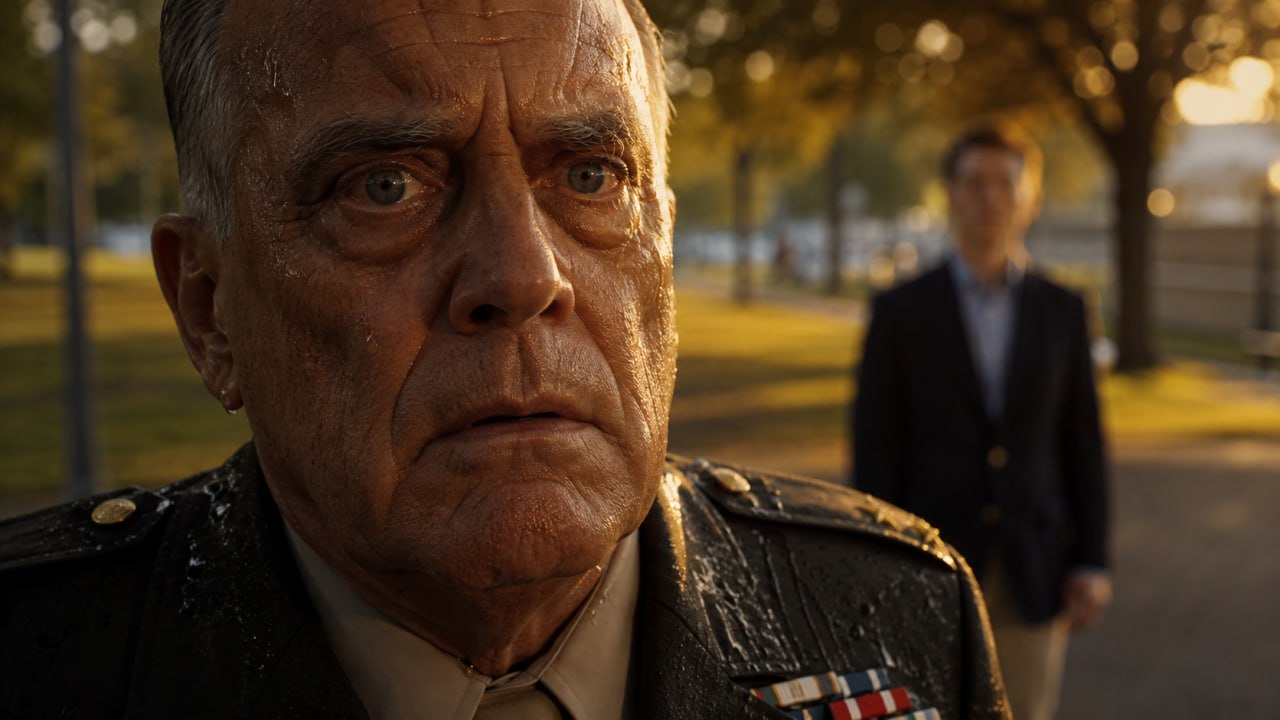
The park was the kind of place that asked nothing of you.
Old elms threw shadows across the paths. Pigeons worked the cracked asphalt. People came here to disappear for a while—and most of them did, without a second glance at anyone else.
Raymond had been coming here for eleven years.
He didn’t own anything worth mentioning. But he had this bench—the one near the east gate, where the shade hit right around two in the afternoon. That was enough.
He peeled the lid off his cup noodles, letting the steam curl up into the cool air, and exhaled slowly.
“Good enough,” he murmured to himself.
It was.
Across the path, a man named Dex Calloway was already annoyed before he’d even sat down.
He’d had a bad morning. A meeting pushed. A client he couldn’t stand. And now his usual coffee spot had a twenty-minute line, so he’d had to walk—walk—to get his order. He was twenty-eight, drove a lease he could barely afford, and had developed the particular talent of mistaking frustration for authority.
He spotted the bench immediately.
One old man. Half the seat taken up by a worn canvas bag.
Dex walked over without slowing down.
“Hey.” He stopped directly in front of Raymond. “Move your stuff.”
Raymond looked up. Calm. Unhurried.
“There’s room,” Raymond said. “You’re welcome to sit.”
“I don’t want to sit next to you.” Dex’s voice had the practiced flatness of someone used to compliance. “I want the bench. Move.”
“Son, I was here first.”
“I don’t care.”
Raymond set his cup noodles carefully on the armrest and met the younger man’s eyes.
“I’m not moving,” he said. Quiet. Final.
A few heads turned.
A woman with a stroller paused on the path. Two college kids at a nearby table looked up from their laptops. A man in a paint-spattered jacket slowed his walk.
Nobody moved.
Dex’s jaw tightened. He looked around—not for help, but for an audience. Something flickered across his face. The need to win, badly enough to do something stupid.
He took the lid off his coffee.
“Last chance.”
Raymond looked at the cup. Then back up at Dex.
“You don’t want to do that.”
Dex did it anyway.
The coffee hit Raymond across the shoulder and chest—dark, steaming, soaking immediately into the old jacket. Raymond flinched. His cup of noodles tipped and fell, spilling across the ground.
The woman with the stroller covered her mouth.
“Maybe next time,” Dex said, his voice bright with something ugly, “you’ll learn your place.”
He laughed. Short. Sharp. Expecting nothing back.
And that’s when Marcus Hale stood up.
He’d been sitting on a low concrete wall maybe thirty feet away, eating from a takeout container—noodles, same as Raymond’s, just from a cart two blocks north. He was forty-three, built like someone who’d done physical work his whole life, wearing a leather jacket that had been through enough weather to look like armor.
He didn’t hurry.
He walked over with his container still in hand, noodles and broth shifting with each step. Dex heard him coming and turned.
“What?” Dex said. “You got something to say?”
Marcus didn’t answer.
He upended the container directly over Dex’s head.
The noodles hit first—thick, slippery, still warm. Then the broth, dark and fragrant, ran down through Dex’s hair, soaked into his collar, spread across the shoulders of his jacket.
Dex stood completely still.
For three full seconds, he didn’t speak.
“What—” His voice cracked. “What did you just do?“
“Now you know what it feels like,” Marcus said.
His voice wasn’t raised. It didn’t need to be.
Dex turned—and realized, suddenly, that the park was watching him. Not the way a crowd watches something exciting. The way people watch something shameful.
“Do you know who I—”
“No,” Marcus said. “And I don’t need to.”
He stepped closer. Not threatening—just present. The kind of presence that doesn’t need to explain itself.
“You poured hot coffee on a man who did nothing to you. You pushed him. You laughed.” Marcus let that sit for a moment. “Walk away. Right now. Before you make this worse.”
Dex’s face went through several things in quick succession.
Rage. Calculation. Fear.
He looked at Marcus. Then at the people watching. Then at Raymond, who was sitting quietly, jacket still wet, watching with an expression that had no anger in it—only a tired, patient clarity.
Dex took a step back.
Then another.
He opened his mouth once more—the reflex of a man who always had to have the last word—but nothing came out. Whatever he’d been about to say collapsed under the weight of everyone watching him not say it.
He turned and walked away quickly, not quite running, weaving around a couple on the path, and then he was gone.
The park exhaled.
Marcus picked up Raymond’s fallen cup from the ground, looked at it, then tossed it in the nearby trash.
“You hurt?” he asked.
“Shoulder’s fine.” Raymond touched his jacket gingerly. “Eleven dollar jacket anyway.”
“Still yours.”
Marcus went to the cart near the gate and came back two minutes later with a fresh cup of noodles, steam rising from the lid. He set it on the armrest beside Raymond without ceremony.
Raymond looked at it. Then at him.
“You didn’t have to do that.”
“No,” Marcus agreed. He sat down on the other end of the bench. “But I was almost done eating anyway.”
Raymond smiled—small, genuine, the kind that takes a moment to arrive.
“Vietnam,” he said after a pause. “Two tours.”
“Army,” Marcus said. “One.”
They sat quietly for a minute. A pigeon investigated the spilled broth near the path.
“He’ll do it again,” Raymond said. “To someone else.”
“Probably.” Marcus peeled the lid off his new coffee. “But not today.”
Raymond ate his noodles.
The park went back to its ordinary afternoon—sunlight through the elms, a kid on a scooter, someone’s music drifting over from the fountain.
The bench stayed theirs.
Two days later, someone posted a video.
Shaky phone footage, shot from near the laptop table: the whole thing, start to finish. The coffee. The push. The laugh. Marcus standing up, walking over. The noodles.
The video got three million views in eighteen hours.
People found Dex Calloway quickly—his company’s LinkedIn profile, his car, his neighborhood. By the time the comments were forty thousand deep, his employer had already issued a statement. By the end of the week, he’d been let go.
He posted an apology that read like it had been written by a lawyer, which it had.
Raymond didn’t see the video until a neighbor’s grandson showed it to him on a phone screen in the lobby of his building.
He watched it once, quietly, then handed the phone back.
“People keep saying he got what he deserved,” the grandson said. “You think that’s true?”
Raymond thought about it for a moment.
“I think he learned something he should’ve learned a long time ago,” he said. “Whether it sticks—that’s up to him.”
He went upstairs.
Made himself dinner.
And slept, for the first time in a while, without waking up in the middle of the night.
Marcus didn’t know about any of it until his sister called him, laughing.
“You’re famous,” she said.
“I’m eating breakfast,” he said.
“Three million views, Marcus.”
He was quiet for a moment.
“Good,” he said. “Maybe somebody else’ll do the same thing next time they see it happen.”
He hung up. Finished his eggs.
Went back to the park that afternoon—same wall, same takeout container—and ate his lunch in the sun.
Nobody bothered anyone that day.
And the bench by the east gate was exactly where it always was, holding whoever needed it.
Original fictional stories. AI-assisted creative content.
