
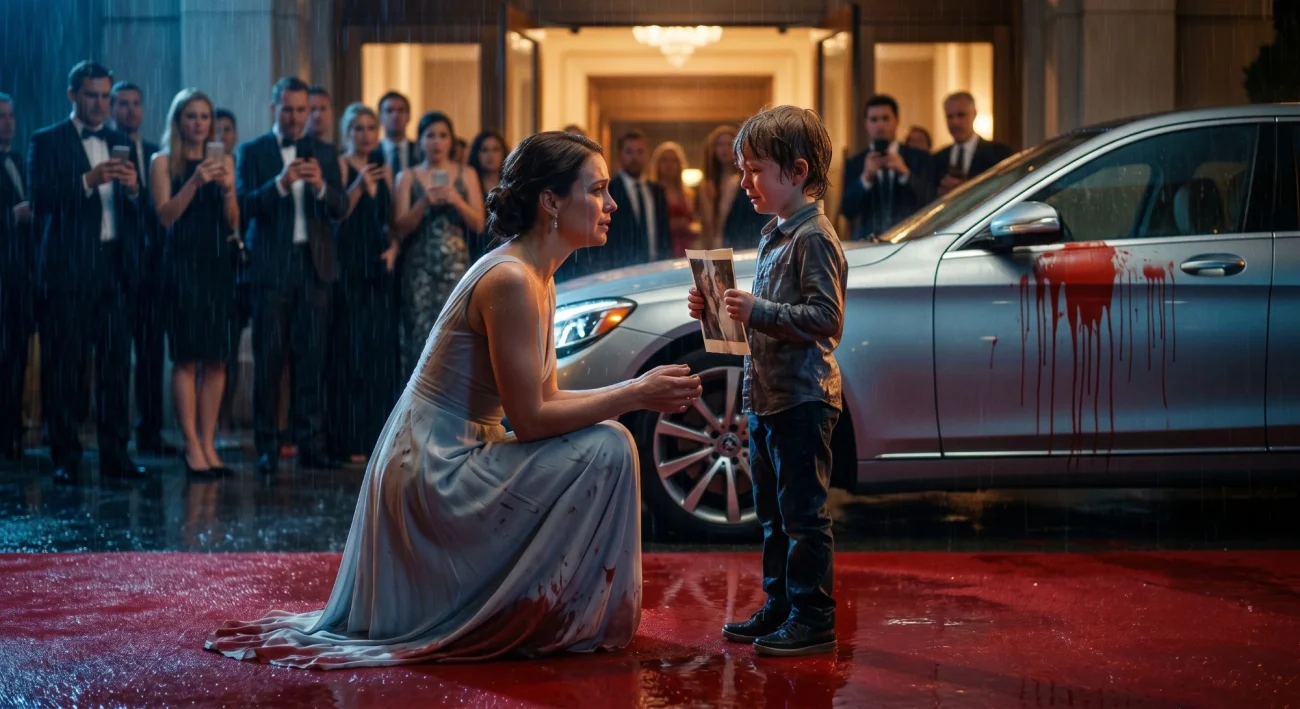
Rain misted over the red carpet outside the Whitman Foundation gala.
Town cars slid to the curb one after another, doors swung open by men in white gloves.
Cameras flashed. Gowns caught the light. The most photographed people in the city smiled, waved, and disappeared inside to be admired.
A silver Bentley eased up to the front.
“That’s Grace Whitman,” a reporter murmured. “Eleanor’s daughter. She never comes to these.”
Then a small shape broke from the edge of the crowd.
He didn’t move like a thief. He moved like someone who had walked a very long way and had nothing left to lose.
He stopped at the curb and stared at the silver car like it had taken something from him.
He was maybe six. Soaked to the skin, his sneakers black with rainwater. A dented paint can swung from one tiny fist.
“Hey—kid—” A guard reached for him. “You can’t be up here, buddy.”
The boy didn’t even look at him.
“Is she in there?” he asked, to no one. “Is the lady in there?”
“What lady? Come on, let’s—”
The boy was faster.
He hauled the can back with both arms and threw it with his whole body.
Red paint burst across the Bentley’s hood like something torn open.
It ran down the white door, dripped off the mirror, pooled red across the wet carpet.
Screams. Phones up. The whole carpet turning at once.
“YOU LET HER DIE!” the boy shrieked. “YOU LET MY MOMMY DIE!”
Guards lunged. Guests stumbled back off the carpet, heels skidding on the wet stone. A woman dropped her clutch and didn’t stop to pick it up.
The boy didn’t run. He stood in the middle of all of it, fists clenched, chest heaving, screaming at a car like it was the only thing in the world that could hear him.
“COME OUT! COME OUT HERE AND LOOK AT ME!”
The rear door opened.
A woman stepped out. Pale gown, dark hair pinned up, the kind of beautiful that looks tired underneath.
“What—” She stared at the paint, then at the boy. “Who are you? What is this?”
“You left her in the rain!” Tears poured down his face, mixing with the drizzle. “She sat at your gate three days! Your men wouldn’t open it!”
“I don’t—I don’t know your mother—”
“YES YOU DO.”
His small hand dove into his coat.
He pulled out a photograph. Soaked at the corners. Held together with yellowed tape.
He opened it with shaking fingers and lifted it into the light.
A girl in a hospital gown. Seventeen, maybe younger. Holding a newborn against her chest, crying and smiling at the same time.
The girl was unmistakably her.
“She said you’re my real mother,” the boy whispered. “She said your name is Grace.”
The carpet went silent.
Grace’s hand drifted to her mouth.
“That’s not—” Her voice cracked. “That photo doesn’t exist. They told me it was destroyed. They told me everything from that day was gone.”
“Linda kept it,” the boy said. “In her Bible. She said it was the only proof I was real.”
“Linda.” Grace said the name like it meant nothing, because it did. “I don’t know any Linda.”
“She’s my mommy.” His chin trembled. “She got me when I was a baby. She said a lady gave me to her. She said the lady was crying so hard she couldn’t even sign her name right.”
Grace went very still.
“What did the lady look like,” she whispered. “In the story Linda told you. What did she look like.”
“Young,” the boy said. “She said the lady was just a kid. She said the lady kept saying she was sorry.”
Grace’s knees nearly went out from under her.
Because she remembered saying it. Over and over, into a hospital pillow, eighteen years old and empty-armed. I’m sorry. I’m sorry. I’m sorry.
“Grace.” A new voice cut across the carpet. Cool. Polished. Final.
An older woman swept out through the gala doors, diamonds at her throat, a fur stole on her shoulders.
She did not look at the boy. She looked only at the cameras, calculating.
“Step inside, darling,” Eleanor Whitman said. “Security will handle this. The child is clearly disturbed.”
“Mother.” Grace didn’t move. “He has the photo. The one you said was gone.”
“He has a photograph of a teenage girl. Children find things. People sell things.” Eleanor’s smile never reached her eyes. “Come inside before you embarrass the Foundation.”
The boy stared up at Eleanor.
Something in his face changed.
“It’s you,” he breathed. “You’re the gate lady. You’re the one who sent her away.”
Eleanor’s smile flickered for half a second.
Half a second was enough.
“I have never seen this child,” she said.
“My mommy showed me your picture,” the boy said. “From the newspaper. She said, ‘If anything happens to me, you find this house. You find Grace. Not the old woman. Never the old woman.'”
A whisper ran through the crowd.
“She was so sick,” the boy went on, the words tumbling out now, like he’d been holding them for days. “She couldn’t walk anymore. I pushed her chair. It rained the whole time. We sat by the gate and she kept ringing the little button and a man’s voice told us to go away.”
His face twisted.
“The third day she got real quiet. She wasn’t cold anymore, she said. I thought that was good. I thought it meant she was getting better.” Tears ran down his cheeks. “She held my hand and she told me your name one more time and then she stopped talking. She didn’t wake up at the hospital.”
The carpet had gone so silent the rain was the loudest thing.
Grace turned to face her mother fully.
“Where is my son, Mother.”
“Grace—”
“Six years ago you told me he went to a family in Connecticut.” Her voice was rising, shaking. “A doctor and his wife. You showed me a house with a blue door. You said they had a nursery painted with sailboats.”
“And he was given every advantage—”
“WHERE IS THE BLUE DOOR.” Grace’s shout split the night. “WHERE ARE THE SAILBOATS.”
Silence.
The boy answered, very small.
“We didn’t have a door like that. We had one room. Linda slept on the couch so I could have the bed.” His lip quivered. “We didn’t have a lot of stuff. But she sang to me every night. Every single night, even when she was too tired to stand up.”
He looked down at the photograph in his hands.
“When I’d ask about my real mommy, she’d say maybe you were a princess. Maybe you got lost. She never said anything mean about you. Not once.” His voice dropped. “Even though she thought you gave me away. She still made you sound nice. So I wouldn’t hurt so much.”
Grace made a sound that wasn’t quite a word.
She sank down onto the wet carpet in her pale gown, paint soaking into the hem, until she was eye to eye with him.
“What’s your name?” she whispered. “What did she name you?”
“Noah.”
Grace pressed her hand over her own heart like something inside it had cracked.
“That’s the name I chose,” she said. “Before they took you. I held you for four minutes and I named you Noah and they told me I’d never see you again.”
The boy stared at her.
“You held me?”
“For four minutes.” Her voice splintered. “I counted every second. I’ve replayed those four minutes for six years. They’re the best four minutes of my whole life and I thought they were all I’d ever get.”
“What did you do?” he asked. “In the four minutes.”
“I told you I loved you.” She was crying without shame now, in front of all of them. “I told you I was sorry. I told you to be brave and that I’d find you somehow, even though they were already taking you out of my arms.” She pressed her forehead to his. “I broke that promise for six years, Noah. But you didn’t let me. You found me. You kept my promise for me.”
“Grace, that is enough.” Eleanor’s voice had a hairline crack in it now. “You were eighteen. You had no money, no husband, no future. I gave that baby a chance at a good life.”
“You gave him to a stranger and told me he had a doctor for a father.” Grace didn’t look up from the boy. “You lied to me every Mother’s Day for six years. You let me think he was somewhere warm. Somewhere safe.”
“He was safe—”
“I wrote him letters.” Grace’s voice broke open. “Every year on his birthday. I gave them to you. You said you’d send them through the agency, that the family would read them to him when he was older.” She turned her wet eyes on her mother. “Did you send a single one?”
Eleanor’s jaw tightened.
“There was no agency,” Grace said slowly, the truth assembling itself in front of two hundred people. “There was no family. You took my letters and you—what. You burned them.”
“Don’t be dramatic.”
“My son spent six years thinking his real mother didn’t want him.” Grace’s hand found the back of the boy’s head and held it against her shoulder, fierce and shaking. “And I had a drawer full of letters that swore I did. And you kept us from each other on purpose.”
“His mother died at our gate.” Her voice dropped to a whisper that carried farther than any scream. “In the rain. Asking for me. And your men pushed her wheelchair back into the street like she was garbage.”
The crowd had stopped pretending not to watch. Phones tracked every word.
“That woman was hysterical and trespassing,” Eleanor said. “I did not know—”
“You knew.” A new voice. Quiet. Certain.
A woman came up the carpet in a plain raincoat, a folder pressed under her arm. “My name is Dana Foster. I was Linda Reyes’s neighbor. I drove her to your gate. All three days.”
She opened the folder.
“Linda asked me to bring this if she didn’t make it. She did not make it. She passed on Tuesday morning, holding that little boy’s hand.”
She pulled out a phone in a cracked pink case and pressed play.
A woman’s voice came out, thin and worn by illness.
“Grace. You don’t know me, but I’ve known about you for six years. A woman named Eleanor Whitman paid me four thousand dollars to take a newborn and never ask questions. She told me his mother was a drug addict who’d died. I believed her. God forgive me, I believed her.”
A long, rattling breath.
“But this boy is the best thing that ever happened to me, and when the doctors said I didn’t have long, I went through the hospital papers I’d kept. Your name was on his birth bracelet, Grace. Not a dead addict. A scared seventeen-year-old. I tried to bring him to you myself. They wouldn’t open the gate.”
Grace had both hands over her mouth now.
“His name is Noah. He likes the color blue. He’s afraid of thunder. He still asks why his real mommy didn’t want him, and I never knew what to say, because now I know — you did want him. They just never let you have him. Please. Take him. And don’t let that woman near him. Not ever.”
The recording clicked off.
Nobody on that carpet breathed.
The boy stared at the phone in Dana’s hand, and his face crumpled.
“That’s her,” he whispered. “That’s her voice. Play it again.”
“Oh, sweetheart.” Dana’s eyes were wet. “Later. I promise. As many times as you want.”
“She made the tape for me,” he said, to Grace now, desperate to explain, to give her something. “She made lots of tapes. Of her singing. So I wouldn’t forget what she sounded like.” His voice splintered. “I didn’t want a tape. I wanted her.”
Grace pulled him in so hard the photograph crushed between them.
Somewhere in the crowd, a woman was openly sobbing. A man turned his phone sideways to keep filming and wiped his face with the back of his hand.
Eleanor’s face had gone the color of bone.
“This is slander,” she said. But it came out small. “A dying woman will say anything—”
“There’s a wire transfer,” Dana said, lifting a sheet from the folder. “Four thousand dollars. From an account in your name to Linda Reyes. Dated three days after Grace gave birth.” She held it up to the cameras. “And the original adoption was never filed with the state. There is no doctor in Connecticut. There never was a blue door.”
Grace stared at the number on the page.
“Four thousand dollars,” she said softly. “That’s what he was worth to you. That’s the price of the lie I lived inside for six years.” She let out a sound that was almost a laugh, and it was the saddest thing on that carpet. “I would have given up everything I own to keep him. You never even asked me. You just decided he was a problem and you made him disappear.”
A man in a tuxedo stepped out of the crowd, ashen.
“Eleanor,” he said. “I’m on the Foundation board. We— we vetted you. We put your name on the building.” He looked sick. “Tell me this isn’t real.”
Eleanor opened her mouth.
Nothing came out.
And in that nothing, two hundred people understood that all of it was real.
A second board member turned on her heel and walked straight back inside without a word — toward the microphone, toward the donors who’d written seven-figure checks on the strength of Eleanor Whitman’s good name.
A photographer who’d spent twenty years shooting these galas lowered his lens, looked at Eleanor with something close to disgust, and raised it again.
Phones rose higher. The whispers turned to something harder.
Eleanor reached for her daughter’s arm. “Grace. Everything I built was for you. For this family’s name—”
“This family’s name.” Grace finally rose to her feet, lifting the boy with her, settling him on her hip like she’d done it every day of his life. “You can keep the name.”
“Grace—”
“You sold my son for four thousand dollars and let me grieve a fairy tale.” Her voice didn’t shake anymore. It was the calmest thing on that carpet. “You will not get one more minute of my life. And after tonight, you won’t have a Foundation, or a board, or a single friend who’ll return your call.”
She looked at the cameras then. Deliberately.
“Get it all,” she told them. “Every word. So she can never lie her way out of it.”
Eleanor stood alone in her diamonds as the crowd drew back from her, the way water draws back from something it won’t touch.
Grace turned away from her mother and did not look back.
The boy’s small arms wound around her neck.
“Are you mad at me?” he whispered. “For the paint?”
“No, baby.” She pressed her lips to his wet hair. “You did the bravest thing anyone has ever done for me. You found me.”
“Linda said you’d be sad.”
“I was.” Tears slid freely down her face now, and she let them. “I was so sad for so long. But you walked through a whole city in the rain to fix it. You fixed it, Noah.”
He pulled back to look at her, studying her face against the photograph he still clutched.
“You look like the picture,” he said. “Just older.”
A broken laugh escaped her. “I got older waiting for you. I didn’t even know that’s what I was doing.”
He reached up with one wet, paint-streaked hand and touched her cheek, very carefully, like he was checking she was real.
“You’re crying too,” he said.
“I know.”
“Linda cried when she was happy and when she was sad. How do I know which one you are?”
Grace caught his small hand and pressed it flat against her cheek.
“Both,” she said. “Happy and sad at the exact same time. That’s the most real thing there is, Noah. Linda was right about that too.”
“Can we get Linda’s things?” he asked, suddenly anxious, the way grief comes in waves at that age. “Her blanket? It still smells like her. And her singing tapes? They’re under the couch in a shoebox. I have to get the shoebox.”
“We’ll get all of it.” Grace held him tighter. “The blanket, the tapes, the shoebox, every single thing. And we are going to keep Linda, Noah. We’ll play her songs in our house. We’ll say her name out loud every day. She’s the reason I have you. She loved you when I couldn’t be there to.”
“You really wanted me?” he asked. The question he had carried his whole life, finally set down. “Linda said you did. But I didn’t always believe her.”
Grace had to breathe through it before she could answer.
“I wanted you so much,” she said, “that I named you in four minutes and I’ve whispered that name every single night for six years. Noah. Noah. You were never not mine. They just took a long time to bring you back.”
“Both my mommies,” he said quietly.
“Both your mommies,” Grace agreed, her voice breaking on the words. “Forever. There’s room. There’s always going to be room.”
A reporter’s assistant quietly draped a dry coat over the boy. Grace tucked it close around him with one hand.
She turned to Dana, the neighbor still standing there in her plain wet raincoat, the folder hugged to her chest.
“You drove her three days,” Grace said. “In the rain. You stayed.”
“She was my friend,” Dana said simply. “And that boy used to color pictures on my kitchen floor. Somebody had to bring him home.”
Grace reached out and gripped her hand. “I will never be able to pay that back.”
“Don’t pay me.” Dana’s voice wobbled. “Just don’t ever let go of him. That’s all she wanted. That’s all any of us wanted.”
Grace nodded, unable to speak, and held on a second longer before she let go.
Behind them, the Bentley sat ruined, red paint still streaking down its white doors into the rain.
Grace didn’t give it a glance.
She carried her son down the wet carpet, away from the lights, away from the diamonds and the cameras and the woman standing frozen and alone in the doorway of a Foundation that would carry her name for exactly one more news cycle.
“Where are we going?” Noah mumbled into her shoulder.
“Home,” Grace said. “A real one. With a blue room. And a nightlight, so the thunder never gets you.”
“You know about the thunder?”
“I do now.” She kissed his temple. “I’m going to learn everything. Every story. Every song Linda ever sang. I have six years to catch up on and I’m not wasting one more second.”
Noah was quiet a moment, his cheek against her neck, his whole small weight finally letting go into her arms.
“I’m tired,” he whispered.
“Then sleep,” she said. “I’ve got you. I’m not putting you down. Not tonight. Not ever again.”
“What if I wake up and you’re not there?”
Grace stopped walking. She turned her head and pressed her lips to his temple and held them there until he felt it.
“Then you say my name,” she said, “and I’ll already be right there. I’ve been waiting six years to hear you say it. I’m not going anywhere, Noah. Not down the hall. Not for a second.”
He nodded against her, believing her the way only an exhausted child can, completely and all at once.
And for the first time in his short, hard life, the boy who’d asked every night why his real mommy didn’t want him closed his eyes against the only answer that had ever been true — that she had wanted him, desperately, every single day, and the world had simply taken six years to let her hold him.
Behind them the gala lights kept glittering for no one. The woman in the doorway, draped in diamonds nobody would ever photograph kindly again, watched her daughter and her grandson walk into the dark, and understood, far too late, exactly what her good name had cost.
And somewhere in a cold one-room apartment across the city, a blue blanket waited on a couch, still holding the shape of the woman who had loved a stolen child enough to send him home.
Original fictional stories. AI-assisted creative content.
