
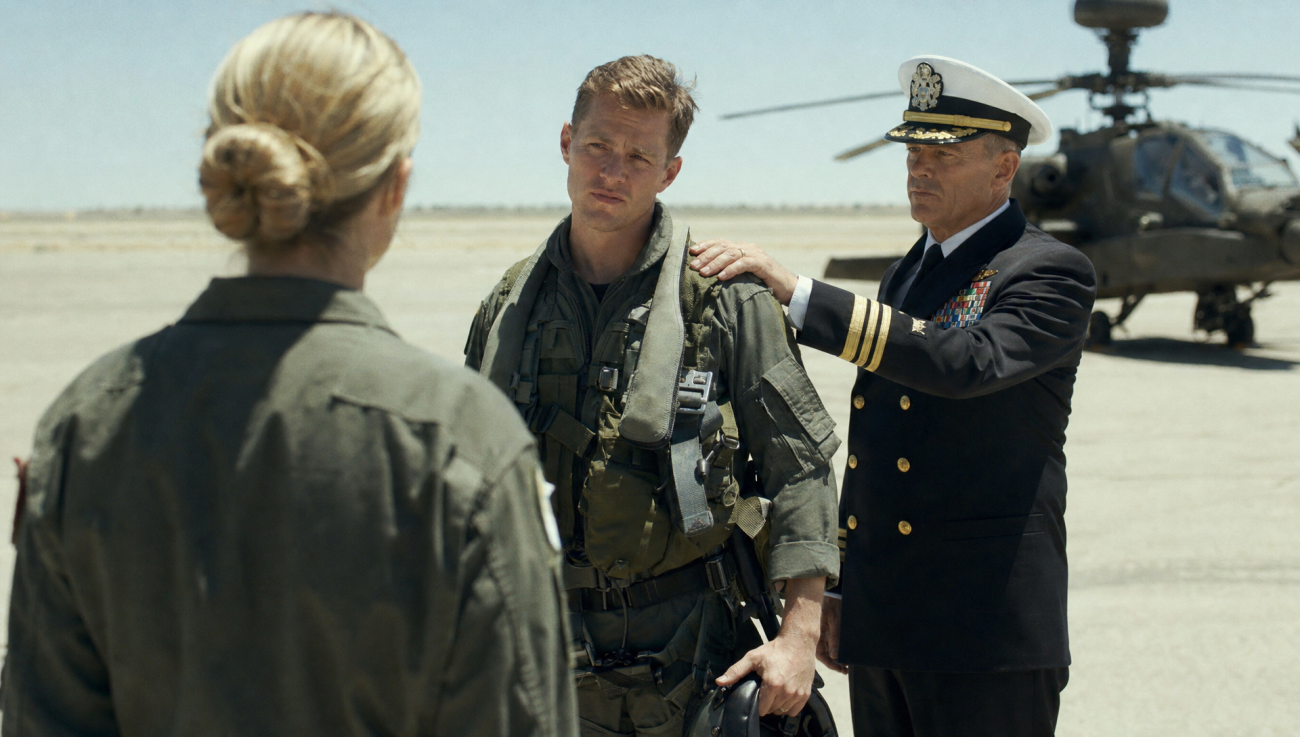
“Are you planning to fly the Apache, or just polish it?”
The laughter hit the Alabama tarmac like a wave. Lieutenant Marcus Nash stood at the center of it, arms crossed, grinning at his own joke. Around him, a half-dozen aviators in pressed flight suits enjoyed the show.
The woman they were laughing at didn’t flinch.
Warrant Officer Joanne Odalis tucked the helmet tighter under her arm, locked her jaw, and walked toward the hangar. Her flight suit was stained with hydraulic fluid and motor grease. Her boots were worn down at the heel. She didn’t look up. She didn’t look back.
Eight months. That’s how long she had been here. Eight months of small jokes, sideways glances, and men who saw the wrench in her hand and decided the story was over.
She let them.
Rear Admiral Daniel Greer had stepped onto the flight line thirty seconds before Nash opened his mouth.
He saw it all.
He watched her walk away — not defeated, not embarrassed. Just contained. Like a weapon with the safety still on.
He turned to his aide. “Who is that?”
“Maintenance, sir,” the aide said, scrolling the roster. “Warrant Officer Joanne Odalis. Transferred in from Pensacola eight months ago. Voluntary demotion.”
Greer’s eyes stayed on the hangar door long after she’d disappeared through it. “Maintenance doesn’t walk like that.”
“Sir?”
“Like she’s survived something the rest of us haven’t even heard of. Pull her file.”
The aide came back ten minutes later. His collar was damp. “Sir, I… can’t. It’s restricted. Entirely. Pentagon-level clearance.”
Greer didn’t blink. He walked to the command office, picked up the encrypted line, and called a man he hadn’t spoken to in two years.
Six minutes later, the file came through.
He read it standing up.
Then he read it again.
Then he walked back out onto the tarmac.
The flight line went silent the moment Admiral Greer crossed it with purpose.
Pilots straightened. Conversations died. Nash turned around, expecting a routine pass-through, and found the Admiral standing directly in front of him.
Greer reached into the folder under his arm. He pulled out a single photograph and pressed it flat against Nash’s chest.
His voice came out quiet, almost gentle. That made it worse.
“You think she’s just a mechanic?”
Nash looked down at the photograph. His face did something complicated.
It showed a younger version of the woman from the hangar — face covered in soot and dried blood, jaw set, dragging a wounded soldier from the burning wreckage of a Black Hawk. Behind her, an Apache sat silently on a Syrian ridge, riddled with bullet holes, both engines dark.
The date in the corner was three years ago.
“Captain Joanne Odalis,” Greer said. “Distinguished Flying Cross. Operation Sand Viper — still mostly classified. She held off an enemy ambush on foot after her gunner went down, then flew that bird back to base on one engine and no instruments. Thirty miles. In the dark. She saved three lives.”
Nash hadn’t moved.
“The only reason she isn’t flying right now,” Greer continued, his voice dropping half a degree, “is because she asked not to. So the next time you open your mouth on my flight line, Lieutenant, you’d better be certain you know exactly who you’re talking to.”
The silence was total.
The other pilots looked at their boots, at the sky, at anything that wasn’t Nash’s face.
Joanne had heard the Admiral’s voice and stepped back out of the hangar, wiping her hands on a rag.
She stood in the entrance, watching. Her expression gave nothing away.
Greer turned from Nash — who had gone the color of old concrete — and walked toward her.
“Captain Odalis. A word.”
He led her to a small office off the tarmac, away from the heat and the audience. For a moment they just stood in the air conditioning, neither of them speaking.
“You didn’t have to do that, sir,” Joanne said finally. No bitterness. No gratitude. Just fact.
“No,” Greer agreed. “But I didn’t do it for your sake.” He leaned against the edge of the desk and looked at her directly. “I did it because I needed to know what kind of person I’m dealing with. And now I do.”
Joanne met his eyes. A careful pause. “Sir?”
“Your file is extraordinary, Captain. Perfect flight record. Commendations. A mechanical intuition that three of my engineers couldn’t match on their best day.” He paused. “Which makes it very strange that a decorated combat pilot voluntarily demoted herself to maintenance at this specific base. Especially now.”
“Especially now?” she repeated.
“Fort Rucker has had eleven equipment anomalies in the past fourteen months. Hydraulic line failure. Rotor sensor misreads. A fuel coupling that nearly cost us a bird on the ground.” He watched her face. “Small things. All caught before flight. But the frequency is wrong.”
Joanne said nothing.
“I’ve been tracking similar incidents,” Greer continued. “Across three installations. All different units, different aircraft, different crews. But one common thread.” He let it sit. “A Senior Chief Petty Officer named Arthur Wallace. Transferred to each base six to eight weeks before the anomalies began.”
The room was quiet for a long moment.
Then Joanne exhaled — a small, tired sound. “I was wondering when someone else would notice.”
She told him everything.
Before Fort Rucker, she had been at Pensacola in an advisory role. Grounded after Syria — not from trauma, not from psych eval, but from a feeling she couldn’t shake. A feeling that something had been wrong with her helicopter before she ever lifted off that night.
The official report cited battle damage. She couldn’t prove otherwise.
But she knew her machine. She knew its sounds and rhythms the way a musician knows an instrument. And something had been off before the first shot was fired.
So she started looking at maintenance logs. Not just hers — all of them. She cross-referenced signatures, parts cycles, replacement records. And she found something that shouldn’t have been there: a pattern of almost-invisible discrepancies, each one too small to flag on its own. Paperwork that was just slightly too perfect. Parts logged as replaced before they should have needed it.
Every thread led back to the same name.
“Wallace is not a traitor,” Joanne said. “He’s not working for anyone foreign. He’s a ghost. He believes he’s making a point.”
Greer nodded slowly. “His son. Marine pilot. Died in a training accident five years ago. The investigation blamed a faulty batch of turbine blades — inadequate QC at the contractor level.”
“Wallace never accepted the ruling,” Joanne said. “He thinks the military buried it. Moved on too fast, protected someone, closed the file before it should have been closed.” Her voice stayed level. “So now he creates doubt. Tiny, almost-undetectable flaws. He’s trying to force a system-wide audit. He doesn’t want anyone to die. He just wants someone to finally look.”
“And today,” Greer said, his voice tightening, “is the annual live-fire exercise.”
Joanne’s blood went cold. “Nash. He’s flying lead.”
“He pushes every aircraft to its absolute ceiling. If anything has a hidden flaw—”
“He’ll find it,” she said. “At altitude. Under load.”
They were both already moving.
Nash was walking toward his Apache when he saw them coming. His face went through three expressions in two seconds — defiance, then uncertainty, then something harder to name.
“Lieutenant,” Joanne said. “Ground your bird.”
Nash stopped walking. “Excuse me?”
“Ground it. Now.”
His jaw tightened. The humiliation from the tarmac was still fresh, and pride was a slow thing to kill. “What, the maintenance girl has a bad feeling?”
“I did your pre-flight this morning,” Joanne said, her voice completely flat. “I signed off on it. But I saw Wallace near your aircraft less than an hour ago. I believe there’s a fault in the cyclic pitch actuator. I can’t prove it yet. But I know it’s there.”
“The pre-flight was clean,” Nash shot back. “Every system was green.”
“Because he’s that good,” she said. “It won’t show in a standard diagnostic. But when you pull a hard bank over the range, the system will fail. You’ll lose the aircraft.”
Nash turned to the Admiral, jaw set. “Sir. This is—”
“You have two choices, Lieutenant,” Greer said quietly. “You trust the pilot who flew a crippled gunship thirty miles over enemy territory in the dark, on one engine, with no instruments. Or you trust the man who laughed at her.” He didn’t blink. “Your call.”
The words landed like a hand on the shoulder.
Nash stood still for a long moment, looking at Joanne — really looking at her, maybe for the first time — and saw something he should have noticed eight months ago. Not a mechanic. Not a washout. A commander who had chosen to get her hands dirty because the work required it.
He reached up and slowly unbuckled his helmet.
“Alright,” he said. “Show me what you’re looking for.”
Greer pulled in a trusted team of four engineers. They swarmed the Apache with a different checklist — not the standard pre-flight, but a deep physical inspection, hands-on, bypassing the digital diagnostics entirely.
Twenty minutes in, one of the engineers looked up. “I don’t see anything, Captain.”
“Keep looking,” Joanne said. She was already elbow-deep in the actuator assembly, her fingers reading the machine the way a blind person reads text.
She could feel it before she could see it.
A rhythm that was wrong. A resistance that had no business being there.
Then her fingertip found the fracture — hairline thin, nearly microscopic, invisible to any standard inspection. But it wasn’t just a crack. Deep inside the fault line, something glistened.
“Hydraulic fluid,” she said softly. “He used a high-pressure micro-injector. Forced fluid into the fracture. Under the stress of a high-G bank, the fluid expands, the bracket shatters, and the actuator fails completely.” She didn’t move for a moment. “Instantaneous. No warning. No recovery window.”
The hangar was silent.
“He built it to look like a material failure,” she said. “It would have been logged as exactly that. Another accident. Another report. Another closed file.”
The engineer beside her sat back on his heels. His face had lost some color. “How did you know?”
Joanne didn’t answer right away. She carefully extracted a small amount of the viscous fluid onto a testing strip.
“The machine told me,” she said finally.
While the engineers documented the evidence and sealed the Apache, Admiral Greer’s security team located Senior Chief Arthur Wallace in the maintenance bay on the far side of the flight line.
He was watching the exercise preparations from a distance, arms folded, face unreadable.
When he saw them coming, he didn’t run. He didn’t argue.
He just looked at them with the exhausted eyes of a man who had been waiting a long time for something — anything — to finally happen.
He handed over a small, handmade toolkit before they even asked. Inside were the specialized instruments he had fabricated himself: a micro-pressure injector, a set of custom fracture guides, a set of tools that didn’t exist in any military catalog.
“My son’s name was Corporal Daniel Wallace,” he said, to no one in particular. “He was twenty-four years old.”
Nobody answered him. There was nothing to say that could sit alongside that.
The live-fire exercise was cancelled. The base became the center of a full JAG investigation within the hour.
As the sun began dropping toward the tree line, Nash found Joanne standing beside the grounded Apache. He stood next to her for a while without speaking. The silence between them had changed — it was no longer hostile. Just heavy.
“I owe you an apology,” he said finally. “For this morning. For all of it. Eight months of — I owe you that.”
Joanne nodded once. Clean. No ceremony. “Don’t be sorry, Lieutenant. Be better.”
He was quiet for a moment. “Why’d you do it this way? You could’ve reported Wallace directly. Gone through channels. You didn’t have to spend eight months in the grease.”
She kept her eyes on the Apache, its rotor silhouetted black against the orange sky.
“Because channels don’t feel what I feel,” she said. “These machines talk if you know how to listen. Wallace was whispering to them for months, and no one could hear it because no one was close enough.” A pause. “Someone had to get close.”
Nash looked at the aircraft for a long time.
“For what it’s worth,” he said quietly, “I hear you now.”
One week later, Admiral Greer called Joanne to his temporary command office.
He slid a file across the desk before she could sit down.
“Full reinstatement of rank,” he said. “Squadron command. Your pick of assignment.”
Joanne looked at the file. She didn’t open it.
“Sir,” she said, “flying was something I did. It’s not who I am anymore.” She met his eyes. “I belong where I can keep the people in the cockpits alive. Not where I am one of them.”
Greer smiled — not surprised. He reached under the first file and produced a second one.
“I had a feeling you’d say that.”
He slid it across.
It wasn’t a command assignment. It was a proposal — three pages, Pentagon letterhead — for a new unit. The Aviation Integrity and Threat Analysis Unit. Reporting directly to him. Tasked with investigating unexplained mechanical failures across all branches, developing advanced diagnostic protocols, and hunting the kind of invisible sabotage that no standard inspection would ever catch.
It was a job that required the mind of a pilot, the hands of a mechanic, and the instincts of someone who had already survived what she was being asked to prevent.
“I need someone to build it from nothing,” Greer said. “And lead it.”
Joanne read the first page. Then the second.
For the first time in three years, something shifted in her face — not quite a smile, but the architecture of one. The tension she had been carrying, the quiet weight of months in the grease and the mockery and the deliberate invisibility, finally had somewhere to rest.
She closed the file.
“When do I start?” she said.
Original fictional stories. AI-assisted creative content.
