
The flight from London landed at Savannah/Hilton Head just after noon. Sixteen hours of travel, and all I could think about was Emily’s face when she saw me walk through the door.
She had been ten when I left. Bright-eyed, stubborn in the best way, always leaving crayon drawings on my desk. I had kissed her forehead, promised her I’d be back before she knew it, and boarded a plane to build something that would take care of us both.
Fifteen years. A logistics company. Contracts across three continents.
And a four-million-dollar mansion in Savannah, Georgia, paid off in full—deeded in Emily’s name before I ever set foot on British soil.
I called ahead from the airport. No answer. I figured Karen was out, or maybe Emily was at the library. She’d always loved the library.
My driver pulled up to the iron gate just past two o’clock. The garden was immaculate. The hedges trimmed. The windows polished to a mirror shine. Everything looked exactly the way I had imagined it from the other side of the Atlantic.
I pressed the gate code—still the same one I’d set up fifteen years ago.
The gate swung open.
I told the driver I could take it from here, grabbed my single carry-on, and walked up the stone path to the front door. I had a key. I had always kept it. I turned it in the lock and stepped inside.
The foyer was cool and smelled faintly of lemon cleaner. Sunlight cut through the tall windows in sharp white bars across the marble floor.
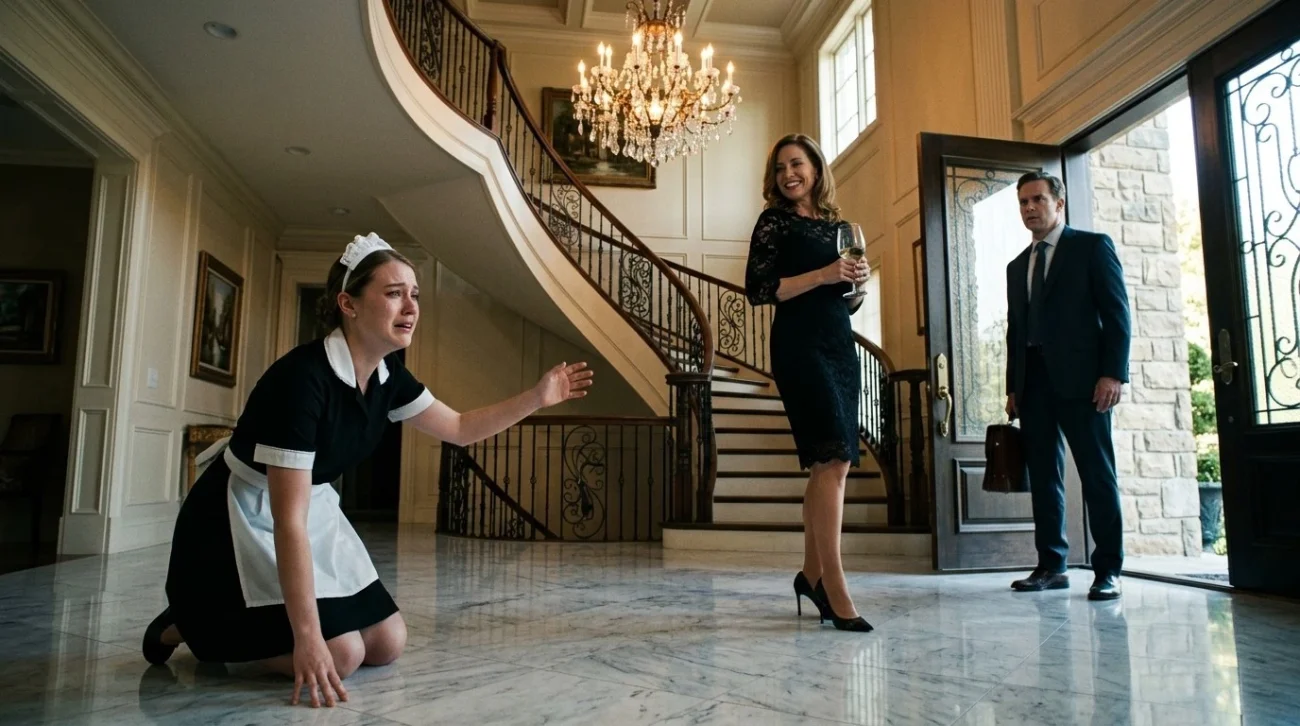
A woman was on her knees near the staircase, scrubbing the grout between the tiles with a brush. Gray uniform. Hair tied back loose. Her arms moving in slow, exhausted circles.
I almost spoke to her. Introduced myself as the owner, asked if she needed anything, offered her a glass of water.
Then she looked up.
My carry-on hit the floor.
“Emily?”
She stared at me for a long moment, like a person trying to understand a word in a language they’d half-forgotten.
“Dad?” Her voice came out thin. “You’re… you’re back?”
She looked twenty years older than twenty-five. Her eyes were sunken and red-rimmed. Her cheeks had lost all their fullness. There were pale yellow-green bruises along her forearms—the kind that were almost healed, which meant they hadn’t been the first.
She started to push herself to her feet and wobbled. I crossed the foyer in four steps and caught her by the elbow.
“Why are you wearing that?” I asked. My voice didn’t sound like mine.
She looked down at the uniform. “Karen said it was easier. For the guests.”
“Guests.”
“She rents out the rooms.”
A door opened across the hall.
Karen stepped out of the living room in a silk lounge set, barefoot, a glass of white wine in one hand and her phone in the other. She was ten years older, but she looked ten years younger than she should have. New cheekbones. New highlights. New shoes that cost more than most people’s rent.
“Oh!” Her whole face shifted in under a second—from startled, to calculating, to warm. She was always good at that. “You’re early. I wasn’t expecting you until—”
“Karen.” I kept my voice flat. “Why is Emily scrubbing the floor?”
“She has chores. Every household has chores. I’ve been running this property practically alone—”
“In her own house.”
Karen’s smile didn’t move, but something behind her eyes did. “There’s context here. A lot of history you don’t have. She went through a difficult phase when she was seventeen, she—”
“Stop.” I reached into my jacket pocket and pulled out my phone. “Don’t say another word.”
I called Thomas Whitford. He picked up on the second ring.
“Thomas. It’s James. I need you at the Savannah house today. Bring everything.” I paused. “Start the full audit.”
The silence that followed lasted about four seconds.
Karen’s wine glass tipped slightly in her hand. A pale ribbon of chardonnay ran down the side and dripped onto the marble floor Emily had just cleaned.
“James, that’s not necessary—”
“Emily.” I kept my eyes on Karen. “Come sit with me in the living room.”
Emily looked at Karen. Karen said nothing. Emily followed me.
We sat on the sofa while Karen hovered in the doorway, recalibrating. She tried twice to pull Emily back into the kitchen on some excuse. Both times I said no. The second time, Emily sat back down on her own.
That small act—choosing to stay—cost her something. I could see it.
While we waited for Thomas, Emily talked. Not easily. Not all at once. But she talked.
She told me that when she turned sixteen, Karen had sat her down and explained that managing a property of this size was too complicated for a teenager. That the finances were overwhelming. That Karen was doing her a favor by stepping in.
Emily had believed her.
By seventeen, Karen had redirected the household accounts into a business entity she controlled—a shell LLC registered under a name Emily didn’t recognize. The monthly transfers I sent were being deposited into Karen’s accounts, not Emily’s.
The mansion’s rooms were listed on short-term rental platforms. Karen hosted corporate dinners, product launches, charity galas—charging premium venue rates. Emily worked the events: cooking, serving, cleaning up afterward. Karen told her this was her contribution, her way of earning her place.
“She said you weren’t sending enough,” Emily said quietly. “That the bills were behind.”
“I sent twelve thousand dollars a month.”
Emily looked at her hands. “I didn’t know that.”
“I know you didn’t.”
She also told me about the calls. The times she’d picked up the phone and dialed my number. Karen would appear in the doorway, smiling, and take the phone gently from her hand. “He’s in a meeting, sweetheart. I’ll let him know you called.” She never did.
After the third or fourth time, Emily stopped trying.
I didn’t say anything for a moment. I looked at the room—the carefully staged furniture, the fresh flowers, the decorative books arranged by color on the shelves. All of it paid for with money that was supposed to be Emily’s.
I said, “Why didn’t you leave?”
She thought about that for a long time. “Where would I have gone?”
Thomas arrived at four-fifteen with a leather portfolio and a associate I hadn’t met before, a young woman named Dana who specialized in financial exploitation cases. They set up at the dining table. Karen stood at the edge of the room in a posture that suggested she was still deciding whether to play offense or defense.
Thomas opened the portfolio and slid the first page toward me without preamble. “Your sister forged eleven documents between Emily’s sixteenth and twenty-third birthdays. She transferred controlling interest in the property to the LLC in year two. She opened seven accounts in Emily’s name and held power of attorney over all of them through a document signed when Emily was a minor and notarized at a firm Karen personally retained.”
“She needed help managing—”
“She withdrew four hundred and sixty thousand dollars from accounts in Emily’s name,” Dana said, not looking up from her laptop. “In addition to the rental income, which we’re still calculating.”
The room went very quiet.
“You stole her life,” I said.
Karen’s voice came back sharp. “I raised her. I kept this house from falling apart while you were running around Europe chasing contracts—”
“You made her sleep in the servant’s room.”
Karen opened her mouth.
Thomas cut her off. “Law enforcement is already reviewing the documents we submitted this afternoon. I’d strongly suggest you stop speaking without counsel present.”
Karen looked at me. Something shifted in her face—not guilt, nothing that honest—but the specific look of a person recalculating their odds.
She said, very quietly, “You can’t prove intent.”
“We don’t have to prove intent,” Dana said. “We have signatures.”
Emily had been sitting very still through all of this, staring at the table. Now she looked up at me. Her eyes were wet.
I reached across and took her hand. “It’s going to be okay now. I promise you.”
The front door opened.
Two uniformed Savannah PD officers stepped into the foyer. One of them held a document. The other kept his hands loose at his sides, professional and unhurried.
Karen spun around. “What is this?”
“Ms. Karen Aldridge?” The first officer’s voice was calm. “We need you to come with us for questioning regarding financial fraud charges and unlawful exploitation of a dependent adult.”
“This is my house,” Karen said. Her voice cracked on the last word.
“It’s not your house,” I said. “It was never your house.”
She looked at Emily. For just a moment her expression broke into something almost human—an appeal, a plea. Emily met her gaze and said nothing.
The officers walked Karen to the door. She was still talking as they guided her outside—her voice rising, then cutting off as the door swung shut.
The silence she left behind was the first real quiet I’d felt since landing.
Emily exhaled slowly.
Thomas stayed another two hours, walking me through next steps. Criminal charges were already in motion. The shell LLC would be dissolved. Every asset Karen had moved would be traced, documented, and recovered. Emily would receive full legal restitution, medical evaluation, and priority access to the counseling resources Thomas’s firm had on retainer for exploitation cases. Dana had already flagged three prior victims from Karen’s business network.
That evening, Emily and I walked through the house together.
She showed me each room with an odd mixture of pride and shame—the way you show someone a place you’ve tended for years without permission to call it yours. The guest rooms with their rental furniture. The kitchen where she’d cooked a hundred dinner parties. The narrow room at the end of the back corridor, barely bigger than a walk-in closet, where she had slept.
There was a small framed photo on the windowsill. She and I, the summer before I left. She was holding a crayon drawing of an airplane.
I picked it up.
“I kept it,” she said. Like that needed explaining.
We sat on the front steps as the sun dropped behind the magnolia trees. The air was warm and heavy with that particular Savannah smell—wet earth and old brick and something sweet underneath.
“I thought you forgot about me,” she said.
“I never did.”
She was quiet for a moment. “You didn’t come back.”
“I know. I thought I was building something for you. I kept telling myself one more year and I’d have enough to come home and never leave again.” I stopped. “That’s not an excuse.”
“No,” she said. “It’s not.”
We sat with that for a while.
“I’m staying,” I said. “The company has people who can run it without me. I’m done.”
Emily turned to look at me. For the first time since I’d walked through that door, something in her face unknotted itself. Not a smile—not yet. But the beginning of one.
“You can have your room back,” she said. “The big one. I kept it clean.”
In the weeks that followed, the investigation moved faster than I expected. Karen’s financials unraveled completely: shell accounts, forged documents, misused power of attorney, rental fraud, and a pattern of exploitation that Dana described as one of the cleaner cases she’d ever worked—meaning the paper trail was unusually well preserved. Karen had been meticulous about keeping records, which turned out to be the thing that buried her.
She was formally charged on fourteen counts. Her bail was set high. Her attorneys were already negotiating.
Emily began working with a therapist Thomas recommended—a woman who specialized in family-based psychological coercion. The first few sessions were hard. Emily came home quiet and wrung out. But she came home.
We had dinner together every night. At first the conversations were careful and short. Gradually they got longer. She started asking questions again—the way she had when she was ten, about how things worked, about the world, about what happened next.
The day the court issued the asset recovery order, Thomas called to tell me that Karen’s LLC had been dissolved and every misappropriated account frozen. Emily would receive full restitution within ninety days.
I told Emily at dinner.
She put down her fork. She looked at the table for a moment, and then she looked at me.
“It’s actually over?” she said.
“It’s over.”
She didn’t cry. She just nodded, slowly, like someone confirming something they’d been afraid to believe.
Later, she went to her room—her real room now, the one she’d reclaimed at the front of the house with the tall windows and the view of the magnolias—and I heard her laughing at something on her phone. A quiet laugh, a little surprised, like she’d almost forgotten she could make that sound.
I sat in the kitchen with a cup of coffee and the lights low and thought about the ten-year-old girl with the crayon drawings. How she’d stood at the gate when the car came to take me to the airport and waved until she couldn’t see me anymore.
I should have come back sooner. I know that.
But I was here now.
And for the first time in fifteen years, so was she.
Original fictional stories. AI-assisted creative content.
