
The Sinclair estate had hosted galas for forty years, but nobody had ever seen the ballroom look like this.
Crystal chandeliers stretched thirty feet overhead. Champagne towers gleamed under warm gold light. The guests wore tuxedos and gowns that cost more than most people earned in a year.
Elena moved through all of it like a ghost.
Black uniform. White gloves. Eyes down. That was the job.
She’d worked three catering events this month just to cover rent. Tonight was the biggest. She needed it to go perfectly.
It didn’t.
“My necklace!”
The scream cut through the music like a knife.
Lady Vivienne Beaumont stood at the center of the ballroom, both hands pressed to her bare throat, her face arranged in perfect, practiced horror.
“My diamond necklace — someone took it!”
The orchestra stopped mid-note. Two hundred heads swiveled toward the sound.
Security moved fast. Elena had been refilling champagne glasses near the dessert table — wrong place, wrong time. A guard grabbed her arm before she could take a single step.
“Don’t move.”
“I haven’t done anything—”
“Don’t. Move.”
The velvet bag hit the floor before Elena even understood what had happened. One second her apron pocket was empty. The next, the bag was there — splitting open on the marble, scattering diamonds and pearls and gold chains across the floor like some terrible magic trick.
The ballroom inhaled as one.
“She stole them.” A woman in blue said it quietly, like stating weather.
“All of it?” Someone counted the pieces with their eyes.
“Disgusting.” A man in a gray tuxedo didn’t bother lowering his voice.
Elena sank to her knees. Not because anyone pushed her. Her legs just stopped working.
“I didn’t take these.” She could barely hear herself. “I’ve never seen this jewelry before. I don’t know how—”
“We all saw it fall from your pocket.” Vivienne’s voice was velvet. She stepped closer, heels clicking on the marble. “I suspected you the moment you walked in. I told Marcus you had a look about you.”
The man beside her nodded immediately.
Elena looked up at the ring of faces. Two hundred people, every single one of them rich, every single one of them certain. Phones had appeared from nowhere. People were already filming.
She thought about her rent. Her bus pass. The fact that she’d have to call her landlord again.
She thought about her mother — the only family she’d ever had — dead three years now, leaving behind nothing but a faded photograph and a name that meant everything.
Then a voice came from the far side of the ballroom.
“What’s happening here?”
Not loud. Not aggressive. Just the kind of voice that expected to be answered.
The crowd parted.
Edward Sinclair walked through the gap like he had all the time in the world. Seventy years old, silver-haired, black tuxedo. His face was unreadable, but the room reacted to him the way iron filings react to a magnet. Everyone straightened. Everyone went quiet.
He reached Elena and stopped.
Vivienne stepped forward immediately. “Edward, I’m so sorry — your staff allowed a thief into—”
“Be quiet, Vivienne.”
She stopped.
Edward wasn’t looking at the jewelry on the floor. He wasn’t looking at the guards. He wasn’t looking at Vivienne.
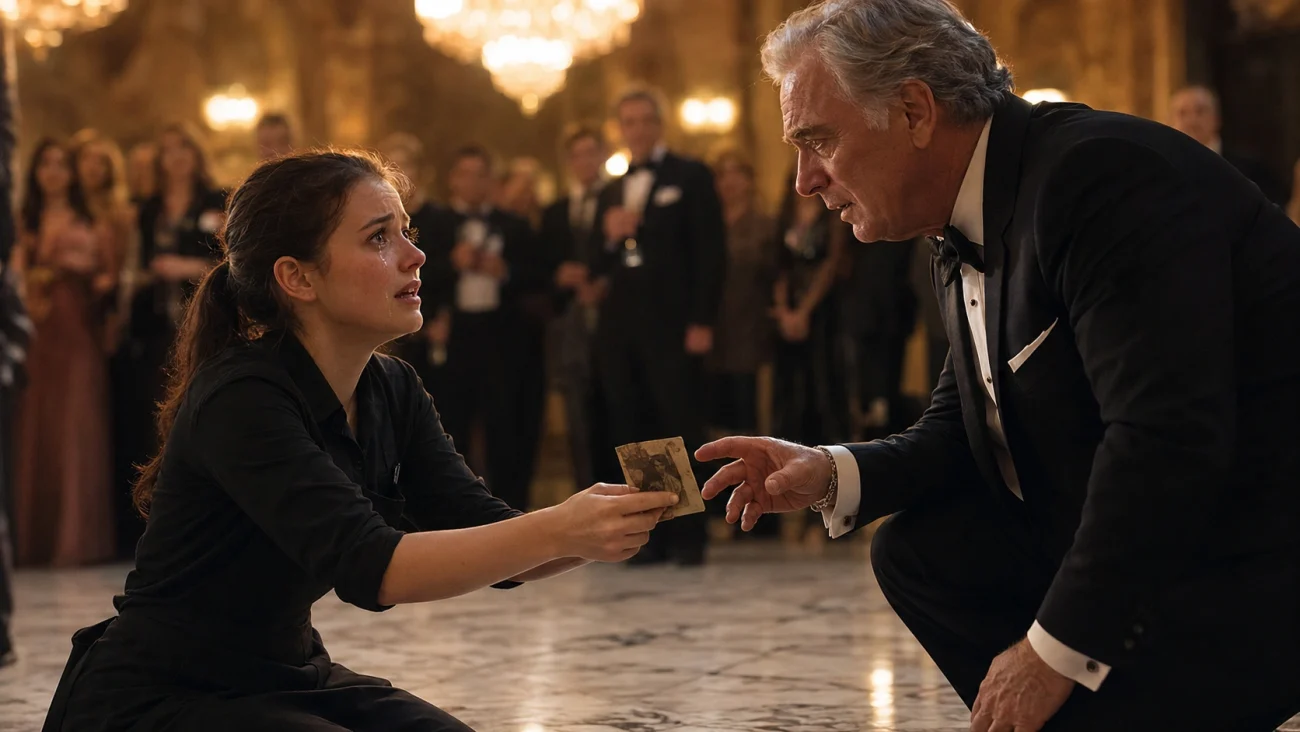
He was looking at a photograph.
It had fallen from the velvet bag when it hit the floor — a small, battered thing, edges worn soft from years of handling. He crouched down and picked it up.
The ballroom watched him look at it.
His face did something no one had ever seen it do.
It broke.
“Where did you get this?”
Elena looked up at him from the floor. “It was my mother’s. It’s the only photograph I have of her.”
Edward’s hand was shaking. “What was your mother’s name?”
“Isabella.” Elena frowned. “Isabella Reyes. She raised me alone. She died three years ago.”
The sound Edward made wasn’t quite a word.
He turned the photograph over. His thumb found something on the back — an inscription, faded but legible. He’d written it himself, thirty years ago, in a hospital room, the day his daughter was born.
My Isabella. My whole world. — E.S.
“That can’t be here.” He was talking to himself. “This photograph was in the car. In the river.”
“What river?” Elena asked.
He looked at her — really looked at her — for the first time. The shape of her jaw. The particular brown of her eyes. The small diamond-shaped birthmark just below her left collarbone, visible where her uniform collar had shifted.
His daughter had the same birthmark.
He’d memorized it from the single photograph they’d recovered after the crash. The investigators had shown it to him twenty-three years ago as proof of identification. He’d had nightmares about it ever since.
“Twenty-three years ago,” Edward said, very slowly, “my daughter Isabella was kidnapped from this estate. The car carrying her went into the river. They found evidence of the crash, but—” His voice stopped. He steadied himself. “They never found her.”
The ballroom had gone completely, absolutely still.
Elena’s lungs felt wrong. “What are you saying?”
“I’m saying my daughter was two years old. And I’m saying her name was Isabella Sinclair.” He reached into his jacket pocket and produced his wallet. From behind a credit card — where he’d kept it for twenty-three years — he withdrew another photograph.
A younger Edward. Dark-haired then. Laughing. Holding a small girl with wild curls and bright eyes.
The same girl in Elena’s photograph.
“The woman who raised you,” Edward said. “She told you she saved you from water.”
Elena’s mouth went dry. “How did you know that?”
“Because I’ve been looking for her my entire life.” He paused. “Because you’re her.”
Vivienne’s champagne glass hit the floor.
Nobody noticed.
Elena stared at the two photographs side by side in Edward’s hands. The same child. The same bracelet on the little girl’s wrist — she could see it clearly now, a tiny silver thing engraved with a crest she didn’t recognize.
“That bracelet,” she said. “I have it. I’ve had it my whole life. My mother — Isabella — she said I was wearing it when she found me.”
Edward closed his eyes.
When he opened them, they were wet.
“That bracelet carries the Sinclair family crest. I had it made for my daughter the week she was born.” His voice was barely holding. “There were only two in existence. I’m wearing the other one.”
He pushed back his sleeve.
The matching bracelet gleamed on his wrist under the chandelier light.
Elena’s hand moved to her throat without thinking. The bracelet she’d worn every day since she could remember, the one her mother had called her lucky charm, the one she’d almost pawned twice when rent was due but couldn’t bring herself to lose—
She unclasped it with shaking hands.
Edward held his wrist out. She pressed the two bracelets together.
The crests matched perfectly. Identical engravings. Identical weight. Made as a pair.
Someone in the crowd started crying. Elena didn’t know who. She was crying too.
“This isn’t proof of anything.” Vivienne’s voice came from somewhere to Elena’s left, sharp and defensive. “A photograph and two bracelets — that’s not—”
“Vivienne.” Edward didn’t raise his voice. He didn’t need to. “You accused this woman of theft in front of two hundred witnesses. You had that bag planted in her pocket—” He looked at the guard who’d first grabbed Elena. The man had gone pale. “—and I intend to find out exactly how. In the meantime, I’d strongly suggest you stop talking.”
The guard took a step backward.
Vivienne’s attorney would later advise her to settle quickly and quietly. She did.
But that was later.
Right now, in the ballroom, Edward Sinclair did something that no one present would forget for the rest of their lives.
He knelt down beside Elena on the marble floor — Edward Sinclair, who had once made a senator wait forty minutes because he didn’t kneel for anyone — and he put one hand on her shoulder.
“I looked for you every single day.” His voice cracked straight through the middle. “I never stopped. Not once.”
Elena looked at the two photographs. Looked at the matching bracelets. Looked at the birthmark on her own collarbone that she’d always thought was just a coincidence of skin.
Looked at his face.
Twenty-three years of orphanages. Of no last name that felt real. Of her mother — the woman who saved her, who loved her, who died leaving her nothing but a photograph and a bracelet and a story about a river.
It all landed at once.
She grabbed his hand and held on.
The chandeliers blazed above them. The marble floor was cold and hard. Two hundred guests stood frozen in a circle of stunned silence, phones lowered, eyes wet, the stolen jewelry still scattered and forgotten at their feet.
None of it mattered anymore.
Three weeks later, the DNA results confirmed what the bracelets already knew.
The morning the results came in, Edward called a board meeting. He spent twelve minutes on the business agenda. He spent the rest of the two hours introducing his daughter to every person in that room.
Elena Sinclair.
The name still felt new in her mouth. She practiced it on the elevator ride up, quiet enough that only she could hear it.
By the end of the meeting, nobody in that room doubted she belonged there.
Vivienne Beaumont pled guilty to charges of theft and fraud. She paid restitution. She lost her seat on two charitable boards. She sold her apartment in the city and moved somewhere quieter.
She never went back to the Sinclair estate.
Elena took her mother’s photograph — Isabella Reyes, the woman who pulled a two-year-old girl from a wrecked car on a dark riverbank and raised her as her own — and had it framed in silver.
She put it on the desk in her new office, right next to the matching bracelets, side by side in a small glass case.
Every morning she looked at both women who’d given her a life.
She didn’t have to choose between them. She never did.
That was the part nobody expected — not the lawyers, not the board, not the gossip columns that ran the story for weeks.
Elena Sinclair kept her mother’s last name too.
Two names. Two women. One life that finally made sense.
Original fictional stories. AI-assisted creative content.
