
Nobody paid attention to the little boy sitting near Gate 23.
Not the businessmen rolling carry-ons. Not the college kids with noise-canceling headphones. Not the families clutching boarding passes like lifelines. The terminal at O’Hare was loud and fast, and the boy — maybe nine years old, maybe younger — was simply furniture.
He sat cross-legged beside a charging station, back against the wall, a small paper cup balanced on his knee. A few coins rattled inside it. His sneakers were split at the toes. His jacket had no zipper pull. His face was blank in the way that meant he’d stopped expecting anyone to look.
People passed him as if he were invisible.
He was used to it.
Diane Calvert was running late.
She dragged her wheelie bag with one hand and kept the other outstretched behind her, locked on her son’s wrist. Ryan was nine and already faster than her when he wanted to be, and right now he wanted to be everywhere at once — spinning toward every departures screen, every gift shop, every paper-bag smell drifting from a pretzel stand.
“Ryan. Ryan, I need you walking. Not sprinting. Walking.”
“I am walking.”
“You are not walking.”
He slowed for approximately four steps. Then he saw something — she never found out what — and pulled free and broke into a full run down the center of the terminal.
“Ryan! Slow down!”
But he didn’t slow down.
He ran.
He ran past gate 21. Past gate 22. He was already past the charging station when something made him stop — not a sound, not a shout — just something that hit his brain wrong and made his feet skid on the polished floor.
He turned around slowly.
The boy near the wall was looking at him.
Ryan looked back.
For a second neither of them moved.
Ryan’s eyes moved from the boy’s forehead to his nose. Down to the jaw. Back up. The eyes. The ears.
The small, curved scar above the left eyebrow — almost exactly where Ryan’s was.
“Wait,” Ryan whispered.
He walked toward the boy. Stopped two feet away.
“Why do you look exactly like me?”
The boy on the floor said nothing at first. He tilted his head slightly, studying Ryan the same way Ryan was studying him. Then, very quietly:
“I was going to ask you the same thing.”
Diane reached them forty seconds later, breathless, bag wheels screaming on the tile.
“Ryan, I told you not to — ” She stopped.
She looked at her son. Then at the boy on the floor. Then at her son again.
Her phone slipped from her fingers.
It hit the floor with a crack that turned three nearby heads, but she didn’t notice. She just stood there with both hands open at her sides, like she’d forgotten what her hands were for.
Ryan looked up at her.
“Mom.”
She didn’t answer.
“Mom. Why does he have my face?”
Diane’s lips moved. No sound came out.
The boy on the floor watched her carefully. His expression hadn’t changed. There was something almost resigned about him — like he’d learned a long time ago not to expect too much from adults. He reached into his jacket slowly, and the movement was so deliberate that both Diane and Ryan watched without speaking.
He pulled out a necklace.
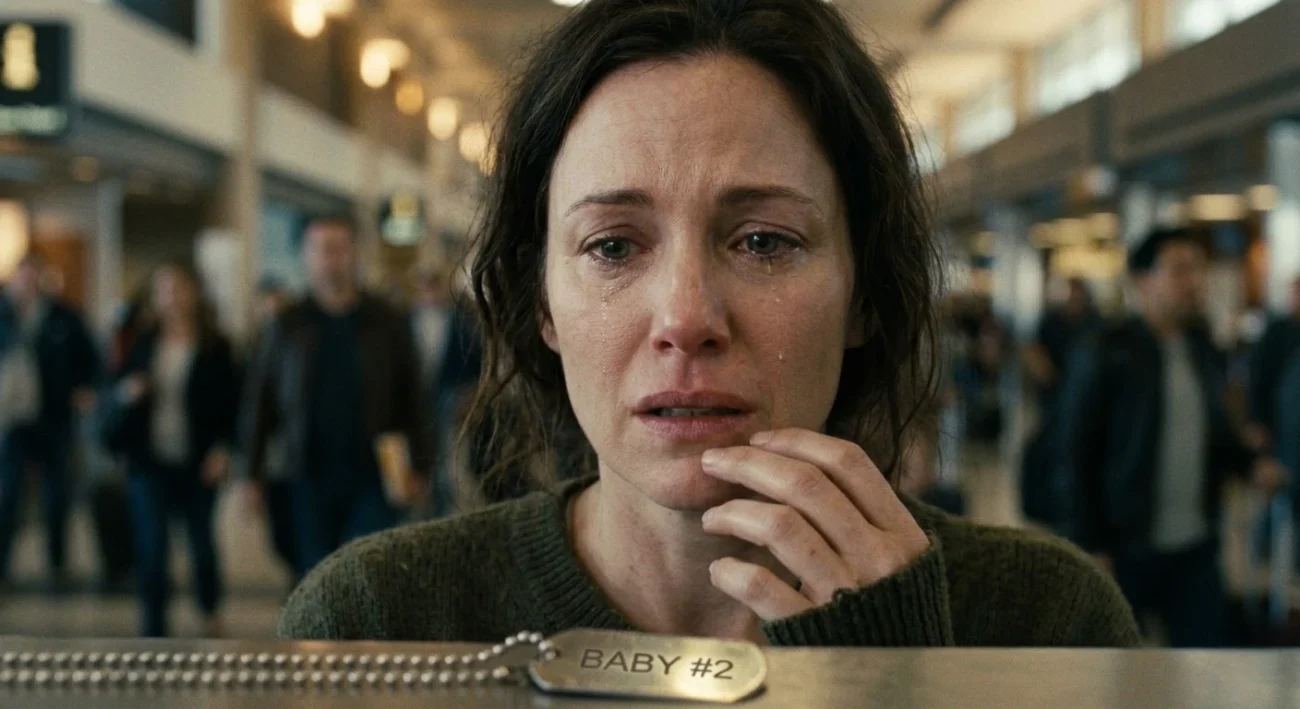
It was old. The cord was frayed. The clasp was broken and had been knotted shut. Hanging from it was a hospital ID tag — the kind given to newborns, laminated plastic, faded with age.
Two words were still legible:
BABY #2
Diane made a sound she hadn’t heard herself make in twenty years. A short, punched-out exhale, like she’d been hit.
“…No.”
“What does it mean?” Ryan asked.
She couldn’t answer. Her eyes were locked on that tag, and her hands had started to shake.
“Where did you get that?” she finally whispered.
The boy looked at the necklace, then back at her. Something shifted in his face. Not suspicion exactly. More like caution.
“My dad gave it to me,” he said. “Before he died.”
Silence settled over the three of them. Around them the airport roared — gate announcements, crying toddlers, the distant rumble of a plane — but none of it reached them. They were in a pocket of stillness.
Then the boy reached into his pocket again.
He produced a photograph.
It was old and soft-edged, the way photos get when they’ve been handled a thousand times. It had been folded and re-folded, the crease lines deep and white. And it had been torn — cleanly, deliberately — right down the middle. Only half remained.
Ryan watched his mother take the photograph with shaking hands.
She stared at it. Then she sat down. Not gracefully — she just lowered herself onto the airport floor like her legs had quietly resigned.
“Mom — “
“Shh.”
She was already opening her bag. She dug past boarding passes, past hand sanitizer, past a lip balm and a granola bar, until she found her wallet. She opened it to the last compartment — the hidden slot behind the credit cards. Her fingers found the edge of something and pulled it out.
A torn half-photograph.
She pressed it against the boy’s half.
The image went whole.
Two newborn babies, side by side in a hospital bassinet. Both swaddled in identical striped blankets. One with a tiny identification tag that said BABY #1 on his wrist. The other — on the right, smaller, eyes screwed shut against the light — with a tag that said BABY #2.
Ryan knelt down on the floor beside his mother.
“That’s you,” he said to her. “In the background. That’s definitely you.”
She nodded. She couldn’t speak.
“And that’s me,” Ryan continued slowly, pointing to the baby on the left.
Another nod.
Ryan looked at the other baby. Then he looked at the boy sitting across from them on the floor, with his worn sneakers and his split jacket and his paper cup with three coins in it.
“Then that’s — ” he started.
“Yes,” Diane said.
The boy’s name was Marcus.
He’d been raised in foster care in Evansville, Indiana. He’d aged out of the system eight months ago, on his eighteenth birthday, with a garbage bag of belongings, two hundred dollars, and the necklace and photograph his foster father — the one good one, the one who’d died three years back — had given him.
He didn’t know where he was going. He’d come to the airport because it was warm.
He told them this simply, without self-pity, while sitting on the floor of Gate 23 while Diane cried silently and Ryan sat with his knees pulled to his chest and said nothing for a very long time.
Finally Ryan said: “What happened to you? Like, at the beginning?”
Marcus shrugged. “Foster dad said the hospital told him I was a twin. That there’d been some kind of emergency with the birth. That the other baby’s mom had signed papers. He thought she knew about me. I guess she didn’t.”
Diane pressed both hands over her mouth.
“I didn’t sign any papers,” she said. The words came out ragged. “They told me he — they told me you didn’t make it. They said there was a complication. A hemorrhage. They said you were gone before I could hold you.”
Marcus looked at her for a long moment.
“They lied.”
“Yes.”
He said it without heat. It was just a fact — one of many facts in his life that he’d had to absorb and keep moving. He’d gotten good at that.
“I’m sorry,” Diane whispered. “I didn’t know. I would have — ” She stopped. Started again. “I would have come for you. I want you to know that. I would have come.”
Marcus looked down at the photograph, the two halves still pressed together on the floor between them.
“I believe you,” he said. Quietly. Like it cost him something to say it, and he’d decided it was worth the cost.
Ryan was the one who stood up first.
He picked up the paper cup from Marcus’s knee, fished out the coins — three quarters and a dime — and set them carefully in his own pocket.
“You don’t need this anymore,” he said.
Marcus stared at him.
“I’m your brother,” Ryan said, with the blunt, matter-of-fact certainty of a nine-year-old who has made a decision. “So you’re coming with us. We have a house. You can have the guest room. Mom redid it last year and nobody ever uses it.”
“Ryan — ” Diane started.
“Mom.” He looked at her steadily. “He’s my brother.”
She looked at her son. Then at the boy on the floor — her other son, the one she’d mourned for twenty years, the one she’d carried as a ghost in her chest through every birthday and holiday and quiet Tuesday when the grief surfaced for no reason at all.
She held her hand out to Marcus.
“He’s right,” she said. “You’re coming with us.”
Marcus looked at her hand for a long moment.
Later — much later — there would be legal steps. A DNA test they didn’t need but did anyway, because the world required documentation for things the body already knew. There would be a lawyer who found the hospital records from twenty years ago, and then a different lawyer, and then a lawsuit, and then a settlement with a number that Marcus quietly donated half of to the foster care system he’d grown up in.
There would be a bedroom that slowly accumulated things — a laptop, a few paperbacks, a plant Marcus grew from a seed because he’d always wanted to know what it was like to keep something alive.
There would be nights when it was hard. When the shape of what had been taken from him was too large to look at directly, and he’d sit on the back porch at two in the morning and Ryan would sometimes find him there and just sit beside him without asking questions.
There would be a Thanksgiving dinner where Marcus laughed at something Ryan’s uncle said and Diane stood in the kitchen doorway for thirty seconds just watching, crying into a dish towel so quietly nobody noticed.
But first — before all of that — there was Gate 23.
Diane on her knees on the airport floor, both hands extended. Ryan standing behind her with his shoulders back and that nine-year-old certainty in his face.
And Marcus, reaching forward.
Taking her hands.
Holding on.
The hospital that had separated them twenty years ago was later found to have been running an illegal adoption operation — taking twins and multiples from low-income and single mothers under the guise of “birth complications,” then quietly brokering private adoptions. Four other families came forward after Marcus and Diane went public with their story.
The administrator responsible died before he could be charged. But the two doctors who had falsified the records were prosecuted, convicted, and stripped of their licenses.
It wasn’t enough. It was never going to be enough.
But Marcus stood in the courtroom when the verdict was read, and he stood up straight, and when a reporter asked him afterward what he felt, he thought about it for a moment.
“Finished,” he said. “I feel finished with that part.”
He was quiet for a second.
“And hungry,” he added. “Ryan promised me tacos.”
He got the tacos.
The necklace — both halves of the photograph laminated inside a frame — now hangs above the fireplace in the Calvert house in a spot Diane chose herself.
Below it, in small letters on the frame’s edge, Ryan had written with a paint marker at age nine:
BABY #1 + BABY #2 = FOUND
Nobody ever moved it.
Original fictional stories. AI-assisted creative content.
