
The wallet hit the pavement without a sound.
Daniel didn’t notice. He was already twenty feet ahead, head down, hands deep in his coat pockets, moving the way men move when they’ve learned to carry grief quietly.
Mia saw it.
She was six years old and serious about important things. She bent down, picked it up with both hands, and ran.
“Sir!”
He didn’t stop.
She ran harder, sneakers slapping the path, breath turning sharp.
“Sir, you dropped something!”
He turned then — startled, the way people are when the world interrupts them mid-thought. For a second he looked almost annoyed.
Then he looked down at her.
His face changed.
“Oh.” He crouched a little, eye level. “Thank you, sweetheart.”
She held the wallet out in both hands. He took it, and his fingers fumbled — it fell slightly open, and Mia’s eyes went straight to the photo tucked behind a cracked plastic sleeve.
She went very still.
It was a photo of a woman.
Dark hair. Soft eyes. A little bit of a smile, like she was about to say something.
Mia’s hand dropped to her side.
She looked up at the man.
“Why do you have my mom’s picture?”
Daniel blinked.
“I’m sorry?”
“That’s my mom.” Her voice was small but completely certain. “That’s her.”
He looked down at the photo. His face went through something private and terrible — recognition, then resistance, then the kind of stillness that means something is breaking quietly inside a person.
“That was my wife,” he said. His voice came out rough. “She passed away. Years ago.”
Mia shook her head.
Slowly. Carefully.
“She made me scrambled eggs this morning.”
The park sounds seemed to stop.
No wind. No kids. No birds. Nothing.
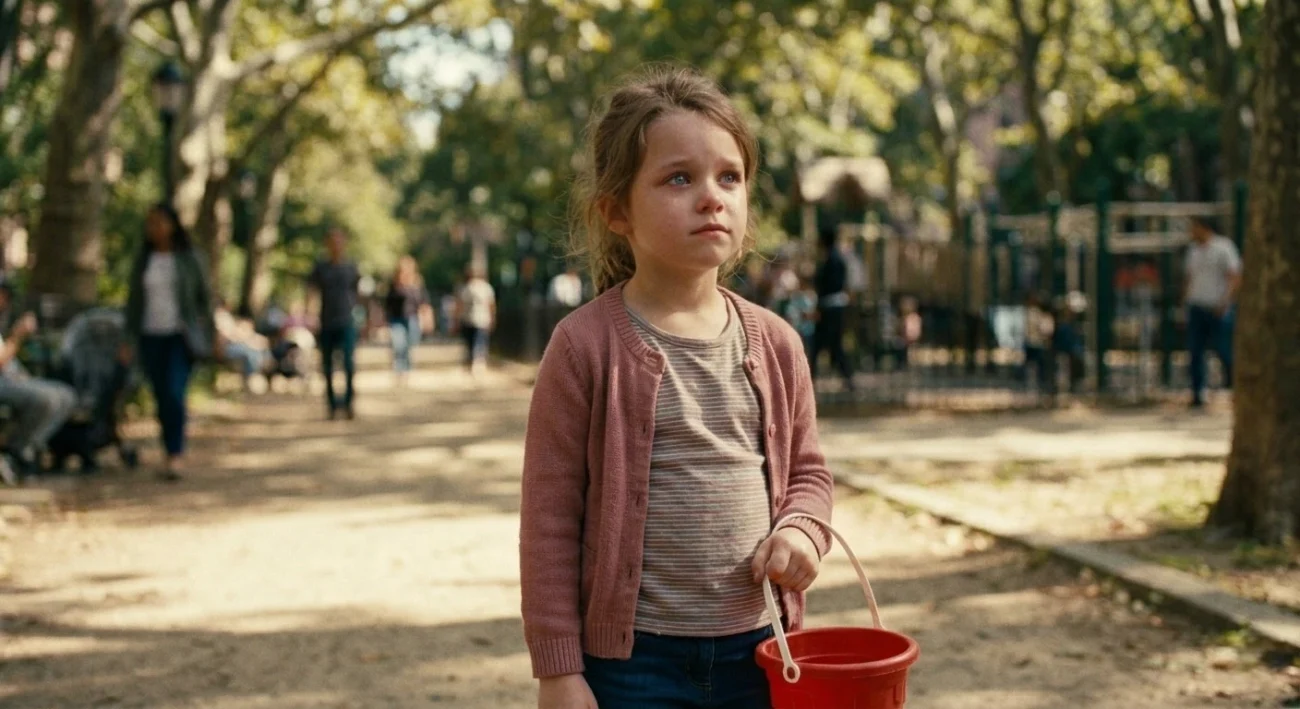
Daniel looked at her — really looked — at her dark hair tied in two low pigtails, at the pink cardigan with the small white buttons, at the red bucket still hanging from her wrist.
“What’s your mother’s name?” he asked.
Mia blinked. “Why?”
“Please.” He was trying to keep his voice steady. He wasn’t succeeding. “What’s her name?”
“Elena.”
The name hit him like a physical thing.
He took one step back without meaning to.
Elena.
The name on the stone he’d bought. The name he’d said out loud to an empty house for seven years because saying it to someone real felt impossible. The name he used to whisper into her side of the bed when the grief was so heavy he couldn’t breathe through it.
“How old are you?” he asked.
“Six.”
Six.
Elena had died — no, Elena had supposedly died — eight years ago. In the accident. In the wreckage of a car on a dark road that they’d said no one survived.
No one.
His throat closed.
“Is she here?” His voice cracked. “Your mom. Is she here with you right now?”
Mia turned and pointed at the playground, calm as if she’d just pointed at the snack bar.
“She’s over there. By the swings.”
He turned.
A woman stood near the swing set with her back to them, one hand resting on the chain, the other holding a small paper bag from a bakery. Simple jeans. A light gray jacket. Dark hair catching the afternoon wind.
His body went cold from the inside out.
It couldn’t be.
It couldn’t.
But his feet moved anyway — moving the way they always had when Elena was in a room, this involuntary pull toward her, a habit seven years of grief hadn’t been able to kill. He moved fast without running, heart slamming.
Mia jogged to keep up.
“Hey,” she said, “where are you —”
The woman at the swings turned at the sound of footsteps.
The paper bag left her hands.
Croissants scattered across the grass.
She made no move to pick them up.
For one long, impossible second, they just stood there — five feet apart, the past and present colliding in the space between them — and neither of them made a sound.
“Elena,” he said. Not a question. He couldn’t make it a question.
Her face crumpled.
Not from confusion. Not from the shock of a stranger using her name. From recognition. From guilt so old it had fossilized in her expression.
Her hands came up to cover her mouth, and he watched her try to hold herself together and fail completely.
Mia stopped between them. Her eyes went to her mother, then to the man, then back again.
“Mama?”
Elena dropped to her knees and pulled Mia into her arms — hard, protective, reflexive — but her eyes stayed on Daniel.
“I thought —” he started, then couldn’t finish.
“Daniel.” Her voice was just barely holding. “I can explain.”
“They told me you were dead.”
The words came out quiet. Steady. Which made them worse.
“I know.” She closed her eyes. “My father told me you left us.”
The silence between them was enormous.
“Left you,” he repeated.
“He called me from the hospital. While I was still in recovery.” She pressed her lips together. “He said you hadn’t come. That you’d cleared out the apartment. That you were gone.”
“I was in that hospital for four days.”
“I know that now.” Her voice broke. “I was on a different floor. He made sure I never —” She exhaled, something ragged and controlled at once. “He moved me. Before I was even discharged. He said he was protecting me.”
Mia had gone very quiet in her mother’s arms. She was watching Daniel with wide, careful eyes.
“Mama.” Soft. “Is this the man in the picture?”
Elena looked at her daughter.
Then at Daniel.
Her expression said everything she couldn’t say in front of the child: yes, and I am so sorry, and there is so much you don’t know yet.
“Yes,” she said. “This is Daniel.”
Mia turned this over. She was six, and therefore very practical.
“Are you my dad?”
The word landed in the center of Daniel’s chest like something had been set down there — something heavy and warm at the same time.
He looked at Elena.
She nodded once. Barely. Eyes full.
Daniel lowered himself to the grass.
Not carefully. Not gracefully. He just went down — knees first, like his legs decided on their own. He was at eye level with his daughter, and his face was doing things he hadn’t let it do in years.
“Yes,” he said.
Mia considered this for three full seconds.
Then she walked forward and put her arms around his neck.
He held her so carefully — like she might dissolve, like the afternoon might fold back on itself and return him to the version of this day where he was just a man walking alone through a park — and then he held her tighter, because she was real, she was warm, she was six years old and she smelled like bakery butter and she was real.
Elena pressed her hand over her mouth again.
She watched her daughter — the daughter she’d spent six years raising alone with a hole where her history should have been — hold the man she’d spent seven years mourning.
And she cried. Quietly. Into the back of her hand.
After a long moment, Daniel looked up at her.
“Your father,” he said quietly. “Is he—”
“He died eighteen months ago.” She met his eyes. “That’s when I found the truth. In his papers. The hospital records. The real story.” Her voice was steady now. Something cleared in her face, like she’d decided to stop carrying it alone. “I’ve been trying to find you.”
“I moved,” he said. Useless. But it was all he had.
“I know. I found your name last month. I’d almost worked up the nerve to —” She stopped. Laughed once, briefly, tearfully. “She ran faster than I could.”
Mia pulled back slightly from Daniel and looked between them.
“Did Grandpa do something bad?” she asked.
Elena inhaled.
“He made a mistake,” she said carefully. “A very big one.”
Mia accepted this with the gravity of someone who has decided to understand it better later.
“Okay.” She looked at Daniel. “Are you going to come have croissants with us?”
He laughed then.
It came out broken — the sound of a man who hasn’t laughed in years trying to remember how — and he pressed his forehead briefly to Mia’s.
“Yes,” he said. “I am.”
He stood up, and Mia immediately took his hand like it was a thing people did.
He looked down at her fingers wrapped around two of his.
Then he looked up at Elena, standing in the afternoon light, croissants still scattered in the grass behind her, tear-tracks drying on her face, the paper bag forgotten.
“I have a lawyer,” she said. “I’ve already started the process. For the records. To correct them. If you want —”
“Elena.”
She stopped.
“Can we start with the croissants?”
She exhaled.
And for the first time in years, she smiled at him.
Not the soft, controlled smile he used to study in the photo. The real one — slightly uneven, a little relieved, a little wrecked, completely hers.
She crossed the grass and picked up the bag.
Two croissants had survived undamaged.
She held the bag out.
“I should have bought more,” she said.
“You always did,” he said.
And they walked together — slowly, with Mia between them holding both their hands and swinging every third step — out of the park and back into a life that had been waiting, quietly, seven years for this exact afternoon.
Original fictional stories. AI-assisted creative content.
