
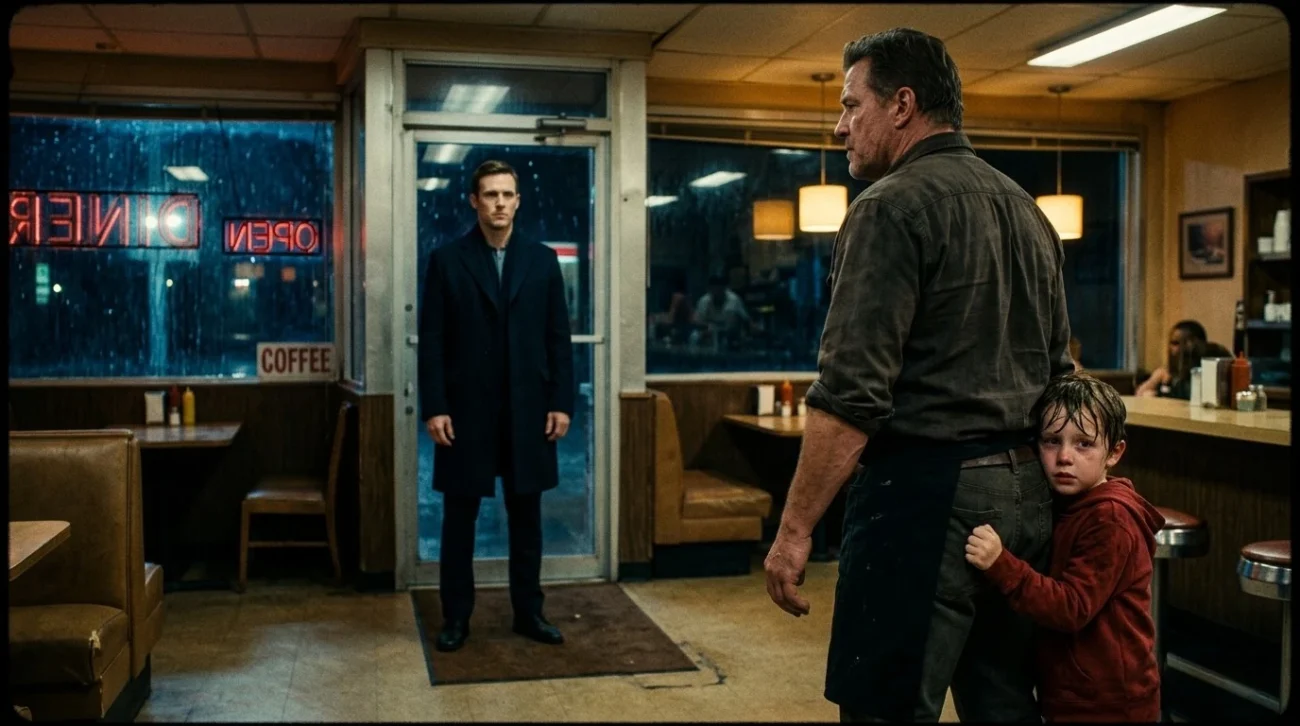
The boy hit the floor at 11:47 p.m.
He came through the glass door sideways, feet slipping on the wet tiles, red hoodie plastered to his skin. He was maybe seven. His hands were out, searching, and then he was behind the only man in the room who looked like he could stop something.
“Please hide me.”
The cook turned from the grill slowly. He had a wide face, a flat nose, and two scars that ran from his left ear down to his jaw. His black apron was smeared with grease and the night was already long.
“Who hurt you?”
The boy grabbed the cook’s apron with both fists.
“He followed me.”
Every customer in the diner stopped eating.
There were six of them. A trucker at the counter. Two women in the far booth. An older man by the window. A teenager on his phone who wasn’t on his phone anymore. A waitress named Donna who had been refilling coffee for thirty years and had seen most things, but not this.
Through the wet glass door, a man stood on the sidewalk in a dark coat. Clean haircut. Good shoes. The kind of face people trusted without asking why. He didn’t rush. He stood completely still and stared in through the rain, then stepped forward and knocked.
Calmly.
Three knocks.
Then he opened the door and stepped inside, tracking in no water at all, like the rain had agreed not to touch him.
“That child is mine.”
His voice was low and certain, the kind that filled rooms without trying.
The cook moved in front of the boy completely, blocking him from view. He didn’t say anything yet. He just looked at the man the way you look at something you need to understand before you break it.
“Then why is he shaking?”
The man’s smile didn’t disappear all at once. It thinned.
“Move aside. This isn’t your business.”
The teenager near the window put his phone face-down on the table.
Behind the cook’s leg, the boy pressed himself flat and whispered four words. He said them so softly that only the trucker at the counter and the two women in the far booth could hear.
“He’s not my dad.”
The cook’s right hand closed into a fist.
His voice dropped below normal speaking volume, into something else entirely.
“Donna.”
She was already moving.
“Lock the door.”
The man in the dark coat took one step forward.
“Don’t do that.”
Donna’s hand found the deadbolt. Her fingers shook but she turned it and the click bounced off every surface in the diner — the laminate countertop, the pie case, the cold glass — louder than anything that had happened all night.
The man stopped.
He looked at the lock, then at the cook, then at the lock again. Then he reached inside his coat.
Three people stopped breathing.
He pulled out a photograph.
He held it up without walking closer, facing it outward so the cook could see. It was a woman sitting in a wooden chair. Her hands were tied behind her. She was holding a handwritten sign against her chest with the diner’s address on it — the actual address, the street number and everything — and her eyes were looking directly into the camera.
“She sent me for him,” the man said. “She needs the boy to come with me now. Tonight. Before anyone does something they regret.”
The boy made a sound into the back of the cook’s apron that wasn’t a word.
The cook stared at the photo.
He stared at the woman first — her face, her eyes, the way she was sitting. Then his gaze moved to the background of the photo. The corner, specifically. The lower left of the frame, where the light was dim and the detail was small.
There was a wrist in the background. A forearm. Barely visible, half in shadow.
On the wrist was a tattoo.
It was a specific tattoo. A bird with a broken wing sitting on a number. Not a common design. Not something you saw twice in a lifetime.
The cook had seen it exactly once before.
Twenty years ago, in a parking lot two miles north, the last night he saw his brother alive.
Something changed in the cook’s face. The customers who were watching him couldn’t name what changed, exactly. But the trucker at the counter leaned back on his stool involuntarily, the way you lean back from a stove that’s suddenly hot.
“Let me tell you something,” the cook said.
His voice was almost gentle.
“You walked into the wrong diner.”
The man in the dark coat started to respond.
He didn’t get to finish.
Headlights swept across the ceiling. Then more headlights. Then a third set. Through the rain-streaked windows, three pickup trucks pulled off the road and into the lot, parking nose-in, engines running, lights on. The doors opened but no one got out yet. They just sat there in the cabs, visible through the glass, waiting.
The man in the dark coat looked at the trucks. He looked at the cook. He looked at the trucks again.
“You don’t know what you’re getting into,” he said.
His voice had changed. The certainty was still there but something underneath it had shifted, like weight redistributing.
“My family owns this whole street,” the cook said. “Every building on it. Including the one your car is parked behind right now.”
He reached under the counter with his left hand and came up with a cell phone. He set it face-up on the counter so the man could see the screen. It showed a live security feed — multiple camera angles, the parking lot, the alley, the front entrance.
“We’ve been recording since you knocked,” the cook said. “Your face, your plates, and that photograph you just held up. All of it.”
The man in the dark coat looked at the phone. His jaw moved once, like he was testing something with his teeth.
“You’re making a mistake.”
“My brother made a mistake,” the cook said. “He trusted somebody with a tattoo on his wrist. A bird with a broken wing. I saw it in your photo.”
The man in the dark coat went completely still.
“I’ve been waiting a long time to find the people connected to that tattoo,” the cook said. “You just saved me a lot of looking.”
The man took one step back toward the door. His hand moved toward the lock.
“I wouldn’t,” said the trucker at the counter, without looking up from his coffee.
The man looked at the trucker. The trucker didn’t look back. He just said:
“The trucks.”
Outside, two of the cab doors opened.
The man in the dark coat put both hands flat on the nearest table and sat down in the booth. Slowly. Like someone who had done the math and arrived at the only remaining option.
The cook came around the counter. He crouched down so he was eye-level with the boy, who was still pressed against his leg.
“What’s your name?”
The boy looked up.
“Marcus.”
“Okay, Marcus. You’re safe now.”
“Is my mom okay?”
The cook held the boy’s face in both of his large scarred hands and looked straight at him.
“We’re going to find her. I promise you that.”
The police arrived eleven minutes later. The man in the dark coat was still sitting in the booth. He hadn’t moved. When they cuffed him, the sleeve of his coat rode up and they saw it — a bird with a broken wing on his left wrist, sitting on the number nineteen.
The cook stood in the doorway watching the cruiser pull out. Behind him, the diner was quiet. Donna was making hot chocolate she hadn’t been asked to make. The trucker had pushed his pie toward Marcus without a word.
Three weeks later, the cook sat in the front row of a county courtroom when the man — whose name turned out to be connected to four open cases, including a twenty-year-old homicide — was denied bail. Marcus’s mother was in the row behind the cook, her wrists still bruised but her eyes clear.
After the hearing, she touched the cook’s shoulder.
“Why did you stay? You didn’t know us.”
The cook thought about his brother. About a parking lot and a tattoo and twenty years of carrying something with nowhere to put it.
“He walked into the wrong diner,” the cook said.
He didn’t say anything else. He didn’t need to.
Original fictional stories. AI-assisted creative content.
