
The snow came down soft and indifferent, the way it always did in cities that didn’t care who was hurting.
Marcus Hale had not planned on stopping. He never planned anything anymore. He just walked — through cold nights, past lit windows — because motion felt safer than stillness.
Then he heard the word birthday.
He turned without thinking.
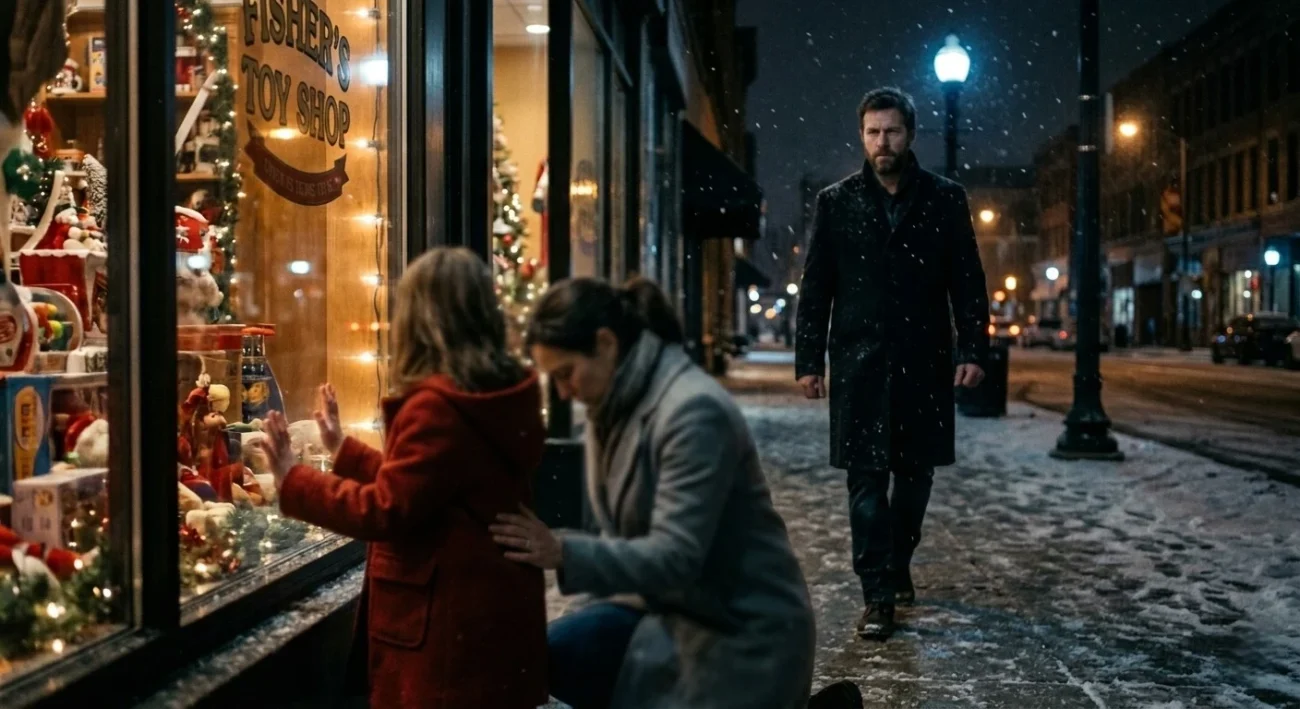
A little girl, maybe nine or ten, stood at the toy store window with both palms flat on the glass. Her breath fogged the pane. Inside, under warm display lighting, a doll in a bright pink dress sat propped on a velvet stand like royalty.
“Look,” the girl whispered. “It’s so beautiful.”
Beside her, a woman crouched in the snow-cold, one knee on the wet sidewalk, her face drawn thin with the particular exhaustion of someone who loved hard and had nothing left over.
“Sweetheart,” she said. “I can’t do a Barbie this birthday. Not this year.”
The girl didn’t cry. She just nodded once — that small, quiet nod that only comes from a child who has already learned that disappointment is a visitor who stays.
That was what made Marcus stop completely.
Not the nod itself. The face that went with it.
He had seen that expression before. That exact downward softness at the corners of the mouth. That tiny crease near the left cheek. The eyes — dark, deep-set, somehow older than the rest of the face.
He had seen it every day for seven years before he lost her.
His wife, Claire, had looked like that whenever she tried not to let sadness show.
Impossible, he told himself. You’re projecting.
But his feet had already moved.
“Excuse me.”
The woman stood fast, all warmth replaced by immediate wariness. The girl stepped behind her leg.
Marcus raised both hands slightly. “I’m sorry. I didn’t mean to startle you. I just — I overheard what you said.”
The woman’s jaw tightened. “It’s fine. She was only looking.”
“I’d like to buy it for her.” He nodded toward the store door. “The doll. Please let me.”
He expected gratitude, or at minimum that awkward hesitation before acceptance.
What he got was panic.
“No.” The woman’s voice dropped hard and flat. “Absolutely not.”
“It’s just a doll—”
“You don’t understand.” Her voice cracked on the last word. Something in her eyes shifted — not suspicion. Something far older than that. Something that looked, impossibly, like recognition.
He frowned. “What don’t I understand?”
She looked at the girl. Her hands pulled the child closer.
Then she looked back at Marcus, and whatever wall she’d spent years building behind her face fractured, just slightly, in the cold.
And she said the sentence that made the snow and the street and the entire city disappear:
“You were never supposed to see her alive.”
Marcus went completely still.
The people passing on the sidewalk blurred. The toy store lights blurred. Everything blurred except those seven words hanging in the frozen air.
“What,” he said, very quietly, “did you just say?”
The woman closed her eyes for one second, like someone bracing for an impact they’d known was coming for years.
“Mama?” The little girl tugged her coat.
Marcus took one step forward. He kept his voice low and careful, but it cost him everything he had. “Who is she?”
The woman looked down at the child, then back up at him. Her eyes were bright with held tears.
“She’s your daughter.”
The world did not tilt. It dropped.
“That’s not possible,” he said. Each word came out flat, like stones. “My daughter died. Ten years ago. I have a death certificate.”
“I know.” The woman’s voice was barely above a whisper now. “Because I watched them file it.”
He stared at her.
“I was a nurse,” she said. “Maternity ward. St. Ambrose Hospital. The night your wife died.”
He knew the hospital. He knew every second of that night. He had replayed it ten thousand times: the fluorescent hallway, the doctor’s face, the paperwork pressed into his hands.
“Your baby didn’t die that night,” the woman said. “She was critical. She needed an immediate transfer to the NICU one floor up. I was the one who called it in.”
“Then why—”
“Your father arrived forty minutes after your wife passed.”
Marcus went cold in a way that had nothing to do with the temperature.
Because his father — Richard Hale — had always arrived exactly when it served him. He had controlled the paperwork that night. The private funeral arrangements. The sealed records. The silence.
Marcus had been too destroyed to ask questions. Too deep in grief to push back against anything his father organized.
You were broken, he thought. And he knew it.
“He came to the nursing station,” the woman continued, her voice steadying into something like testimony. “He said the child was too weak to survive the transfer. He said it would be better to let nature take its course.” She swallowed. “Then he told me that if the baby lived, your wife’s estate — her inheritance — would be tied up in a trust for the child and would never fully revert to his side of the family.”
Marcus said nothing.
“He said your wife’s father had left everything to her, and to her children after her. He said the baby’s survival would cost him millions.”
“So he asked you to let her die.”
The woman’s face broke open. “He didn’t ask. He told me it was already handled. That the transfer had been quietly canceled. That the attending had been — persuaded.”
Marcus’s hands were trembling now. He pressed them flat against his coat.
“And you?” he asked.
She looked at him with ten years of exhaustion in her face.
“I took her,” she said simply. “I put her in my car at the end of my shift. I told myself I’d find a way to bring her back to you once I had proof. Once I was safe. But your father had people watching. He knew I’d taken her within three days. He made it very clear what would happen to both of us if I surfaced.”
“You’ve been running for ten years.”
“Moving every two years. Cash only. No social media.” She exhaled. “I named her Lily.”
The name hit him like a physical blow.
Because that was the name. The exact name. The name he and Claire had whispered to each other in the hospital room, weeks before the delivery, when it was just the two of them in the dark.
If it’s a girl, Lily.
They had told no one. Not his parents, not her parents, not a single friend.
He looked at the woman. “How do you know that name?”
She pressed her lips together. “Your wife said it. Just before she went. I was the last person in the room.” Her voice broke. “She said, ‘Tell him her name is Lily.’ And then she was gone.”
The toy store light spilled golden warmth across the snow, and Marcus Hale — who had not cried in public since the funeral — knelt down in the wet cold of the sidewalk until he was eye level with a little girl who had her mother’s mouth and his own dark eyes.
“What’s your name?” he asked, though he already knew.
“Lily,” she said softly.
Something in his chest cracked and fell.
The woman reached into the inner pocket of her coat and produced something small: a hospital identification bracelet, the plastic yellowed and brittle with age, the ink still legible.
He took it with both hands.
Baby Girl — Lily. Mother: Claire Hale. DOB: Dec. 14.
He covered his mouth.
Lily watched him with careful, serious eyes. Then she asked, very quietly, “Are you the man my mama says used to sing to me before I got taken away?”
He could barely speak. “Yes.”
“She said you sang a song about stars.”
“‘Twinkle, Twinkle,'” he managed. “Every night in the last month. Before you were born. She said she wanted you to know it before you got here.”
Lily nodded slowly, as if confirming something she had always half-believed.
Then the woman’s face changed.
Not emotionally. Physically. The blood left it.
She was looking past Marcus toward the street.
“He found us,” she whispered.
Marcus turned.
A black town car had slowed at the curb, hazard lights clicking orange in the snow. The rear door opened. A man in a dark overcoat stepped out — silver-haired, deliberate, with the unhurried confidence of someone accustomed to owning every room he entered.
Richard Hale.
His father scanned the sidewalk until he found Marcus’s face. Something moved behind his eyes — not guilt. Calculation.
“Marcus.” He said it the way he said everything: as if the situation were already managed. “I’m glad I found you.”
“How did you find us?” Marcus’s voice came out dangerously flat.
“I’ve always known where she was.” Richard glanced at the woman with cold dismissal. “I let it alone as long as it stayed quiet.”
“You knew.” Not a question.
“I protected our family.”
“You buried my daughter.”
“I preserved—”
“Say one more word about preservation,” Marcus said, stepping forward, “and I will make sure every journalist in this city hears what you did.”
Richard’s expression didn’t waver. “You have no proof.”
“I have a hospital bracelet.” Marcus held it up. “I have a woman who worked your maternity ward who will testify. I have the name Lily — which no one alive knows except me, because Claire told no one, and the only way this woman knows it is if she was in that room.”
A muscle twitched near his father’s jaw.
“And,” Marcus said, reaching into his own coat pocket for his phone, “I’ve had this recording running for the last four minutes.”
He pressed stop.
Richard stared at the phone.
“You approached a witness,” Marcus said. “On a public street. In front of my daughter.” He let that land. “My lawyer will have a copy of this file in thirty minutes. I’d suggest you get back in your car.”
For the first time in Marcus’s memory, his father had nothing to say.
He looked once more at Lily — just once, with an unreadable expression — then turned, got back into the town car, and the door closed.
The car pulled away.
The hazard lights disappeared around the corner.
The snow kept falling, soft and indifferent, as if nothing of consequence had happened.
Marcus turned back to the woman and his daughter.
“What’s your name?” he asked her. “Your real name.”
“Patricia,” she said quietly. “Patricia Dunn.”
“Patricia.” He exhaled slowly. “I’m going to need you to tell everything you told me to a lawyer. Tonight, if you’re willing. Everything. The dates, the names, the conversations, all of it.”
“I’ve been waiting ten years for someone to ask me that,” she said.
Lily was looking at the toy store window again, not with longing now, but with a kind of thoughtful calm.
“You don’t have to stand outside anymore,” Marcus said to her.
She looked up at him.
He nodded toward the door.
She looked at Patricia, who gave one small nod.
Lily pushed open the door of the toy store with both hands, and the warm light and the sound of soft holiday music came spilling out into the cold street, and Marcus Hale followed his daughter inside for the first time.
Three weeks later, Richard Hale’s attorneys released a statement confirming he would not contest the emergency petition for full legal recognition of Lily Hale’s parentage. The civil suit was filed by Marcus’s legal team the same afternoon the recording was authenticated. A separate criminal referral went to the DA’s office regarding the falsified death record and the financial coercion of hospital staff.
Patricia Dunn’s nursing license — suspended during the investigation she had fled — was reinstated after a review board ruled her actions had been taken to preserve a patient’s life under duress.
Richard Hale’s estate attorneys began quietly restructuring the trust.
Marcus did not attend any of the hearings.
He spent that particular Tuesday morning in a brightly lit apartment teaching Lily the words to “Twinkle, Twinkle” — which she already half-knew, because Patricia had been humming it to her for years, having heard it the night Claire whispered the name.
Lily learned the second verse in under ten minutes.
She had, it turned out, always been a fast learner.
Original fictional stories. AI-assisted creative content.
