
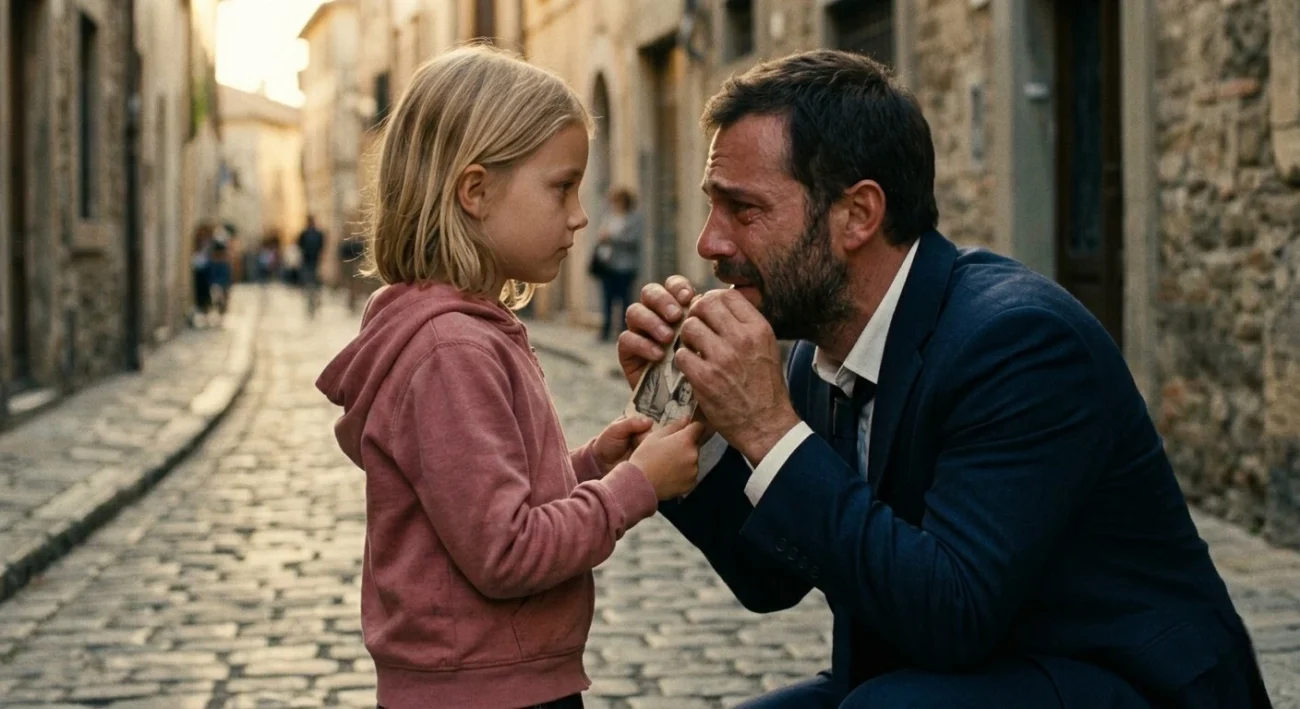
Daniel Reed had worn grief like a second skin for so long he’d stopped noticing the weight of it.
Every morning: the dark suit. Every evening: the narrow street home. Every day: the photograph in his inside pocket — Elena, smiling in the sunlight, one hand raised to shield her eyes, laughing at whoever was behind the camera.
He never knew who’d taken it. He only knew he’d die before he stopped carrying it.
She had disappeared on a Tuesday in October, rain hammering the streets, just after eight in the evening. She’d texted him: On my way. Ten minutes. Then nothing. Police found her scarf three days later, snagged on a drainage grate near the river’s edge. The detective — a tired man named Cahill — had sat across from Daniel in the station’s fluorescent glare and said words Daniel had never allowed to fully land.
Presumed drowned. No evidence of foul play. These cases… most of the time, Mr. Reed, they don’t come back.
He had never signed the death certificate. His lawyer said it was just paperwork. Daniel said he’d get to it.
Five years later, he still hadn’t gotten to it.
He was walking home on an evening that had turned unexpectedly golden — that particular autumn light that makes a city look like it’s being filmed — when the photograph slipped from his pocket.
He didn’t notice.
It tumbled in the slight breeze and settled near the base of a low stone step where a little girl sat alone, her knees pulled up, watching pigeons with the focused patience of a small scientist.
She picked up the photo carefully, the way children handle something they sense is important.
Daniel kept walking.
The girl looked at the picture.
And something changed in her face.
“Mister.”
He didn’t hear her.
“Mister!”
He turned. A child — seven, maybe eight — was standing up on the step, holding his photograph in both hands, extending it toward him with a frown that was pure, unsettled recognition.
“Why do you have a picture of my mommy?”
Daniel stopped.
The street didn’t stop. The pigeons kept doing what pigeons do. A man on a bicycle rang his bell somewhere behind him. The world continued indifferently.
But Daniel stopped.
He walked back toward her slowly. She didn’t flinch, didn’t retreat. Just watched him with big, steady eyes — brown, almost amber in the fading light — the photo still extended in her small hands.
He crouched down to her level.
“What did you say?” His voice came out wrong. Too quiet.
The girl held the photo up so he could see it alongside her own face.
“My mommy,” she said plainly.
Daniel looked at the photograph. Then at her. The shape of her face. The set of her jaw. The way she held herself — that careful stillness that Elena had always had, as if she was constantly deciding whether or not to trust you.
“That’s my wife,” he said. The words felt like gravel in his mouth. “She— she passed away. A long time ago.”
The girl pulled the photo back to her chest and shook her head with complete certainty.
“No she didn’t.”
“What?”
“My mommy’s alive.” She pointed down a narrow side alley between two old buildings, ivy crawling over the stone. “She lives there.”
Daniel straightened slowly. He felt light-headed. He felt like a man who’d just been handed something dangerous and wasn’t sure how to hold it.
“What’s your name?” he asked.
“Lucy.”
“And your mother’s name?”
The child looked at him for a moment — assessing, exactly the way Elena used to — then answered without blinking.
“Elena.”
The world went sharp and strange all at once.
Daniel turned toward the alley. At the far end: a small apartment building, worn stone, second floor. One window half-open. A white curtain moved in the breeze.
Then a silhouette crossed the glass.
Height. Posture. The way she lifted her hand to her hair.
Daniel’s breath left his body.
“Lucy,” he whispered. “Who is up there?”
The girl was watching him with a child’s perfect, heartbreaking certainty.
“My mom.”
He ran.
Not strategically. Not with the careful composure he’d built like a shell around himself for five years. He ran like a man sprinting toward something before his own mind could talk him out of it.
He hit the alley at full speed, Lucy’s small shoes clattering on the cobblestones behind him. He reached the building’s front door, shoved it open, took the stairs two at a time. Second floor. His chest burning.
The apartment door was half-open.
He pushed it.
A small, dim room. A narrow bed. A child’s drawings taped to the wall. A mug on the table, still steaming. A knitted gray sweater over the back of a chair.
And Elena.
Standing in the middle of the room.
Alive.
She was thinner than he remembered. Her hair was different — shorter, pulled back. She had the look of someone who’d been exhausted for a very long time and had simply gotten used to it.
She was staring at him like she was seeing a ghost.
He supposed they were both seeing ghosts.
Neither of them moved for a long, airless moment.
Then Lucy came through the door behind him and went directly to her mother’s side, wedging herself between Elena and whatever was happening, the way children will.
Elena’s hands were shaking. Her eyes were full.
“Daniel—”
“Don’t.” The word came out before he could stop it. Five years of hollow mornings, five years of carrying that photograph, five years of not signing a piece of paper because he couldn’t make himself believe she was gone — all of it had just arrived at once and it wasn’t grief. It was something harder. “Don’t start with my name like we just saw each other last week.”
She closed her eyes. Tears ran down her face.
“I know.”
“You were dead.” His voice cracked down the middle. “They found your scarf in the river. Cahill sat in front of me for two hours telling me— I had a funeral, Elena. I stood in front of a closed casket because there was no body, and I stood there anyway because his chaplain said it would help me— “
“I know.” She was crying openly now, not trying to stop it. “I know what I did to you. I know.”
“Then tell me why.”
Lucy pressed herself harder against her mother’s side, her small face confused and frightened. Elena put a hand in the girl’s hair — automatic, tender — and then looked at Daniel with something that wasn’t quite a plea and wasn’t quite an apology.
“Sit down,” she said quietly. “Please. I’ll tell you everything.”
“I don’t want to sit down.”
“Daniel. Please.”
He didn’t sit. But he stopped moving.
Elena reached into a drawer in the small table by the bed. She pulled out an envelope, old and slightly creased, and held it out to him.
He took it.
Inside was a photograph — not a warm one, not a smiling one. Elena, standing next to a black car on a wet street, her face pale with shock. A bruise starting under her left eye.
And standing beside her, one hand on her arm:
His brother, Victor.
Daniel’s voice came out almost without sound.
“No.”
Elena sat on the edge of the bed and pulled Lucy gently into her lap. She spoke quietly and without drama, like someone recounting something they’d rehearsed telling for a long time.
“The night I disappeared, Victor came to see me at the office. He said your father had changed his will.” She stopped, steadied herself. “He said that if you had a family — a child — everything would go to you. He’d already been managing the estate for three years. He’d moved money. A lot of it.”
Daniel stared at the photograph in his hands.
“He said if Lucy and I stayed in your life, we’d never be safe.” Her voice dropped. “He said the river would be kinder than your family.”
Silence.
Lucy had buried her face in her mother’s shoulder, not looking at either of them.
Daniel set the envelope down on the table. He set it down the way you’d set down something you knew was evidence.
“He threatened you,” he said. Flat. Certain.
“He found me once. About eight months after I’d gone. I was at Saint Agnes — a nun there had helped me, given me a room, no questions. Victor showed up at the church. He showed me a photo of your car parked outside your office and told me—” She held Lucy a little tighter. “He told me if I ever came near you, Lucy would disappear next.”
Daniel turned away from both of them and pressed his palm flat against the wall.
Five years.
Five years, because his brother couldn’t risk losing an inheritance.
He breathed slowly. In through the nose, out through the mouth — the way his therapist had taught him in year two, when the grief had started doing strange things to his sleep.
Then he turned back around.
Lucy was watching him from her mother’s arms, her eyes full but dry, her expression carrying that particular child’s seriousness that appears when small people realize the adults around them are in real pain.
“She knew me,” Daniel said. “From the photograph.”
Elena nodded.
“I told her about you every night.” A tear fell and she didn’t wipe it. “I told her that if she ever saw you — if a man ever looked sad and looked like you — she would know, because even when you were smiling, you always looked like your heart was waiting for someone.”
Something broke open in Daniel that he didn’t have a name for.
He crossed the room in four steps and went down on one knee in front of Lucy. Up close, he could see it clearly — his own eyes looking back at him from his daughter’s face, set in Elena’s cheekbones, above Elena’s mouth.
He didn’t trust his voice for a moment.
“I’m your father,” he finally managed.
Lucy studied him. She chewed her lower lip exactly the way Elena always had when she was deciding something.
“Are you gonna disappear too?”
It hit him like a physical thing.
He opened his arms and she came into them — tentatively at first, then with her whole small body — and he held her against his chest and felt five years of accumulated silence pour out of him all at once.
“No,” he said into her hair, his voice gone entirely. “Never. I promise.”
Elena knelt beside them both and pressed her forehead against his shoulder, and for one long, aching minute, all three of them stayed like that on the floor of a dim apartment while the golden light outside the window gave way to evening blue.
Then Daniel raised his head.
His face had changed.
Not away from them — toward something beyond the room.
“Victor has been running the estate for five years,” he said.
“Yes.”
“With you gone and me grieving, he had full authority.”
Elena’s jaw tightened. “He moved money, Daniel. I don’t know how much, but — I kept records. Everything he said to me that night. The photo. Names. Dates. I kept all of it.”
Daniel looked at the envelope on the table.
“Where?”
She crossed to the wardrobe and reached behind a row of Lucy’s small hanging clothes. She pulled out a battered manila folder, thick with paper — documents, handwritten notes, dates circled in red, photographs.
She handed it to him.
He opened it, scanned the first page, and felt the last five years reorganize themselves around a single clear point.
“I need to make a call,” he said.
“To who?”
“Marcus Webb.” He was already reaching for his phone. “He’s been my father’s attorney longer than Victor’s been running the estate. He doesn’t know Victor the way Victor thinks he does.”
Elena watched him. “Daniel.”
“He threatened my wife. He threatened my daughter. He stole five years of our lives to protect money that wasn’t even his to touch.” He met her eyes. “He didn’t bury us. He just gave me five years of motivation.”
Marcus Webb answered on the third ring.
“Daniel. It’s been a while.”
“It has.” Daniel’s voice was steady now — not cold exactly, but resolved, the way a man sounds when he’s stopped grieving and started deciding. “I need to meet with you tomorrow. Early. I have documentation regarding the estate and my brother’s management of it, and I need you to look at it before I take it to a fraud investigator.”
A pause on the line.
“How serious?”
“Five years of unauthorized transfers, witness intimidation, and an inheritance manipulation that required my wife to fake her death to survive it.” He paused. “She’s alive, Marcus. She’s sitting across from me right now.”
The silence on the other end lasted exactly three seconds.
“I’ll be at your office at eight,” Webb said.
Three weeks later, a judge signed the order.
Victor Reed’s access to the estate was frozen pending investigation. Forensic accountants found what they were looking for inside of forty-eight hours — transfers, reclassifications, a web of shell accounts that had seemed invisible when no one was looking for them. When someone was, it unraveled fast.
Victor’s lawyer tried the family-dispute angle. The judge looked at the photograph of Elena’s bruised face, at five years of meticulous handwritten records, and at the testimony of a nun from Saint Agnes who remembered very clearly the frightened young woman who had shown up at her door one October night with nothing but a winter coat and a story.
The judge was not moved by the family-dispute angle.
Victor was moved to pretrial detention pending a hearing on fraud, witness intimidation, and obstruction charges. He called Daniel from the processing facility. Daniel let it go to voicemail. He’d stopped feeling the need to pick up.
On a Saturday morning six weeks after Lucy had stood up from that stone step and asked a grieving man why he was carrying her mother’s picture, Daniel signed a piece of paper.
Not the one his lawyer had been waiting five years for him to sign.
The other one — the enrollment form for Lucy’s new school, two blocks from the house where she and Elena had moved the week before.
He signed it at the kitchen table while Lucy ate cereal and told him at length about a girl at her new school named Harper who had a hamster that could navigate a maze.
“Does it get rewards for that?” Daniel asked. “The hamster.”
“Sunflower seeds.” Lucy considered this. “I think that’s enough.”
“I think that’s enough too.”
Elena set a mug of coffee in front of him and met his eyes over Lucy’s head. Nothing dramatic. Just the quiet of two people who had come back to each other through something that should have been impossible, and were choosing, every morning, to stay.
He reached across the table and covered her hand with his.
She turned her palm up and held on.
Outside, the autumn light came through the kitchen window, the same gold it had been the evening Lucy found his photograph on the street.
It was enough. It was more than enough.
It was exactly what Victor Reed had spent five years trying to make sure they’d never have.
Original fictional stories. AI-assisted creative content.
