
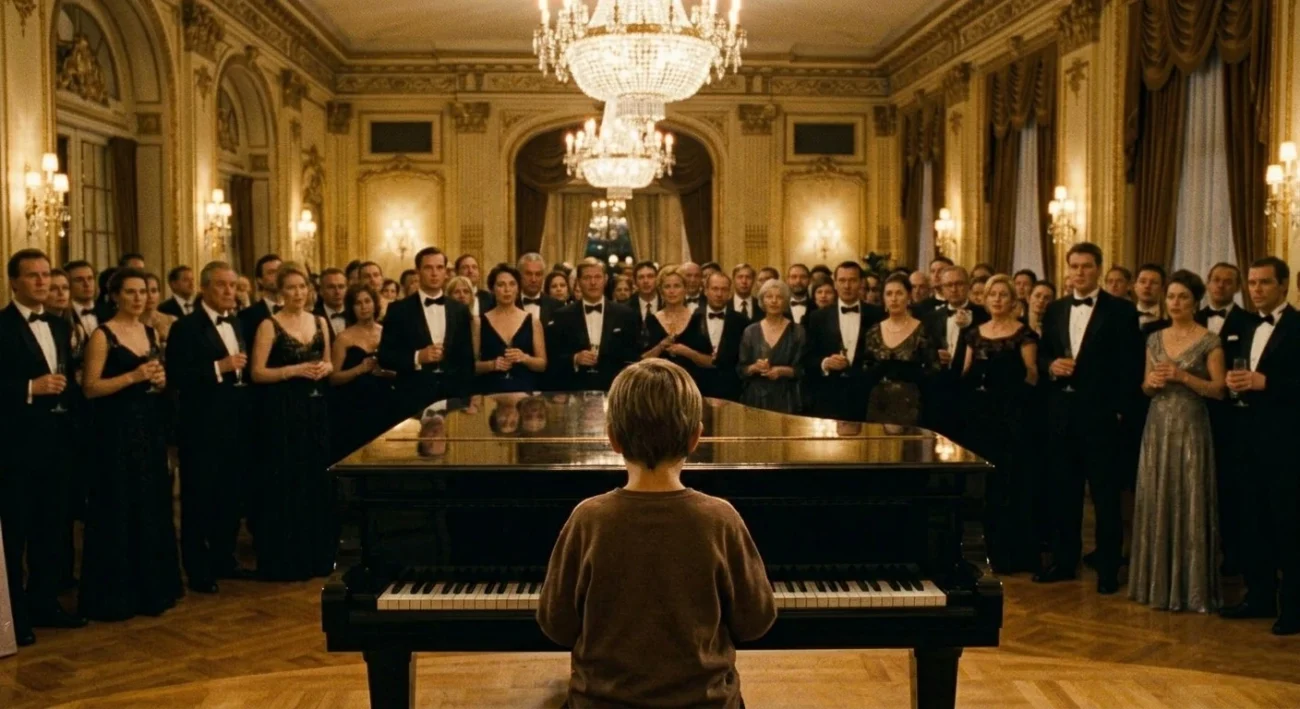
The grand hotel lobby hummed with the usual sounds of money — ice clinking in crystal glasses, shoes clicking across polished marble, the low hum of conversations that went nowhere.
Then he walked in.
Small. Maybe nine or ten. Jeans torn at the knee, sneakers held together with wishful thinking, a faded jacket two sizes too big. A boy who had no business being inside this kind of place.
Nobody said anything at first. They just watched.
He moved through the lobby slowly, calm as a kid with nowhere to be and nowhere to go, until he stopped in front of the grand piano near the fountain. He studied it for a moment — tilting his head the way a person does when they recognize something from a dream.
Then he sat down.
“Hey.” A man in a tailored gray suit stepped forward. Broad shoulders, silver watch, the kind of tan you get from vacationing in places that don’t appear on tourist maps. His voice carried — meant to. “You can’t just — this isn’t a playground.”
A few nearby guests looked up from their drinks.
“Play one song, kid.” The man’s mouth curled. “Or go back to the street where you belong.”
Laughter rippled. Light, careless, the kind people throw out without thinking about where it lands.
Phones came out.
The boy didn’t answer. He didn’t react. He placed both hands on the keys — gently, like they were something that could shatter — and he played a single note.
Soft. Fragile. Hanging in the air.
Then another.
Then the melody found itself — slow, searching, heartbreakingly precise. Not a pop song. Not a classical piece anyone in that lobby would recognize. Something older. Something private. Like a lullaby that was never meant for a room this size.
The laughter stopped.
Conversations died in the middle of words. Glasses lowered. A woman near the elevator pressed her hand to her mouth without knowing she’d done it.
The man in the suit had gone still.
His name was Richard Hale. He owned three hotels and a development company and sat on two nonprofit boards so that his name appeared in programs alongside words like community and generosity. He had not cried in eleven years. He was not going to cry now.
But his feet moved forward without permission.
“Wait.” His voice came out wrong. “That melody—”
He stopped himself. Shook his head slightly, the way a person does when they’re trying to shake loose something that doesn’t belong. “That’s not — you couldn’t know that.”
The boy kept playing. Eyes down. Hands steady.
Richard took another step closer, and now his voice was barely above a whisper. “That melody was never published. It was never recorded. My father wrote it for —” He stopped again. The word wouldn’t come. “It was private.”
Still the boy played. Each note dropping into the lobby like a stone into water — rippling outward, pulling silence behind it.
The final note rang. Held. Faded.
The boy lifted his hands from the keys. He sat very still for a moment. Then he turned on the bench and looked up at Richard Hale — not with anger, not with fear. Just steady. Patient. Like someone who has been waiting a long time to be looked at.
“My mom taught me,” the boy said. “She said her father taught her. She said it was the only song he left her with.”
Richard’s mouth opened. Nothing came out.
“She died in February.” The boy reached into his jacket pocket and set something on the top of the piano. Small. Gold. A ring with a crest worked into the metal — a family crest. “She was wearing this. Said it was yours. Said you’d know.”
Richard stared at the ring. The blood left his face in one long pull.
“That’s — that’s my father’s —” His hand moved toward it and stopped. “How did she — who was she? What was her name?”
“Elena,” the boy said. “Elena Marsh. But her name before that — before she left — was Elena Hale.”
The lobby had ceased to exist. It was just Richard and the boy and the ring on the piano and the melody still hovering in the air like something not ready to leave.
“My sister.” The word came out broken. “She was — we thought she was — my wife said she left. That she chose to—” He turned suddenly. Turned toward the woman in the ivory blouse standing twenty feet away near the bar, who had gone the color of chalk. “Catherine.”
His wife didn’t move.
“Catherine.” His voice had an edge in it now. A new one. “How did my sister’s son end up on the street? How did Elena end up — how did she —” He couldn’t finish the sentence. He couldn’t say dying. “Tell me you didn’t know.”
Catherine set her glass down with extraordinary care.
“Richard—”
“Tell me you didn’t know she was alive. Tell me you didn’t know about the boy.” His voice was rising now, cracking at the edges. “Tell me.”
“It was complicated,” she said quietly. “She was unstable. You know how she was, she would have—”
“She was my sister.”
The room had gone entirely silent. Everyone watching. Phones still raised but forgotten — no one was thinking about content anymore. They were just watching a man come apart in front of a grand piano, and a small boy with steady eyes sitting at the center of it.
“Richard, I did what was best for the family—”
“You let her die.” He said it very simply. Like a door closing. “You knew where she was, and you let her—” He stopped. Looked at the boy. At the ring. Then back at her. “You need to leave.”
Catherine straightened. “Excuse me?”
“This hotel. This building. Every building with my name on it.” His voice had found its footing now — quiet, precise, final. “You need to leave all of it.”
“You can’t be serious right now. You’re — Richard, this child walks in off the street and plays a song and you’re going to—”
“Marcus.” He turned to his head of security — the man had materialized at some point without Richard noticing. “Please help Mrs. Hale gather her things.”
Catherine looked around the lobby. At the guests. At the phones. At the pianist near the corner who had quietly stopped playing forty seconds ago. She opened her mouth once more and found nothing there worth saying. Then she picked up her clutch from the bar and walked toward the elevator with her chin up, because that much, at least, she could keep.
Richard waited until the elevator doors had closed. Then he turned back to the boy.
The boy was still on the bench. Watching. Not afraid.
“What’s your name?” Richard asked.
“James,” the boy said. “James Marsh.”
Richard sat down on the edge of the bench beside him. An awkward fit — a broad-shouldered man in a tailored suit and a small boy in a torn jacket, side by side at a piano no one was playing anymore.
“James.” He picked up the ring from the top of the piano. Held it for a moment. “She taught you that song.”
“Every night,” James said. “She said someday someone would hear it and know.”
Richard closed his hand around the ring. When he looked up his eyes were wet and he wasn’t doing anything about it.
“She was right,” he said.
He put his arm around the boy’s thin shoulders — carefully, the way you hold something you’re afraid has already been broken — and the boy leaned into it, just slightly.
In the corner, the lobby pianist began to play again. Something soft. Something that didn’t ask anything of anyone.
Three months later, the family crest ring sat in a glass display case in the hallway of Richard Hale’s home — his and James’s home now, legally and in every way that counted. Beside it was a photograph: a young woman laughing at a piano, a small boy on her lap, her hands guiding his over the keys. On the back, in her handwriting: For when you find him.
Catherine signed the divorce papers on a Thursday. She contested nothing.
James played the melody one more time that evening — just for himself, just for the empty room — and then he learned a new song.
Original fictional stories. AI-assisted creative content.
