
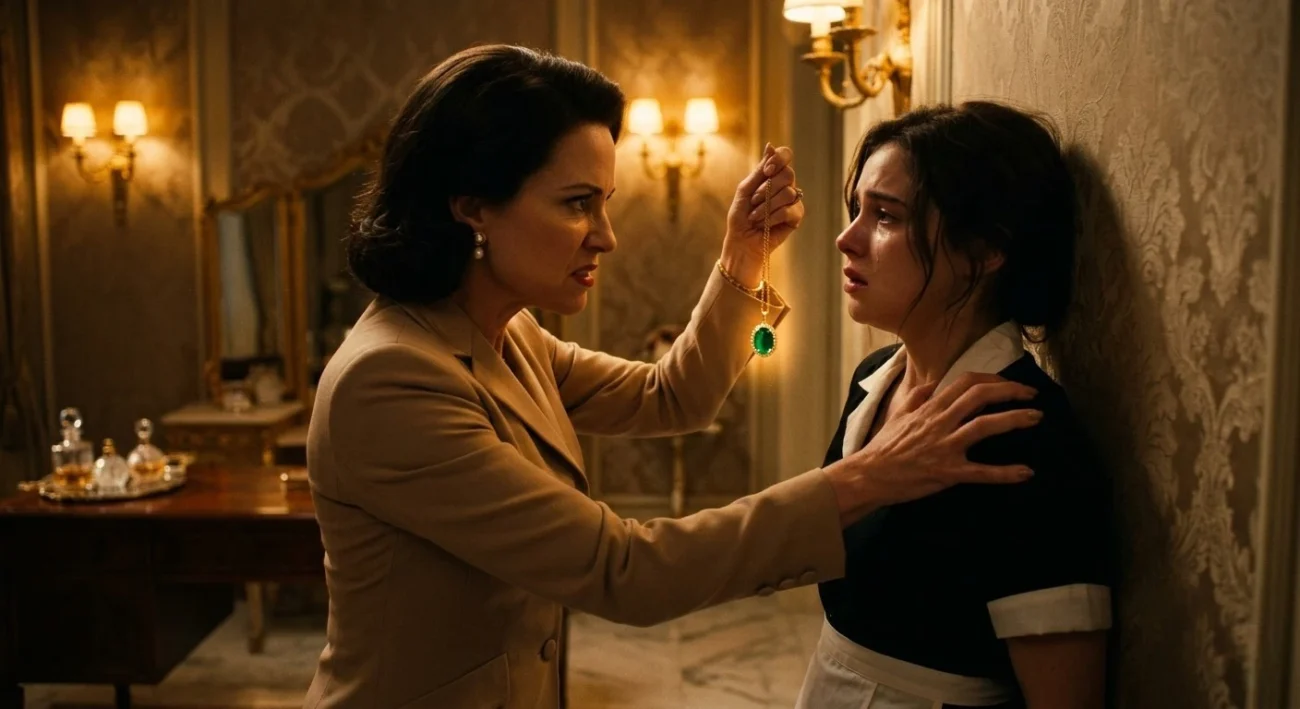
The bedroom glowed like a trap.
Warm gold light pressed against every surface — the mirrored vanity, the silk drapes, the crystal perfume bottles lined up like soldiers. Everything polished. Everything perfect. Everything a performance.
Except me.
I stood near the edge of the bed in my black-and-white uniform, hands folded, eyes down. I had spent four years in this house learning how to disappear. How to move like air. How to exist without being noticed.
Today that skill would fail me.
Madam Madeline Ashford sat before the vanity, fastening her pearl earrings with the slow precision of a woman who had never once been rushed. Her eyes moved across the mirror’s surface like a security camera — scanning, assessing, cataloguing every flaw in her reflection.
Then they stopped.
“What is that?”
Her voice cut clean through the room.
The chair legs scraped the marble as she stood. Before I could even process her movement, her hand closed around my shoulder and yanked the necklace out from beneath my collar.
The chain bit into my throat. I gasped.
She didn’t react. She was staring at the emerald pendant the way you stare at something that should not exist — the way you look at a ghost standing in broad daylight.
“There were only two,” she whispered. “In the world. There were only two.”
“I didn’t steal it.” My voice cracked on the words. “I swear. I didn’t steal anything.”
Her eyes finally found mine. They were cold. Precise. Dissecting.
“Then where did you get it.”
It wasn’t a question. It was a demand.
“A nun gave it to me.” I held her gaze even though my legs were shaking. “At Saint Brigid’s Orphanage. She said — she said my birth parents left it for me. That it was the only thing they ever gave me.”
The room went completely silent.
Not the polite silence of a pause in conversation. A different kind of silence. The kind that comes right before something enormous shifts.
Madeline let go of my shoulder.
Her hands were trembling.
She turned without a word and crossed to the velvet-lined cabinet beside the wardrobe — the one that stayed locked. Always. The one I had never once seen her open in four years of working in this room.
She opened it now.
Inside, resting in a crimson velvet cradle, was a necklace.
The same heavy gold chain. The same brilliant emerald cut. The same delicate engraving looping across the back.
Identical. Down to the last millimeter.
She lifted it with both hands, moved toward me, and held them side by side.
The two pendants caught the golden light and held it — two mirrors of the same secret, finally in the same room.
“She said your birth parents,” Madeline repeated. Her voice had gone strange. Hollow. Like it was coming from somewhere very far away. “That’s what she told you.”
“Yes, ma’am.”
“What was the nun’s name.”
“Mother Agnes. She passed — she passed three years ago. Before she died, she gave me the necklace and a letter. She said I would know when I needed it.”
Madeline’s face cracked.
Not into anger. Into something older and rawer than anger — something that looked like a wound that had never healed, split open all over again.
“Twenty-two years ago,” she said softly, almost to herself, “I gave birth to twins.”
I didn’t move.
“They told me the second girl didn’t survive the night.” Her jaw tightened. “They said I couldn’t see her. That it would be better for me not to. That she was already gone.”
The air in the room felt like it was being pressed out of my lungs.
“I believed them.” Her voice broke on the last word. “For twenty-two years, I believed them.”
“Madam—”
“You’ve been working in my house.” She looked at me — really looked at me, maybe for the first time. “For four years, you’ve been in my house.”
“Yes.”
She pressed one fist to her mouth, fighting to hold herself together. The flawless aristocratic exterior was fracturing in real time — hairline cracks spreading outward from some center point of pressure she could no longer contain.
“Then you are my—”
The bedroom door swung open.
“Madeline.” Lord Arthur Ashford filled the doorway, his voice carrying the automatic authority of a man who had never once been told no in his own home. “What is all this shouting?”
He stepped into the room and stopped.
His eyes moved to the emerald against my collarbone.
And every ounce of blood drained from his face.
I watched it happen. Watched the color leave him. Watched something ancient and calculated flicker behind his eyes — not surprise, not grief, not the stunned recognition of a father finding a lost child.
Calculation. Pure and cold.
“Arthur.” Madeline turned to him with the matching necklace still in her hand. “Look at this. The maid — she has—”
“She’s a thief.” His voice landed flat and absolute. “She went through the private study. She’s had access to this house for four years and she’s been stealing from us.”
“Arthur—”
“CALL SECURITY.” He crossed the room with long, aggressive strides and reached for my neck. “I will have you arrested. I will have you rotting in a cell so fast—”
“Don’t touch me.” I stepped back hard, pressing the emerald against my chest. My voice came out steadier than I expected. Steadier than I felt. “Don’t you dare touch me.”
“You little—”
“Arthur, STOP.” Madeline moved between us, her voice suddenly made of iron. “Look at the necklaces. Look at them.”
“It’s a fake. She had it made. She’s running a con—”
“It isn’t a fake and you know it.” Madeline’s voice dropped into something quiet and terrifying. “You’ve always known it.”
Arthur’s jaw worked silently.
“The engraving,” she said. “The commission mark on the back. These were made by my grandfather for my parents’ anniversary — custom pieces, one of a kind, split between two daughters in the will. No forger would know those details. No one would know that except—”
“Madeline.” He held up both hands. “You’re upset. You’re not thinking clearly.”
“I am thinking perfectly clearly for the first time in twenty-two years.”
His composure slipped — just for a second, just a hairline fracture — and in that fracture I saw the truth. Not guilt. Not remorse. Just the cold animal panic of a man watching his exit routes close off one by one.
“You told me she died.” Madeline’s voice fell below a whisper. “You were in that hospital with me. You spoke to the doctors. You made all the arrangements.”
“It was a difficult night—”
“You made all the arrangements,” she repeated. “You. Not my father. Not the hospital. You.”
Silence.
I reached into the deep pocket of my apron.
“Call the police,” I said. “Please. Call them right now.”
Arthur looked at me sharply.
I pulled out a document — yellowed, fragile, sealed in a clear plastic sleeve. The Mother Superior had pressed it into my hands the morning I left Saint Brigid’s for the last time. She said: You’ll know when the moment comes. Trust the moment.
This was the moment.
“This is the original transfer authorization,” I said. “Signed at Saint Brigid’s Orphanage, twenty-two years ago this November. It transfers custody of ‘Infant Female — Ashford, unnamed’ from Hargrove Memorial Hospital to the orphanage’s care.”
I turned it so Madeline could read the bottom line.
“The signatory,” I said quietly, “is Arthur James Ashford.”
The room detonated.
The phone slipped from Arthur’s hand and shattered on the marble floor.
Madeline took the document from me with both hands. Her eyes moved across the faded text — slow, deliberate, every word landing like a stone dropped into still water.
Arthur’s voice came out scraped and small. “It was for the family. Your father — if he found out there were two daughters, the inheritance would have split. The company would have split. Everything we built—”
“Everything you wanted.” Madeline’s voice was barely above a whisper. “Everything you decided. Without me.”
“I made a business decision—”
“She was a baby.” The whisper broke open. “She was my baby.“
“Madeline—”
“You told me she died in my arms.” Her voice rose, raw and ragged. “You sat next to my hospital bed and you told me she was gone and I — I grieved her. I grieved her for twenty-two years. I put flowers on an empty grave.”
“You need to calm—”
SMACK.
The sound cracked through the room like a gunshot.
Arthur’s head snapped sideways. His lip split. A thin line of red appeared at the corner of his mouth, and for one long second, the entire universe seemed to hold its breath.
“Get out of my house.”
Madeline stood with her hand still raised, her chest heaving, her face stripped down to something ancient and elemental — not the polished Madam, not the controlled socialite, not the obedient wife. Just a mother. Burned clean by twenty-two years of stolen grief.
“This estate was built on my family’s money. My family’s name. My family’s blood.” Her voice dropped to a register I had never heard from her before. Low and absolute and final. “By morning, my attorneys will have frozen every account that carries your name. The board will have your resignation on the table before noon. And if you are still standing in my doorway in sixty seconds, I will call the police myself and show them this document.”
Arthur Ashford — the man who had dictated the terms of everyone else’s lives for decades — looked, for the first time, like what he was.
Small.
He looked at me. Something moved behind his eyes — shame, maybe, or the ghost of it. Then it disappeared, replaced by the last refuge of a coward: contempt.
He picked up his broken phone. He straightened his jacket. He walked out.
The door didn’t slam. It clicked.
And in that soft, ordinary click, twenty-two years ended.
Madeline turned to me. The emerald at my throat caught the gold light one more time, and I watched her eyes trace it — the way it lay against my collarbone, the familiar weight of it, the engraving she had known since childhood.
She crossed the room in three steps and put her arms around me.
She was shaking.
I stood very still for a moment — four years of trained invisibility, of folded hands and lowered eyes and silent footsteps, holding me in place.
Then I held her back.
She sobbed — not prettily, not quietly, but with the full force of everything that had been packed down and sealed away for two decades. And I stood in the golden light of a room I had cleaned a hundred times, in a house I had been born to inherit, and let myself be held for the first time in my life.
By morning, the attorneys were already drafting.
By the end of the week, Arthur Ashford had left the estate with two suitcases and the kind of public disgrace that follows a man into every room he enters for the rest of his life. The board voted him out unanimously. The charitable foundations my mother’s family had built quietly returned to her control.
And me?
I stopped folding my hands.
I stopped lowering my eyes.
I walked through every room of that house — the marble foyer, the east wing gallery, the garden terrace with the stone fountain — and I let myself exist in all of it. Loudly. Visibly. Without apology.
The woman who spent twenty-two years learning how to disappear had finally learned to take up space.
And the man who had made her invisible?
He learned what it costs to build your comfort on someone else’s erasure.
The lesson arrived right on time.
Original fictional stories. AI-assisted creative content.
