
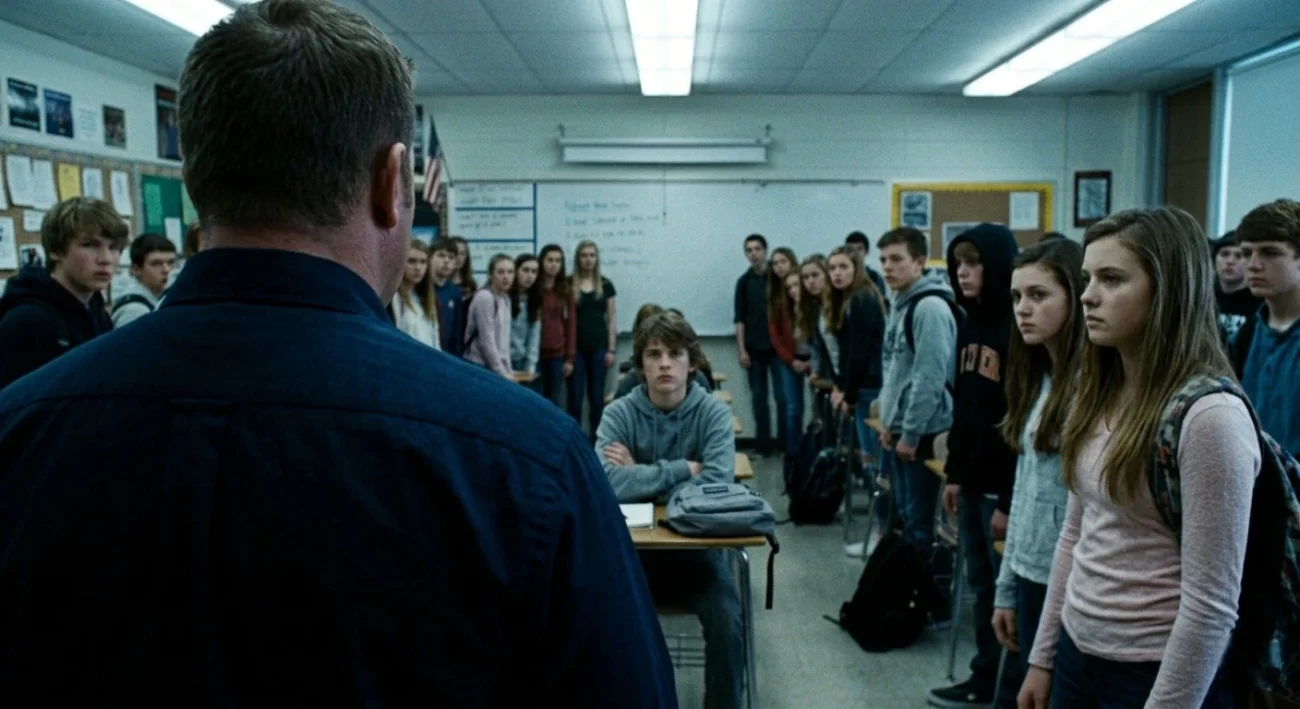
The door hit the wall so hard the whiteboard rattled.
Every head in Room 14 snapped toward the entrance. Thirty-two eighth-graders froze mid-sentence, mid-laugh, mid-breath. The substitute teacher—Mr. Farrell, barely twenty-six and already sweating through his collar—spun around from the board.
A woman rushed in first. Mrs. Calloway, the third-grade teacher from the east wing. She was clutching a little girl so tightly you could see the fabric of her cardigan bunching in the child’s fists. The girl’s face was buried in her shoulder. Her shoulders were shaking.
Sobs. Real ones. The kind that come from somewhere below the throat.
But no one was looking at the girl.
Because behind Mrs. Calloway, a man had walked in.
He was broad, heavy-shouldered, wearing a jacket with a security company logo on the chest. His jaw was set like concrete. His eyes were already moving across the room—scanning, sorting, calculating.
“Everyone stand up.”
It wasn’t a request. It wasn’t even really loud. But every single student rose to their feet like the floor had tilted.
Mr. Farrell stepped forward. “Sir, you can’t just—”
“Who hurt my daughter?”
Silence. The kind that has weight.
The girl’s grip tightened on Mrs. Calloway’s sweater. A small, muffled sound escaped her. Not words. Just pain.
“Daddy.”
The man’s whole body changed. For one second, the concrete in his jaw cracked. His eyes found her, and something in him went soft and broken at the same time. He crossed the room in three steps, crouched down, and put both hands on her shoulders.
“Hey. Hey, look at me. I’m here.”
She turned her face just slightly. Her eyes were red and swollen, her lower lip trembling. She was five years old and she looked like she’d been carrying something twice her size.
He pressed his forehead to hers. “You’re safe. Okay? I’ve got you.”
Then he stood up. Slowly. And everything hard came back.
“Which one of you did this to her?”
No one moved. A few students exchanged looks. One girl near the window started crying quietly. Most of them just stared at the floor or at each other, paralyzed by the specific guilt of people who witnessed something and did nothing.
Mr. Farrell moved forward again. “Sir, I’m going to need you to wait in the hallway while I call the principal—”
“I’ve been waiting in a parking lot for forty minutes because someone told me my five-year-old daughter was hurt and no one was calling me back.” His voice didn’t rise. It dropped. “So I’m going to ask one more time.”
From the back of the room—unhurried, unbothered—a voice cut through.
“Relax.”
Every head turned.
The boy was still seated. Arms crossed. Back against the chair like he had nowhere better to be. He was maybe fourteen, big for his age, with an expression that had clearly never learned to be embarrassed.
The father’s eyes locked on him.
“Relax,” he repeated, quieter, almost testing the word in his own mouth. He took a step toward the back of the room.
The boy didn’t flinch.
“You’re yelling without knowing the story,” the boy said. Flat. Almost bored.
The man stopped in the middle of the aisle. He was close enough now that the size difference between them was obvious and meaningless at the same time. Something about the boy’s stillness made the room smaller.
“Then tell me the story.”
A pause that lasted too long.
The boy shrugged. One shoulder. Casual as a coin flip.
“She started it.”
The father blinked. Whatever he’d been preparing to feel—anger, grief, the need to destroy something—collided with pure confusion.
A five-year-old.
The invisible eye of the room shifted. Thirty-two faces turned toward the girl.
She’d stopped crying. She was still pressed against Mrs. Calloway, but she was watching the boy now. And something passed over her face that had no business being on a five-year-old—a flash of recognition, or maybe fear, or maybe something much worse than either.
She shook her head. Barely. Almost invisible.
No.
The father saw it. His eyes moved between his daughter and the boy, and something clicked into place that he didn’t have language for yet.
“She started it how?” he asked. His voice was different now. Lower. More careful.
The boy leaned back further in his chair. “She was in our hallway. Third graders aren’t supposed to be in the eighth-grade wing. She was looking for something. I told her to leave. She didn’t. Things escalated.”
“Things escalated.” The father let the phrase sit in the air between them like something rotten. “She’s five.”
“She was trespassing.”
A girl two rows over made a small, horrified sound. The boy didn’t react.
“Marcus.” Mrs. Calloway’s voice was quiet but pointed. “Stop.”
The boy—Marcus—finally looked at her. “I’m just telling the truth.”
“You pushed her,” said a voice near the door. Small. Tight. Scared of itself.
Everyone turned. A girl standing near the back corner—slight, with her arms wrapped around herself—was staring at Marcus with the expression of someone who’d been holding something down for a very long time and just felt it break loose.
“Priya—” Marcus said, and for the first time, there was something in his voice that wasn’t boredom. A warning.
“You pushed her into the lockers,” Priya said, louder this time. “She was just standing there. She wasn’t doing anything. She wasn’t looking at you. She was looking at a drawing on the wall and you walked up and you—” Her voice cracked. “You just shoved her. Because you were mad about something else and she was small and she was there.”
The room stopped breathing.
The father looked at his daughter again. The little girl’s lip was trembling. A fresh tear slid down her cheek. She looked at Priya with something that might have been gratitude, or might have been relief, or might have been both wrapped up inside each other.
“I want to see the hallway camera footage,” the father said. His voice was completely level now. That was somehow more frightening than the anger.
Marcus sat forward for the first time. “There’s no cameras in that hallway.”
“There are cameras in every hallway,” Mr. Farrell said quietly, and even he seemed surprised he’d said it out loud. “New system went in last month. Every wing.”
Marcus went still.
It was a different kind of still than before. Before, his stillness had been performance—control, dismissal, the very deliberate act of a person who wanted you to know they couldn’t be touched. This stillness was something else. This was the stillness of a boy who had just run the numbers and didn’t like what he’d come up with.
“We’ll pull the footage right now,” Mr. Farrell said, pulling out his phone. “I have the admin’s number.”
“I want the principal,” the father said. “And I want a copy of that recording. And I want someone to explain to me how a fourteen-year-old physically assaulted a five-year-old in a school hallway and no staff member stopped it.”
Mrs. Calloway closed her eyes briefly. “That’s a fair question. And I’m so sorry. I should have—” She paused. “I should have called you immediately.”
“Why didn’t you?”
A beat.
“Marcus’s mother is on the school board,” she said quietly.
The air in the room changed again. A different kind of weight now—not the weight of shock but the weight of recognition. A few students exchanged glances. A few others stared at the floor with the guilty expression of people who had already known.
Marcus said nothing.
“That changes nothing about what happened,” the father said. “My daughter is five years old. She has bruises on her shoulder. And the reason this took forty minutes is because someone was protecting the person who hurt her.”
He looked at Marcus then. Not with rage anymore. Something quieter and more permanent.
“Get up,” he said.
Marcus didn’t move.
“I’m not going to touch you,” the father said. “I’m going to stand here until the principal walks through that door, and when she does, we are all going to watch that footage together. Every second of it. And you are going to sit across from my five-year-old daughter and explain—to her face, not to me—what she did to deserve that.”
Marcus opened his mouth. Closed it.
The door opened.
Principal Dana Okafor walked in. She was small, precise, with the expression of someone who had been running toward this room since the moment her phone rang. Behind her was the vice principal, and behind him was a woman in a blazer who looked like she’d come straight from somewhere that required a blazer at 11 a.m.—polished, composed, and already forming a sentence designed to make this go away.
“Mr. Reyes,” Principal Okafor said carefully. “Why don’t we—”
“The camera footage,” he said. “I want it pulled. Right now. In front of everyone.”
The woman in the blazer stepped forward. “I’m Diane Holloway. I’m on the board of—”
“I know who you are,” Mr. Reyes said, and his voice was the flattest it had been all morning. “Pull the footage.”
Principal Okafor looked at Diane Holloway. A look passed between them—one of those looks that carries a whole conversation. Then Okafor looked at the father. Then at the little girl still pressed against Mrs. Calloway. Then at the bruise visible along the edge of the girl’s collarbone where her shirt had shifted.
She pulled out her radio.
“Security. I need the camera log for the eighth-grade east corridor. Timestamp 9:45 to 10:05. Pull it to the main office screen.”
Diane Holloway said, sharply, “Dana—”
“Diane.” Principal Okafor’s voice didn’t waver. “A five-year-old child has a bruise on her shoulder. We’re watching the footage.”
They watched the footage.
Thirty-eight seconds.
That’s all it took. Thirty-eight seconds of a small girl in a yellow shirt stopping to look at a mural painted on a cinder block wall, and a boy walking past, slowing, turning back, saying something the camera didn’t catch, and then—in one quick, sharp motion—shoving her sideways with both hands hard enough that she hit the lockers and slid to the ground.
Nobody moved when it ended.
Diane Holloway had gone very still.
Marcus was looking at the floor.
“She was looking at the mural,” Priya said, from the back of the room. Her voice was steadier now. “The fourth graders painted it last spring. She was just looking at it.”
The father crouched down next to his daughter. She looked up at him, her eyes still wet, but something had shifted in her face—the tight, private shame of a child who has been hurt and somehow made to feel responsible for it was loosening, piece by piece, as the room rearranged itself around the truth.
“You didn’t do anything wrong,” he told her. “You hear me? Not one thing.”
She nodded slowly. Her breathing was still uneven, still catching at the edges, but she nodded.
He stood up and turned to Principal Okafor.
“I want a formal incident report filed today. I want his record updated. And I want to know the name of every adult who knew about this before I walked in here.”
Okafor nodded once. Crisp. Final. “You’ll have it.”
Diane Holloway straightened her blazer. “This doesn’t need to become a—”
“Diane.” Okafor turned to face her fully. “My office. Right now. Alone.”
Something shifted in Holloway’s expression. Not defeat exactly—more like the first awareness that the architecture of a situation she’d always controlled was no longer holding.
Marcus got up from his chair without being asked. His face had changed. The practiced indifference was gone. In its place was something younger and smaller than he’d wanted anyone to see—a boy staring at the distance between who he thought he was and what the camera had just shown everyone in that room.
“Marcus,” Principal Okafor said. “You’ll come with Mr. Farrell and wait outside my office.”
He walked out without looking at anyone.
The girl watched him go. Then she looked up at Priya, who was still standing near the back wall, arms still wrapped around herself like she needed the support.
“Thank you,” the little girl said. Barely a sound. But it landed in the room clearly.
Priya’s arms dropped. She walked over and crouched down to the girl’s level.
“You weren’t doing anything wrong,” Priya said. “Everybody in this school has seen that mural. It’s beautiful. You were just looking at it.”
The girl’s face opened up in the particular way a child’s face opens when someone gives them back something they didn’t know they’d lost.
Her father put a hand gently on Priya’s shoulder as he passed. He didn’t say anything. He didn’t need to.
By noon, Marcus had been formally suspended pending a disciplinary hearing. Diane Holloway resigned from the board three weeks later—it came out that she’d been tipped off before the father arrived and had told Mrs. Calloway to delay the notification call, which violated three separate district policies. The incident report, once filed, triggered a review of two prior complaints against Marcus that had been quietly buried.
Priya got a commendation from the school at the end-of-year assembly. She walked up to accept it wearing the same expression she’d had in that classroom—a little scared, completely certain.
The girl in the yellow shirt came back to school the following Monday. On her way to class, she stopped in the eighth-grade corridor to look at the mural again. It was still there. Bright painted figures and block letters and the particular colors that only exist when fourth graders are given free reign and enough tempera paint.
She stood in front of it for a long time. And this time, nobody bothered her.
Original fictional stories. AI-assisted creative content.
