
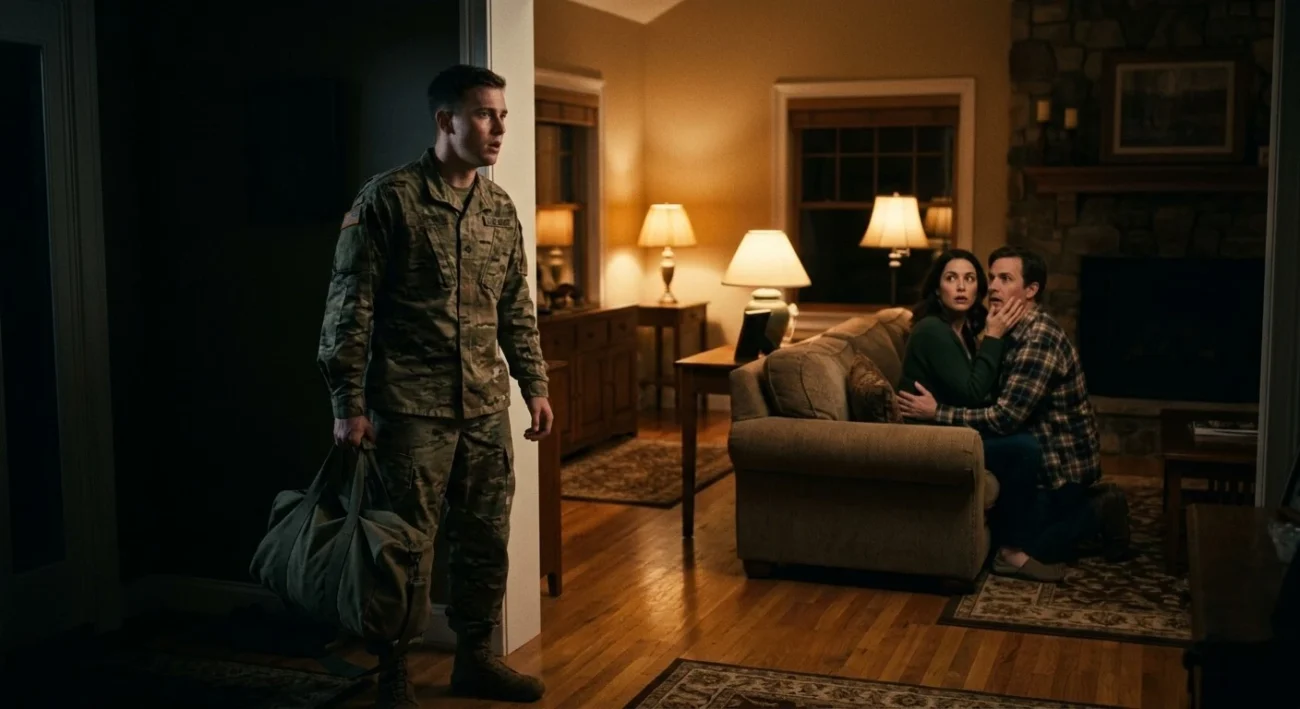
Marcus had one image burned into his brain through two years of hell: the front door of the house on Clover Street swinging open, and Amy running out barefoot the way she always did.
That picture got him through a lot.
Through mud and noise and the kind of nights when the only thing standing between a man and the dark was the memory of someone waiting.
So when he finally turned the key and stepped inside, duffel bag over his shoulder, the warm yellow light of the living room hit him first.
Then the couch.
Then her.
Then the man sitting beside her.
Amy stood up so fast the throw pillow hit the floor.
“Marcus—”
The other man rose too. Careful. Almost like he’d rehearsed this moment and was still afraid of it.
Marcus said nothing. His hand tightened on the strap of his bag. He looked at the man. At Amy. At the two coffee cups on the table. At the way the lamp was on and the TV was off, and the whole room had the soft quiet of people deep in conversation.
He’d written her whole paragraphs about this room. About coming back to it. About the two of them sitting in it with time on their hands and nothing to be afraid of.
“You need to hear her out,” the man said quietly.
Marcus turned to look at him dead-on.
“Who are you?”
The man didn’t flinch. “My name is Daniel. I’m a trauma counselor.”
“For who?”
“For Amy.” A beat. “And for your daughter.”
The word hit Marcus like a pressure wave — the kind you feel in your chest before you hear the sound.
“My what?”
Amy pressed her hand over her mouth. Her shoulders folded inward. She was crying before he even took a full step into the room.
“I didn’t know how to tell you,” she said. “I didn’t — Marcus, they told me you were dead.”
He stood very still.
“They told me you were missing first. Then they told me you were gone. They had me sign papers. Official papers. They said there was nothing left to—” She broke off. Swallowed. “She was born seven months after they told me.”
Marcus looked at Daniel.
Daniel reached for a folder on the coffee table. He set it in front of Marcus without a word.
Marcus opened it.
Hospital records. A birth certificate. Therapy intake forms. Emergency contacts.
On the first page, under the name of a little girl — Lily — there was a single blank next to the word Father.
Someone had filled it in by hand.
Deployed.
His knees wanted to quit.
“The letters,” he said. It came out rough. “I sent letters. Command confirmed delivery.”
Amy shook her head hard. “I never got them. I swear to you, Marcus. Not one.”
His eyes moved to the coffee table. To the small stack of envelopes sitting there like evidence at a crime scene. He crossed the room in four steps and picked one up.
His handwriting. His stamps. His return address.
Unopened.
All of them unopened.
“Where did these come from?”
“They showed up three weeks ago,” Amy said. “All at once. I called the base. They said there’d been a routing error. A routing error.” Her voice cracked on the last two words. “Two years of letters. Three weeks ago.”
Marcus set the envelope back down. Slowly. Like he was afraid of what he might do if he moved too fast.
Daniel said nothing. He understood when to be furniture.
Marcus pressed his palms flat on the table. Breathed. Looked at the folder again. Then he saw the photo.
It had slipped halfway out from between two pages.
A little girl asleep on her side, one arm stretched out, fist curled around something small and frayed.
He picked the photo up.
His patch.
His unit patch from his first deployment, the one he’d left on the dresser the morning he shipped out. He remembered moving it. He remembered thinking he’d grab it when he got back.
She was holding it like a stuffed animal.
He stared at the photo until his vision blurred.
“She knows about you,” Amy said softly. “She’s always known. I read her your letters — the ones I made up, when I thought the real ones were gone. I told her you were a hero. I told her you were coming home. Even when I didn’t believe it myself, I told her.”
Marcus set the photo down carefully.
He turned to Daniel. “You’re not — you and her — you’re not—”
“No,” Daniel said, plain and clean. “No. I’ve been helping Amy manage the grief. And helping Lily with anxiety. That’s all I am.”
Marcus nodded once. Something in his chest loosened, just slightly, like a knot losing one of its layers.
He turned back to Amy.
She looked hollowed out. Like the last two years had taken a tax he hadn’t been billed for yet.
“I never replaced you,” she said. “I was just trying to keep her alive. And trying to keep myself from going under.” She took one careful step toward him. “I am so sorry for what they did to us.”
Marcus looked at her for a long moment. At the woman who had spent two years building a version of him in a child’s mind — a hero, a father, a man coming home — when she had every reason to believe that man was in the ground.
He looked at the stack of letters. At the folder. At the photo still lying on the table.
Then, from the hallway, a small sound cut through everything.
“Mom?”
All three of them turned.
A little girl stood at the edge of the hallway, hair loose from sleep, bear hanging from one hand. She looked at Daniel first — safe, familiar. Then at her mother. Then at the stranger by the table.
Her eyes went to his hand.
To the photo he was still holding.
Her photo.
Something moved across her face — not recognition exactly, but the edge of it.
Her gaze traveled up to his face, and she studied him the way children study things they have already decided to trust.
Then she looked at the patch in his trembling hand. At the frayed edges of it. At the faded insignia that matched the one in her crib photo, the one her mother had put in her hands before she was old enough to ask why.
“Are you the hero from Mommy’s letters?” she asked.
Marcus couldn’t speak.
He went down on one knee, slowly, the way a man does when the ground beneath him has become sacred. He held the photo out to her — her own sleeping face, her own curled fist.
She stepped forward and took it. Looked at it. Then held it back out to him.
“You can keep it,” she said. “Mommy has more.”
The sound that came out of Marcus wasn’t a sob. It was quieter than that. The kind of sound that happens when something that has been locked for a very long time finally opens.
He gathered Lily carefully, the way you hold something you’re still learning is real, and she let him, her bear pressed between them, her head coming to rest against his shoulder like she’d been practicing it.
Amy crossed the room and sat on the floor beside him, her hand finding his back.
Daniel closed the folder quietly, stood, and let himself out of the front door without a word.
He would file his session notes later. Under the prognosis section, he would write four words: Family reunification. Outcome: complete.
In the weeks that followed, Marcus filed a formal inquiry with the Department of Defense about the two-year mail routing failure. The investigation revealed a systemic administrative error affecting sixteen other deployed service members — all of whose families had received incorrect or delayed correspondence. The story made national news.
An official apology was issued. A corrections officer lost his post. A policy was changed.
It didn’t give anyone those years back.
But it meant no one else lost them the same way.
Marcus framed the first letter he ever wrote to Amy — the one that had sat unopened for two years — and hung it in the hallway of the house on Clover Street. He never opened it. They agreed they didn’t need to. Everything he’d meant to say, he’d spent the rest of his life saying out loud.
Lily grew up knowing exactly who her father was.
Not from letters.
From the man who came home.
Original fictional stories. AI-assisted creative content.
