
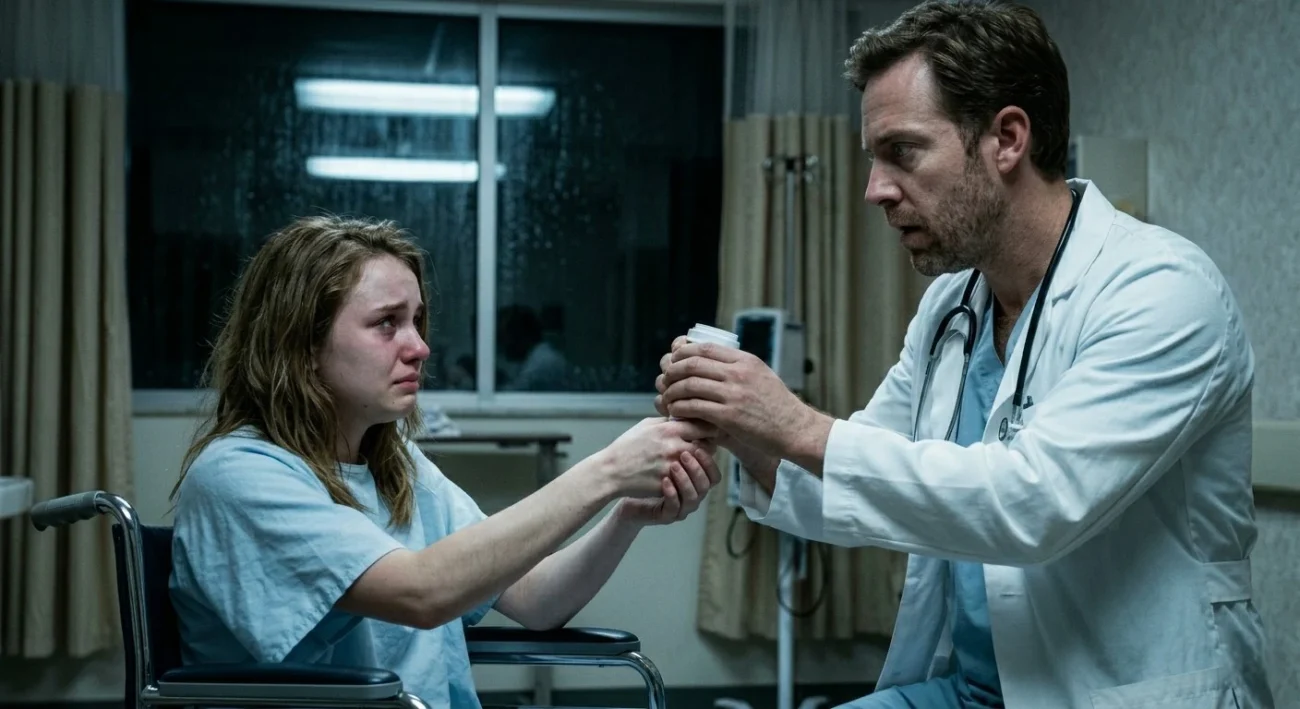
The rain hit Saint Mercy Hospital like it had a grudge.
Fourteen-year-old Emily Carter sat alone in Room 214, the orange medicine bottle pressed between both palms. Her legs hadn’t worked right in almost two months. She’d stopped asking why three weeks ago. Tonight, she started again.
She’d heard the nurses talking outside her door.
“Something about this case doesn’t feel right.”
That was all she needed.
Dr. Michael Reeves came in at 9:47 p.m. to check her vitals. He was the kind of doctor who actually looked at you when he talked, like you were a person and not a chart. Emily had always liked that about him.
“Dr. Reeves,” she said quietly.
He looked up from the monitor. “What’s up, Emily?”
She held out the bottle with both hands, the way a kid holds evidence they’re not sure they’re allowed to show.
“What is this medicine for?”
He took it with a casual half-smile. Read the label.
The smile disappeared.
He read it again.
“Emily.” His voice dropped to almost nothing. “Where did you get this?”
“My mom gives it to me every night. She said it would help my legs.”
He turned the bottle over. Turned it again. His jaw was tight.
“How long have you been taking it?”
“Almost two months.”
Dr. Reeves set the bottle down on the tray table very carefully, the way you set down something you suddenly realize is dangerous. He pulled a chair close to her wheelchair and sat down so they were at eye level.
“I need you to stay calm,” he said. “Can you do that?”
Emily’s throat tightened. “Yeah.”
“This isn’t medication,” he said. “It’s an experimental neurotoxin. It was developed for restraint programs — violent offenders. It attacks the nervous system.” He paused. “In sustained doses, it causes permanent paralysis.”
The word permanent landed like a stone in still water.
Emily stared at the bottle.
“My mom gave it to me,” she said. Not a question. Just the sentence, hanging there.
“I know.”
“She told me it would help me walk.”
“I know.”
“That doesn’t make sense.”
Dr. Reeves didn’t say anything to that, because there was nothing to say that would make it make sense.
He stepped into the hallway and made three phone calls in nine minutes.
The floor went into quiet lockdown — no announcement, no visible shift, just a subtle tightening of activity that patients never notice but nurses always feel. Two blood draws were ordered STAT. A toxicology panel. A soft page to hospital security.
Then he went back into Room 214 and sat with Emily while they waited.
She didn’t cry yet. She just kept turning the medicine bottle in her hands, reading the label over and over like the words might rearrange themselves into something less terrible.
“Did you know it was hurting me?” she asked.
“I didn’t know you were taking it until tonight.”
“I mean my mom.” She looked at him. “Do you think she knew?”
Dr. Reeves was quiet for a moment. “I think we need to find that out.”
Emily nodded slowly.
“She loves me,” she said. “She really does. I know she does.”
He didn’t answer that either.
The blood results came back at 11:22 p.m.
Dr. Reeves read them in the hallway, jaw tight, hands completely still. The neurotoxin levels were significant. Not emergency-room critical — not yet — but another few weeks and the nerve damage would have crossed a line that no amount of physical therapy could walk back.
Three more weeks. Maybe four.
He went back to Emily. “The tests confirmed it. Your body’s been fighting this for a while. But we caught it in time.” He held her gaze. “You’re going to be okay.”
“Are you sure?”
“I’m sure.”
She exhaled — long, shaky, like she’d been holding it for two months.
“My legs are going to work again?”
“With treatment. Yes.”
For the first time all night, something in her face softened.
Then the door opened.
Detective Linda Harris arrived at 11:51 p.m. with a junior detective named Cho. She had the kind of face that was built for bad rooms — steady, readable only when she wanted it to be. She introduced herself gently, pulled a chair close to Emily’s wheelchair, and spoke like she had all the time in the world.
“Emily, I just need to understand what happened. You’re not in any trouble. I promise.”
Emily told her everything. The medicine. The nightly routine. The way her mother made it seem normal, even comforting.
“Did she ever tell you where the medicine came from?”
“No. She just said it was for my condition.”
“Did she name a pharmacy? A doctor?”
“No.”
Detective Harris nodded, made a note. “Did anything change at home after your dad passed away?”
Emily hesitated.
“Yeah,” she said finally. “She changed.”
She described it carefully, the way only a kid who’s been paying very close attention describes something. The crying in the kitchen. The strange silences. The way her mother would sometimes look at her — not with anger exactly, but with something hollow behind her eyes.
“But she loves me,” Emily said again. “I want you to know that. She really does.”
Harris wrote it down.
Dr. Reeves stood near the window and said nothing.
At 12:14 a.m., the door opened.
Julia Carter walked in soaking wet, coat dripping, hair flattened by the rain. She looked exhausted and desperate in the way people only look when they’ve been driving around unable to go home.
She saw the police officers.
She stopped.
For just a second — maybe less — something moved across her face. Not fear. Guilt. The specific, involuntary kind that doesn’t wait to be invited.
Emily saw it.
Every organ in her chest dropped three inches.
“What’s going on?” Julia’s voice was sharp, controlled. “What happened? Why are there — “
Detective Harris stepped forward and held up the medicine bottle.
“Mrs. Carter. Where did you get this?”
Julia’s eyes went to the bottle. Then to Emily. Then back to the bottle.
She didn’t answer.
“Mom,” Emily said softly.
Julia forced a smile. “Sweetheart, it’s okay. There’s been a misunderstanding — “
“That substance is a paralysis agent.” Dr. Reeves’s voice cut across the room, flat and clinical. “Your daughter has been ingesting it for eight weeks. She could have lost the ability to walk permanently.”
The room went completely silent.
Julia’s face crumpled.
“Mom.” Emily’s voice broke. “Why?”
Julia covered her face. Her shoulders shook.
For a long moment, the only sound was rain against the window.
Then she let her hands drop.
“When David died,” she said, “everything fell apart. The medical bills were already there from before he got sick. Then the debt. Then the house.” She looked at Emily like she was trying to explain a war. “I couldn’t keep up. I was drowning.”
“So you used her,” Dr. Reeves said.
“I didn’t know — ” Julia’s voice cracked. “A pharmaceutical company reached out. They said they were running neurological studies. Private research. They said it was low-risk, completely temporary. They offered me thirty thousand dollars if Emily participated.”
Detective Harris didn’t blink. “You consented on her behalf.”
“They said the effects were reversible. They promised — “
“You kept giving it to her,” Harris said. “Even after you saw the symptoms.”
Julia shook her head desperately. “I tried to stop. I told them I was pulling out. But they threatened me. They said they’d leak information that would destroy any chance I had of keeping custody — lies they said they’d fabricate — and I panicked. I was scared. I was — ” She stopped. Looked at Emily. “I was trapped.”
Emily was watching her mother with a stillness that was harder to look at than tears.
“You told me it would help me walk,” she said.
“I know.”
“Every single night. You handed it to me and told me it would help.”
“Emily — “
“You watched me get worse.”
Julia broke completely. “I’m so sorry. I’m so sorry. I didn’t — I never wanted — ” The words dissolved into sobs.
Emily looked away.
“Take her,” Detective Harris said quietly.
Two officers moved toward Julia, who reached for Emily, saying her name over and over, but Emily didn’t look up. The door opened. The sound of her mother’s crying receded down the hallway and then was gone.
The room was very quiet.
Dr. Reeves walked over to Emily’s wheelchair and crouched down to her level.
“You did that,” he said.
Emily looked at him.
“You asked the right question at the right time,” he said. “You trusted your instincts. That’s why you’re going to be okay.”
She didn’t say anything for a moment.
“I still love her,” Emily said.
“I know.”
“Is that stupid?”
“No,” he said. “It’s not stupid at all.”
She looked back at the window. Rain still ran in long streaks down the glass.
“What happens now?”
“Treatment starts tomorrow morning. We flush the toxin, monitor your nerve response, start physical therapy as soon as your body’s ready.” He paused. “It’s going to take time. But your labs are showing real recovery potential.”
“And the company?”
“They’ll be investigated. That’s already in motion.”
Emily nodded slowly.
She placed the medicine bottle on the tray table. Set it down carefully, deliberately — the way you put something down when you’re done with it for good.
“Okay,” she said.
The federal investigation moved fast.
A whistleblower inside NeuraTech Laboratories had been sitting on documentation for months, waiting for an external case to anchor it. Emily’s toxicology report was the anchor. Within seventy-two hours, the FBI had seized servers. Within two weeks, the FDA had suspended operations. Within a month, eight executives had been indicted on charges including illegal human experimentation, falsification of clinical trial data, and coercion.
The case made national news.
Julia Carter was arrested and charged. She accepted a plea agreement — reduced sentencing in exchange for full testimony against NeuraTech. Her cooperation was considered critical to the prosecution’s case. She was sentenced to four years, with eligibility for early release based on conduct.
Emily was not present at sentencing.
She was in physical therapy.
The recovery was slow and honest. There were days when her legs cooperated and days when they didn’t. Days when she felt like herself and days when something heavy sat behind her sternum that had nothing to do with nerve damage.
Dr. Reeves checked in every week, even after she’d technically moved out of his direct care. That was just how he was.
“How’s it feeling today?” he asked one Thursday morning, six weeks into outpatient therapy.
“Better,” Emily said. “I made it down the hall without the wall.”
“That’s a big deal.”
“I know.” She paused. “I got a letter from her.”
He didn’t have to ask who.
“Did you read it?”
“Not yet.”
“You don’t have to.”
“I know.” She looked at her hands. “I’m not ready. But I kept it.”
He nodded.
“That’s enough for now,” he said.
The day Emily walked unassisted across the full length of the therapy room, the staff stopped what they were doing.
A physical therapist named Donna, who Emily had spent three months with, clapped first. Then everyone else.
Dr. Reeves was standing near the door. He smiled — the real kind, not the professional reassurance kind.
Emily reached the far wall. Touched it with her palm. Turned around.
She looked at all of them looking at her, and she felt something she hadn’t felt in a long time.
Solid.
“Okay,” she said. “Let’s go back.”
The night before Emily was officially discharged from outpatient care, she stood at the window on the fourth floor — the same side of the building as Room 214, two floors up. Rain was falling again, the same kind of heavy Chicago rain that had been falling the night everything changed.
She stood without holding anything.
Just stood.
The window glass was cold against her fingertips.
She thought about her father, who had never meant for any of this to happen when he died. She thought about her mother, who had made a choice Emily would never fully understand and might never fully forgive. She thought about the nurse in the hallway who had whispered that something felt wrong — whoever she was — and how that one sentence had saved her life.
She thought about the bottle. The label with no pharmacy name.
The question she’d had the courage to ask.
Dr. Reeves appeared beside her. He’d come to walk her out, give her the final discharge paperwork.
“Ready?” he asked.
Emily looked at the rain.
“Yeah,” she said.
She picked up her bag and walked to the elevator under her own power, without holding the wall, without looking back.
The floor count dropped: 4… 3… 2… 1.
The lobby doors opened.
She walked out into the rain.
Original fictional stories. AI-assisted creative content.
