
Maya was seven years old, and she had already learned the kind of things most people spend their whole lives trying to forget.
She knew which grocery stores had cameras pointed at the door and which ones pointed at the register. She knew that babies cried louder when they were hungry than when they were scared, and she knew the difference between the two. She knew that some promises couldn’t be kept and some had to be, no matter what.
Tonight’s promise was the milk.
She stood at the counter of the corner store on Benton Street, one hand gripping a small carton of whole milk, the other pressed flat against the baby strapped to her chest in a worn fabric wrap. The baby’s name was officially Marcus, but she called him Bug because he had come into the world small and persistent and impossible to ignore.
Bug was seven weeks old.
He had not eaten since yesterday afternoon.
“I’m not stealing,” Maya said out loud — to herself, to the clerk, to whoever was listening. “I’m going to pay. I just don’t have any money right now.”
The old clerk behind the register, a man named Garrett who had worked this store for twenty-two years, looked at her over the top of his glasses. He didn’t say anything. He had seen a lot of things in this store. He had learned to let some of them unfold.
Maya set the carton on the counter. Her chin was up. Her eyes were wet. She was not going to cry. She had decided that an hour ago, and she was keeping that promise too.
“I’ll come back and pay,” she said. “I’ll be older by then.”
“You planning on being gone that long?” said a voice behind her.
She spun around.
The man stood near the refrigerated drinks aisle — tall, dark suit, no tie, the kind of stillness that didn’t come from being relaxed. He was maybe forty. He had the face of someone who had spent a long time looking for something and was very tired of looking.
He wasn’t a cop. Maya knew what cops looked like even when they weren’t in uniform. This was something else.
“I wasn’t talking to you,” she said.
“I know.” He took one step forward, unhurried. “I heard what you said anyway.”
Bug made a small unhappy sound and squirmed. Maya shifted her weight automatically, rocking him without thinking. Her eyes didn’t leave the man.
“What do you want?” she asked.
He glanced at Bug. Then back at her.
“I want to ask you a question,” he said. “But first I’d like to buy that milk. If that’s all right with you.”
Maya stiffened. “I don’t need charity.”
“It’s not charity,” he said quietly. “It’s just milk. The question is the part that matters.”
Garrett had stopped pretending to sort receipts behind the register. He was watching now, hands flat on the counter, saying nothing.
The man walked to the counter, set down a twenty-dollar bill beside the carton, and looked at Garrett. Garrett rang it through without a word, slid the change back, and looked at the floor.
The man picked up the carton and held it out to Maya.
She didn’t take it right away.
“What’s the question?” she said.
“Where’s your mother?”
The air went out of the room.
Maya’s hand, which had been reaching toward the carton, went still.
“She’s at home,” Maya said.
That was the lie she had practiced.
It wasn’t a very good one. She could tell by the way the man’s face didn’t move at all that he already knew it.
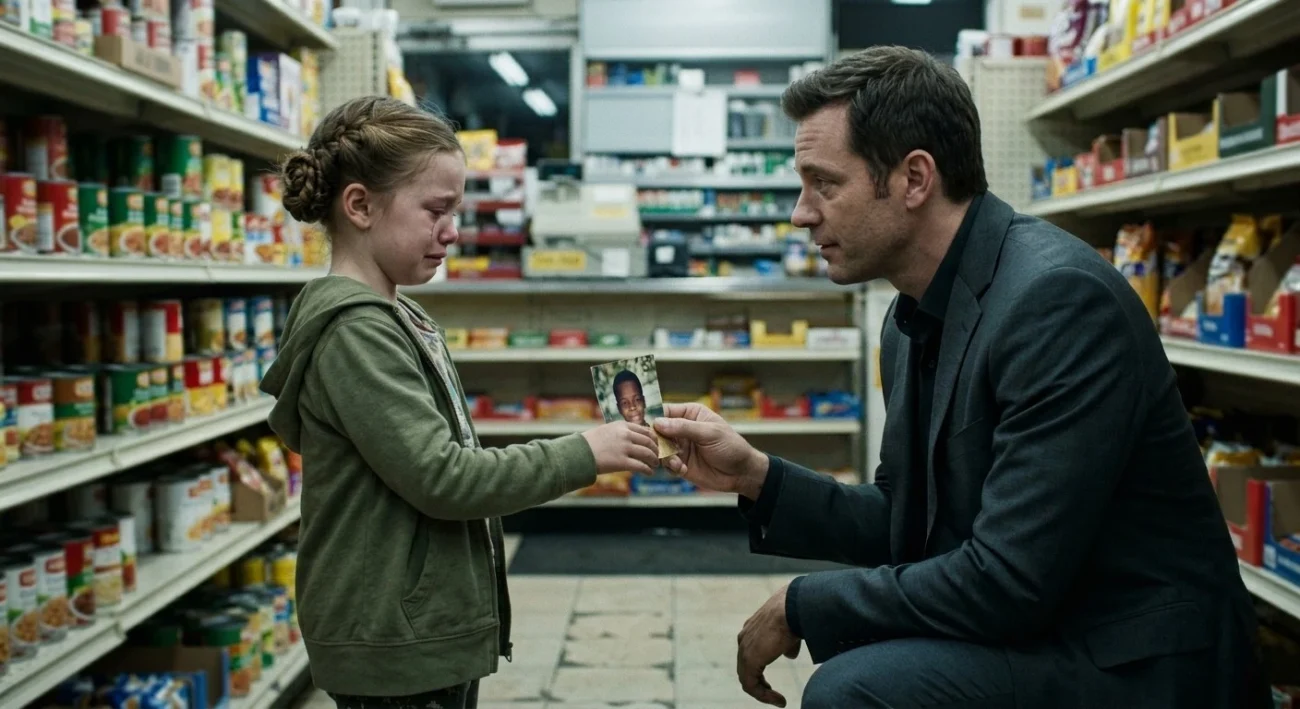
He reached into the inside pocket of his jacket slowly — slowly enough that she could see the movement coming, slowly enough that she could have run if she’d decided to. He pulled out something small and folded and held it out the same way he had held out the milk. An offering. Not a demand.
It was a photograph.
Creased down the middle. The edges soft from being handled too many times.
Maya took it.
She looked at it.
And the world tilted.
Her mother’s face looked back at her — younger, thinner, hair loose in a way Maya hadn’t seen in years — standing in what looked like a hospital corridor, holding a baby wrapped in a blue-and-white blanket.
The blue-and-white blanket that Bug was wearing right now.
Maya looked up. Her voice came out in a scrape. “Where did you get this?”
“From a detective,” the man said. “Who got it from a hospital in Claremont three months ago.” He paused. “My name is Daniel Reeves. My sister had a son. He was taken from the maternity ward twelve weeks ago. A nurse went missing the same night. That photograph was found in the nurse’s apartment along with your mother’s name and a burner phone.”
“My mother didn’t steal anyone.”
“I know.”
That stopped her.
“Then why—”
“Because I think your mother was trying to protect him,” Daniel said. “And I think that means someone else was trying to do the opposite.”
Bug made another sound — louder this time, edging toward a real cry. Maya bounced him automatically, her eyes not leaving Daniel’s face.
“He’s hungry,” Daniel said. He held the milk carton out again.
This time she took it.
She crouched against the base of the refrigerator unit, opened the carton with practiced ease, and fed Bug from a small bottle she pulled from her jacket pocket — already measured, already ready, because she had been doing this long enough to be ready. Daniel crouched to her level and waited.
Garrett brought two paper cups of water from the back without being asked and set them on the floor beside Maya and went back to the register.
“My mom told me,” Maya said after a moment, eyes on Bug, “that if anyone ever found us with a last name that started with R, I had to run.”
Daniel went very still.
“She said some people would say he belonged to them,” Maya continued. “But belonging isn’t about blood. Belonging is about who keeps you alive.”
“What did she tell you about why she took him?”
Maya was quiet for a long time. Bug was eating now, making small satisfied sounds, and she watched his face the way she always did — checking, measuring, making sure.
“She said his birth father had already paid people to make sure he didn’t survive past six months,” Maya said. “She said his mother was gone and there was no one left who would fight for him. She said she found out by accident and she had two hours to decide.” She looked up. “She made her decision.”
Daniel’s jaw tightened.
“Where is she now?”
Maya’s hand paused on the bottle.
“She told me that if she wasn’t back when the streetlights came on,” Maya said, very carefully, the way you say something you’ve been holding for days, “I was supposed to keep walking and not tell anyone his real name.”
“The streetlights came on.”
“Three nights ago.”
The store was completely silent.
Garrett turned away and looked at the wall.
Daniel sat back on his heels and pressed one hand over his mouth for a moment. Then he lowered it. His face had gone through several things in a short time and had arrived somewhere that looked like grief stripped of everything else.
“The man who ordered it,” he said finally. “My brother-in-law. My sister died in childbirth. He didn’t want the baby because the baby was the only thing standing between him and her estate.”
“Then you’re not here to take him back to them.”
“No.”
“Then who are you here for?”
“I’m here because he’s my blood,” Daniel said. “And because my sister would have wanted someone to fight for him. And because I’ve been looking for three months and I found a photograph and followed it for four states and ended up in a convenience store watching a seven-year-old girl risk a shoplifting charge to feed my nephew.”
Maya looked at him for a long time.
Bug finished the bottle and made a small complete sound.
“How do I know you’re not lying?” she asked.
“You don’t,” he said. “Not yet.”
“What happens if I trust you and you’re wrong?”
“Then I’ll be wrong,” he said. “And you’ll be no worse off than you were three nights ago standing here with an empty carton and nowhere to go.”
That was honest.
She hated that it was honest.
Bug yawned — a massive, total-body yawn that scrunched his whole face and made his tiny fists open and close. Maya looked down at him. She thought about her mother’s voice, steady and certain even when her hands shook. She thought about the streetlights.
She thought about the weight of a promise that was getting heavier by the hour.
“He has a birthmark,” she said. “On his left shoulder. Shaped like a comma.”
Daniel closed his eyes for one second. When he opened them they were wet.
“His mother called it his little pause,” he said. “Like he was catching his breath before the rest of his life.”
Maya stood up. Bug settled against her chest, warm and full and already falling asleep. She looked at the milk carton, at the change sitting on the counter from the twenty-dollar bill, and at Garrett, who was still looking at the wall.
“Sir,” she said to Garrett.
He turned.
“Thank you for not calling anyone,” she said.
Garrett nodded once. “Good luck, kid.”
She looked at Daniel.
“I need to find my mom first,” she said. “Before I go anywhere with you.”
“I know,” he said.
“And if something happened to her because of your family—”
“Then that’s on me to make right,” he said. “And I will.”
She studied his face. The exhaustion in it. The grief in it. The specificity of it — the way it looked like someone who was telling the truth not because it was convenient but because he didn’t have anything left to lose by telling it.
She took a breath.
“Okay,” she said. “But I choose where we start looking.”
They found her mother two days later.
She was in a hospital in the next county — beaten, two broken ribs, a fractured wrist — but alive. She had been found in a parking garage by a stranger who called an ambulance and stayed until the paramedics arrived. She had given a false name, which was why she hadn’t been found sooner.
When Maya walked into the hospital room with Bug in her arms, her mother made a sound that wasn’t a word and wasn’t quite a cry — something between the two, something that had been waiting for days to come out.
“I kept the streetlights rule,” Maya said. “But I cheated a little.”
Her mother pulled her close and held on.
Daniel stayed in the doorway.
When the mother finally looked at him, her expression was careful and frightened and full of questions.
“I’m not here to take him,” he said. “I’m here to make sure the right people know what my brother-in-law ordered. And then I’m going to make sure he never gets near Marcus again.”
“You can prove it?”
“I can,” he said. “I’ve been building the case for three months. I just needed to find Marcus first to make the last part of it matter in court.”
The mother was quiet for a long time.
Outside the hospital window, the afternoon light was going orange and soft. Bug was asleep in Maya’s arms, completely unbothered by any of it. She rocked him the way she always did.
“My daughter kept him alive for three weeks by herself,” the mother said. “She’s seven years old.”
“I know,” Daniel said.
The mother looked at Maya for a long moment — something immense and quiet passing between them, the kind of look that doesn’t need words because words would only make it smaller.
Then she looked back at Daniel.
“You have one chance to be who you say you are,” she said. “Don’t waste it.”
He didn’t.
Six weeks later, the man who had ordered his own son’s death was arrested on conspiracy charges. A hospital administrator was indicted alongside him. The nurse who had disappeared — the one whose apartment had held the photograph — testified from protective custody, alive, having run the moment she understood what she’d stumbled into.
Marcus’s legal name was recorded as Marcus James — his mother’s maiden name.
Bug, Maya called him anyway.
He had no idea what any of it meant. He just knew the arms that held him, and the voice that sang off-key at two in the morning, and the particular rhythm of being carried by someone who had decided, very early and very firmly, that he was worth every single thing it cost.
He would understand it eventually.
She would tell him.
She had already decided.
Original fictional stories. AI-assisted creative content.
