
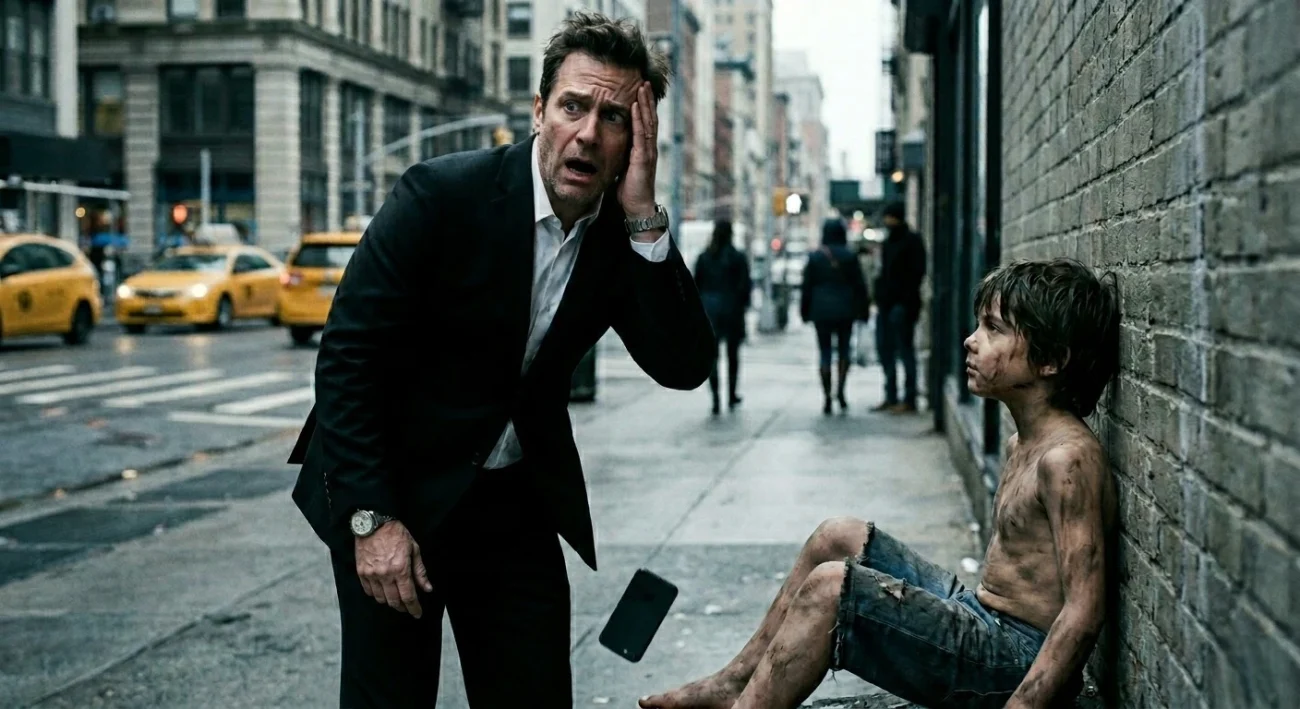
The rain had stopped, but Chicago’s streets still wept.
Water pooled in the gutters outside Redline Station, streetlights painting everything amber and cold. Most people moved fast — heads down, coats pulled tight, no time for anything that didn’t matter to them.
The boy sat near the entrance like he’d always been there.
Eight years old, maybe. No shirt despite the November chill. Brown hair tangled over eyes that looked older than his face. A torn blanket beside him. A cardboard sign: HUNGRY.
Coins hit the ground near him every few minutes. He barely glanced at them.
Across the street, a black SUV pulled to the curb and people moved automatically — not because of the car, but because of the man who stepped out.
Daniel Harper. Thirty-four years old. One of the youngest investment firm owners in the city. Tailored suit, silver watch, the kind of jawline that looked sculpted to project authority.
He was on his phone before his feet hit the pavement.
“I don’t care what Lawson says,” he said flatly. “Tell him to close the Meridian deal by Thursday or I’ll find someone who will.”
He ended the call without waiting for a response. Shoved the phone in his pocket. Walked.
And then he saw the boy.
He slowed for a second — maybe two. Something flickered across his face before the habit of control smoothed it away.
He reached into his jacket and pulled out his wallet. Inside: a thick stack of hundreds. He peeled off four of them without looking at the amount.
People nearby noticed. A couple turned. A woman with a stroller slowed her pace.
Daniel crouched slightly and held the cash out toward the child.
“Here,” he said. “Go get some food.”
The boy looked at the money.
He didn’t move.
Daniel shifted his weight. “Take it.”
Still nothing.
The boy slowly raised his eyes — dark brown, steady, unnervingly calm — and looked directly at Daniel’s face.
“Keep it,” the child said quietly.
Daniel’s hand didn’t move. “What?”
“You’re going to need that.” The boy’s voice was soft, measured. Like he was simply stating weather. “Soon.”
A man behind Daniel laughed nervously and kept walking. A teenage girl slowed her steps.
Daniel’s brow drew together. “What did you say to me?”
Silence.
“You think that’s funny?” Daniel straightened up fully now. His voice sharpened into the tone that made his employees flinch. “You think you’re being clever?”
The boy just watched him.
“Take the money.” Daniel pushed the bills forward again. “Don’t play games with me.”
“I’m not playing,” the boy said. “You’re about to lose everything.”
Something locked behind Daniel’s eyes.
“Who told you to say that?” He scanned the sidewalk. “Is someone recording this? Is this a bit?”
No answer.
“You have no idea who you’re talking to,” Daniel said, his voice dropping to something colder.
The boy didn’t blink.
“I know exactly who you are,” the child said.
And something in that sentence — the flatness of it, the certainty — made Daniel go still.
His phone buzzed.
He yanked it from his pocket, jaw tight, glaring at the boy like this was an interruption he’d deal with after.
“What,” he said into the phone.
His assistant’s voice came through shaking. “Sir. We have a — we have a situation.”
“I’m busy.”
“All company accounts have been frozen. Federal investigators. It just happened — like ten minutes ago.”
Daniel turned away from the boy. “That’s not possible.”
“Three board members have already submitted resignations. Investors are calling. Someone leaked the internal documents — everything, sir, the whole Meridian structure — it’s online right now. Every financial channel is running it.”
Daniel’s breathing changed. The hand holding the phone dropped to his side for a moment before he pulled it back up.
“Who leaked them?”
“We don’t know. And sir — Mr. Lawson isn’t responding. His office says he left the building two hours ago and nobody’s heard from him since.”
The city noise seemed to compress around him.
He lowered the phone.
Car horns. Wind off the lake. A child laughing somewhere down the block.
He turned back slowly.
The boy was still sitting exactly where he’d been. Still watching.
Daniel walked toward him like something was pulling him. He crouched down in front of the child, expensive pants sinking into the wet sidewalk without him noticing.
“How did you know?” he asked.
The boy said nothing.
“How did you know that?”
The boy looked past him at the street. Quiet. Then:
“Do you remember a place called Ashbury Shelter?”
The name arrived in Daniel’s chest like something thrown hard.
Ashbury Shelter.
South side. Three story brick building with broken radiators and windows that never fully closed. A place where kids nobody wanted ended up.
A place that burned down twelve years ago.
“How do you know that name?” Daniel whispered.
“You slept near the back window,” the boy said. “You always moved your mattress there because the draft was less. You said it was warmer even though it wasn’t.”
Daniel’s throat closed.
Nobody knew that. Nobody. He’d never spoken about Ashbury. Not to business partners. Not to lawyers. Not to the journalists who wrote his success profiles. That chapter of his life was sealed shut, buried under a decade of distance and deliberate forgetting.
“Who are you?” he asked.
The boy tilted his head just slightly.
“You don’t remember me?”
And then it hit him.
Not the boy in front of him. But another boy, years back. Small. Always running a fever. Quiet in a way that wasn’t peaceful — it was the quiet of a child who had learned not to ask for things.
Daniel used to share food with him sometimes. Peanut butter crackers. Half a sandwich from the donation box.
The night the shelter caught fire, the owner had locked the doors from outside — something about an inspection he was trying to hide, heating violations, the details had blurred over time. The fire started in the boiler room just after midnight.
Smoke hit the hallway first.
Children screaming. Someone breaking a window. Daniel had scrambled through a gap in a side panel, dropped six feet to the ground, hit the frozen grass hard.
He’d made it out.
And there had been a boy — small, already coughing — pinned under a fallen beam near the back.
Daniel had looked at him.
And run.
He’d been fifteen. Terrified. Already outside when he heard the structure groan. He told himself he couldn’t go back in. He told himself nobody could.
He’d told himself that so many times it had smoothed into something he almost believed.
“You…” Daniel could barely speak. “You didn’t — they said you didn’t —”
“Make it out?” The boy looked at him with those ancient, steady eyes.
Daniel sat all the way down on the wet sidewalk. He didn’t care anymore. His suit, his watch, the people walking past, the cameras on every corner — none of it registered.
“I’m sorry,” he said.
The word came out raw. Like something that had been packed into a very small space for a very long time.
“I should’ve gone back in. I knew where you were. I knew — and I ran.” His voice broke apart on the last word. “I have thought about it every single day. Every single day.”
Tears ran down his face. He didn’t wipe them.
“I built everything — all of it — because I was so scared of being powerless again. Because I never wanted to feel like that kid who ran. And somewhere in between I became — I became exactly the kind of person who left you there.” He looked at the ground. “I became worse.”
The boy was quiet for a long moment.
Then he stood.
Daniel looked up. “Wait — please —”
“You still have time,” the boy said softly.
“To do what?”
“To become human again.”
A city bus groaned past between them. The headlights swept the block. The air brakes hissed.
When the bus was gone —
The child was gone.
Daniel lurched to his feet. He spun. Checked the subway entrance, the alley beside the station, both directions down the sidewalk.
Nothing. No footsteps. No small figure disappearing into the crowd.
A woman in a green parka watched him from a few feet away, frowning slightly.
“You okay?” she asked.
He couldn’t answer.
He looked down.
The torn blanket was still there.
The cardboard sign was still there.
But the words had changed.
Not hungry anymore.
Daniel Harper stood on a wet Chicago sidewalk with four hundred dollars in one hand and his ruined empire in the other, and for the first time in years he felt nothing — none of the strategies or calculations or protective numbness that had carried him for over a decade.
Just a fifteen-year-old boy standing in the cold, watching a building burn, making the worst decision of his life.
He pulled out his phone again.
Not to call his lawyers. Not to call a PR firm.
He pulled up a search engine and typed: Ashbury Shelter survivors. Chicago.
Then he sat back down on the sidewalk, back against the station wall, and he started to read.
Over the next three months, Daniel cooperated fully with the federal investigation. He returned assets, testified against Lawson, and waived his legal protections on two counts to ensure the Meridian families received full restitution.
He sold his apartment. The car. The watch.
He found eleven survivors from Ashbury through records that had been misfiled and nearly lost. He met each one. He didn’t make speeches. He showed up and he listened.
He rebuilt nothing for himself.
But one year later, a new transitional housing shelter opened on the south side of Chicago — fully funded, properly inspected, staffed by people who’d been through the system themselves.
On the dedication plaque by the entrance, there were twelve names.
His was last.
Above his, carved in clean letters, was the name of the boy from the shelter fire — listed not as a victim, but as a founder.
Daniel stood in front of that plaque for a long time on opening day.
He didn’t say anything.
He didn’t need to.
Original fictional stories. AI-assisted creative content.
