
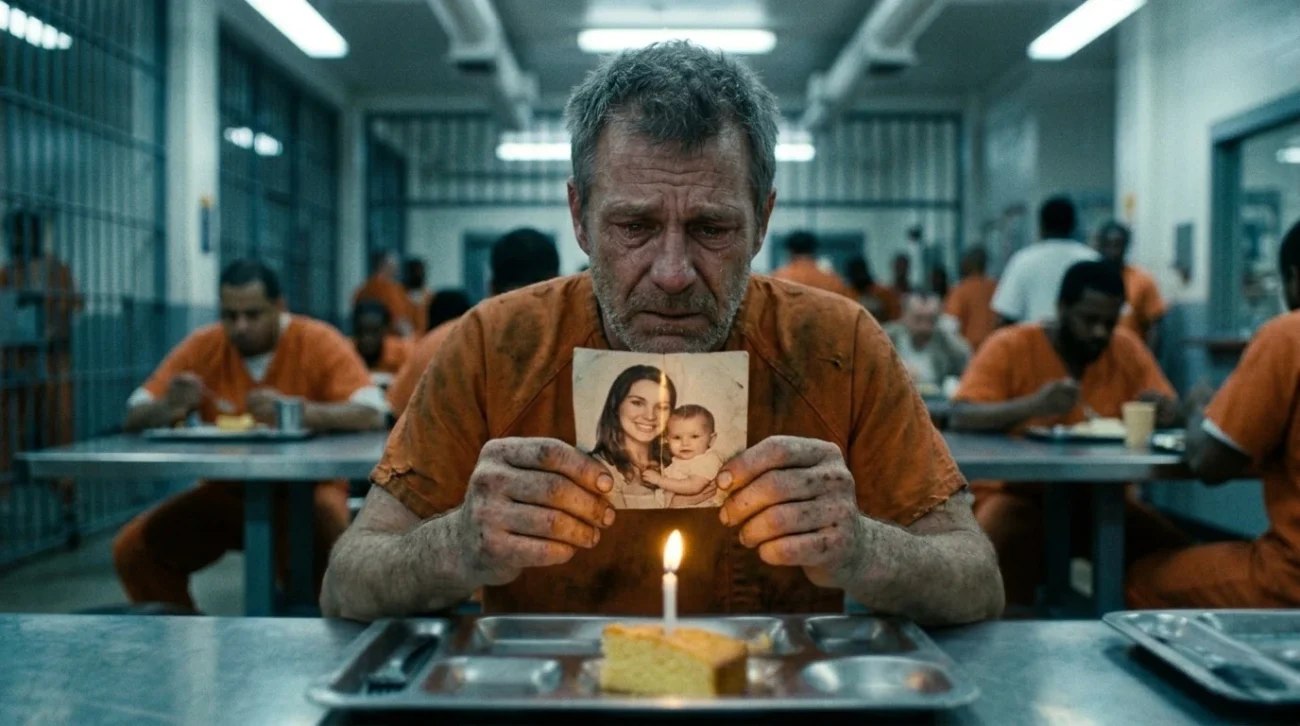
The mess hall at Iron Yard never stopped smelling like old bleach and boiled things. Elias Thorne had eaten in enough bad places over fifty years to know this was close to the bottom.
He slid his tray to the far end of the table, away from the cluster of bodies, away from the noise. Six hundred and twelve days in this place and he’d learned one thing: the far end was the only real estate worth having.
He set the bun in the center of the tray. Placed his spoon beside it like silverware.
“You’re doing it again,” said Marcus from two seats down. Marcus was twenty-three, in for a stretch that would eat most of his youth. He watched Elias the way young men watch old ones—half curiosity, half dread of recognition.
“Doing what?”
“The thing. With the food.”
Elias didn’t answer. He reached into the waistband of his jumpsuit, where the cotton had worn thin. Pulled out a stub of birthday candle—white, barely two inches, bent slightly at the tip. He set it upright in the soft center of the bun with the precision of a man performing surgery.
Marcus stared. “The hell is that?”
“Birthday candle.”
“You can’t—”
“I know.”
He cupped both hands around it. Shielded the tiny flame from the air conditioning that ran year-round regardless of season. The match barely made a whisper when he struck it.
The flame caught. Yellow. Warm. Impossibly small against the fluorescent cold.
Elias closed his eyes.
He wasn’t in Iron Yard anymore. He was twenty-two and standing in a backyard in Cleveland, and his wife was laughing at something stupid he’d said, and the smell of cut grass was everywhere, and he was so young he didn’t even know it.
“Thorne.”
The voice came from directly above him. Flat. Without color.
Officer Miller. Big man. Square-jawed, gray at the temples, the kind of face that had stopped expecting anything from anyone a long time ago. He stood with his arms at his sides and looked down at the candle the way a doctor looks at a symptom.
“Safety Protocol 402, Thorne. Open flame. You know this.”
Elias didn’t move. Didn’t open his eyes. Just kept his hands around the tiny warmth.
“Thorne.”
He opened his eyes. Looked up. “It’s my birthday.”
Miller said nothing. He reached down—not roughly, not with theater—and lifted the tray. Tipped it. The bun tumbled. The flame died. A thin strand of smoke curled up toward the fluorescent lights and then was gone.
The smell of it—that one second of warm smoke—hung in the air.
Elias stared at the empty table in front of him. He breathed through his nose. His jaw tightened once and then went slack. He was too tired to be angry. Anger was a young man’s currency and he was overdrawn.
He reached into his pocket.
The photograph was soft at the edges. Salt-stained. Creased through the middle from being folded too many times. He smoothed it against the table and looked at it.
A younger Elias—not thin-faced, not hollow-eyed, but full and upright—standing in desert camouflage outside a building that no longer existed. Next to him, a woman in a yellow dress. Her hair was pulled back and she was laughing at something off-camera. And in her arms, wrapped in a hospital blanket, a baby whose face was still learning what faces were for.
Marcus had gone quiet. He was looking at the photograph from a distance, not intruding, the way young men learn to look at things that belong to someone else.
Elias put his thumb over the baby’s face. Pressed lightly.
“She know it’s your birthday?” Marcus asked.
“She knows.”
“You talk to her?”
“Three weeks ago. She’s doing a recital next month. Piano.”
Marcus nodded slowly. “How old?”
“Eleven.”
Another silence. The mess hall churned around them—trays clattering, someone arguing in the back, a guard radio popping static.
Then a tray slid onto the table in front of Elias.
He looked at it.
It was not the dry bun. It was a full meal—burger, fries, a small cup of coleslaw, a sealed apple juice. The kind of food that came from the visitors’ auxiliary kitchen, not the line. Hot enough to steam.
Elias looked up.
Miller was standing two feet away. His face was exactly the same as before—unreadable, carved from something dense and weathered. But his hand rested on the edge of the table for a half second longer than it needed to.
“Mess allocation error,” Miller said. “Yours got mixed up.”
He walked away without looking back.
Elias stared at the food. Then at Miller’s back. Then at Marcus, who had his mouth open slightly.
“Mess allocation error,” Marcus repeated.
“That’s what the man said.”
“He’s never—”
“Marcus.”
“Yeah.”
“Let me eat.”
Elias picked up the burger. It was real beef. He couldn’t remember the last time he’d tasted real beef. He took one slow bite and sat with it for a moment—eyes half-closed, elbows on the table, the photograph still beside his tray.
He was halfway through the fries when the sound changed.
The heavy steel doors at the back of the hall—the ones that connected to the visitor corridor—ground open. That sound was specific. Everyone knew that sound. It meant something from outside was coming in.
Miller stood at the threshold. He nodded once at Elias.
Elias stood slowly. His knees were bad. He steadied himself on the table.
The corridor beyond the doors was dim. Then two figures moved through it.
The woman came first. She was older than the photograph, lines at the corners of her eyes that hadn’t been there before, but she moved the same way—shoulders back, chin level, the walk of someone who had kept herself together through things that should have broken her. She was holding a white bakery box in both hands.
The girl came beside her.
She was small for eleven, pink dress, hair in two braids. She was carrying a birthday cake. Real. Round. Lit with candles—Elias couldn’t count them from here, but there were many. The warm glow of them moved against the cold fluorescent light of the hall and held its ground.
The girl’s eyes found her father.
She walked fast. Then faster. Then she was running.
“Daddy.”
She hit him with both arms around his waist and he went down to his knees on the concrete floor and held her with both hands on her back and pressed his face into her hair and didn’t make a sound. His shoulders shook once. Then again.
The whole hall had stopped.
Not quieted. Stopped.
Two hundred and forty men with their trays and their noise and their thousand private grievances—stopped. Forks down. Heads turned. The arguing in the back had ceased. The guard radio had gone off somewhere.
No one said anything.
Marcus was looking at the floor. His jaw was working silently.
The woman set the cake on the table next to Elias’s tray. She put her hand on Elias’s shoulder—not urgently, not dramatically. Just there. Present. The way you touch someone to prove they’re real.
“Happy birthday, baby,” she said quietly.
The girl pulled back just enough to look at his face. She reached up and pressed both palms to his cheeks—the way children do, without self-consciousness, without the armor adults build—and she studied him.
“You’re crying,” she said.
“I know.”
“It’s okay.”
“I know that too.”
She turned and pointed at the cake. “I put fifty. Mom said that was too many but I counted and you’re fifty so there should be fifty.”
Elias laughed. It came out of him rough and unpracticed, like a door opening that hadn’t been opened in years. “You’re right,” he said. “There should be fifty.”
Officer Miller was standing at the door. He had his hands clasped behind him. He was looking at the far wall—not at Elias, not at the cake, not at the girl.
But he was still there.
Marcus leaned over to the man next to him and said, low and private: “That’s his daughter.”
The other man—a heavyset guy named Renard who had not smiled at anything in fourteen months—looked at Elias on his knees on the floor with his daughter’s hands on his face and the birthday cake burning its fifty candles against the industrial gray of Iron Yard.
Renard looked for a long moment.
Then he started to clap.
It was slow at first. Deliberate. One pair of hands in two hundred. But it moved down the table and across the room in a wave, the way things move through crowds when something true has happened, and within fifteen seconds the entire mess hall was clapping—some men standing, some staying seated but with their hands raised above the table.
Elias heard it and kept his face buried in his daughter’s hair.
“They’re clapping for you, Daddy,” she said.
“I hear them.”
“Why?”
He pulled back and looked at her. Fifty years of roads and mistakes and costs and waiting—all of it right there in his face, and below it, something that had survived all of it.
“Because they see you,” he said. “And that’s enough to remind a man of everything worth being.”
He stood. He took the candles in one breath—all fifty, on the first try.
The hall roared.
Even the Iron Yard, built to strip a man of everything, couldn’t take this.
Original fictional stories. AI-assisted creative content.
