
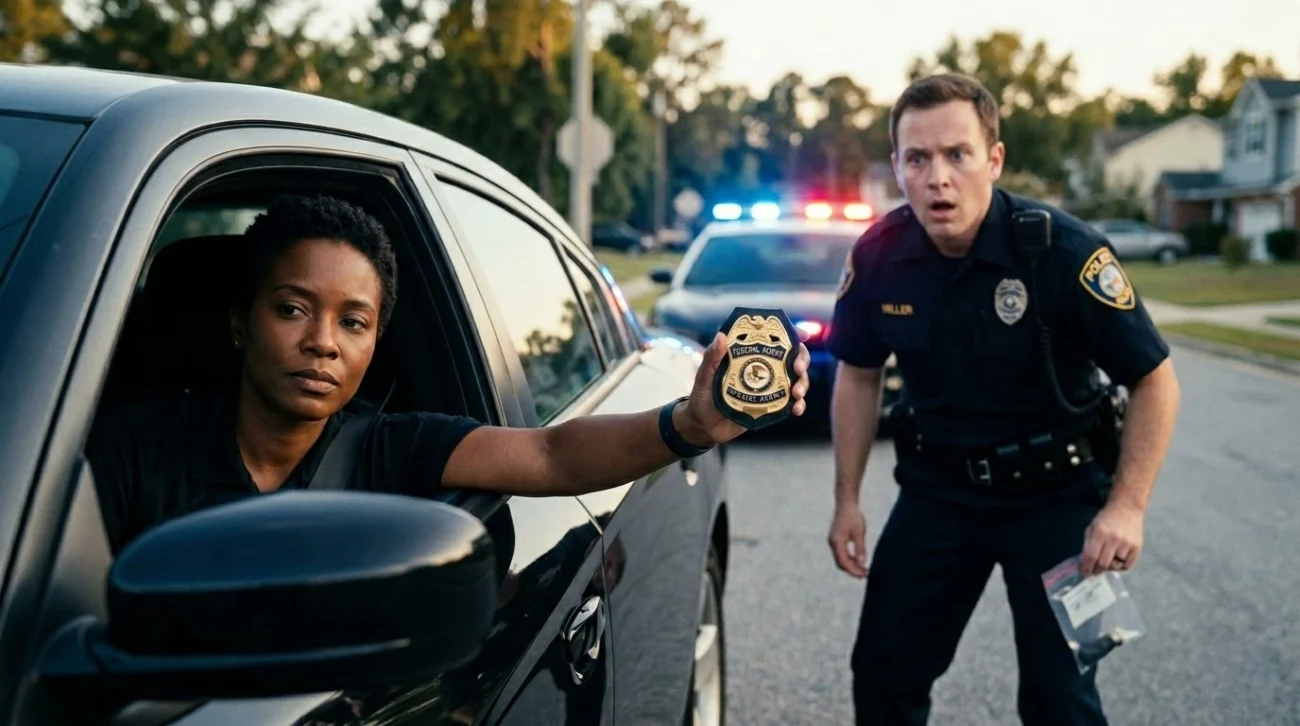
The red and blue lights hit Maya Carter’s rearview mirror at 4:47 in the afternoon.
She didn’t flinch.
She checked her mirrors, activated her blinker, and eased the black sedan onto the shoulder like she’d been expecting this exact moment for months.
Because she had.
Officer Daniel Reeves stepped out of the cruiser with the slow, unhurried ease of a man who believed he owned every road he patrolled.
He adjusted his belt. Let one hand drift near his holster. Smiled the kind of smile that wasn’t friendly.
Maya rolled her window down halfway.
“License and registration,” he said, not even pretending to look at her first.
She handed them over without a word. Her hands were steady.
“Was I speeding, officer?”
He didn’t answer. He was too busy scanning the inside of her car — the back seat, the center console, the space under the steering wheel.
Looking for a reason. Any reason.
“Step out of the vehicle.”
Maya kept her voice flat. “May I ask why?”
“Routine check.”
She almost smiled.
Routine. Sure.
She stepped out slowly, arms relaxed, posture straight. The afternoon air was cool and tasted faintly of diesel from the highway overpass nearby.
Reeves walked around the car like he was appraising it. Once. Twice. He made a small sound in the back of his throat, like a man working up to something.
Then he stopped at the driver’s side.
Leaned in without asking.
Without warning.
Maya’s jaw tightened. “What are you doing?”
No answer.
She stood still. She did not move. She did not speak.
Three seconds. Five. Eight.
Then Reeves straightened up.
In his hand: a small transparent pouch. White powder inside. Just enough to ruin someone’s life.
He held it up between two fingers, tilted it so it caught the light, and let the silence do its work.
“Well, well,” he said slowly. “Look what I just found under your seat.”
Cars passed. Wind moved. Somewhere behind the trees, a dog barked twice and went quiet.
The whole world seemed to pause.
And Maya looked at the pouch.
Then at him.
“You mean the bag you just hid there yourself?”
The smirk cracked. Just slightly. Just for a second.
Reeves blinked. Then he chuckled — a low, dismissive sound, the kind used to make people feel small.
“Careful with accusations.”
Maya took one step forward. Not aggressive. Deliberate.
“I don’t think you know who I am,” she said.
Something changed in the air. Nothing visible. Just a shift.
Reeves drew himself up. “And who exactly do you think you are?”
She didn’t answer right away.
Instead, she reached — slowly, deliberately — into her coat pocket.
Reeves snapped. “Hands where I can see them!”
She stopped mid-motion. Raised both hands, empty. Made sure he could see every finger.
“Relax,” she said quietly. “If I wanted to make a move, you wouldn’t see it coming.”
That wasn’t a threat.
It was a fact.
Reeves frowned. “You’re making this worse for yourself.”
“Am I.”
It wasn’t a question.
She reached back into her pocket — slower this time — and pulled out a small object.
A badge.
Not municipal. Not county.
Federal.
Reeves stared at it.
The blood left his face in stages, like the tide going out.
“My name is Maya Carter,” she said, and now her voice carried weight, the kind that came from years of being underestimated and having it on tape. “Internal Affairs. Federal division.”
Silence.
The flashing lights suddenly felt louder. More present. Less like a power move and more like a spotlight.
Reeves’ fingers tightened around the pouch.
“That’s…” he started. Stopped. Swallowed. “That’s not possible.”
“Why?” Maya tilted her head. “Because you didn’t check?”
His mind was running now. You could see it in his eyes — the fast calculation of someone trying to find a door that wasn’t there.
“No — no, this is — I can —” He looked up and down the road. Checking for witnesses. Checking for cover.
There was nothing.
“Go ahead,” Maya said softly. “Call it in.”
He hesitated.
That hesitation said everything he wasn’t going to say out loud.
Her gaze hardened. “Or should I?”
She reached into her other coat pocket and produced a small device, matte black, no bigger than a thick pen.
A bodycam.
The little red light had been blinking the entire time.
Reeves’ stomach dropped so fast he almost reached for the cruiser to steady himself.
“You see,” Maya said, “I’ve been tracking complaints out of this district for eight months. Unlawful stops. Evidence planting. Charges that somehow never stuck — because the DA knew something was wrong but couldn’t prove it.”
Each word landed clean.
“Three people lost jobs. One lost custody of her kids. Another spent sixty days in county before the case fell apart.”
Reeves opened his mouth. Closed it.
“And today,” she continued, “I decided to take a drive.”
She watched his face go through the full sequence — denial, calculation, anger, and then something that looked almost like collapse.
“This isn’t what it looks like,” he said. His voice had lost its ease. Now it sounded like a man reading from a script he’d memorized for someone else’s situation.
Maya didn’t blink. “It’s exactly what it looks like.”
“I can explain—”
“Please do.”
He had nothing.
The silence stretched for five seconds.
Ten.
Then — from down the road — the sound of engines. Moving fast.
Reeves’ head snapped up.
Two black SUVs came around the bend, unmarked, running no lights. They pulled up tight behind the cruiser and stopped.
The doors opened almost in unison.
Six people stepped out — four men, two women. Plain clothes. Focused. No wasted movement.
Federal agents.
Reeves stepped back instinctively, and the motion made him look small.
“Backup,” he muttered, like he was trying to convince himself.
Maya shook her head. “Not yours.”
One of the agents moved forward, badge out, voice even. “Officer Daniel Reeves. Step away from the vehicle. Hands where we can see them.”
Reeves turned to look at Maya.
The arrogance was gone.
What replaced it was something rawer. Younger. He looked, suddenly, like a man who had never actually considered that the worst could happen to him.
“You set me up,” he said.
Maya held his gaze.
“No,” she replied. “You did that yourself. I just made sure someone was there to see it.”
The agents moved efficiently.
One photographed the pouch where it now lay on the pavement — Reeves had dropped it without realizing it, his fingers opening on reflex.
Another bagged it carefully, labeling it with gloved hands.
A third approached Reeves with handcuffs already out.
“Don’t —” Reeves started.
The cuffs clicked.
The sound cut through the road noise, through the passing traffic, through everything.
Final.
As they led him toward one of the SUVs, Reeves kept looking back over his shoulder.
Not at Maya.
At the car. At the road. At the exact spot where he’d thought he’d had complete control of what was happening.
He couldn’t find the moment where it went wrong. That was the part that showed on his face — not just fear, but confusion.
Maya watched him go.
She’d seen that look before. The men who did what Reeves did always assumed that power ran in one direction. That a car on the shoulder was a situation they controlled. That a face looking up at them from a driver’s seat was just evidence waiting to be arranged.
They never checked who was in the car.
They never thought to.
One of the senior agents — tall, quiet, gray at the temples — walked over to her.
“You okay?”
“Yeah.” She exhaled slowly. “You get everything?”
He held up a tablet. The bodycam footage played back across the screen, crystal clear. Reeves leaning into the car. Reeves straightening. The pouch in his hand. His face when she showed the badge. All of it.
Every second.
“We got him,” the agent said. “Clean.”
“Good.”
Maya looked at the road for a moment. Quiet now. Just the normal sound of traffic two hundred yards away.
“How many complaints did we end up with? Final count?”
“Eleven confirmed victims. DA’s office is looking at the full case by end of week. Three of them may get convictions overturned.”
Maya nodded slowly.
She didn’t feel triumphant.
She felt tired, the way you feel when something that should have been simple took too long and cost too many people too much.
But underneath the exhaustion, something else was there.
Solid. Settled.
The kind of feeling that came from a thing done right.
She walked back to her car and opened the driver’s side door. Before she got in, one of the younger agents jogged over.
“Agent Carter.”
She turned.
“For what it’s worth,” he said, “what you did today — the setup, the months of work — a lot of us in the field wanted someone to finally go after Reeves.”
Maya looked at him for a moment.
“It shouldn’t have taken this long,” she said.
He nodded like he didn’t have an argument for that.
Because he didn’t.
She got in the car.
Started the engine.
Pulled back onto the road — no lights, no sirens, no fanfare — and let the suburban sprawl close back around her.
In her rearview mirror: two SUVs, a cruiser, a team doing their jobs, and the slow careful work of consequence catching up.
She didn’t watch for long.
There was already another case file open on her laptop back at the office.
Another district.
Another pattern of complaints that nobody higher up seemed to want to look at too closely.
Maya Carter had a way of looking at things others didn’t.
She’d been doing it for eleven years.
She wasn’t done.
Three weeks later, a judge signed off on the formal charges.
Daniel Reeves was indicted on six counts — evidence tampering, civil rights violations, perjury, and two counts of filing false police reports. His partner of four years, who had covered for him on at least three documented incidents, was placed on administrative leave pending a parallel investigation.
The DA announced a review of every arrest Reeves had made in the last three years.
Forty-one cases.
Forty-one people.
Some of them heard the news on their phones while standing in their kitchens, or sitting in parking lots, or lying awake in apartments they’d moved to after everything had fallen apart.
One woman — the one who’d lost custody — sat at her kitchen table and cried for a long time.
Not because it fixed everything.
It didn’t.
But because someone had finally looked.
And this time, the truth didn’t get buried.
Original fictional stories. AI-assisted creative content.
