
The afternoon heat hit like a wall the second you walked into the Dusty Creek Rodeo Arena.
It was a Wednesday in July, and the bleachers were packed anyway. In this part of Texas, Wednesdays didn’t matter. Heat didn’t matter. What mattered was the show.
And today’s show had a name.
Diablo.
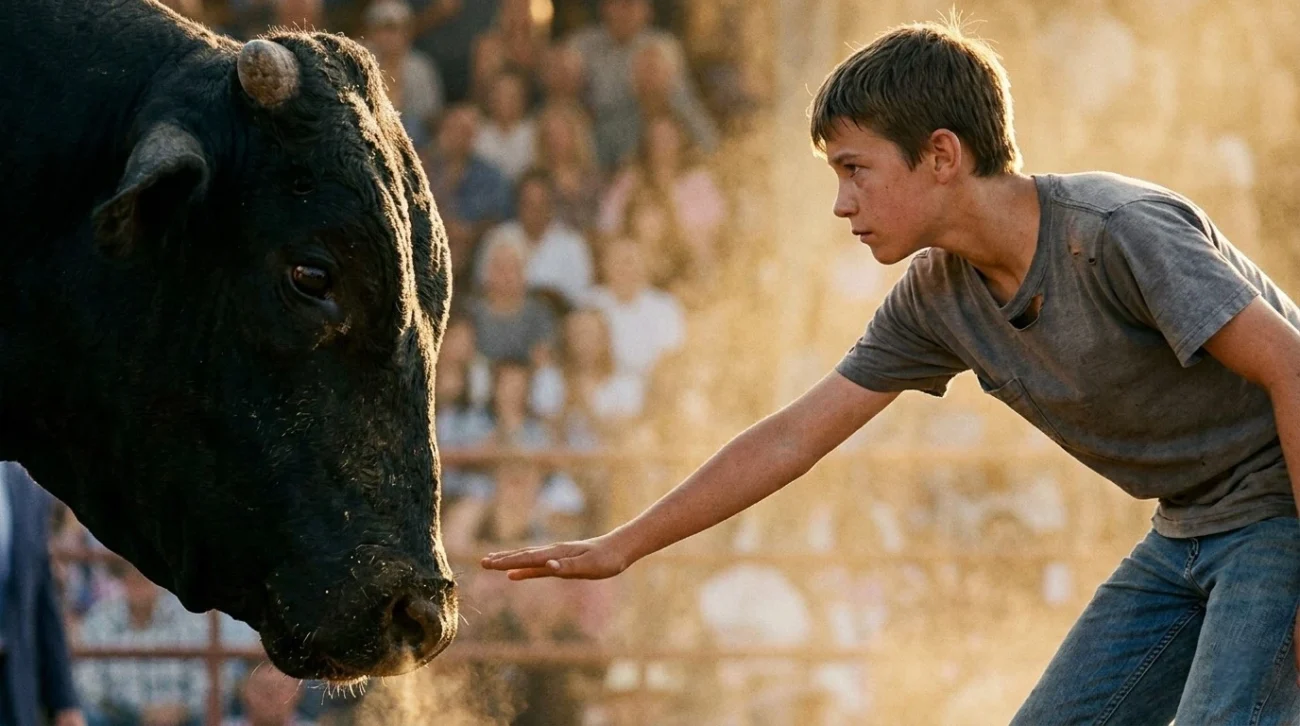
The bull stood at the far end of the dirt floor like something carved out of anger. Black hide. Thick neck. Horns that curved sharp and low. He wasn’t pacing the pen — he was daring it. Every stomp sent a little cloud of dust rising around his hooves like something biblical.
People had been talking about Diablo for eighteen months.
Three professional riders. Two airlifted. One who still walked with a cane and wouldn’t talk about it.
No one had lasted eight seconds.
The man in the suit appeared near the main gate around two in the afternoon.
Nobody knew who he was at first. But he was impossible to miss — navy jacket, pressed slacks, shoes that didn’t belong anywhere near a dirt arena. He carried a thick envelope in one hand and walked with the kind of calm that said he’d already calculated every risk and decided it didn’t apply to him.
He stopped in the center of the floor.
Diablo watched him from thirty yards away and didn’t even blink.
The man raised the envelope above his head. Slowly. Like a priest with an offering.
“One hundred thousand dollars.”
His voice carried clean across the arena. No microphone needed.
The crowd stirred instantly.
“One hundred thousand,” he repeated, “to the man who can tame this animal. Or defeat him. Either way — I pay.”
For a second, nobody moved. Then everyone started looking at everyone else. Old cowboys. Young ones. Men who’d ridden bulls their whole lives, who had the broken fingers and the crooked noses to prove it.
Nobody stepped forward.
“Come on,” the suited man said, a faint smirk pulling at his mouth. “A hundred thousand. Cash. Today.”
Still nothing.
A vendor selling peanuts actually laughed. “Guess that money’s staying in the envelope.”
Then the fence rattled.
A loud, metallic clang that made everyone look left.
A boy dropped down from the railing onto the dirt floor.
Fourteen, maybe. Could’ve passed for twelve. Faded jeans, a gray t-shirt with a small tear at the collar, worn sneakers that had seen better years. He was thin in the way kids are when they’ve grown up on not-quite-enough.
The laughter started almost immediately.
“Oh, this oughta be something—”
“Somebody call his mama—”
“Kid, the playground’s on the other side of town—”
The suited man stared at the boy. His smirk flattened into something more like confusion.
“Son,” he called out. “I think you misunderstood the situation.”
The boy didn’t answer.
He dusted his hands off on his jeans — a weirdly adult gesture — and started walking toward the center of the arena.
Straight toward Diablo.
The laughter started dying about ten seconds in.
Not because anything dramatic happened. Just because of the way the boy moved.
He didn’t shuffle. He didn’t hesitate. He walked like he already knew the layout of every inch between him and that bull, like he’d walked it a hundred times in his head before he ever jumped that fence.
Diablo noticed him.
The bull’s massive head turned. His ears flicked forward.
He stopped pawing the ground.
“Hey—” someone in the stands said, quieter now. “What’s he doing?”
“No idea.”
“Somebody stop him—”
But nobody moved to stop him, either. Nobody could seem to look away.
The boy stopped about fifteen feet from Diablo.
The two of them just looked at each other.
The bull was three times the boy’s weight, easy. Maybe four. His horns alone were longer than the kid’s arm.
Diablo scraped one hoof slowly through the dirt. A warning. The kind that usually sent people scrambling for the fence.
The boy raised his right hand.
Not high. Not dramatic. Just up, palm forward. Slow and steady, like he was saying hold on to someone he knew.
The whole arena held its breath.
“He’s insane,” a man behind the peanut vendor said.
“He’s gonna get killed,” a woman said, pulling her son closer like she could protect him from just watching it.
Diablo charged.
The ground shook. Four seconds, maybe five, from dead still to full thunder. Dust erupted in a wall behind him. People screamed.
The boy didn’t run.
At the last possible second — the kind of moment that exists in fractions — he stepped to the right. Not a leap. Not a frantic dive. A single, precise step, shifting his weight just enough.
Diablo hammered past him, horns slicing through the space where the boy’s chest had been a half-second before.
The bull skidded. Turned. Angrier.
“He’s DEAD—” someone started—
But the boy was still standing.
Still breathing steady.
Still watching the bull like he was reading a slow sentence.
Diablo charged again.
Same result.
The boy moved sideways — fluid, unhurried — and the bull stormed past him again.
And again.
Four times. Five.
Each dodge was a little different. A step left. A pivot. Once, the boy actually leaned back slightly and let the horn graze his shirt, close enough to tear the fabric, and the crowd made a sound that wasn’t quite a scream and wasn’t quite anything else.
“Is he — is he playing with it?” the peanut vendor said.
The suited man had stopped smiling entirely. He was standing very still, watching, the envelope still in his hand but forgotten.
After the sixth charge, something changed.
Diablo pulled up short.
The bull was breathing hard. Not from weakness — from confusion. Every charge had connected with nothing. Every roar had met silence. The thing he was built to destroy kept just… not being where it was supposed to be.
He stood still, watching the boy.
The boy stood still, watching him back.
Nobody in the arena moved.
Then — slowly — the boy started walking toward the bull.
Not away. Toward.
“No—” someone whispered.
“Don’t—”
“Kid, what are you—”
The man in the suit took a half-step forward. “Son—”
The boy didn’t look at him.
He kept walking.
Eight feet from the bull. Six. Four.
Diablo’s muscles were coiled, all that weight balanced on the edge of another explosion. His nostrils flared. His head dropped low — the position right before a charge.
The boy stopped.
He raised his hand again. Same as before. Slow. Calm.
And then he leaned his head slightly to the side and said something.
Nobody heard it. Not a word. Not a syllable. Whatever he said was between him and the bull and the dust and the heat.
Diablo went still.
Not frozen. Not shocked. Still. The kind of still that’s the opposite of tension — the kind that comes from something releasing.
The bull’s head dropped lower.
His breathing slowed, visibly. The enormous ribcage expanding and contracting slower. Slower.
The boy placed his hand gently on the side of Diablo’s face.
And the bull just stood there.
A five-second silence fell over the Dusty Creek Rodeo Arena that people would try to describe for the next ten years and never quite get right.
It wasn’t applause. It wasn’t cheering.
It was the sound of five hundred people realizing they’d just seen something they didn’t have a word for.
The boy stood with his hand on Diablo’s head for a long moment.
Then he stepped back.
He turned and walked toward the fence.
That’s when the arena finally broke open.
The noise was enormous — cheering, shouting, people on their feet, strangers grabbing each other’s arms. A woman two rows up from the gate burst into tears and couldn’t explain why.
The suited man found his voice again. “Wait—” He started moving through the crowd toward the fence. “Wait! Son — you — that’s — the money is yours, hold on—”
The boy had already reached the railing. He paused at the top of the fence and looked back.
Not at the man with the envelope.
Not at the crowd.
At Diablo.
The bull hadn’t moved. He was still standing in the same spot, head low, calm.
The boy looked at him for a moment. Something passed across his face — not pride, exactly. More like recognition. Like seeing something familiar in a place where you didn’t expect to find it.
Then he dropped down the other side and disappeared into the noise.
The suited man pushed through the crowd for four full minutes before he had to admit the boy was gone.
He grabbed a nearby arena worker — a weathered guy in his fifties with a clipboard. “The kid. Did you see where he went?”
The worker shook his head slowly. “Nope.”
“He lives around here? You know him?”
“Never seen him before today.”
The man stared at the fence where the boy had been. The envelope was still in his hand. A hundred thousand dollars in cash, and nobody to give it to.
“He didn’t even ask,” the man said, mostly to himself. “He didn’t even look at it.”
The worker squinted at him. “Mister, I been doing rodeos for thirty years.” He paused. “That kid didn’t come in here for the money.”
“Then what did he come in here for?”
The worker watched Diablo, still calm in the center of the arena, still standing in that same spot.
“Beats me,” he said. “But whatever it was, I think he found it.”
Three weeks later, a rodeo journalist named Carla Briggs drove down from Dallas to write a piece on what she was already calling “the Diablo incident.”
She interviewed twelve people who’d been in the stands that day.
Every single one described it differently.
Some said the boy looked scared and hid it well. Others said he looked like he’d never been scared a day in his life. Some said Diablo charged at least eight times. Others counted four. One man swore the boy whispered to the bull in Spanish; another swore it was English; a third said it didn’t sound like words at all, just sound, just tone.
The one thing they all agreed on?
The silence.
“When that kid put his hand on that animal,” one woman told Carla, “the whole arena just — stopped. You know how sometimes you hear something so loud it feels quiet? Like that.”
Carla’s article ran on a Tuesday. By Thursday it had half a million reads.
By the following Monday, the suited man — whose name turned out to be Gerald Hatch, regional director of a livestock investment firm — had given three interviews about the incident. In all three, he said the same thing:
“I’ve been in this business for twenty years. I have never seen anything like that. And I offered a hundred thousand dollars and he just — walked away. I still don’t understand it.”
Nobody ever figured out who the boy was.
There were theories, of course.
A rancher’s kid from one of the properties out past Route 7. A runaway. Someone’s nephew visiting from out of state. A couple of people even said they’d seen him before — at a livestock auction in Abilene, a county fair in Odessa — but the details never matched up enough to matter.
One thing did surface, about two months after the incident.
A woman named Rosa Vega, who ran a small cattle operation twenty miles east of Dusty Creek, told a friend that she thought she knew the boy. Said there was a kid — her neighbor’s son — who had a way with animals that she’d never seen explained. Said he used to sit with sick cattle in the middle of the night, and in the morning they’d be calmer. Said he’d once walked up to a horse that had thrown three riders and put it to sleep in under a minute.
She said his name was Cody.
She said she hadn’t seen him in a while.
She didn’t say more than that, and the friend didn’t push.
At the Dusty Creek Arena, things went back to normal pretty quickly.
Diablo was retired from competition two weeks after the incident. The arena’s owner said the bull had “lost his fight,” though the vet who examined him found nothing physically wrong.
Gerald Hatch kept the envelope for a while. Then he donated the money to a youth rodeo training program in the county. He never explained why, and nobody asked.
The fence where the boy had jumped? Someone scratched a small X into the metal railing. Nobody admitted to putting it there.
Every rodeo season, somebody pointed it out to somebody else.
That’s where he jumped.
Yeah, I know.
You believe it?
And the answer, always, was the same.
I was there. So yeah. I do.
Because here’s the thing about what happened that Wednesday in July.
It wasn’t about the bull.
It wasn’t about the money.
It wasn’t even really about the boy.
It was about the moment — the one suspended second where five hundred people saw something they couldn’t explain and stopped trying to explain it and just felt it instead.
The world is loud. It crowds in fast. It fills every silence before you can notice the silence was there.
But for about ninety seconds in the middle of a dusty Texas arena, everything went quiet.
And a fourteen-year-old kid in a torn gray shirt stood in the center of it and didn’t flinch.
Sometimes that’s all it takes.
Sometimes understanding is the thing that looks the most like nothing — and turns out to be everything.
Gerald Hatch still has the video on his phone.
He watches it sometimes, late at night when the noise won’t stop.
And every time it gets to the end — the boy’s hand on the bull’s face, the silence, the stillness — he does the same thing he did the first time he saw it live.
He just stops.
And breathes.
Original fictional stories. AI-assisted creative content.
