
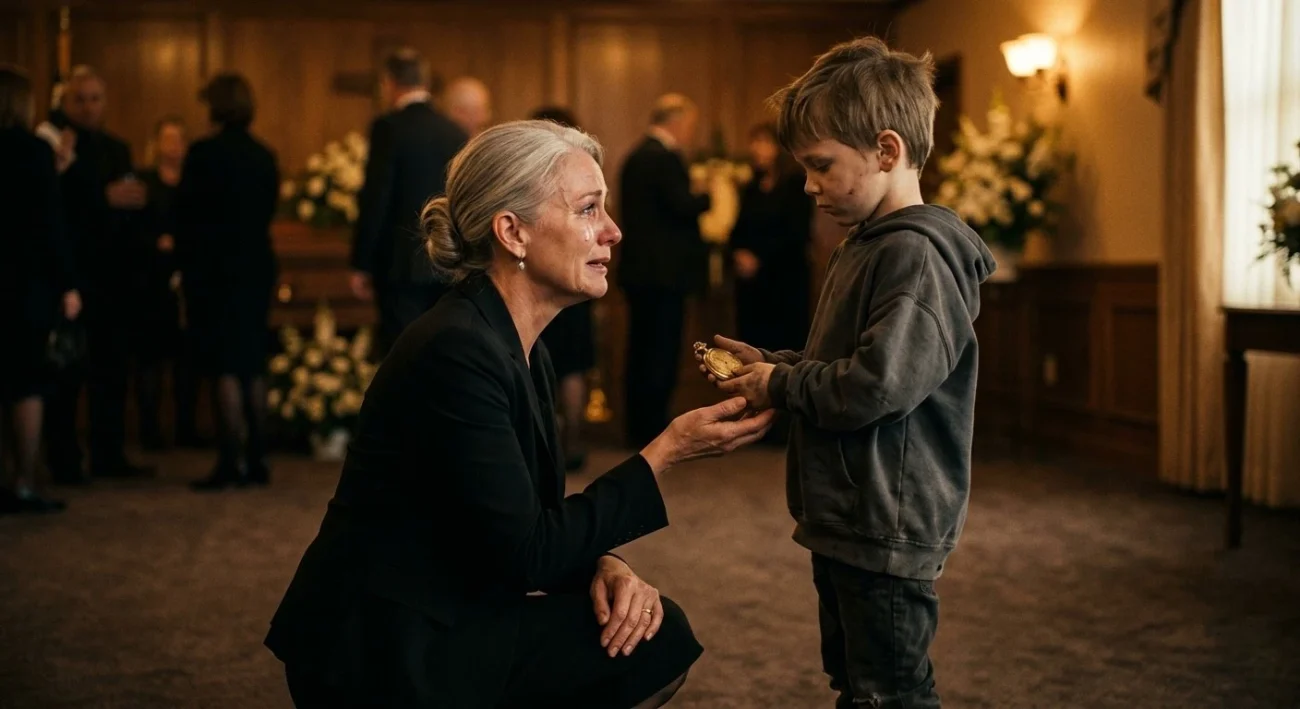
The funeral home was silent in the way that made you feel watched.
Margaret Calloway stood near the casket, hands folded, nodding at the right moments as relatives pressed her arm and murmured things she’d stopped hearing an hour ago. Her brother Richard lay perfectly still in the mahogany box. Looking more put-together in death than he ever had in life.
She was doing fine. She was composed.
Then the boy walked in.
He couldn’t have been older than six. His dark hoodie was two sizes too big. His sneakers were worn down to almost nothing. There was actual dirt on his face — not a smudge, but the kind of grime that doesn’t come off with one wash.
He stopped at the entrance and looked around the room like he was memorizing it.
Then his eyes found Margaret.
He walked straight to her.
“Excuse me,” the funeral director said quietly, stepping forward. “Is this child with someone?”
“He’s with me.” Margaret said it before she understood why.
The director backed off. The boy stood in front of her, very still, looking up with eyes that were unnervingly calm for his age.
“He said if he died,” the boy said, “you would take me.”
Margaret felt the room tilt slightly.
“I’m sorry?”
“He said you would take me.” The boy didn’t raise his voice. He wasn’t performing anything. He was just stating a fact and waiting to see what she would do with it.
“Who said that?”
The boy looked at the casket.
Margaret followed his gaze. Back to the boy. Back to the casket.
“What is your name?”
The boy didn’t answer. Instead, he reached into the front pocket of his hoodie and pulled out a folded funeral card — the kind they print at these services, with the photo and dates on the front. He held it out.
She took it.
On the back, in handwriting she recognized immediately — Richard’s cramped, leftward-slanting scrawl — were six words:
Give him the watch she hid.
Margaret’s hand went cold.
“Where did you get this?”
“He gave it to me.” The boy said it simply. “Three weeks ago.”
Three weeks.
“He found me,” the boy added, reading her face. “He came to the shelter. He said he’d been looking for me for a long time.”
Margaret looked at the boy carefully for the first time.
The shape of his jaw. The slight downward tilt of his head when he was thinking. The way he held absolutely still when he was frightened, as if stillness could protect him.
Richard used to do that.
“What happened to your mother?” she asked, and her voice came out quieter than she intended.
“She died last winter.”
A sound escaped her. Not quite a word.
“He said I’m all that’s left.”
Margaret turned away from the room and faced the window. Outside, a parking lot. A gray sky. Two pigeons on a bare-branched tree.
She had been seventeen years old when Richard fell in love with a girl named Dara. Poor. Young. Working at a diner on Route 9. Their mother had called it a phase. Their father had called it worse.
When the pregnancy came to light, it hadn’t been a conversation. It had been a verdict. Money was routed through a family lawyer. Dara was quietly encouraged to relocate. The whole situation was sealed like an envelope and no one discussed it again.
Margaret had not argued. She had told herself she was protecting her brother. Protecting the family.
She had taken the gold watch — their father’s watch, engraved with the family name and the words For my son — out of Richard’s apartment the night he signed the paperwork. She couldn’t destroy it. But she couldn’t let him keep it either. Not then. Not when everything was being so carefully erased.
She had told herself she would give it back someday.
Someday became twenty years.
She reached into her black handbag.
The velvet pouch was there, where it had been all morning. She hadn’t known why she’d brought it today. She understood now.
She turned back to the boy and crouched down to his level.
“What’s your name?” she asked again.
“James,” he said. “James Dara Calloway.”
Calloway. He had his mother’s name in the middle and his father’s name on the end. Dara had given him both.
“James.” Margaret opened the velvet pouch and placed the watch in his small, dirty hands. “Your grandfather left this for your father. And your father should have given it to you a long time ago.”
The boy looked down at the watch. Turned it over. Found the engraving.
His lips moved slightly as he read it.
He didn’t cry. He just held it the way children hold things they don’t fully understand yet but know are important.
“Does this mean you’ll take me?” he asked.
Margaret looked at him. At his face, which was so much her brother’s face that it almost hurt to look at directly. At the worn shoes and the oversized hoodie and the way he was trying so hard not to hope too much.
She stood. Took his free hand.
“Go tell the director you need a glass of water,” she said. “Then come back. We have some things to talk about.”
She watched him cross the room — small, deliberate, steady.
Then she took out her phone and called her attorney.
“David. I need to start guardianship paperwork. Today.” She paused. “Yes, today. His name is James Calloway. He’s six years old. He’s Richard’s son.” Another pause. “I know what that means. That’s why I’m calling you first.”
She hung up before he could ask more questions.
The room was still full of relatives in black. The lilies still smelled too sweet. The casket was still closed now, the service nearly over.
But something had shifted in the room’s weight — the way a balance tips when the last piece is finally placed.
James came back with his water, climbed into the chair beside her, and sat the way she was sitting: straight, quiet, watching.
Margaret Calloway had spent forty years being good at the wrong things.
She wasn’t going to make that choice again.
Original fictional stories. AI-assisted creative content.
