
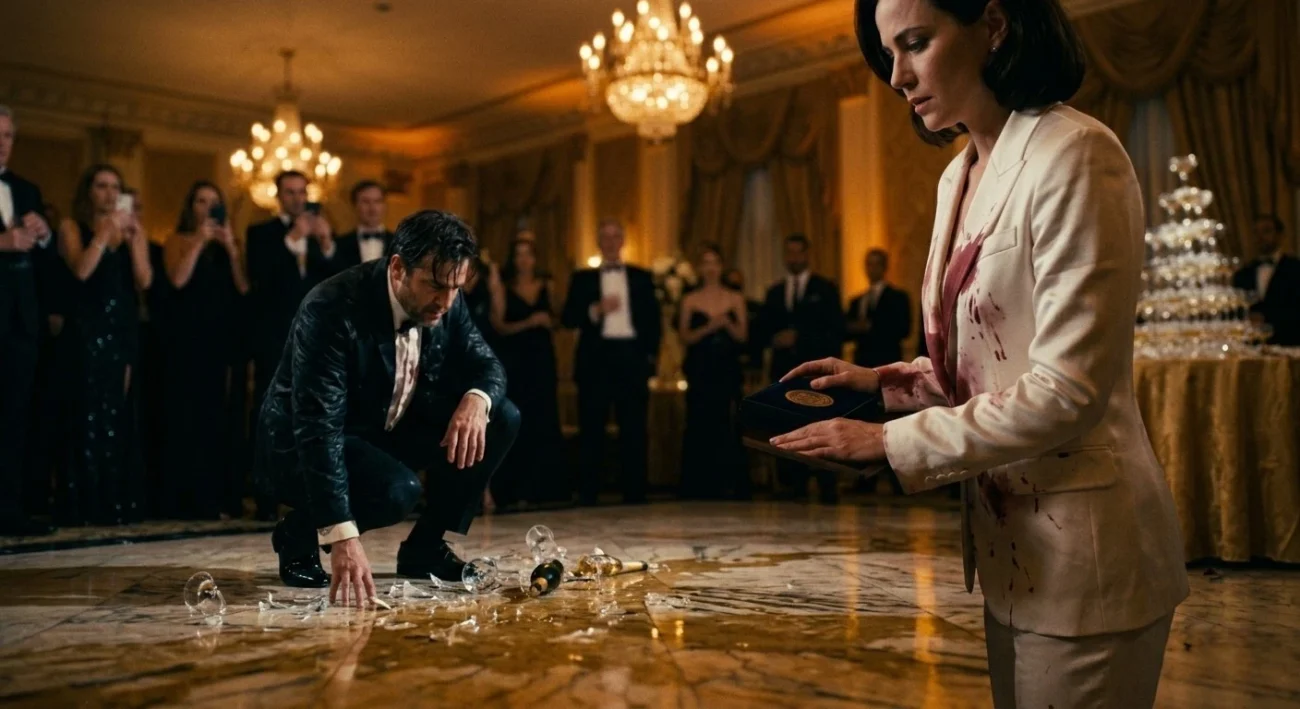
The ballroom of the Harborview Grand was the kind of place that made people behave differently. Gold chandeliers, a twelve-piece orchestra, plates that cost more than rent. Tonight it hosted the Meridian Capital Annual Gala — two hundred investors, thirty board members, and one woman nobody bothered to learn the name of.
Sarah Voss stood near the far end of the reception table in a white silk dress, studying the room the way a chess player studies a board. She was holding sparkling water, not champagne. She never drank at these things.
She was there to watch.
She had been watching for three years.
The first blow came without warning.
A sharp crack of glass, a rush of cold, and then — red.
Wine exploded across her chest, saturating the silk from shoulder to waist in one violent bloom of crimson. The gasp that rippled through the room was almost musical.
Cynthia stood beside her, hand still curled around the now-empty wine flute, smile already in place. “Oops.”
It was the kind of oops that meant the opposite.
Julian appeared at Cynthia’s shoulder, adjusting his cufflinks, and tossed a fistful of cloth napkins directly at Sarah’s chest. They hit her and fell to the marble in a sad pile.
“Clean it,” he said, already turning away.
The orchestra played one more bar. Then it stopped.
The room had developed that particular silence — the one that forms when polished people are weighing whether to intervene or pretend they saw nothing. Three hundred people leaned slightly toward the second option.
Sarah looked down at the napkins on the floor.
She crouched slowly and picked one up. Held it for a moment.
Then opened her fingers and let it fall again.
“No.”
She turned and walked toward the stage.
Her heels hit the marble in clean, deliberate cracks — the sound of someone not rushing, not fleeing, not performing. Just moving with a destination.
Julian processed this a half-second too late.
“Sarah—” He stepped after her, voice dropping to a controlled hiss. “You can’t go up there. I’m serious. Stop.”
She didn’t stop.
She climbed the three carpeted steps to the executive stage, reached the center podium, and lifted the microphone from its stand.
The feedback scream tore through the ballroom.
Every conversation dissolved. Every face turned. Servers froze mid-pour.
Julian had made it to the base of the steps. He stopped there, jaw tight, visibly recalculating. Going up those stairs now, in front of three hundred people and their phones, would be its own disaster.
He stayed at the bottom.
Sarah waited for the room to fully settle. She had learned patience from three years of watching men like Julian assume that waiting was surrender.
“Good evening.”
Her voice through the speakers was calm and unhurried, the way a surgeon’s hands are calm — not because nothing is at stake, but because everything is.
“Many of you were just introduced to me by Julian Mercer as his executive assistant.”
A pause.
“That’s incorrect.”
From the front table, something happened that no one expected.
Maxwell Reid — chairman, founder, the name on the building — set down his champagne glass. Then, slowly and deliberately, he brought his palms together.
Once.
Twice.
He didn’t look at Sarah. He looked at Julian.
Julian went very still.
Sarah glanced at Maxwell. He gave her the smallest nod — the kind that meant go ahead, we always knew this moment was coming.
She turned back to the room.
“I’ve attended this gala for three years. Every year, Julian has introduced me differently. Last year I was his ‘scheduling coordinator.’ The year before that, ‘his team.’ Tonight I became the nanny.” She let the word sit. “I want to correct the record.”
She reached into the inner pocket of her ruined jacket — she’d worn a blazer over the silk, knowing she’d need the pocket — and produced a gold keycard folder. She held it up slowly, the way you hold something you’ve been carrying for a very long time.
Cynthia, three tables back, said, “What is that?”
Sarah opened the folder.
Inside: a packet of documents — share certificates with a court seal, a merger authorization letter on Meridian Capital letterhead, and at the bottom, a signature page bearing Maxwell’s initials next to a title.
She read it aloud.
“Controlling shareholder. Fifty-one percent. Executed and notarized fourteen months ago.”
The room tried to process this.
Julian found his voice first. “She’s lying.” He said it too quickly, too loud. It filled the wrong kind of space. “This is a stunt. Those documents are fabricated — whatever she’s shown you—”
“Then explain the forgeries.”
The room stopped again.
Sarah produced a second document — a side-by-side comparison, printed on card stock, laminated. Her signature as it appeared on three years’ worth of operational contracts Julian had submitted to the board. Her actual signature, notarized and witnessed, from her personal legal file.
“Three years. Forty-one documents. Each one submitted to this board with my name on it.” She looked directly at Julian. “None of them signed by me.”
Phones were in the air now. Board members had left their tables and were drifting toward the stage like the gravity had shifted in the room.
Julian moved forward. “You can’t just—those are internal documents, you can’t publicly—” He reached for the papers.
Two men in dark suits materialized between him and the stage. Maxwell’s security. They hadn’t moved quickly. They hadn’t needed to.
Julian stopped.
He stood very still, breathing through his nose, looking at the men, then at Maxwell, then at Sarah. And in his face was the particular expression of someone watching a plan they’d had for years reach its expiration date in real time.
Cynthia had gone pale.
She’d drifted closer to the stage during all of this, pulled forward by the same reflex that makes people slow down at accidents. Now she was close enough for her voice to carry.
“Who are you?” she whispered.
It wasn’t hostile anymore. It was genuine. The way someone asks when the ground has moved and the map no longer matches.
Sarah looked at her.
“Three years ago, Meridian Capital was in a restructuring crisis. My father’s estate held the controlling block of shares. I was named in the trust as the acting authority pending resolution.”
She paused.
“Julian was retained as interim CEO to manage operations while the trust cleared probate. His directive was to run the company, report to me quarterly, and execute no major decisions without my countersignature.”
She held up the stack of forged documents one more time.
“He chose a different approach.”
Cynthia’s mouth opened slightly. Then: “Your father was—”
“David Voss.” Sarah said the name like she’d said it ten thousand times and was done performing around it. “Founder. Majority shareholder. My father.”
The ballroom detonated.
It wasn’t screaming — it was the sound of three hundred people talking simultaneously, a kind of roar that builds from whispers. Board members clustered in threes. Investors pulled out their phones and started making calls, stepping away from tables, moving toward corners and exits and each other.
Julian stepped backward.
He didn’t mean to, probably — it was an involuntary step, the kind the body takes when something large moves toward it. His heel caught the bottom tier of a champagne tower that had been sitting, gleaming and untouched, at the edge of the main display table.
The tower went.
The sound it made was extraordinary — a cascading, crystalline collapse, dozens of flutes shattering and rolling across marble, champagne spreading in a wide, glittering pool. Julian stood in the middle of it, shoes soaked, surrounded by broken glass, looking like a man who had just watched his entire life’s work pour across a ballroom floor.
Nobody moved to help him.
Cynthia took a step backward, distancing herself with the practiced speed of someone used to reading which way a situation is falling.
Maxwell climbed the stage steps slowly, without hurrying, the way he did everything. He was seventy-one years old and had built two companies from nothing and he moved through the world like someone who had nothing left to prove and found that restful.
He carried a flat velvet case — the kind used for the company seal and formal instruments of office.
He set it on the podium in front of Sarah.
“I owe you an apology,” he said quietly. Not into the microphone. Just to her. “I should have moved on this eighteen months ago.”
“You moved when it mattered,” Sarah said.
“Later than that.” He opened the case. Inside was the embossed company seal and a formal letter of authority, already signed, transferring operational chairmanship. “Chairwoman,” he said. The word was simple and complete.
Sarah picked up the seal.
She held it the way her father used to hold it — she’d seen him do it once, when she was eight, at a ribbon cutting she’d been brought to because her mother was traveling. He’d held it with both hands and looked at it like it was a living thing that required care.
She held it the same way now.
Then she looked down at Julian.
He was still in the wreckage of the champagne tower, crouching now, trying to find somewhere stable to put his hands. His tuxedo was ruined. His face had gone past red into something quieter and worse — the color of someone who understands that the version of their life they were living no longer exists.
Sarah let the silence hold for exactly as long as she wanted it to.
Then she said, clearly, with no malice, no satisfaction, just the plain factual weight of a full circle closing:
“Now clean it.”
Julian’s lawyers arrived at the Harborview Grand at 10:47 PM, forty minutes after the gala ended.
They were too late for the room. The board had already voted an emergency interim resolution authorizing Sarah’s operational authority pending full legal review. Maxwell’s team had photographed every document. The forgery comparison had been sent to three independent forensic firms before dessert was served.
Julian was escorted from the building at 11:15, not by police — not yet — but by Maxwell’s security team, and by the wordless consensus of a room that had already made its decision.
Cynthia left alone.
She paused once at the exit, turning back, looking at Sarah on the stage — still there, going through documents with two board members and Maxwell’s general counsel. Sarah didn’t look up.
Cynthia left.
The morning headlines took the story that had already started leaking from three hundred phone videos and made it into something permanent. Meridian Capital Chairwoman Revealed at Annual Gala. Former CEO Faces Forgery Investigation. Three Years of Fraudulent Filings Under Review.
Sarah read the coverage at her father’s old desk — now her desk — in the executive office on the forty-third floor, with a cup of coffee and the city visible through floor-to-ceiling glass, and said nothing out loud because there was nothing left to say.
The story had told itself.
She set down the paper, picked up the company seal, and got to work.
Original fictional stories. AI-assisted creative content.
