
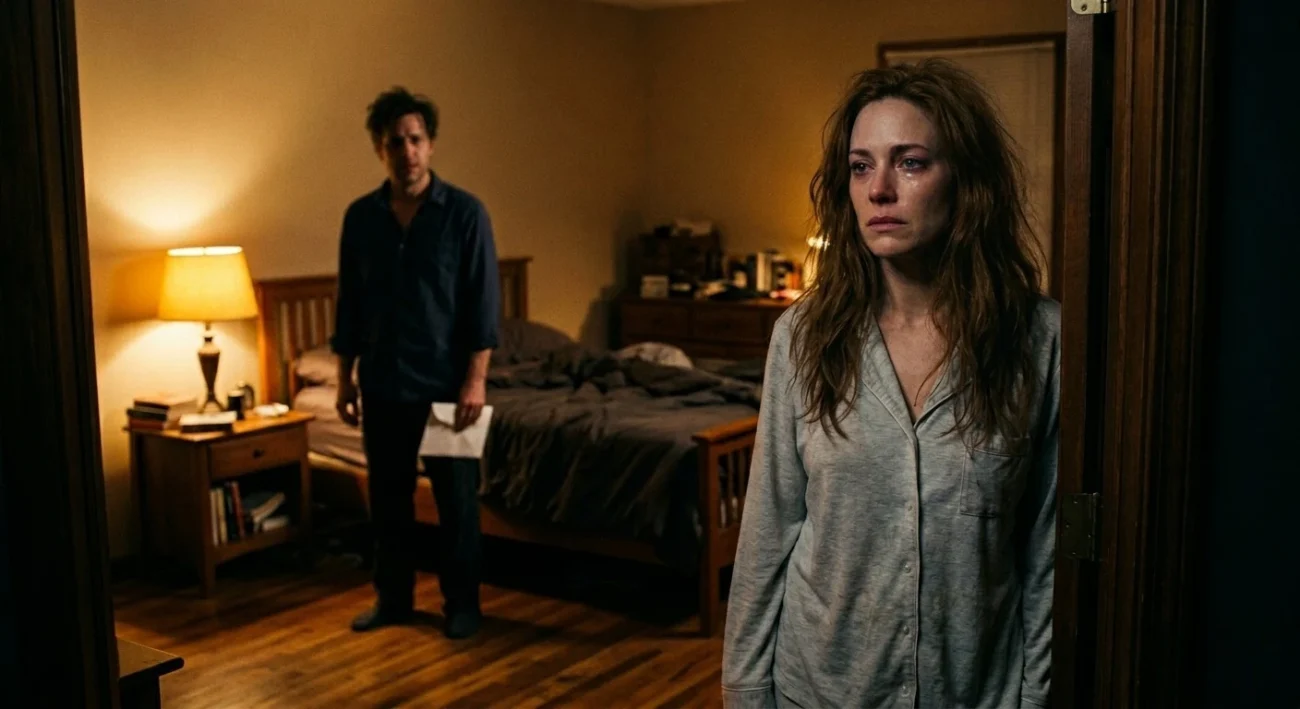
The house was silent.
Only the low hum of the bedside lamp kept the darkness company. Elena had woken to whispers — small, urgent, wrong — and now she stood barefoot in the hallway, fingers pressed against a half-open door, not breathing.
Inside the bedroom, her husband sat on the edge of the bed.
Too close to his mother. Too tense. Too quiet.
“I can’t do this anymore, Mom,” he said, his voice cracking. “I don’t know how long I can keep pretending.”
Elena’s whole body went cold.
Pretending.
A tear slid down her cheek before she could stop it. Her fingers tightened on the wood.
His mother raised a sharp hand. “Lower your voice,” she whispered. “You’ll wake her.”
Her. Not Elena. Not her name. Just her. Like she was a problem sleeping in the next room.
Elena’s lips moved but no sound came out. She leaned closer to the door, terrified and desperate at the same time.
Her husband dragged a hand over his jaw. He looked like a man standing at the edge of something he couldn’t survive. Then he looked at his mother and said — more firmly this time — “Maybe it’s time she wakes up.”
Another tear fell.
Elena’s mind scattered through every memory she’d built her life around. Every soft morning, every promise, every night he’d held her face in his hands and told her she was safe.
Was it all borrowed? Was it all constructed?
Her bare foot shifted.
A tiny creak cut through the silence.
His mother’s eyes snapped toward the door.
Elena gasped.
The door swung open.
She stood there trembling, face wet, hand still frozen against the frame. For one brutal second, no one moved.
Her husband shot up from the bed like a man caught in a fire. His mother rose slower — not guilty, not ashamed — defensive. Like Elena had committed the crime.
Elena looked only at him.
“Pretending what?” she whispered.
He opened his mouth. Nothing came out.
That silence hurt more than any word could have.
His mother stepped forward first, chin lifted, voice controlled. “You were never supposed to hear any of this.”
Elena turned to her slowly, stunned.
Then back to him.
He still couldn’t meet her eyes.
Finally, like a man dragging himself over broken glass, he spoke.
“At first,” he said, “I was pretending to love you.”
The room tilted.
Elena’s breath caught in her throat. She swallowed the sob before it surfaced, but her hands shook at her sides.
His mother moved closer to him — not to comfort, but to guard. To protect the architecture of the lie she had built.
“I told him to do it,” she said, cold and clinical. “You were too fragile. You needed stability. You needed this house. Someone to anchor you.”
Elena stared at her. “You arranged this.”
“I made a decision for the good of —”
“For the good of what?” Elena’s voice broke open. “I was a person, not a project.”
His mother pressed her lips together and said nothing.
Elena turned back to her husband. He was crying now — quietly, the way men cry when they’ve been holding something too long.
“I did pretend,” he said. “In the beginning. I want you to know that — I’m not going to lie to you anymore. I did.”
“Then what is this?” Elena asked, her voice almost gone. “What are we?”
“Something I chose,” he said. “Not something I was told to do.”
“That’s easy to say now.”
“I know.” He took one careful step toward her. Then another. Like he was walking across something fragile. “I know it means nothing if you don’t believe it.”
His mother’s voice cut sharp between them. “Don’t do this. You’ll destroy everything we built.”
He turned to her — and this time his jaw was set. This time the guilt was gone and something harder had taken its place.
“No,” he said quietly. “You built it. I’m done carrying it.”
His mother blinked. She hadn’t expected that.
Neither had Elena.
He faced Elena again, and his voice dropped to almost nothing.
“I stayed,” he said. “I stayed even when I could have left. Even when she told me to. I stayed because somewhere in the middle of all of it, I stopped pretending.”
Elena’s throat ached.
She wanted to believe him. Every part of her wanted to believe him.
But wanting and believing are different things, and she knew it.
“She said I still don’t know why you married me.” Elena’s voice barely held. “So tell me. Why did you?”
His mother stepped in fast. “Don’t.”
“Mom.” His voice came down like a door closing. Final. Quiet. Absolute. He looked at his mother for a long beat, and what passed between them was twenty years of obedience running out.
Then he looked at Elena.
“Because she told me you were going to inherit your grandmother’s house,” he said. “The property on Miller Lane. She wanted me inside that family before the will was finalized.”
The air went out of the room.
Elena’s mind went still — the particular stillness of a person who has just understood everything at once.
The house on Miller Lane.
Her grandmother’s house. The one she’d spent every summer in. The one with the blue shutters and the apple tree in the yard. The one her grandmother had quietly deeded to her three weeks before her wedding, because, she’d said, “I want to know it goes to someone who will love it, not sell it.”
Elena looked at her mother-in-law.
The older woman’s expression didn’t break. But something shifted behind her eyes — the first honest thing Elena had ever seen on her face.
“You knew my grandmother was going to leave me that house,” Elena said.
No answer.
“And you sent your son in to marry me before it transferred.”
Still nothing.
“How long?” Elena asked. “How long did you know?”
“That’s not —”
“How long?“
“Eight months before the wedding,” her husband said.
His mother turned on him. “That is enough —”
“It’s done, Mom.” His voice was quiet and final. “It’s over. I’m not protecting this anymore.”
Elena’s hands stopped shaking.
Something cold and clear settled over her — not grief, not rage, but the particular calm that comes when a woman understands exactly what has been done to her and decides what happens next.
She crossed to the dresser. Opened the top drawer. Pulled out a small envelope she had put there two weeks ago — the day she’d come home early from a trip and found documents on the kitchen table she wasn’t supposed to see. Documents with her grandmother’s property address and her mother-in-law’s name on a legal memo.
She held the envelope out toward her husband.
“What is that?” he asked.
“A copy of the deed.” Her voice was steady now. “I had my grandmother’s estate lawyer resend it after I found those papers.” She paused. “The property transferred to me — only me — and is protected by a sole-ownership clause my grandmother insisted on. It cannot be co-claimed by a spouse without my original signature on a separate asset agreement.”
His mother’s face went white.
“There is no asset agreement,” Elena said. “Because I never signed one. Because no one told me I was supposed to.”
The silence that followed was a different kind of silence. Not the silence of a secret. The silence of a collapse.
His mother sat down slowly. For the first time, she looked old.
Elena looked at her husband.
“I believe you fell in love with me,” she said. “I think that’s true. I think you’re telling the truth right now — maybe the first full truth you’ve ever told me.” She stopped. “But I need you to understand what you participated in. What I lost because of it. What I have to decide now.”
“I know,” he said.
“I’m not sure you do.”
She set the envelope on the dresser.
“I’m going to stay in the guest room tonight,” she said. “Your mother is going to leave this house in the morning. And in three days, I’m going to meet with my lawyer.” She looked at them both one last time. “What happens after that depends entirely on what you choose to do with the truth between now and then.”
His mother opened her mouth.
Elena raised one hand — not sharp, not cruel, just immovable.
“Not tonight,” she said. “You don’t get to speak tonight.”
She walked out of the bedroom. Down the dark hallway. Back to the guest room, where she closed the door softly behind her.
She sat on the edge of the bed.
Her hands were still.
Her eyes were dry.
Outside the window, the first pale light of morning had started to lift the dark, and Elena sat in it and thought — not about the marriage, not about the house, not about any of the things that had been taken from her — but about her grandmother, who had known, somehow, to protect her.
I want to know it goes to someone who will love it, she’d said.
Elena exhaled slowly.
She had always loved it.
And it had always been hers.
Three days later, Elena’s lawyer confirmed what she already knew: the property was ironclad, protected, untouchable.
Her mother-in-law left the house the next morning without a word.
Her husband signed the separation papers six weeks later — not because Elena forced him, but because she asked him once, quietly, and he said yes.
The house on Miller Lane went on to house Elena and her younger sister for the next twelve years, and every spring, without fail, the apple tree in the yard bloomed exactly the way her grandmother had promised it would.
Some things, when protected properly, survive everything.
Elena had finally learned to be one of them.
Original fictional stories. AI-assisted creative content.
