
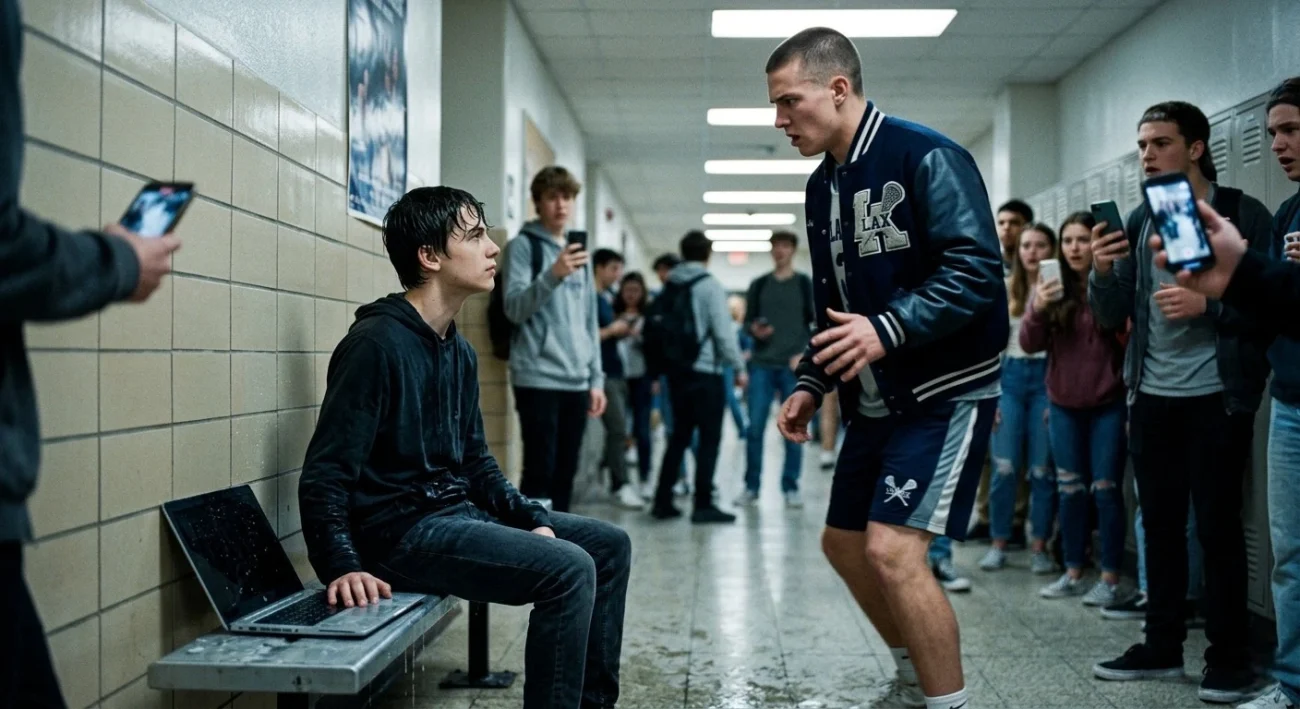
The hallway was loud at 7:43 a.m. — lockers slamming, sneakers squeaking on waxed floors, the usual chaos of first period. Ethan sat at the corner bench near the senior wing, head down, laptop open, earbuds in. He’d been there since 6:55, same as every morning. No one bothered him. No one noticed him.
That was the arrangement. Had been for two years.
Marcus noticed him today.
“Well, well.” Marcus stopped in front of the bench, cup in hand, lacrosse bag slung over one shoulder. Two of his friends trailed behind him like satellites. “You’re in my spot.”
Ethan looked up slowly. Pulled one earbud out. “There’s no name on it.”
A beat of silence. The kind that meant something was already decided.
“You hear this kid?” Marcus turned to his friends, grinning. “He talks.”
Ethan went back to his screen. His thesis draft was open — twelve pages, four months of research on algorithmic bias in academic placement systems. The state scholarship committee had emailed yesterday. Submission deadline: Friday.
“Hey.” Marcus knocked the bench with his knee. “I’m talking to you.”
“I know.” Ethan didn’t look up. “I’m choosing not to answer.”
The grin fell off Marcus’s face.
“You think that’s funny?”
“I think it’s Tuesday,” Ethan said. “And I have work to do.”
That was when the cup tilted.
The hallway froze.
Dark liquid poured — slow, deliberate — straight into the hood of Ethan’s jacket, running down his neck, soaking into the keyboard. It hit the screen. It dripped from his chin onto the keys.
Tap. Tap. Tap.
Three students gasped. Someone in the back said, “Oh my God.” A sophomore covered her mouth.
Marcus leaned in, smiling with teeth now. “What’s the matter? Cat got your tongue?”
Ethan didn’t move.
He sat completely still as the liquid pooled between keys, ran along the trackpad crease, dripped onto the tile.
Someone laughed — nervous, quick, cut short.
Then silence.
Not comfortable silence. The kind that crawls under your skin.
Ethan set his one remaining earbud down on the bench. Slowly. Like he had all the time in the world.
He inhaled.
Once.
His fingers twitched.
Then he raised his head.
His eyes found Marcus’s — and they were calm. Not the calm of someone suppressing rage. Calm like still water over something very deep.
Marcus’s smile cracked, just slightly, at the edges.
Ethan stood up.
The chair scraped hard across the tile. The sound cut through the hallway like a blade.
Students stepped back automatically. Not because anyone told them to. Because something in the air had shifted and every instinct said: give this room.
Phones lowered.
No one laughed anymore.
“Are you done?” Ethan asked.
His voice was quiet. Not shaking. Not theatrical.
Marcus blinked. Reset. Squared his shoulders. “Yeah,” he muttered. “I’m done.”
Ethan stepped forward.
Water still dripping from his sleeve onto the floor.
“Good.”
Another step. Now they were close — close enough that Marcus could see Ethan’s jaw wasn’t clenched. His hands weren’t fists. He wasn’t angry.
That was the part that didn’t add up.
“Now it’s my turn,” Ethan said.
A girl nearby pressed against the lockers. Someone in the back whispered, “Don’t—”
Marcus tensed. His chin came up. “You think you’re funny? You think you’re gonna do something?”
Ethan didn’t answer.
He raised his hand.
Marcus flinched.
Hard.
His whole body reacted — shoulders up, chin back, hands rising — before he could stop himself.
The hand didn’t swing.
It moved past him.
Calm. Deliberate. Precise.
Ethan reached down — past Marcus, past the soaked laptop, past the spilled cup — and pressed a single key.
Just one.
The Enter key.
For half a second: nothing.
The hallway breathed.
Then —
Bzzzt.
One phone buzzed. Then another. Then ten. Then thirty.
The entire hallway lit up at once — screens glowing from every pocket, every hand. A notification. Mass auto-play. A shared school server ping.
Students looked down.
Confusion.
Then stillness.
Then shock.
The video was shaky — shot from a phone, indoor lighting, slightly overexposed. But the audio was crystal clear.
“Delete the scholarship file. Make it look like he failed the integrity check.”
Marcus’s voice. Unmistakable.
The hallway went silent in a way it had never been silent before. Not the silence of boredom or distraction. The silence of a hundred people simultaneously holding their breath.
Marcus’s face went white.
“No — no, that’s not —”
A second clip cut in automatically. Marcus again. Laughing this time, leaning on a desk after school, talking to someone off-camera.
“Who’s gonna believe that kid anyway? He’s nobody. They’ll think he cheated.”
A girl stepped back from Marcus. One step. Then another.
A junior boy shook his head slowly. “No way.”
Another student turned away from Marcus entirely, like the act of looking at him had become distasteful.
“No — wait —” Marcus’s voice cracked. He looked at the phones. At the faces. At the spreading sea of silence closing in around him. “That’s — you can’t just — I was joking, I didn’t actually —”
Ethan leaned in slightly, voice low and completely controlled.
“I warned you. Three times. In writing. I have the texts.”
Marcus’s breathing sped up. “You recorded me?!”
“My laptop records everything.” A beat. “Runs automatically when it detects elevated audio within three feet. Has for two years.” Ethan tilted his head slightly. “You should’ve read the terms.”
“You — you can’t do that! That’s illegal, you can’t just —”
“It’s legal in this state when one party consents.” Ethan picked up his soaked laptop. “I consented.”
Behind them —
a door opened.
Slow. Heavy.
Principal Dorsey stepped into the hallway. He was already looking at his phone. Already had the notification. Already watching the clip.
He looked up. His eyes moved past Ethan. Past the crowd. Settled on Marcus.
“I think,” he said, perfectly calm, “we need to talk. Right now. My office.”
Marcus spun around. Panicking now, the performance completely gone. “No, I didn’t — it was a joke, I was just messing around, I didn’t actually delete anything —”
“That’s what we’re going to find out,” Dorsey said. He held the door open. Not a request.
Marcus looked at his friends.
His friends looked at the floor.
He looked at the crowd.
The crowd looked back — faces flat, phones still in hand, nobody moving to defend him. Nobody.
He looked at Ethan.
Ethan had already sat back down. He was blotting his keyboard with his hoodie sleeve, leaning over the screen, checking his files.
“My draft’s still here,” Ethan said, almost to himself. He scrolled. Clicked. “And your deletion didn’t go through. Server backup kept it.” He looked up at Marcus once more — not triumphant, not cruel. Just clear. “You tried to take four years of work from me. You failed. And now everyone knows exactly who you are.”
Marcus opened his mouth.
Nothing came out.
“Marcus.” Dorsey’s voice had an edge now. “Now.”
The walk to the principal’s office was the longest thirty feet of Marcus’s life. The crowd parted for him — not dramatically, not mockingly, just quietly stepped aside. Like he’d become something they didn’t want to touch.
No one filmed it. They didn’t need to.
The story was already out.
Two days later, Ethan submitted his thesis draft. Twelve pages, four months, a conclusion section he’d rewritten at 11 p.m. with a still-slightly-sticky keyboard. It uploaded at 11:58 p.m.
The state scholarship committee confirmed receipt at 11:59.
He read the confirmation email twice. Closed the laptop. Put his earbuds in.
The hallway, even empty, felt different now. Lighter. Like something that had been pressing against the air had finally let go.
His phone buzzed.
It was an email from the district academic office. Subject line: Recording Evidence — Scholarship File Tampering Confirmed. Student Conduct Review Scheduled.
Marcus was suspended pending investigation. His varsity eligibility was frozen. His early admission letter to State was under review.
Ethan set the phone face-down on the bench.
He had a calculus problem set due Thursday. A history paper outline due Monday. A scholarship interview in two weeks that he’d been preparing for longer than he could remember.
He opened the laptop.
Got to work.
That Friday, the scholarship was awarded.
Ethan’s name was read first.
He didn’t cheer. Didn’t pump his fist. Didn’t post it anywhere.
He just nodded once — to himself, to the four years, to every 6:55 a.m. — and went to call his mom.
She cried.
He almost did too.
Almost.
Marcus didn’t return to school that semester. The district’s investigation confirmed file tampering on the scholarship server — two separate access attempts, one partially completed before the backup system intervened. His legal team got involved. It became, in the careful language of school board minutes, an ongoing matter.
The lacrosse bag stayed in his locker for three weeks before someone from administration finally cleared it out.
Nobody claimed the corner bench after that.
It was understood, without anyone saying so, that it belonged to Ethan now.
The following fall, in the school’s annual academic achievement ceremony, Ethan was asked to say a few words. He stood at the podium, straightened the microphone, looked out at the auditorium.
He thought about what to say for a long time before he said anything.
“I spent two years trying to be invisible,” he said finally. “Because I thought small was safe. It’s not.” He paused. “Small just means you can be erased quietly.” Another pause. “Don’t be erasable.”
Short. Clean. Done.
He stepped back from the mic.
The auditorium was quiet for one full second.
Then it filled up.
Original fictional stories. AI-assisted creative content.
