
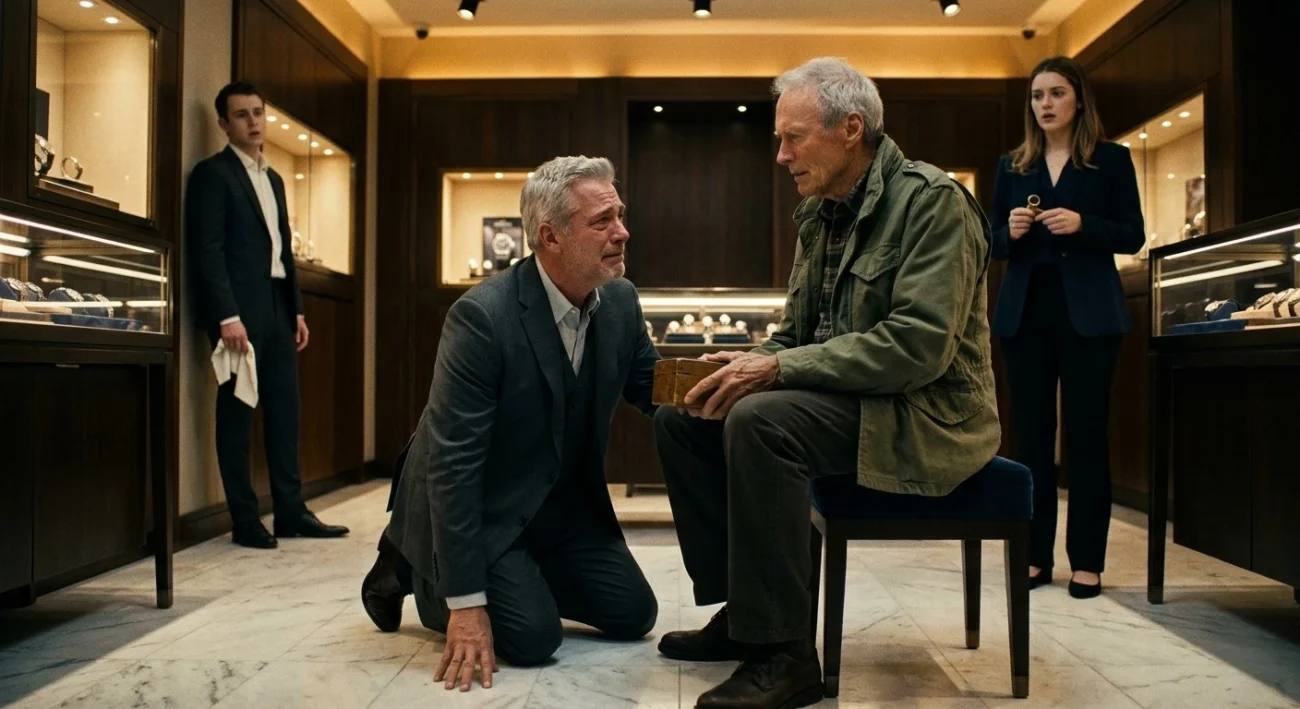
The door opened, and the city’s chaos leaked in for a second — cab horns, wind, diesel — before the boutique swallowed it whole.
Elias stepped inside.
He was seventy-three years old, with the hands of a man who had spent half a century inside the guts of machines. His field jacket was faded olive, stained at the cuffs with something dark. Machine oil, or maybe just time. His boots were salt-rimmed and scuffed, the leather cracked at the toe like old bark. He was holding a small wooden box against his chest, two-handed, the way a man holds something he doesn’t want to drop.
The boutique hummed around him. A thousand watches ticked in their velvet cases. Spotlights made the gold leaf shimmer like cold fire.
Julian looked up from behind the central display counter.
He was thirty-one, recently promoted to junior floor manager, and he wore his title the way some men wear a new watch — conspicuously, constantly, hoping someone would notice. He clocked Elias in under two seconds. The jacket. The boots. The box.
He turned back to the display case and began polishing a crystal face that didn’t need polishing.
Elias approached the counter. He set the box down gently, like a man placing a sleeping child. “Excuse me,” he said. His voice was quiet but not weak. “I was hoping someone could take a look at a piece for me. An appraisal, if possible.”
Julian didn’t look up. “Do you have an appointment?”
“I don’t. I apologize. I was in the neighborhood and—”
“Appointments are required for appraisal services.” Julian finally looked up, let his gaze travel down and back up, and allowed a small, practiced smile to settle on his face. “Also, I should be transparent with you — we specialize in contemporary luxury timepieces. Not antique restorations. Not… collector pieces from secondary markets.” He paused. “There’s a pawn shop on Forty-Seventh. Very reputable, I hear. More suited to your needs.”
Elias didn’t flinch. He just looked at Julian for a moment with calm brown eyes. “It’s not from a secondary market,” he said. “I made it.”
Julian laughed. It was a short, dismissive sound, the kind designed for an audience. And there was an audience — two women in their fifties examining a rose-gold bracelet watch nearby, and a man in a charcoal suit pretending to read a brochure. Julian glanced at them, confirming the room was watching.
“Sir.” He leaned forward slightly. “We don’t appraise flea market finds. I’m going to have to ask you to leave before you disturb our other guests.”
He raised his hand toward the security guard at the door — Marcus, a large quiet man who’d worked the boutique for six years and had never particularly liked Julian.
In the back corner of the floor, behind a narrow writing desk that served as an intern station, Sarah looked up from her laptop.
She was twenty-two, three days into her first week. She’d been cataloguing inventory, entering serial numbers into a spreadsheet, doing the invisible work that keeps floors running while managers perform on them. She had very little authority, and she knew it.
But she had eyes.
She watched Elias — the careful way he held himself, the stillness in his face. That wasn’t embarrassment. That wasn’t the deer-in-headlights of someone out of place. That was dignity. Something had gone quiet inside him when Julian spoke, but not because he’d been shamed. It was the quiet of a man choosing not to respond the way he could.
She pushed back from the desk.
“I’ll take a look,” she said.
Julian turned. “Sarah—”
“He’s a customer.” She walked toward the counter. “I’m sorry for the wait,” she said to Elias, and her voice was calm. “Can I get you some water? We have still or sparkling.”
Elias blinked. Something in his expression shifted, almost imperceptibly — the way a muscle relaxes after holding tension too long. “Still,” he said. “Thank you.”
Julian stepped toward her. “You are not authorized to conduct appraisals—”
“I’m not conducting an appraisal. I’m getting a customer a glass of water.” She held his gaze for exactly one second, then walked to the side table and poured from the carafe.
She brought it to Elias and gestured to the velvet stool beside the counter. He sat. His hands were shaking slightly — Sarah had noticed — not from nerves, she thought. From something older and heavier. The weight of coming here at all.
“May I?” she said, nodding at the box.
Elias slid it toward her.
He didn’t open it himself. He watched her do it.
The box was hand-carved mahogany, the hinges worn smooth from years of opening and closing. Inside, on a bed of yellowed chamois leather, lay a watch.
It was not what Julian would have called impressive.
The case was steel, not gold. No gem settings, no exhibition caseback, no fluted bezel. The dial was simple — matte white, aged to cream, with applied baton indices and a small subsidiary seconds dial at six o’clock. The crown was slightly oxidized. The crystal had a shallow scratch across its upper left quadrant.
Julian leaned over and looked at it. “It’s junk,” he said flatly. “Steel case, no hallmarks, no brand markings — it’s a prototype blank at best. Throw it away.”
Sarah didn’t respond to him.
She picked the watch up — carefully, by the case edges — and turned it over.
On the caseback, there was no ornament. No see-through window. Just steel, and a single line of engraved text.
She read it once.
Then she read it again.
Her hands stopped moving.
“What?” Julian said.
Sarah set the watch down slowly. She looked at Elias.
“Sir,” she said, and her voice was different now — not unkind, just precise, the way you speak when you understand the magnitude of what you’re holding. “This serial number…” She turned the watch toward him. “It starts with zero-zero-one.”
Elias nodded once.
“I know,” he said.
Julian grabbed the watch from the counter before Sarah could stop him. He tilted it in the light, squinting at the caseback. He read the number. Then he looked at the name engraved above it — the company name, the one that ran across every display case in the room, the one on the shopping bags stacked behind the register, the one carved into the marble above the entrance doors. His face went very still.
“This can’t be—” he started.
“It’s the original prototype.” Elias’s voice was level. “Made in the workshop on Rue du Rhône in 1973. Before the company moved production. Before the IPO. Before any of this.” He gestured, slightly, at the room around him. “I machined that wheel train by hand. Took me four months. The movement had a tolerancing problem in the third wheel — I solved it by recutting the pivot by three microns. No one else knew how to do that then.” He paused. “Still not many who do.”
The watch lay on the counter between them.
For a long moment, Julian didn’t move.
Then from above — from the open mezzanine that overlooked the floor — came the sound of rapid footsteps on marble stairs.
The man who descended was sixty-two, silver-haired, wearing a charcoal suit that had been fitted by someone who understood the difference between a suit and a costume. His name was Daniel Reeves. He had been CEO for eleven years. His grandfather had been a business partner. His father had been a distributor. And he had grown up on stories about the watchmaker — the one who had walked away from everything, who had taught his father everything the family knew about horology, and who had disappeared into a life so quiet that Daniel had spent years trying to find him.
He had heard the commotion from his office.
He had come to see about a complaint.
He stepped onto the floor and stopped.
He looked past Julian. Past Sarah. Directly at the old man on the velvet stool, with the oil-stained jacket and the worn wooden box.
Something moved across Daniel’s face — recognition, disbelief, and something that looked very much like grief and relief arriving at the same moment.
He walked forward.
He did not stop at the counter.
He kept walking until he was standing in front of Elias, and then, in front of every person on that floor — the two women with the rose-gold bracelet, the man with the brochure, Julian, Marcus, Sarah, and three other clients who had drifted in from the side galleries — Daniel Reeves dropped to one knee on the marble.
“Teacher,” he said.
It came out barely above a whisper.
Elias looked down at him for a moment. Then he placed one hand on Daniel’s shoulder — briefly, the way a man who has never been sentimental allows himself to be, once, when the moment earns it.
“Get up, Daniel,” he said quietly. “You’re kneeling on your own floor.”
Daniel stood. His jaw was tight. He turned to look at Julian.
Julian had gone the color of bleached silk.
“Julian.” Daniel’s voice was controlled in the way that things are controlled when the alternative is something much louder. “Step off the floor, please.”
“Mr. Reeves, I wasn’t aware—”
“Step off the floor.”
Julian stepped back. He kept stepping until his back touched the wall by the archive door, and then he stood there, very still, holding his polishing cloth.
Daniel turned to Sarah.
She was standing with her hands at her sides, watching Elias with an expression she wasn’t trying to hide — the pure, uncomplicated attention of someone who has understood exactly what they witnessed.
“What’s your name?” Daniel asked.
“Sarah. Sarah Kline. I’m a first-week intern.”
“You’re a first-week employee,” Daniel said. “Effective now.”
He turned back to Elias. The room had gone completely silent — even the watches seemed to pause, though of course they hadn’t.
“How long have you been in the city?” Daniel asked.
“Came in this morning,” Elias said. “I live upstate now. Small place. I fix old farm equipment.” He looked down at the watch on the counter. “I wanted to bring it somewhere people would understand what they were looking at.”
“I understand,” Daniel said. He looked at the watch with the kind of attention that cannot be performed — the attention of a man who has spent a lifetime learning to see what others walk past. “I’ve been looking for you. My father asked me to.”
“I know,” Elias said. “He wrote me letters. I’m sorry I didn’t answer.”
The apology was quiet and without excuse, the way apologies are when they’re real.
“He understood,” Daniel said. “He told me you were the only man he ever met who was richer than all of us and wanted nothing we could give him.”
Elias looked at the room. The cases. The spotlights. The gold and the glass and the velvet. He looked at it all with no contempt, but also no longing.
“I made one of these things once,” he said. “The rest was just what happened after.”
He reached into the box one more time.
He took out a small brass loupe — a jeweler’s eyepiece, old and simple, the lens edge worn where decades of fingers had pressed it. He held it for a moment, then turned and held it out to Sarah.
She took it carefully. It was heavier than it looked.
“You saw the number,” Elias said. “Before you knew what it meant. That matters.”
He looked at Julian, who was still standing against the wall, smaller now than he had been twenty minutes ago.
“The world sees the gold,” Elias said, not unkindly but without mercy. “Only the wise see the gears.”
He closed the wooden box.
He stood up, steadier than a man his age had any right to be, and shook Daniel’s hand with the grip of someone who has worked with his hands for fifty years and would work with them for fifty more if time allowed.
He left the way he came — through the front door, into the gray noise of the city — a man who had nothing left to prove and knew it.
Behind him, Julian was escorted by Marcus to the HR office on the fourth floor. The title of junior floor manager would remain empty for three weeks, while Daniel reviewed the floor’s conduct policy and Sarah learned how to read a serial number like she was reading a name.
The thousand watches kept ticking.
They didn’t care who was watching.
Original fictional stories. AI-assisted creative content.
