
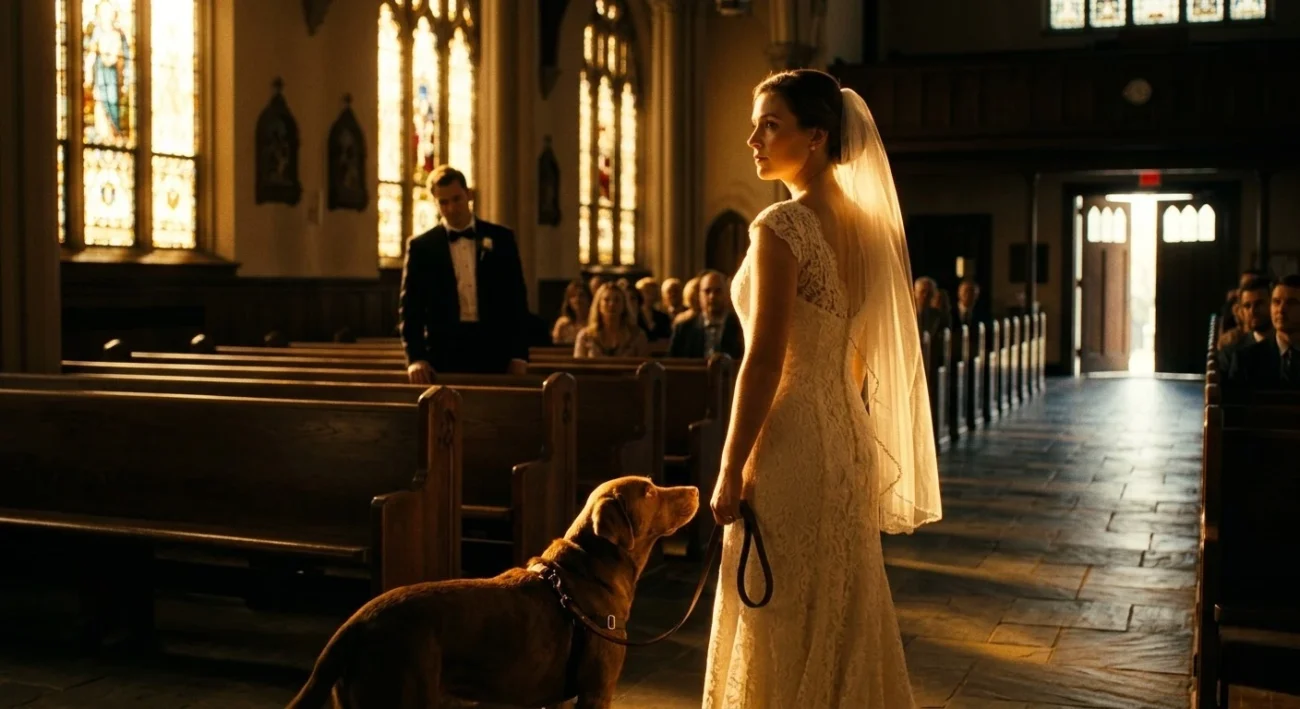
The church smelled like white roses and candle wax.
Every pew was packed. Aunts in pastel dresses. Cousins holding programs they hadn’t read. A flower girl who’d already eaten half the petals.
Mara stood at the back of the aisle, bouquet clenched so hard her knuckles had gone pale. Beside her, on a short leash held by her maid of honor, sat Duke — a hundred-and-ten-pound brown Labrador mix who had slept at the foot of her bed since she was nineteen years old.
She’d fought for him to be here. Her mother had called it embarrassing. The venue coordinator had called it a liability.
Mara had called it non-negotiable.
“Okay,” she whispered to herself. “Okay. Let’s do this.”
The organist shifted into the processional.
Duke stood up.
The first thirty seconds were perfect.
Mara took her first steps down the aisle and the guests rose. Cameras clicked. Someone’s grandmother cried. The golden afternoon light came through the tall windows in long, warm columns, and for a moment, it all felt like the version of this day she’d been picturing for two years.
Daniel stood at the altar — tall, steady, that half-smile she’d fallen for. He looked like he’d been there waiting forever.
Duke walked beside her, calm and straight, like he understood the assignment.
Then they were ten feet from the altar.
And everything stopped.
Duke planted his feet.
His whole body stiffened — not scared, not confused. Locked. Like something had tripped a wire inside him.
“Duke.” Mara tugged the leash gently. “Come on, buddy.”
He didn’t move.
Then the barking started.
Not one bark. Not two. A sustained, urgent, rising alarm — the kind of sound Duke only made when something was genuinely wrong. Mara had heard it once before, the night a gas line cracked in her apartment building. She’d grabbed her coat before the alarm even sounded because Duke had already known.
“Duke—” She crouched down, hand on his neck, trying to read him. “Hey. Hey, look at me.”
He wasn’t looking at her.
He was looking at Daniel.
The guests shifted in their pews. A murmur passed through the room like a wave.
Mara’s mother half-rose from her front-row seat, wearing an expression that could strip paint.
Daniel took a step toward them, arms out, his voice carefully casual. “He’s probably just overwhelmed. Too many people.”
“He’s been to parties with two hundred people,” Mara said, still watching Duke. “This isn’t that.”
“Mara—”
“Give me a second.”
Duke lunged.
Not at Daniel — at her dress. His teeth closed around the hem and he pulled backward, planting his full weight, a low sound coming from deep in his chest that wasn’t quite barking anymore.
It was something more like warning.
Mara stumbled. The maid of honor grabbed her arm. The bouquet hit the floor.
“Get the dog out of here,” someone hissed from the pews.
“Don’t you dare,” Mara said, very quietly, to no one in particular.
She didn’t move toward the altar.
She stood there, looking at Daniel, and something in the back of her mind that she’d been pressing down for months began to surface.
The trips he said were work. The second phone she’d glimpsed once, left face-down on the kitchen counter. The way he always, always stepped outside to take certain calls.
She’d explained every one of them away.
Duke was still pulling.
The doors at the back of the church blew open.
Not slowly. Both of them, all the way, so hard they hit the walls and the sound cracked across the nave like a gunshot.
Every head turned.
The woman standing in the doorway was still wearing the drive in her clothes — wrinkled, hurried, like she’d gotten dressed in a car. Her dark hair was coming loose. Her eyes were red and wild and locked onto Daniel with the precision of someone who had been rehearsing this moment the entire drive here.
“Stop the wedding.”
Her voice carried all the way to the altar without effort.
The organist stopped mid-note.
Daniel did not move. Did not speak. His face did something complicated and then went flat.
Mara straightened up slowly.
“Who are you?” she said.
The woman walked forward. The guests parted without anyone deciding to.
“My name is Claire,” she said. “And I need two minutes before you make the biggest mistake of your life.”
“You need to leave,” Daniel said. Low. Controlled. The voice he used when he was pretending to be calm. “You’re upset. You don’t know what you’re doing.”
“Don’t.” Claire’s jaw was tight. “Don’t do that to me right now.”
She reached into the bag on her shoulder and pulled out a small box — the kind that comes from a hospital gift shop, pink cardboard, a yellow ribbon that had long since lost its curl. She set it on the nearest pew like it was the most important thing in the room.
Which, Mara was beginning to understand, it probably was.
“Open it,” Claire said.
No one moved.
“Please,” Claire said, and the word broke in half on the way out.
Mara stepped forward and opened the box.
Inside: a tiny hospital bracelet, white with pink lettering. The name on it was printed in that small, no-nonsense hospital font.
Baby Girl Hartwell.
Hartwell.
Daniel’s last name.
Mara looked up.
“When?” she said.
The word came out steady. She was a little surprised by that.
“Fourteen months ago,” Claire said. “She was early. There were complications.” She pressed her lips together. “He told me she didn’t make it. He cried. I believed him. He held my hand and I believed him and then he left and I—”
Her voice gave out.
She steadied herself against the end of a pew.
“I couldn’t find any record. Any grave. Any documentation. For a year I thought I was losing my mind. And then three weeks ago, I hired someone. And they found her.”
Mara turned around.
“Daniel,” she said.
He said nothing.
“Daniel.” Her voice was different now. Something had stripped out of it — the uncertainty, the need, the two years of small doubts she’d smoothed over with better explanations. What was left was just the question. “Where is her baby?”
The silence lasted five full seconds.
Then a woman’s voice came from the back of the church.
“She’s right here.”
Everyone turned again.
This was someone different — older, composed, wearing the deliberate stillness of someone who had made a decision and arrived on the other side of the fear. She stood in the doorway holding a small hand.
The little girl beside her had Daniel’s eyes.
She was maybe a year old, steady on her feet the way toddlers are when they’ve only recently figured it out — precarious and proud all at once. She looked around the room with the total calm of someone too young to understand what she’d just walked into.
Then her gaze found Claire.
And she smiled.
“Mama.”
The word was soft. Uncertain. A word practiced and known but not yet automatic.
Claire made a sound like something breaking.
She crossed the room in six steps and dropped to her knees and the little girl walked straight into her arms.
Mara watched this happen.
Duke had gone completely still beside her. His leash hung slack. His job, apparently, was done.
Daniel tried exactly once more.
“Mara, I can explain—”
“I know you can,” she said. “I know you have one. I know it’s probably good.” She handed his ring back to the altar boy, who was standing three feet away looking like he wanted to be literally anywhere else. “I don’t want it.”
She picked up her bouquet from the floor.
She looked at her guests — two hundred people in their best clothes, sitting in total silence, the afternoon light still coming through the windows, still warm, still golden, indifferent to all of it.
“I’m sorry you drove here,” she said. “There’s going to be a lot of food that nobody’s eating. Please help yourselves.”
Then she clipped Duke’s leash back to her wrist and walked to where Claire was still kneeling, her daughter’s face pressed against her neck, both of them crying with the specific exhaustion of people who have been holding something too long.
Mara crouched down.
The little girl looked at her with Daniel’s eyes and Mara felt something — not grief, not yet, but the precursor to it. The moment just before you understand the shape of what you’ve lost.
“Hey,” she said softly.
The little girl blinked.
Duke leaned forward and licked her cheek, and the little girl made a sound that was almost a laugh.
Claire looked up.
“I didn’t come here to—” she started.
“I know,” Mara said.
“I just needed her to know the truth. I needed someone to know.”
“I know.” Mara sat down on the floor of the church, bouquet in her lap, white dress pooled around her. After a moment, Claire sat down too.
Behind them, Daniel was speaking in low, urgent tones to the pastor, who was looking at him with the expression of a man profoundly reconsidering his career.
Two of the groomsmen quietly took off their boutonnieres and put them in their pockets.
Mara’s mother was on the phone — probably calling the caterer, possibly calling a lawyer, maybe both.
Someone, somewhere in the pews, started eating the wedding almonds.
The attorney’s letter arrived six weeks later.
It was addressed to Daniel, and Mara knew about it only because Claire texted her a photo of it with a single line: I had a very good week.
The woman who had been standing in the doorway holding the little girl turned out to be the owner of the private investigation firm Claire had hired. She’d come not just as a witness but as a notary — the documentation she carried established paternity, established Daniel’s knowledge of the child’s survival, and established, quite specifically, that he had signed paperwork redirecting his parental designation to a state agency under false pretenses.
The family court date was set for the following month.
Daniel had retained four lawyers so far. He was working on a fifth.
Claire got full custody.
The little girl’s name, as it turned out, was Lily.
Mara got coffee with Claire twice over the following months — not because they were close, not because the circumstances had made them friends exactly, but because they had both survived something and they’d survived it in the same room and that created a kind of gravity between two people.
At the second coffee, Claire said: “I keep thinking about your dog.”
“Duke.”
“The way he just — knew.” She shook her head. “I always thought that was a myth. That animals sense things.”
“He’s been right about people before,” Mara said. “I just usually listen to him.”
Claire looked at her.
“This time, too,” she said. “You listened this time.”
Mara thought about the weight of that moment — crouched at the edge of the altar, Duke pulling her backward, the part of her that had already half-known letting herself finally know it.
“Yeah,” she said. “I did.”
She moved in August. Smaller apartment. Better neighborhood. Duke slept across her feet the first night the way he always had and she lay in the dark and let herself feel the whole shape of it — the loss, the relief, the particular loneliness of not grieving something that hadn’t been real.
She didn’t grieve long.
Duke had known all along, after all.
And so, she was starting to think, had she.
Original fictional stories. AI-assisted creative content.
