
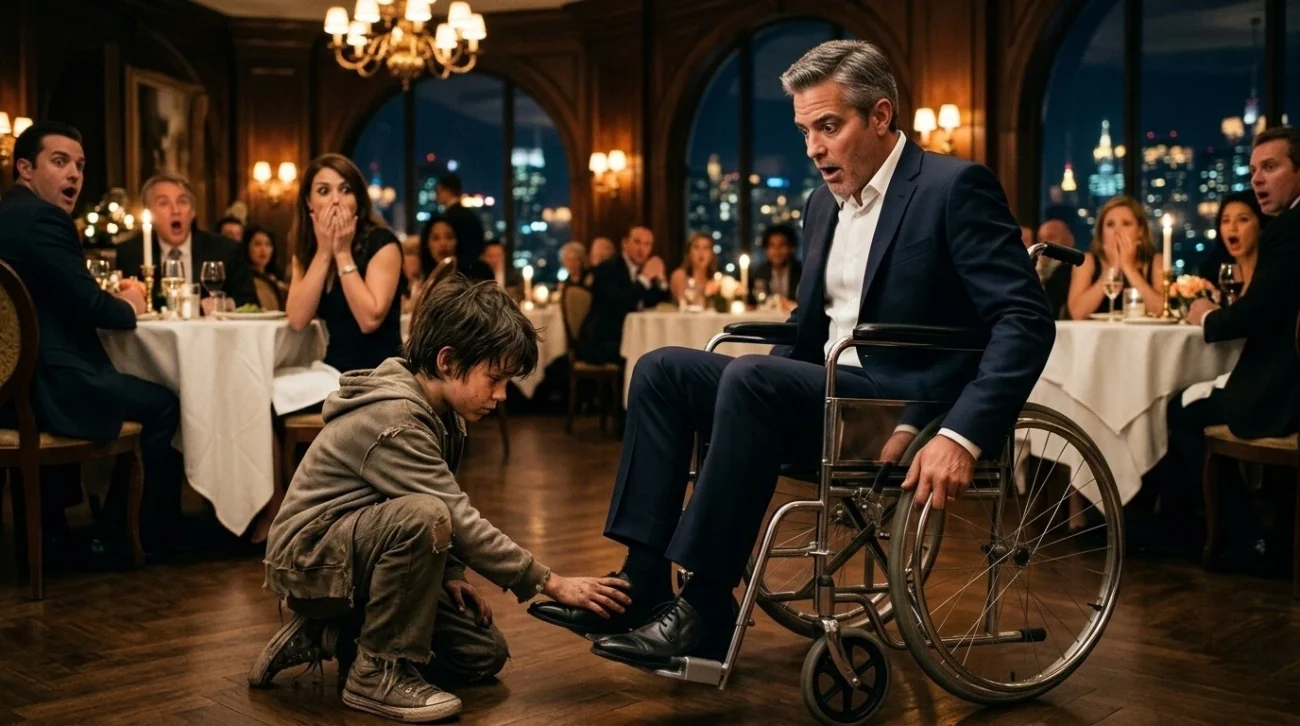
No one at the rooftop restaurant knew the boy’s name when he stepped into the light.
They only noticed the contrast.
The marble table. The skyline behind the glass. The chandelier glow on crystal and gold.
And then this thin little boy in torn clothes, hair uncombed, shoes half-broken — standing directly in front of Julian Voss like fear had somehow forgotten to follow him inside.
Julian looked up from his wine glass with mild amusement.
He was used to people staring at the wheelchair. Used to pity, curiosity, that particular brand of fake politeness wealthy strangers performed when they couldn’t look away but didn’t want to be caught looking. But this boy’s face held none of those things.
Only certainty.
“Sir,” the boy said.
The word landed strangely. Too formal. Too old for the mouth it came from.
A few guests nearby smirked. One woman in a sequined dress leaned toward her bald companion as if a joke was about to begin. The sommelier near the east wall paused mid-pour.
Julian lowered the glass.
“You?” he asked. Not unkindly. Not cruelly. Just — surprised.
The boy stepped closer.
“I can fix your leg.”
That made the woman laugh under her breath. A small sound, quickly swallowed, like she wanted to be entertained but didn’t want to seem cruel.
Julian almost laughed too. Almost.
Instead, he leaned forward, studying the child more carefully. The thin arms. The jaw set hard against what Julian could only guess was a pounding heart. The strange, unblinking focus.
“How long would that take?” he asked.
The boy did not flinch.
“A few seconds.”
Julian set the glass down on the marble.
“I’ll give you a million.”
He said it the way a man says something he expects will end a conversation. A number large enough to be absurd. A test he was almost certain the child would fail — by flinching, or smiling, or running.
The boy did none of those things.
He crouched beside the wheelchair.
The room changed with that movement. It stopped being entertainment and became something harder to name. Something that made several guests set down their silverware and lean forward without realizing they were doing it. The boy was close enough now for Julian to see the dirt under his nails, the fine shake in his fingers, and something else — a strange, deep sadness in his eyes that did not belong on a face that young.
The boy looked once at Julian’s exposed foot resting on the wheelchair’s footrest.
Then up into Julian’s face.
Like he recognized him.
Then he placed his hand on the foot.
A strange little sound seemed to pass through the silence — so soft Julian almost thought he’d imagined it. Not a word. More like a breath with a shape to it.
“Count with me,” the boy said.
Julian gave a thin, tolerant smile. The smile of a man humoring something ridiculous.
“This is ridicu—”
“One.”
Julian jerked so hard his hand slammed the edge of the table.
The wine glass trembled. The crystal rang once, quietly.
A woman gasped.
Julian’s breath caught in his throat.
Because something had happened.
Something real.
His toes twitched.
Not in memory. Not in the phantom fire of nerve damage. Not in one of the false little ghost-sensations doctors always warned him about — those mocking little echoes from a body that had already given up.
They moved.
He watched them.
They moved again.
The boy’s own breathing was shaking now — audible, ragged — but his hand stayed perfectly still on Julian’s foot.
“Two.”
Julian stared at his foot in something close to horror.
Another twitch. A full curl of the second toe this time. Then a flex at the ankle so small it might have been a tremor, but wasn’t.
The laughter in the restaurant was gone. The guests had gone still. Even the waitstaff had stopped moving — a young woman in a black uniform frozen near the dessert cart, a water pitcher tilted in her hand, forgotten.
Julian lifted his eyes slowly to the child’s face.
“What did you do?”
The boy swallowed hard. His jaw was tight. Tears had gathered in his eyes now, though he hadn’t let them fall yet. He was fighting it.
“My mother begged you to help her too.”
That sentence cut deeper than the touch.
Julian’s face changed.
Not because he understood it immediately. Not because the words made immediate sense. But because something old and buried had just been called by name without using the name. Some locked room inside him had been found in the dark.
The boy lifted his free hand and opened his palm.
A small pendant lay in it.
Oval. Worn. Silver faded so smooth with time it had lost its shine entirely. A tiny chip at the edge of the setting, right where the clasp met the frame.
Julian stopped breathing.
He knew that pendant.
He had clasped it around a young woman’s neck twelve years earlier in a one-room apartment above a pharmacy on Clement Street, promising he would come back before sunrise. She’d laughed at him — softly, like she didn’t quite believe him, but wanted to. He’d kissed her forehead. Said, “I’ll come back.”
Her name had been Elena.
And by morning, she was gone.
His family had told him she’d left the city. That she’d decided it was too complicated. That she’d gone back to her people. That she’d been paid well for her trouble and that was that.
At least, that was the story his family gave him.
He had been twenty-four, recently injured, recently medicated, recently broken in four places that couldn’t be set with plaster. He had believed them because he’d had nothing left to not believe them with.
“She said if your leg ever woke up…” the boy whispered. His voice was barely there. “…you’d finally look at me.”
Julian stared at the pendant. Then at the boy’s face.
And something sickening began to rise inside him.
The eyes.
He had noticed the eyes first — the moment the child had stepped into the light — and he had refused to let himself think about them. Had filed it away under coincidence the way people file away things that would cost too much to open.
Now he could not unsee it.
Elena’s eyes.
His own mouth.
His own jaw when he was afraid.
The boy’s lips trembled.
Then he said the words that emptied the whole room of air:
“My mother told me not to hate you until I saw your face myself.”
Julian’s hands gripped the arms of the wheelchair so hard the leather creaked.
The guests behind him looked from the boy to Julian and back again, sensing the shape of something terrible before they fully understood it. Several phones had come out again — not for amusement this time, but from the deep human reflex to document something irreversible.
Julian tried to speak.
Nothing came out.
The boy took one tiny step closer.
His voice dropped to almost nothing.
“She’s dying downstairs.”
Julian went white.
“What?”
“In Saint Claire’s charity clinic,” the boy said. “Three floors below this building. She told me rich people like to eat close to suffering as long as the glass is dark enough.”
The woman in sequins covered her mouth.
Julian’s hand began to shake violently.
The boy’s eyes filled completely now. He let them. He’d run out of room to hold it back.
“She told me one more thing.”
Julian could barely force out the words.
“What?”
The child looked at him with quiet, devastating steadiness. Like he’d rehearsed this. Like he’d been rehearsing it for years, waiting for a leg to move.
“She said if your foot moved…”
His throat tightened around the words.
“…ask him why his brother paid to hide his son.”
Julian froze.
The restaurant, the skyline, the chandelier, the crystal — all of it went distant.
Because only one person in the world could have known that his brother had handled Elena’s disappearance. Only one person could have known the particular way it had been handled — not with cruelty, exactly, but with that cold administrative efficiency his brother had always applied to problems.
And in that exact moment, behind the glass doors of the private dining entrance, a tall man in a charcoal suit stepped into view.
Julian’s brother, Marcus.
He had come to find Julian for their scheduled dinner.
Instead, he found this: a thin, ragged boy crouched beside a wheelchair in the center of a silent restaurant, holding something silver in his open hand.
And the moment Marcus saw the boy — the moment his eyes adjusted and he understood what he was seeing — all the color drained from his face.
Julian did not turn toward his brother right away.
He didn’t need to.
He had already seen enough in the reflection of the glass.
Fear.
Not confusion. Not annoyance. Not the particular practiced blankness Marcus used in board meetings when he needed to conceal discomfort.
Fear.
The boy rose slowly from beside the wheelchair, still holding the pendant. He looked at Marcus the way a child looks at someone they’ve imagined so many times they’re not sure the real version is real.
Marcus approached too fast, trying to recover control before anyone else understood the scene.
“Julian,” he said. Voice low. Sharp. Urgent in the way of a man who has managed crises before and believes this is merely another one. “You need to come inside. Now.”
Julian finally looked at him.
“Who is he?”
His brother’s jaw tightened.
“A mistake.”
The room recoiled.
The boy flinched — a full-body flinch, just one, quickly controlled — but he didn’t step back.
Julian stared at his brother as if he had never seen him before.
“A mistake?” he repeated.
Marcus lowered his voice further, but the silence around them was so complete that everyone still heard it.
“Elena was unstable. Desperate. She was going to bring the whole family down. I solved a problem you were too broken to solve yourself.”
The child’s face broke first.
Not loudly. There was no cry. Just a shift — like the bravery in his expression had developed a crack that widened slowly — and underneath it, the little boy he actually was became visible.
Julian’s world tilted.
Because there it was.
Not denial. Not misdirection.
Confession.
“You hid my child,” Julian said.
Marcus’s expression hardened. The fear was still there, but it was being layered over now, the way ice forms over water — thin, brittle, already too late.
“I protected your future. You were injured. Medicated. You weren’t in a state to make decisions. Father would have destroyed everything to keep her away from the family. I handled it quietly. I gave her enough to disappear. I thought—”
“You thought I’d never ask,” Julian said.
His brother said nothing.
Julian laughed once.
It sounded wrong. Hollow. Like a sound from the body, not the person.
Then he looked down at his foot.
Moved it.
A full movement this time. Not a twitch. Not a flutter. The heel came up off the footrest and settled back down, deliberate and undeniable.
A woman at the nearest table pressed her hand to her chest.
And suddenly Elena’s old words returned to Julian with brutal, specific clarity. Words she’d whispered to him in that apartment above the pharmacy, the night before everything ended.
Your body isn’t dead, Julian. Your truth is.
He had fired her for that. Not with anger — with cold, medicated distance. He’d sent money instead of an apology. Let his brother handle it. Let silence do what silence does when you give it enough room.
The boy wiped his face with the back of his sleeve.
“My name is Noah,” he said quietly.
Julian repeated it like a wound.
“Noah.”
The boy nodded once.
“My mom said you picked it before I was born.” A pause. “She said you were sitting by the window in the apartment and she asked what you’d name a boy and you said Noah without even thinking about it. She said that was the only time she was sure you were going to stay.”
That finished him.
Julian pushed down on the wheelchair arms.
Rose halfway.
His legs shook — those legs that had been still for years, that he’d made his peace with, built his identity around, used as the architecture of a man who no longer needed to run from anything because he had nowhere left to go.
He shook.
Stopped.
The restaurant held its breath.
Then he forced himself fully upright.
Gasps spread through the room — small, involuntary, the sound of people witnessing something they haven’t been told they’re allowed to witness.
Julian stood.
His legs trembled. His face was grey with effort. He grabbed the edge of the table with one hand and found his balance slowly, like someone reclaiming something stolen.
His brother took one step toward him.
“Julian. Sit down. This isn’t — you need to—”
“No.”
Just that. One word. Quiet.
No.
Then Julian turned to Noah.
“Is she really downstairs?”
Noah nodded. Tears were falling freely now, no longer being managed.
“She kept asking me what the skyline looked like from up here.” He swallowed. “She made me describe it three times. She said it must be beautiful.”
Julian shut his eyes for one second.
When he opened them again, they were wet.
He looked at his brother.
“All these years. Every time I asked about her. Every time I told myself there was something I couldn’t remember clearly about that last night—” His voice broke and rebuilt itself in the same breath. “You knew.”
Marcus said nothing.
His silence was the most complete admission possible.
Julian took one trembling step forward.
Then another.
Each one looked painful. Each one looked like something that should have happened years earlier but hadn’t, because the right person hadn’t yet been standing in front of him holding a worn silver pendant and a name that still fit inside his chest like it had never left.
He stopped in front of Noah.
Then he did something he had not done in twelve years without thought — something that required no money, no staff, no power, no performance.
He knelt.
Awkwardly. Shakily. With one hand on his own knee and the other on the edge of the table, his body cooperating only reluctantly, without dignity, without the smooth authority he’d spent a decade building back after everything fell apart.
Noah stood still. Breathing hard. His arms at his sides.
Julian looked up at him.
“I should have found you,” he said.
Noah’s lower lip trembled.
“You should have found her.”
Julian bowed his head.
“Yes.”
Then he did the only honest thing he had left.
He held out both arms.
Noah stared at him for one long second. Not with forgiveness — with consideration. With that particular look children have when they are deciding, in real time, whether an adult deserves the thing they’re asking for.
Then he stepped into them.
Julian held his son for the first time.
With the whole restaurant watching. With the whole city shining cold and indifferent beyond the glass. With his brother standing five feet away and the ruins of twelve years of convenient silence arranged around them like broken furniture.
The boy’s thin arms came up slowly and gripped the back of Julian’s jacket.
And Julian held on like the grip itself was keeping him standing. Which, in a way, it was.
Behind them, Marcus looked suddenly smaller than the lie he had spent years defending. The charcoal suit. The straight posture. The practiced control. None of it was doing anything useful anymore.
Julian rose again, slower this time. One hand on the table. The other resting on Noah’s shoulder, careful, as if the boy might still decide to run.
Noah didn’t.
Julian straightened fully and looked at the nearest stunned restaurant manager — a man in his forties who had been frozen near the host stand since the wine glass trembled, his clipboard pressed against his chest like a shield.
Julian’s voice came out low and completely level.
“Call the board. Get my personal attorney on the phone — not the firm, David Mercer directly. And make sure my brother does not leave this building.”
The manager blinked.
“Sir—”
“Now.”
No one hesitated.
Because the balance of the room had already changed completely — shifted by the weight of something witnessed, something that couldn’t be unfiled or unseen or quietly settled later over dinner.
Two members of the restaurant’s private security materialized near the entrance almost immediately, positioning themselves on either side of Marcus without drama. Marcus looked at them. Looked at Julian. Opened his mouth.
Closed it.
Julian did not look at him again.
He looked down at Noah.
“Take me to her.”
Noah searched his face with those eyes — Elena’s eyes, he could see that clearly now, the particular shade and shape of them, the way they went still when they were deciding something important.
“Are you really coming?”
“Even if she hates me,” Julian said.
That made Noah cry harder.
“She told me you might say that.” He breathed. “She said if you said it, to tell you—” He stopped.
“Tell me what?”
Noah looked up at him.
“She said to tell you she kept the pendant because she never wanted it to be true that you didn’t come back. She said hating someone and keeping their pendant at the same time is the most honest thing a person can do.”
Julian shut his eyes again.
Kept them shut a beat too long.
“Let’s go,” he said.
Father and son moved toward the elevator together.
One limping. One in torn clothes. Both carrying more grief than either should have had to carry alone for this long.
The restaurant parted around them silently.
No one spoke. No one lifted a phone. No one performed anything.
They just watched.
And in the watching — in the particular quality of that silence, which was not the silence of entertainment or spectacle but something older and heavier and harder to name — something like witnessing passed through the room.
The elevator doors opened.
Noah stepped in first. Julian followed, one hand on the wall, then the door frame, then letting go.
The doors closed.
Three floors below, in a charity clinic with fluorescent lights and thin mattresses and a window that looked out at a brick wall rather than a skyline — Elena was waiting.
She had sent her boy up there because she had nothing left to lose, and because she had believed, against every reason not to, that a body remembers the truth even when a person doesn’t.
She had been right.
The elevator opened onto the clinic’s third floor.
A nurse looked up from her station with immediate, trained professionalism.
Noah stepped forward before Julian could speak.
“Room twelve,” he said. “She’s in room twelve.”
The nurse looked at Julian. At the way he was standing — trembling but upright, one hand steadied on the door frame, dressed in two thousand dollars of fabric and carrying something that had nothing to do with money.
She nodded and stepped aside.
The corridor was narrow and white and lit too brightly.
Each step Julian took was slower than the last — not from exhaustion, but from something else. The particular weight of a door you’ve avoided for twelve years getting closer with every step.
Noah stopped outside room twelve.
He looked up at Julian.
“She doesn’t know I came up there tonight.”
Julian looked at him.
“She told me about the pendant,” Noah said. “She told me about the restaurant. She told me she’d had a feeling for three days that something was going to change.” He paused. “She said if I was going to go, to go alone. That you’d either look at me the right way or you wouldn’t.”
“And if I hadn’t?”
Noah considered this.
“Then I was going to leave the pendant on the table and walk out.”
Julian looked at him for a long moment.
“How old are you?”
“Eleven.”
Julian nodded slowly.
“She did a good job.”
Noah’s expression shifted — something small and complicated crossing his face.
“She did everything,” he said simply.
Julian put one hand on the door.
Pushed it open.
The room was small. One window. Fluorescent light. A thin blanket on a thin bed. A plastic cup on the nightstand.
Elena was awake.
She turned her head toward the door and her face went through four things in a single second — recognition, shock, something that looked like fury, and then something that looked like the opposite of fury.
She was thinner than Julian remembered. Her hair was shorter. She had the particular still quality of someone who has been ill long enough that stillness has become a kind of fluency.
But her eyes were the same.
The exact same.
“You’re standing,” she said.
Her voice was rough and quiet, but it was steady.
“Noah did something,” Julian said.
Elena looked past Julian to where Noah stood in the doorway.
“You went up there,” she said.
Noah didn’t deny it.
“You told me not to go alone,” he said. “I didn’t. I brought the pendant.”
Elena stared at her son for a long time.
Then she looked at Julian.
“He’s mine,” she said. Not a question. Not a challenge. Just the first thing she had decided to say, because it was the most important thing, and she didn’t have unlimited time for less important things.
“I know,” Julian said.
“He’s been mine for eleven years.”
“I know.”
“And you didn’t—”
“I didn’t know,” Julian said. “Elena.” His voice broke around her name. “I didn’t know. I asked about you. They told me you’d left. I was—” He stopped. Tried again. “I was not in good shape that year and I let myself believe it because believing it was easier than fighting and I was ashamed of how easy it was.”
Elena looked at him.
The silence stretched.
“Marcus,” she said. It wasn’t a question either.
“He’s being held upstairs. My lawyers are being called. I don’t know yet exactly what’s going to happen to him, but he’s not walking out of this building before I understand everything.”
Elena closed her eyes for a moment.
When she opened them again, some of the tension had left her face. Not all of it. Not most of it.
But some.
“You named him before he was born,” she said.
“I know.”
“I used to hate you for that. That you’d picked a name and then disappeared and he still had to be named something and I couldn’t use anything else.”
Julian moved toward the chair beside her bed.
He sat down slowly — not with the practiced drop of a wheelchair user transferring, but the uncertain, effortful sit of a man whose legs were still relearning the language of weight.
“What do you need?” he asked.
Elena looked at him.
“She needs a specialist,” Noah said from the doorway. His voice was controlled in the way voices get when they’ve delivered bad news several times and have learned to keep it level. “The doctors here said the treatment she needs costs—”
“I’ll take care of it,” Julian said.
“You haven’t heard the number,” Elena said.
“It doesn’t matter.”
Elena studied him.
“Don’t say things you won’t mean tomorrow,” she said. “He’s heard enough of those from other people. I need you to mean it or I need you to leave.”
Julian met her eyes.
“I mean it.”
Another long silence.
Noah moved into the room and sat down on the edge of the bed near his mother’s feet, careful not to jostle the blanket. Elena reached down and put her hand on his shin without looking at him — an automatic gesture, the kind that lives in muscle memory rather than intention.
“He fixed my leg,” Julian said quietly.
“He does things sometimes,” Elena said. “I stopped trying to explain it a long time ago.”
Julian looked at Noah.
Noah looked back at him calmly, the way he’d looked at him in the restaurant — without awe, without performance, just a clear, steady assessment.
“Did you know it would work?” Julian asked him.
Noah thought about this.
“I knew what needed to move,” he said.
Julian nodded slowly.
“What’s going to happen now?” Noah asked.
Julian looked at him. Then at Elena.
“Tonight,” Julian said, “I’m going to sit here until you tell me to leave. Tomorrow I’m going to have Elena transferred to the best facility in the city and I’m going to find out everything Marcus did and everything he hid and I’m going to spend however long it takes making sure the two of you are never sitting in a room like this again because there wasn’t enough money or someone in the right place to help.”
“And after that?” Noah asked.
Julian looked at his son.
“I’m hoping you’ll tell me.”
Noah held his gaze.
“She said you were funny sometimes,” he said. “Before you got hurt. She said you used to make her laugh in the apartment and that it was one of the things she missed most.”
Julian’s throat tightened.
“She told you that?”
“She told me a lot of things,” Noah said. “She said if I ever found you I should give you all of it. So you wouldn’t be able to pretend you were just some stranger.”
Julian looked at Elena.
Elena looked back at him with those eyes that were exactly the same as her son’s and exactly the same as they had always been and said nothing, because she had already said the only things that mattered — twelve years ago in a one-room apartment, and then again tonight through a thin eleven-year-old boy who had walked into the most expensive restaurant in the city without a cent in his pocket and had known exactly where to put his hand.
“You can stay,” she said finally. “Tonight.”
Julian nodded.
“Thank you.”
Elena looked away toward the window.
“The skyline,” she said. “Noah described it to me. He said it was beautiful from up there.”
“It is.”
“I want to see it.”
“I’ll make that happen.”
She glanced back at him.
“Not from this room,” she said. “Not like a gift from someone who owes me. When I’m better. I want to go up there and order something that costs too much and look at it like I’m supposed to be there.”
Julian held her gaze.
“I’ll be there,” he said.
“You better be standing when we go,” she said.
“I’ll practice.”
Elena’s mouth moved — just slightly. Not quite a smile. The beginning of the muscle memory of one.
Noah looked from his mother to his father and back again.
Outside the window, the city went about its ordinary brightness — indifferent to everything that had just broken open three floors below a restaurant where the glass was dark enough to pretend that suffering was somewhere far away.
It wasn’t.
It never had been.
But tonight, for the first time in twelve years, the people who had been separated by one man’s choice to manage another man’s life were in the same room.
And Marcus Voss, sitting in a private dining room upstairs with two security guards and a lawyer being summoned, was finally, irrevocably, exactly where his actions had always been leading him.
The truth, it turned out, had never needed a leg to move.
It had only needed someone willing to kneel.
Original fictional stories. AI-assisted creative content.
