
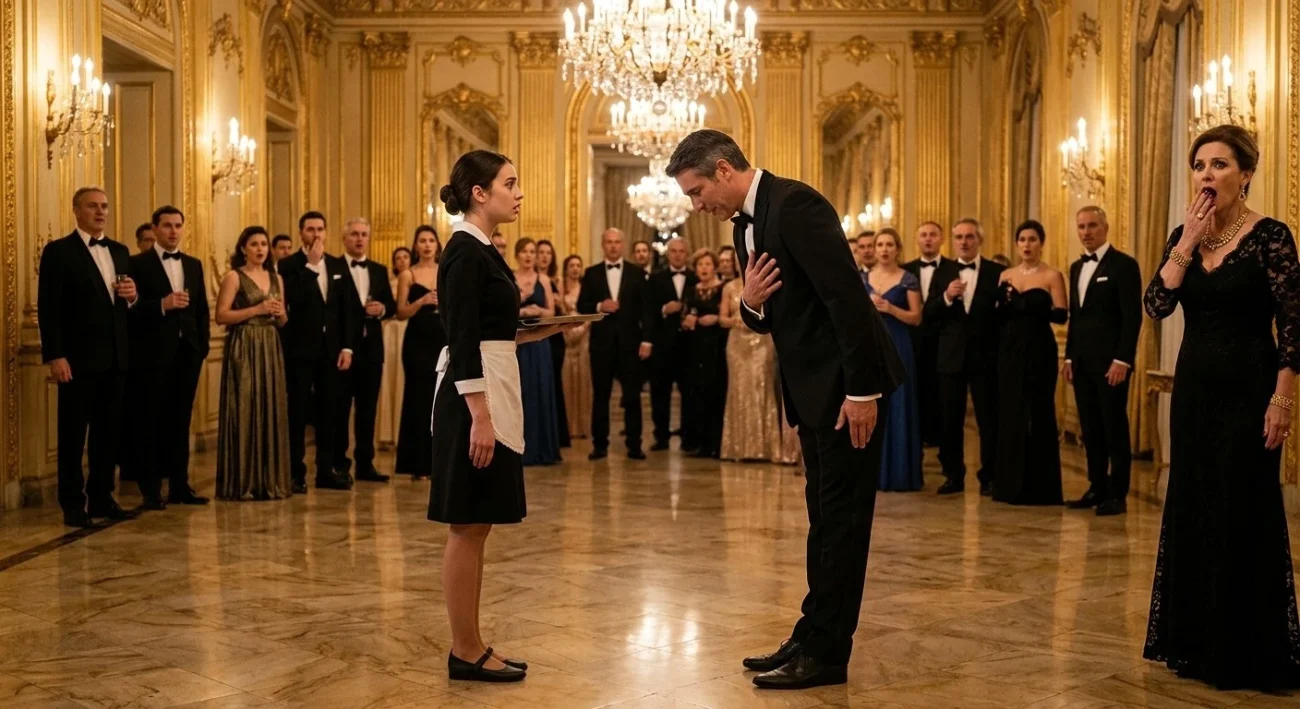
The ballroom smelled like roses and money.
Elena had learned, in the eleven months since she’d married into the Hargrove family, that money had a smell. It was warm and dry, like paper left near a heater. Like something that had been handled so many times it had lost its texture.
She stood near the kitchen door, apron tied tight, hands still damp from washing stemware.
“Faster.” Margaret Hargrove’s voice cut across the room without effort. No raised volume. No anger. Just certainty. “Don’t keep guests waiting.”
The tray was shoved into her hands.
CLANG.
The sound rang out beneath the chandeliers. A few heads turned. Not all. Just enough.
Elena looked down. Straightened the glasses. Moved forward.
She didn’t look up. Didn’t search for a friendly face. There were none to find.
“Is that her?” someone whispered. “The daughter-in-law?”
A soft laugh followed. Polite. Brief. The kind of laugh people use when they want to be cruel but need to be forgiven for it.
Elena kept walking.
She had gotten good at that—at moving through a room like she wasn’t in it. Like her body was a useful thing and her feelings were a luxury she couldn’t afford.
Her husband, Daniel, stood near the bar with his back to her. He was laughing at something his brother had said. He hadn’t looked over once.
She set glasses down at the far table and turned back toward the kitchen.
“You missed a spot.” Margaret appeared at her elbow. Up close, she was all sharp edges—cheekbones, jaw, the line of her smile. “The table by the window. The crystal, not the regular glasses. Don’t embarrass me.”
“Of course.” Elena said it quietly. No argument.
She had learned that, too. Arguing cost more than it was worth.
She walked toward the window table. Outside, snow was beginning to fall. Fine and thin. The city lights caught it and made it look like the sky was slowly dissolving.
Elena pressed her hand briefly against the cold glass.
She missed her grandmother. She missed her own language. She missed the small house with the cracked tile in the bathroom and the smell of bread in the afternoon.
She pulled her hand back. Set the glasses. Moved on.
The evening was halfway through when the music stopped.
Not faded. Stopped. Clean. Wrong.
The quartet near the fireplace lowered their instruments one by one, confused. The lead violinist looked toward the entrance.
Then everyone looked.
The double doors had opened.
A man stood in the frame.
He wasn’t tall in the way that calls attention. He was still. And stillness, Elena had learned, was rarer and more powerful than height. He wore a dark suit, no tie, and he walked forward like the room belonged to him—not arrogantly, but simply. As if ownership were a fact, not a performance.
He was mid-forties. Silver at his temples. Eyes that moved with purpose.
He scanned the room.
And then he saw her.
He stopped.
Just for a second. Just long enough.
Then he walked forward again, faster now, cutting through the cluster of guests near the center. People stepped aside. They didn’t know why. They just did.
He stopped in front of Elena.
She stared at him.
He was looking at her the way people look at something they thought they’d lost. Like he was counting the details. Making sure.
Then he lowered his head.
A small bow. Deliberate. Respectful.
“Your Highness.”
The words hit the room like something falling from a great height.
No one moved.
No one spoke.
Elena felt the tray go slightly loose in her hands. She tightened her grip.
“…what did you say?” Margaret’s voice came from behind her. It had changed. The certainty was gone from it.
The man turned. Looked at her. His expression didn’t shift.
“I said—” a pause “—Princess Elena.”
The word moved through the room like a slow fire.
Elena heard glass clink somewhere. A nervous adjustment. She heard someone breathe in sharply.
She looked at the man.
She had never seen him before in her life.
But there was something about his eyes. Something familiar in the way he stood. Something she couldn’t name that pulled at the edge of her memory, like a word in a language she used to speak.
“I don’t understand,” she said.
“I know.” His voice was low. Careful. “There’s a great deal you don’t know. But I’m here to tell you.”
“This is absurd.” Daniel appeared at her side. She could feel the tension in his arm without touching him. “Who are you? How did you get in?”
“I was invited.” The man reached into his jacket and produced a folded envelope. “By your grandmother.”
He held it out. Not to Daniel.
To Elena.
She didn’t take it immediately.
Her hands were still full of the tray. The tray she’d been carrying all evening. The tray that meant she was the help.
She set it down on the nearest surface without looking where.
Glass clinked. Nothing broke.
She took the envelope.
It was heavier than expected. The paper was thick, expensive, the kind that costs more per sheet than most people spend on dinner.
Her name was on the outside.
Not her married name. Not her current name.
Her birth name. A name she hadn’t heard spoken aloud in years. A name she’d been told, gently but firmly, not to use anymore.
Her hands were shaking. Just slightly.
“Elena.” Daniel reached for the envelope.
She pulled it back. Looked at him. Said nothing.
Something in her face made him stop.
She opened it.
The letter was short. Three paragraphs in a handwriting she didn’t recognize. But at the bottom—
A signature.
And beneath the signature, a seal. A small pressed image in dark wax.
She had seen that seal before. In a photograph. In a frame that had hung in her grandmother’s house, in a small room with faded curtains, in a country that felt like another life.
Her throat closed.
“What is it?” Margaret’s voice had gone tight and controlled. The hostess mask was cracking around the edges. “What does it say?”
Elena didn’t answer.
The man spoke instead.
“Her grandmother—her biological grandmother—passed away six weeks ago. She was the last of the line. Elena is the only living heir.” He paused. “To a title. And to an estate that has been held in trust for twenty-three years.”
Silence.
Then: “That’s ridiculous.” Margaret’s laugh came out short and thin. “She’s a—” she stopped herself.
“A what?” Elena asked.
The room was very still.
Margaret didn’t answer.
“A servant?” Elena said. Her voice was quiet. Not angry. Just precise. “Is that the word you were looking for?”
“I didn’t say that.”
“You handed me a tray in front of two hundred people.” Elena looked at her. “You told me I was embarrassing you. You’ve been telling me, in one way or another, since the day I married your son, that I was less than everyone in this room.”
Margaret said nothing.
“I carried it.” Elena folded the letter carefully and held it at her side. “I didn’t fight back. I didn’t make scenes. I did exactly what you wanted.” She paused. “Because I thought that was how you earned respect.”
She looked around the room. The faces. All of them watching now. No one pretending to look away.
“I was wrong,” she said. “You don’t earn respect here. You either have power or you don’t. And now—” she held up the envelope slightly “—I have it.”
Daniel moved first.
He stepped forward, voice low. “Elena. Let’s not do this here. Come upstairs, we can—”
“No.”
The word came out clean and flat.
He blinked. In eleven months, she had never said no to him. Not directly. Not in front of people.
“There are things we need to discuss,” he said. “Privately.”
“Like what? Like the money? Like whether any of this changes your plans?” She studied his face. “You already know about the estate, don’t you.”
He didn’t answer fast enough.
“Daniel.” Her voice was very steady. “Look at me and tell me you didn’t know.”
He looked at her.
He said nothing.
She nodded once. Something locked shut behind her eyes.
“My attorney,” the man in the dark suit said quietly, stepping forward, “is prepared to begin the transfer process. As of tonight, Ms. Elena is the named heir to the Ashvale estate, including its properties, its holdings, and its legal title.” He looked at Daniel briefly. “Any legal challenge to that will be reviewed in light of the prenuptial agreement, which, I believe, does not account for this development.”
Daniel’s jaw tightened.
“There is no prenuptial agreement,” Elena said.
“Exactly.” The man allowed himself a small, precise smile.
Margaret crossed the floor in three steps. “I don’t know who you are or what you’re trying to pull, but this family has lawyers—”
“So does she.” He handed Margaret a card. She looked at it. Her face went pale.
The guests had stopped pretending to socialize twenty minutes ago.
Some had quietly excused themselves. Others stayed—magnetized by the unfolding. The kind of thing you only saw in films or in old families with old secrets and enough money to bury them.
Elena walked toward the fireplace.
Above the mantel: the family portrait. The Hargroves. Three generations. Painted in oil, framed in gold. Perfect and untouchable.
She stood in front of it.
“Why are you looking at that?” Margaret said from behind her. Defensive now. Alert.
Elena didn’t answer.
She was looking at a woman in the painting. Second row. Dark hair. A composed smile.
At her throat: a necklace.
Silver. Thin chain. A small asymmetric pendant that caught the painted light in a way the artist had clearly spent time on.
Elena reached up and touched her own throat.
The same necklace.
The room shifted.
“That necklace—” Margaret began.
“Was given to me,” Elena said, “by my grandmother. The one who raised me. She told me it belonged to my mother.” She turned around. “My mother who died in a fire before I was born. Or that’s what I was told.”
Margaret had gone completely still.
The older woman in the painting—Elena recognized her now. Catherine Hargrove. The grandmother. Eighty-two years old, still attended every function, still ruled every room she entered.
Catherine had not been in the ballroom tonight. She had reportedly retired early. Claimed fatigue.
As if on cue, the doors at the back of the room opened.
Catherine Hargrove walked in.
She moved slowly. She always moved slowly now. But her eyes were sharp, and they went immediately to Elena’s throat.
And Catherine stopped breathing.
“Grandmother.” Daniel’s voice was uncertain. Warning her about something he couldn’t quite name.
Catherine walked forward until she was three feet from Elena. She looked at the necklace for a long moment.
Then she looked up at Elena’s face.
Her hands were shaking. Both of them. The left worse than the right.
“Where did you get that,” she whispered.
“From the woman who raised me.” Elena held her gaze. “She said it belonged to my mother.”
“That necklace—” Catherine’s voice cracked “—was buried. After the fire.” Her eyes filled. “With my daughter. With Sophia.”
The name fell into the room like a stone into water.
“Sophia died in the fire,” Margaret said sharply. “We all know that. This is some kind of—”
“Sophia didn’t die.” The man in the suit spoke quietly. Everyone looked at him. “She was taken. By someone inside this household. Someone who wanted the estate to pass differently.” He looked at Margaret. “The fire was real. The death certificate was not.”
Margaret’s face was a mask. A very good one.
But her hands had found the back of a chair.
“I have documentation,” the man continued. “Medical records. A birth record filed under a different name. And—” he reached into his briefcase “—testimony from the woman who transported a two-year-old girl across the border under instructions from a man named Victor Hargrove.”
Daniel went pale.
“My father,” he said.
“Your grandfather,” the man corrected. He looked at Elena. “Victor Hargrove had Sophia removed from the family and relocated. He altered the records. He arranged the death certificate.” He paused. “He had reasons. Primarily financial.”
Catherine made a sound. Not a word. Just a sound. Something low and broken.
Elena reached out and took her hand. She didn’t know why. It was instinct.
Catherine grabbed it. Hard. Her whole body was trembling.
“I looked for her,” Catherine said. Her voice was barely a whisper. “Twenty years. I had people looking.” She looked at Elena. Searched her face. “You have her eyes. I noticed it at the wedding. I thought I was—I thought I was being foolish.”
“You weren’t,” Elena said softly.
The room had gone quiet in the way that rooms go quiet when the foundation shifts.
Margaret Hargrove was still standing near the chair. She had not moved in four minutes. She was watching her life rearrange itself around her and calculating—you could see it, the calculation—what could still be saved.
“There’s no proof,” she said finally. “Paper trails can be manufactured. Anyone could have found that necklace. This entire situation is—”
“The DNA test was run three weeks ago.” The man in the suit opened a folder on the table. “With a sample provided voluntarily by Mrs. Catherine Hargrove and a sample obtained from a personal item belonging to Elena—with her knowledge and consent.” He set the paper on the table. “The result is a 99.97% match for a first-degree maternal relative.”
Silence.
Then Catherine turned to her.
“Granddaughter,” she said.
The word broke something open in Elena’s chest. She felt it go—some held breath she’d been holding for years without knowing.
Her eyes filled.
She did not look away.
“I didn’t know,” Elena said. “I promise you, I didn’t know any of this.”
“I know.” Catherine touched her cheek. “I know.”
Daniel tried three more times.
Once, quietly, to suggest they wait for lawyers before making any decisions. Elena looked at him until he stopped.
Once, slightly louder, to suggest that the marriage was a factor—that legally, as her husband—Elena handed him the business card the man in the suit had given Margaret. He looked at it. He stopped.
Once more, toward the end of the evening, to ask her to come home.
She looked at him for a long moment.
“This is your home,” she said. “It hasn’t been mine for a long time.”
He had no answer for that.
Margaret made her move at midnight.
The guests had mostly gone. A few stragglers remained—people who had stayed because they couldn’t bring themselves to leave before the ending. People who would describe this evening for the rest of their lives at dinner parties.
Margaret pulled Elena aside near the side corridor. Her voice was low and precise and had recovered most of its confidence.
“I want you to understand something,” she said. “Whatever this man claims, whatever paperwork he’s produced, the Hargrove family has protected this estate for three generations. We have influence. We have attorneys. And we have very long memories.”
Elena looked at her.
“I’m sure you do,” she said.
“If you pursue this—if you try to use this story to take anything from this family—”
“I’m not trying to take anything.” Elena’s voice was steady. “I’m correcting a theft. My mother was taken. Her identity was erased. I was raised under a false name in a country where no one knew who I was. My grandmother—” she glanced across the room at Catherine, who was sitting now, pale and quiet, with the man in the suit beside her “—spent twenty years looking for her daughter.”
She looked back at Margaret.
“You want to protect the estate. I understand that. But Victor Hargrove committed fraud. He altered legal documents. He arranged for a child to disappear.” She let that land. “So when you say you have long memories—so do I.”
Margaret said nothing.
“I’d like you to have your attorneys call mine by Monday,” Elena said. “Early is better.”
She walked away.
By one in the morning, only Catherine remained in the ballroom.
And Elena.
They sat in two chairs near the fireplace. The portrait above them. Sophia’s necklace—Elena’s necklace—catching the firelight.
“Tell me about yourself,” Catherine said. Her voice was frail but present. “Everything. From the beginning.”
So Elena did.
She talked about the small house. The cracked tile. The smell of bread. The woman who raised her—who had loved her, Elena believed that, she had to believe that—but who had kept the secret until the end.
She talked about coming to this country at nineteen. About working. About meeting Daniel at an industry function when she was twenty-four and thinking, foolishly, naively, that love was enough to bridge whatever distance lay between their worlds.
She talked about the apron. The tray. The sound of the CLANG that had echoed tonight under these same chandeliers.
Catherine listened to all of it.
When Elena finished, Catherine sat quietly for a moment.
“I should have known,” she said finally. “At the wedding. I looked at you and I felt—something. Something I couldn’t explain.”
“You couldn’t have known.”
“I should have.” She shook her head. “I should have trusted it.”
Elena reached over and covered Catherine’s hand with her own.
“You know now,” she said.
Catherine looked at her.
For the first time in a very long time—possibly the first time tonight—she smiled.
Not the polished smile of the portrait. Not a social smile.
Something real and relieved and exhausted.
“I do,” she said. “I know now.”
The formal proceedings began the following Thursday.
Margaret’s attorneys, as it turned out, were very good. They raised six challenges in the first filing. The man in the suit—whose name, Elena had learned, was Mr. Adair—had anticipated all of them.
The DNA evidence was irrefutable. The documentation was airtight. Victor Hargrove had been careful, but not careful enough—there was a paper trail in a foreign archive that he had apparently believed would never be accessible.
He had been wrong.
Daniel filed for divorce in the fourth week. His attorney sent a letter that was careful and expensive and said nothing Elena hadn’t expected.
She signed the papers on a Tuesday. Set them on the kitchen counter—the kitchen of the apartment Catherine had insisted she move into, in a building three blocks from the Hargrove estate. She signed them without ceremony and went to make tea.
She stood at the window while the kettle heated. Outside, the city moved the way it always moved. Indifferent. Continuous.
She felt lighter.
Not happy—not yet. That would take time. But lighter. Like something she’d been carrying had been finally, formally set down.
The estate transfer was completed on a Friday afternoon, six weeks after the ballroom.
There was paperwork. A lot of it. There were signatures and notarized documents and two separate attorneys and one very long phone call that Mr. Adair handled while Elena sat in a leather chair and looked at a window.
At the end of it, he slid one final document across the desk.
She looked at it.
At the top: her name. Her real name. The name that had been erased before she could speak.
Below it: the designation. The title. The transfer of inheritance.
She picked up the pen.
She thought of the ballroom. The tray. The sound of the CLANG.
She thought of Daniel’s back at the bar. Of Margaret’s voice cutting across the room. Cold. Public. Absolute.
She thought of her grandmother—the one who had raised her—and wondered what she had felt, keeping the secret. If it had been guilt. If it had been love. If it had been both, tangled together into something that couldn’t be undone.
She thought of Catherine. Of the way her hands had shaken. Of the word she had said.
Granddaughter.
Elena signed.
She wore the necklace to the first official family dinner.
Catherine had insisted on it. Not the large formal event—something small. Just the two of them and Mr. Adair and the family attorney and two cousins who, it turned out, had also suspected something was wrong for years and had been quietly relieved.
No apron. No tray.
She sat at the table and ate and talked and answered questions about herself.
At one point, one of the cousins—a woman named Grace, who had red hair and a sharp laugh—leaned over and said, “I always thought there was something strange about that wedding. You looked at Daniel like you were waiting for something.”
“I was,” Elena said.
“For what?”
Elena considered.
“For him to surprise me,” she said. “For any of them to.”
Grace looked at her for a moment. “Did they?”
Elena picked up her glass.
“Not in the way I hoped,” she said. “But eventually—yes.”
She set it down.
Across the table, Catherine was watching her.
She was smiling again.
That real smile. The exhausted, relieved one.
Elena smiled back.
Margaret Hargrove issued a statement through her attorneys six weeks later. It acknowledged the DNA findings. It expressed, in carefully chosen language, that the family had been deceived by certain parties within its own history and that it accepted the legal outcome of the inheritance proceedings.
It did not apologize.
Elena read it once, in the apartment, with tea going cold beside her.
She folded it in half.
Set it in the recycling.
Went to the window.
The city moved below. Indifferent. Continuous.
She pressed her hand to the glass—the same gesture she’d made at the ballroom window, months ago, when she’d been invisible and aching and holding a tray.
The glass was cold.
The world outside was exactly the same as it had always been.
But she was not.
She was not the woman in the apron. She was not the woman holding the weight of other people’s contempt. She was not invisible.
She was here.
She had a name—her real name, finally, after twenty-three years.
She had a grandmother who sat across tables from her and smiled with relief and exhaustion.
She had an estate and a title and a future that had been stolen and then returned.
And she had something else, too—something smaller and harder to name.
The knowledge that she had survived all of it with her dignity intact. That she had not broken. Had not begged. Had not become cruel in return for cruelty.
She had just waited.
And eventually, the room had turned.
She let her hand drop from the glass.
Straightened.
Walked back to the kitchen to reheat the tea.
Original fictional stories. AI-assisted creative content.
