
The morning of my dissertation defense, I found Hector in the hotel hallway at five a.m., sitting on the carpet in his borrowed suit, shoes already on, staring at nothing.
“You’re up early,” I said.
“Couldn’t sleep.” He smoothed his tie — borrowed too, from the neighbor in apartment seven. “Didn’t want to be late.”
The defense started at nine. He’d been awake since two.
My name is Marisol. I grew up in Santiago Vale, which sounds poetic until you understand it: six hundred people, one paved road, and rice fields that flood every July. My mother, Elena, moved us there after my father left. I was three. By four, she had remarried.
Hector Alvarez came with a thermos, a tool belt, and a bicycle with a bad rear brake. He worked construction. He smelled like cement and cigarettes and, on good evenings, like the soap he used after a long shower when he thought we were asleep.
He never asked me to call him anything. He just showed up.
When I was seven, I fell off a bike and split my knee open. He didn’t drive — we didn’t have a car — so he carried me on his back to the health post a kilometer away. Didn’t say anything the whole walk. Just held my legs steady.
When I was ten, three boys from the school behind the market started waiting for me on the corner. The second week, Hector was already there when they showed up. He didn’t threaten them. He just stood next to me until they left. Then he walked me home and said:
“You don’t have to tell me what that was. But if it happens again, tell me.”
It didn’t happen again.
He wasn’t educated. He could read a work order and fill out a form, but long books made his head hurt and he said so without embarrassment. Still, he bought me a dictionary the year I started middle school — thick, yellow-paged, secondhand — and put it on my desk like it was something important.
“I don’t know what half these words are,” he told me. “But you will.”
I passed the Metro City University entrance exam the winter I was seventeen. My mother wept at the kitchen table. Hector went outside to the porch and smoked. When he came back in, his eyes were red from something he blamed on the cold.
Within the month, he sold his motorbike — the Yamaha he’d spent six years paying off — and pooled the money with what my grandmother had saved in an envelope under her mattress. Together, it was enough for my first semester and a bus ticket.
He drove me to the terminal in a borrowed truck. When we got there, he handed me a canvas bag with rice, dried fish, peanuts, and a folded note tucked under the peanuts.
“Don’t open it on the bus,” he said. “You’ll embarrass yourself.”
I opened it on the bus.
I may not understand your studies, but I will work for them. Don’t worry about us. Just study well. — H.
I folded it into my wallet and kept it there for nine years.
University became graduate school. Graduate school became a doctoral program in educational policy. My thesis was on first-generation rural students and structural access gaps — which is a formal way of saying I wrote about people like me, and people like Hector, and what the system had cost them.
Every semester break, I came home to Santiago Vale. Every time, Hector’s back was a little more curved. His hands were more scarred. He had a new brace on his left wrist from a fall the previous spring.
“You should stop,” I told him the summer before my final year. “You’re sixty-one. You’ve been doing this for forty years.”
“I’m raising a PhD,” he said. “That’s more than enough reason to get up.”
“I’m almost done.”
“Then I’ll rest when you’re done.”
He said it like a deal. I shook my head. He lit a cigarette and watched the rice fields.
Defense day was a Thursday in late March. The room held maybe forty people — faculty, committee members, other doctoral candidates, a handful of students I’d mentored. My mother sat in the third row, hands folded, watching me the way she had at every school play and graduation and ceremony since I was small.
Hector sat in the last row. Borrowed suit. New cap — gray, with a small brim — which I’d bought him at the city market the day before because his old one had a stain he couldn’t get out. He sat perfectly straight, like sitting up straight was the contribution he could make that day.
The defense went well. My committee chair, Professor Daniel Reyes — a tall man with reading glasses and the reputation of someone who had failed more dissertations than he’d passed — asked hard questions. I answered them. When it was over, he told me to wait outside while they deliberated.
Fourteen minutes. I counted.
When they called me back in, he shook my hand and said: “Congratulations, Dr. Alvarez.”
I had kept my stepfather’s name. I hadn’t announced that decision to anyone — it was simply what I’d done when I registered for the program, quietly, without ceremony.
Afterward, there was the reception — department-sponsored, plastic cups of sparkling water and cheese on toothpicks. My committee mingled. My mother cried again. I introduced her to Professor Reyes, who said kind things about my work.
Then he saw Hector.
Hector was standing slightly apart from the group, holding his cup with both hands, watching the room like someone unfamiliar with rooms like this. His cap was in his jacket pocket. He was trying not to look out of place and almost succeeding.
Professor Reyes stopped walking. He looked at Hector for a long moment — three seconds, four, enough that people nearby noticed.
“Excuse me,” Reyes said. He crossed the room. “Are you Hector Alvarez?”
Hector blinked. “Yes.”
“From Santiago Vale?”
The room had gone very quiet. My mother looked at me. I had no idea what was happening.
“Yes,” Hector said again, more carefully this time.
Professor Reyes set down his cup. He reached into the inside pocket of his jacket and — I saw this before I understood it — he withdrew a small, folded photograph. Old, soft at the edges, the way photographs get when they’ve been handled many times.
He handed it to Hector.
Hector looked at it. His face did something complicated.
“You carried me,” Reyes said. His voice was steady but quiet. “I was nine. The river flooded — the old bridge at the edge of the Vale, do you remember? — and the current took me off the bank. You were working the pipe crew upstream. You went in after me.”
The photograph was black and white. It showed two figures on a riverbank — a man in work clothes, soaked through, and a small boy wrapped in what looked like a work jacket.
Hector was silent for a moment. Then: “You were wearing a red shirt.”
“Yes.”
“I remember the current was bad that day.” Hector looked at the photograph again. “Your mother came running. She screamed all the way down from the road.”
“She did.” Reyes’s jaw tightened briefly. “She passed away four years ago. But she kept this photo on the wall in her kitchen until the day she died. She told me to find you if I ever could. I didn’t know your name for years — you left before she could ask. A colleague’s wife grew up in Santiago Vale. When she mentioned the name Alvarez on Marisol’s application, I checked.”
He paused.
“I’ve been waiting six years to say this to you.”
Hector stood there with the photograph. His hands — scarred, calloused, bent slightly at the knuckles from years of work — held it like it might break.
“I just did what anyone would do,” he said finally.
“No,” Reyes said. “You did what very few people do.”
There was a long pause. The cheese and plastic cups and dissertation certificates seemed very small.
Then Reyes did something no one in the room expected: he extended both hands and took Hector’s right hand in both of his — the formal double-grip, the kind usually reserved for presidents and elders and people you owe more than words can cover.
“Thank you,” he said. “For my life. And for hers.”
Hector looked at him for a long moment. Then he looked at me.
I had been standing six feet away, not breathing.
He said nothing. He didn’t need to. The expression on his face — not pride exactly, not triumph, something quieter and deeper than either — said everything that forty years of early mornings and sold motorbikes and folded notes in lunch bags had been building toward.
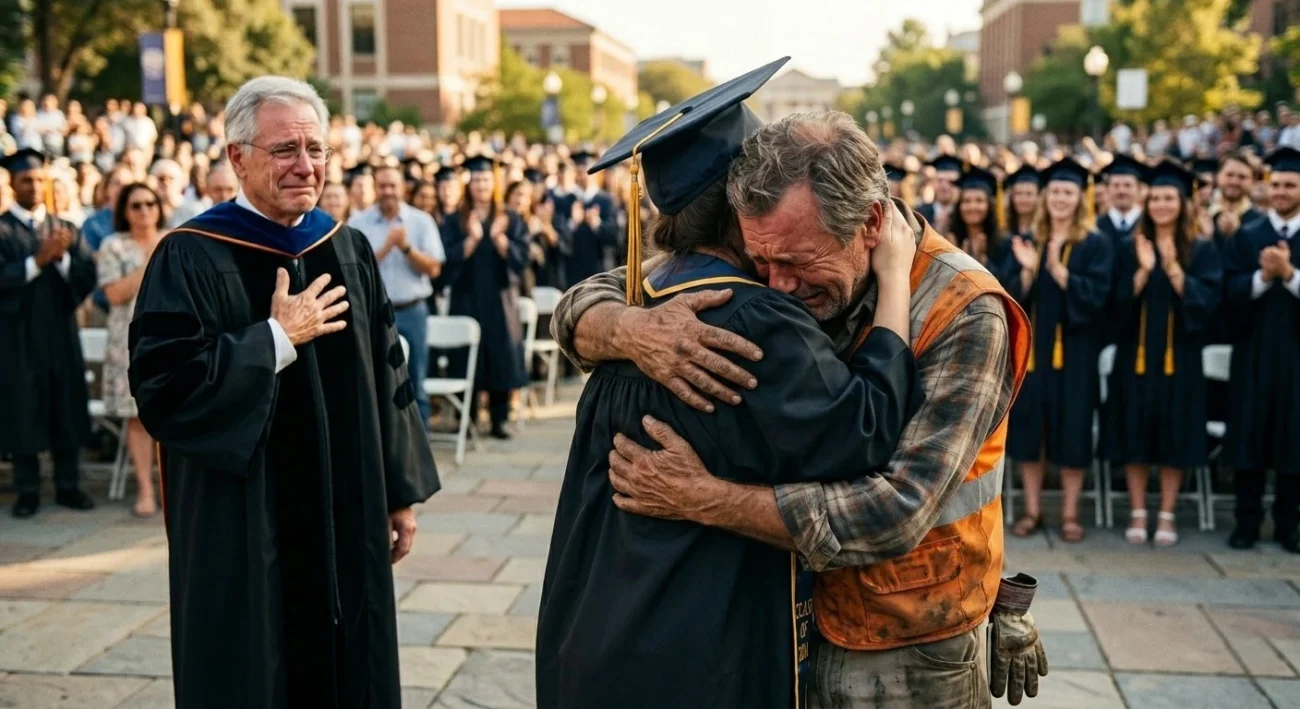
I crossed the room and hugged him. He held on longer than I expected.
Against my shoulder, very quietly, he said: “I told you. Knowledge commands respect.”
He was not talking about me.
Later that evening, back in the hotel, Hector finally took off the borrowed shoes and the borrowed suit jacket and sat on the edge of the bed in his undershirt. My mother brought him tea. He drank it slowly.
“Are you going to rest now?” I asked.
He thought about it seriously, the way he thought about everything.
“Monday,” he said. “I’ll rest Monday.”
But he said it smiling, which meant he meant it.
The photograph — Reyes had given it to Hector at the end of the evening, insisted on it — sat on the nightstand between the hotel lamp and his new gray cap.
A soaked man on a riverbank. A small boy in a work jacket.
Forty years later, both their names on the same diploma.
Original fictional stories. AI-assisted creative content.
